Thursday, November 1, 2007

Man charged with killing neighbour for watering his lawn

Barbara McMahon in Sydney
Guardian Unlimited, UK


Drop of water from a hosepipe
Water has been a frequent cause of disputes in Australia, which is in its sixth year of severe drought. Photograph: PA
A man has been killed in a fight over watering his lawn in drought-stricken Australia in an apparent case of water rage.

Retired lorry driver Ken Proctor, 66, was using a hose on the front lawn of his house in Sylvania, Sydney, when a man walked past and challenged him about wasting water. The two men began to argue and Mr Proctor turned the hose on the man, soaking him.

A fight broke out and the pensioner was knocked to the ground and punched and kicked before other passers-by, including an off-duty police officer, intervened.

As his distraught wife looked on, Mr Proctor was treated at the scene by ambulance officers but died of cardiac arrest after being taken to hospital.

Police later charged 36-year-old Todd Munter, who lives nearby, with the pensioner's murder.

Australia is in its sixth year of severe drought and most towns and cities have restrictions on water use. Garden sprinklers are banned, it is illegal to wash cars with hosepipes and gardens may only be watered on set days. People caught breaching the regulations are fined.

There are special telephone lines to report transgressors and there have been violent incidents in the past because of so-called "water vigilantes" informing on their neighbours. However, this is the first time an argument over water has led to a fatality.

A spokesman for Sydney Water revealed that Mr Proctor had not in fact been in breach of water restrictions because he was watering his lawn on his allocated day, had been using a hand-held hose and was carrying out the task within approved hours.

As Mr Proctor's shocked family gathered at his house today, neighbour Bruce Buscombe described the dead man as "a very likeable sort of fellow, a real knockabout sort of bloke."

"I can't believe it. It could've been me hosing my lawn. I would have said the same thing if somebody told me off," he told the Sydney Morning Herald.

Mr Proctor, who drove a truck for his local council's civil works and parks department and who retired five years ago, had recently become a grandfather when his daughter gave birth to a girl last month.

Appearing in court today, Mr Munter looked upset and close to tears as members of his family, including his elderly parents, looked on from the public gallery.

His lawyer Danny Saad told the court that his client had been on medication for a chronic back problem for several years and may need an operation soon. He did not apply for bail on his client's behalf and Mr Munter was remanded in custody until November 15.

Wednesday, October 31, 2007

La Nina seen persisting into 2008

From: Reuters

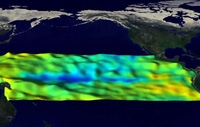
GENEVA (Reuters) - A "La Nina" cooling of sea temperatures is under way in the Pacific Ocean and the phenomenon is likely to persist into next year, the United Nations weather agency said on Wednesday.

La Nina, or 'Little Girl' in Spanish, is an unusual cooling pattern that usually brings rain to eastern and northern Australia and to Southeast Asia, a major producing region of coffee, cocoa, rubber, sugar, palm oil and rice.

In its latest update, the World Meteorological Organization (WMO) said the sea surface was about 1.5 degrees Celsius colder than normal across the central and eastern equatorial Pacific.

"We expect that these conditions will continue until the first quarter of 2008," WMO scientific officer Leslie Malone told a news conference in Geneva.

The current event has strayed from normal trends, and has not brought rainfall to the region, Malone said, attributing this to cool sea temperatures across the north of Australia to the Indian Ocean, which had altered expected weather patterns.

"As long as this situation continues, it is expected to lead to unusual climate patterns in surrounding continental regions, ones that are atypical of La Nina," WMO said in its update.

"Rains have been unusually heavy in parts of eastern Africa, while dry conditions have persisted in many parts of Australia."

Australia is gripped by its worst drought in 100 years, resulting in crop failures that have propelled wheat prices to record highs. The country last experienced wetter-than-usual weather in 1999 through 2000 as a result of La Nina, which is normally characterized by incessant rainfall, storms and floods.

The La Nina weather pattern occurs about every three to five years and often follows El Nino, a warming of Pacific waters, which can also wreak havoc on weather around the world.

Caribbean deaths mount in wake of Tropical Storm Noel

From: Anthony Boadle, Preview

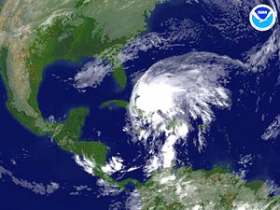
HAVANA (Reuters) - Tropical Storm Noel strengthened as it began to head toward Florida and the Bahamas on Wednesday after drenching Cuba and killing at least 61 people with surging floodwaters and mudslides in the Dominican Republic and Haiti.

The death toll from days of downpours in the Dominican Republic, in particular, begun to climb as emergency workers fanned out to bring aid to towns and villages cut off by raging rivers and inundated by chest-high floods.

Forty-one people were confirmed dead and another 33 were missing while at least 25,540 people were homeless and 6,300 homes had been destroyed, said Luis Luna Paulino, head of the Dominican Republic's emergency operations center.

Luna Paulino appealed to boat owners to offer their services and their vessels to rescue teams so they could reach people trapped in cut-off villages.

Thousands of people were evacuated from vulnerable areas but no casualties were reported in Cuba, which boasts one of the most effective civil protection operations in the region.

The storm dumped six inches (150 mm) of rain in just six hours over Baracoa in Cuba, causing floods and cutting off roads at the already water-logged eastern tip of the island.

"We are getting a constant downpour and strong gusts of wind. The sea is very rough," said Hector Rodriguez, a hotel worker in Cayo Coco, an island resort on the north coast of central Cuba.

The 14th named storm of the 2007 Atlantic storm season was not expected to strengthen into a hurricane over water, the U.S. National Hurricane Center said.

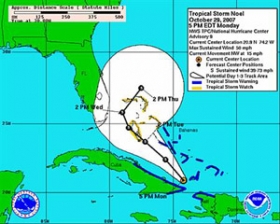
Forecasters projected the storm would veer northeast over the Bahamas on Thursday, away from Florida and well clear of U.S. oil and gas installations in the Gulf of Mexico.

DOMINICAN DEATH TOLL SEEN CLIMBING

But the death toll in the Dominican Republic was expected to climb further, officials said. Several bridges had collapsed and mudslides blocked roads and at least 39 communities were cut off by floods, Luna Paulino said.

Emigdio Sosa, director of the presidential office's social assistance plan, said that so far 145,000 families had been given emergency aid in the form of food, blankets, mattresses and mosquito nets. The government expected to also distribute construction materials such as zinc and wood.

"We project that we will be helping more than 300,000 families," Sosa said in a statement.

In Haiti, the most vulnerable of Caribbean countries to flashfloods and mudslides because most of its trees have been chopped down to make charcoal, at least 20 people died.

Eighteen bodies were counted by the national Civil Protection Office, said its director Alta Jean-Baptiste.

Another two people died in the small town of Terre Neuve. One was a 10-year-old boy swept away by floods and the other a 36-year-old woman crushed by a tree, according to regional civil protection official Faustin Joseph.

About 3,400 people were staying in emergency shelters and around 400 houses had been destroyed.

In Jamaica, one person died when a house collapsed in the heavy rain, the disaster preparedness agency said.

The storms' center was located just off the north coast of Cuba around 190 miles south-southwest of Nassau in the Bahamas by 2 p.m. EDT (1800 GMT), the hurricane center said.

Noel had been drifting to the west before coming to an apparent stop. "A turn to the north is expected later today," the hurricane center said.

Its top sustained winds reached 50 miles per hour (85 km per hour), some way short of the 74 mph (119 kph) at which tropical storms become hurricanes.

The storm began drenching the island of Hispaniola, shared by the Dominican Republic and Haiti, over the weekend. Swathes of the two countries were awash after days of rain.

Torrential rain was also falling over parts of the Bahamas.

Strong winds sent waves crashing onto southeast Florida's Atlantic beaches and rain whipping down the streets of Miami.

(Additional reporting by Joseph Guyler Delva in Port-au-Prince and German Marte in Santo Domingo)

Wildfires emitted large amounts of greenhouse gases

(10-31) 17:00 PDT San Diego - --

The fires that roared through Southern California last week spewed the same amount of greenhouse gases as what is produced in about one week from the state's burning of fossil fuels, scientists at the National Center for Atmospheric Research report.

The preliminary data by NCAR and the University of Colorado at Boulder show that the fires emitted 7.9 million metric tons of carbon dioxide between October 19 and 26. That's equivalent to 25 percent of the monthly emissions from all fossil fuel burning throughout California, according to the report.

The study used satellite observations and a computer model to determine emissions based on amount of vegetation that burned.

Large fires in western and southeastern states can pump as much carbon dioxide into the atmosphere in a few weeks as a state's entire motor vehicle traffic in a year, according to the paper, which will be published online Thursday in the journal "Carbon Balance and Management."

The study estimates that fires in the contiguous United States and Alaska release about 290 million metric tons of carbon dioxide a year, the equivalent of 4 to 6 percent of the nation's total carbon dioxide emissions from fossil fuel burning.

A copy of the article will be posted Thursday at www.cbmjournal.com.

E-mail Peter Fimrite at pfimrite@sfchronicle.com

Monday, October 29, 2007

More than dozen dead as storm drenches Hispaniola

From: German Marte, Reuters

SANTO DOMINGO (Reuters) - More than a dozen people died in the Dominican Republic on Monday after Tropical Storm Noel dumped torrential rain on the Caribbean country, sending thigh-high water surging through streets and cutting power to thousands.

Hundreds of families were left homeless after the 14th named storm of the 2007 Atlantic hurricane season poured 10 to 30 inches of rain on the Dominican Republic and over the treeless hillsides of Haiti, its neighbor on the island of Hispaniola.

The head of the Dominican National Emergency Committee, retired Gen. Luis Luna Paulino, said 13 deaths had been confirmed.

He said there was a report of a family buried when their house collapsed on them and another of a family in a car killed by a falling wall. "If those two accidents are confirmed then the deaths climb to 18," he said.

Juliana Pierossi of international humanitarian agency World Vision said roads were flooded and impassable throughout the Dominican Republic and power cuts were widespread.

"We're getting a lot more action with Tropical Storm Noel than we did with Hurricane Dean," said Pierossi, who was also in the Dominican Republican when Hurricane Dean passed to the south of the country in August.

Flights to and from the International Airport of the Americas near Santo Domingo were suspended.

By 5 p.m. (2100 GMT), the storm was about 50 miles north of the eastern tip of Cuba and moving northwest at 15 miles per hour (85 km per hour), the U.S. National Hurricane Center said. Its top sustained winds had increased to 50 mph (85 kph) but it was not projected to grow into a hurricane.

Noel's track was expected to spare U.S. oil and gas facilities in the Gulf of Mexico but Florida could be affected if the system failed to turn as sharply to the northeast and head out over the Bahamas as computer models predict.

HAITIAN CAPITAL OVERCAST

The storm swept past the Haitian capital Port-au-Prince, but the heaviest rains appeared to have fallen over the Dominican Republic to the east.

Haitian Civil Protection Director Alta Jean-Baptiste said a few houses were destroyed in northeast Haiti but there had been no reports of deaths or injuries.

David Wimhurst, a spokesman for a United Nations peacekeeping mission in Haiti, said U.N. forces in the provinces had received no reports of emergencies.

"It looks like we're OK," he said.

The poorest country in the Americas, Haiti is particularly vulnerable to deadly floods because 90 percent of its forests have been chopped down, mainly to make charcoal. The Dominican Republic has far more tree cover.

In 2004, Tropical Storm Jeanne passed north of Haiti and buried the port city of Gonaives in mud, killing 3,000. In spring that same year, flooding in the south killed 2,000 more.

In the first two weeks of October this year torrential rains killed 45 people, and made 1,000 people homeless.

In addition to Haiti, storm alerts were posted for the central Bahamas, the Turks and Caicos islands and Cuba.

The six-month hurricane season runs until the end of November. While the 14 storms so far this year are more than normal, it has been a far cry from the record-busting 2005 season, when 28 storms formed and several fierce hurricanes, including Katrina, slammed into the United States.

© Reuters2007All rights reserved

Malaria moves in behind the loggers

Deforestation and climate change are returning the mosquito-borne disease to parts of Peru after 40 years

Andrés Schipani in Mazán and John Vidal
The Guardian, UK


The afternoon is hot and sticky on the banks of the Napo river, an arm of the Amazon, but Claudio, a logger, is shivering in his creaky wooden bed.

"I feel bad, very bad, pain all over my body, fever, high fever, shudders," he says. "I have malaria; this is the 17th time so far. I don't know what to do any more."

The mosquito-borne illness has returned to the many villages only accessible by boat in the Peruvian Amazon, inflicting on the inhabitants days of fever, permanent anaemia and - in the worst cases - death.

In Peru, malaria was almost eradicated 40 years ago, but this year 64,000 cases have been registered in the country, half in the Amazon region. It is thought there are many more unregistered cases deep within the massive and humid rainforest, where health authorities find it almost impossible to gain access.

"Malaria is present. There have been 32,000 cases this year in this area alone - that says malaria is very much present," said Hugo Rodríguez, a doctor at the Andean Health Organisation, which is fighting malaria in border areas of Peru, Ecuador, Colombia and Venezuela.

His organisation distributes mosquito nets to some villagers, spreading the message through the area that the illness is dangerous and - where they can identify the cases - helping in post-infection treatment.

"Now we are not talking about eradicating malaria any more, as that is impossible and unsustainable; we are doing our best to try and control it," he added.

Climate change and deforestation are behind the return of malaria in the Peruvian Amazon.

Off-season rain is altering the pattern of mosquito development, leaving puddles containing the lethal larvae in areas where malaria had been nonexistent.

"The actual malaria problem of the Peruvian Amazon is caused by constant climate changes," said biologist Carlos Pacheco, head of the mosquito control unit in Iquitos, the regional capital south of Mazán.

And deforestation is having a similar effect, forcing the mosquito to move to new areas and spreading the disease to places where people are not aware of the disease, where villagers lack the means to get hold of mosquito nets and preventive medicines, and where health authorities have no presence.

"Every time we fight the mosquito, we feel we are fighting against a much more evolved and adaptable one, one that can easily migrate to areas that were clean of malaria before and that are very hard to access," said Mr Pacheco.

Two scientific reports last year linked malaria with deforestation. Peruvian researchers found that frontier areas cleared of trees for logging, settlements, roads, farming or mining were far more likely to harbour malaria-carrying mosquitoes.

In one Peruvian study, researchers said the biting rate of mosquitoes in deforested areas was nearly 300 times greater than in virgin forests. Increases in human population density had no impact on biting rates.

The insects lay their eggs and thrive in open, sunlit pools of water. Roadbuilders dig channels and culverts which become blocked, silt washes off farmland blocking streams, and opencast mines and new settlements create ideal breeding grounds.

Anyone who catches malaria in the Amazon region has few opportunities for treatment. Even in the most densely populated areas, there are few health centres.

Loggers are the mosquitoes' main victim.

"The districts with the higher logging activity are the critical ones, making the disease there to be almost impossible to control," said Dr Rodríguez.

"It is very hard to access the areas where the clearing of the rainforest occurs and these people are not conscious of the risks and once infected - and sometimes because of the illegality of this activity - loggers are very reluctant to get treated by health authorities."

Alongside the Amazon river and its many tributaries, poverty-stricken loggers like Claudio move deep into the rainforest, in areas where malaria is prevalent, without taking any precautions and for meagre wages.

Pointing at his neighbour's one-year-old son who is recovering from the disease, Arquímedes of the village of Manacamiri near Iquitos said: "Here most people suffer from this disease, from malaria.

"There are no other diseases like this, no other problems like this here ... We have now become the malaria zone."

Behind him, the bank of the low Nanay river seems nothing more than a mud puddle with mosquitoes buzzing around.

"Children, elderly, how many deaths we already had," said Arquímedes.

"At the beginning we had no idea what it was, and it was malaria ... there is not a single day without a malaria patient."

Saturday, October 27, 2007

Lovelock urges ocean climate fix

By Richard Black
Environment correspondent, BBC News website

Salps occur in great swarms

Two of Britain's leading environmental thinkers say it is time to develop a quick technical fix for climate change.

Writing in the journal Nature, Science Museum head Chris Rapley and Gaia theorist James Lovelock suggest looking at boosting ocean take-up of CO2.

Their idea, already being investigated by a US firm, involves huge flotillas of vertical pipes in the tropical seas.

The two scientists say they doubt that existing plans for curbing carbon emissions can work quickly enough.

The stakes are terribly high
James Lovelock

"We are taking the very strong line that we are not going to save the planet by the regular approaches like the Kyoto Protocol or renewable energy," Professor Lovelock told BBC News.

"What we have to do is to look at it in a systems sense, or a Gaian sense, and see if it's curable by direct action."

Natural cycles

Professor Rapley, who has just moved to head up the Science Museum from a similar post at the British Antarctic survey, said the two men developed the ocean pipes concept during country walks in James Lovelock's beloved Devon.

It's worth investigating these kinds of ideas, but premature to start deploying them
Ken Caldeira

Unbeknown to them, a US company, Atmocean, had already begun trials of a very similar technology.

Floating pipes reaching down from the top of the ocean into colder water below move up and down with the swell.

As the pipe moves down, cold water flows up and out onto the ocean surface. A simple valve blocks any downward flow when the pipe is moving upwards.

Colder water is more "productive" - it contains more life, and so in principle can absorb more carbon.

One of the life-forms that might benefit, Atmocean believes, is the salp, a tiny tube which excretes carbon in its solid faecal pellets, which descend to the ocean floor, perhaps storing the carbon away for millennia.

Atmocean CEO Phil Kithil has calculated that deploying about 134 million pipes could potentially sequester about one-third of the carbon dioxide produced by human activities each year. But he acknowledges that research is in the early stages.

Gray whale. Image: Geoff Shester
The scheme could pose problems for marine creatures such as whales
"There is much yet to be learned," he told BBC News. "We need not only to move towards the final design and size (of the pipes), but also to characterise the ecological effects.

"The problem we would be most concerned about would be acidification. We're bringing up higher levels of CO2 along with the nutrients, so it all has to be analysed as to the net carbon balance and the net carbon flux."

Atmocean deployed experimental tubes earlier this year and gathered engineering data. The pipes brought cold water to the surface from a depth of 200m, but no research has yet been done on whether this approach has any net impact on greenhouse gas levels.

The company says a further advantage of cooling surface waters in regions such as the Gulf of Mexico could be a reduction in the number of hurricanes, which need warm water in order to form.

And Professors Lovelock and Rapley suggest that the ocean pipes could also stimulate growth of algae that produce dimethyl sulphide (DMS), a chemical which helps clouds form above the ocean, reflecting sunlight away from the Earth's surface and bringing a further cooling.

Ethical fix

In recent years, scientists have developed a wide range of technical "geo-engineering" ideas for curbing global warming.

Seeding the ocean with iron filings to stimulate plankton growth, putting sunshades in space, and firing sulphate aerosols into the atmosphere from a giant cannon have all been proposed; the iron filings idea has been extensively tested.

But the whole idea of pursuing these "technical fixes" is controversial.

Chris Rapley.  Image: BBC
There's evidence that the Earth's response to climate change might be going faster than people have predicted
Chris Rapley

"One has to understand what the consequences of doing these things are," commented Ken Caldeira from the Carnegie Institution at Stanford University in California, who has published a number of analyses of geo-engineering technologies.

"There are scientific questions of safety and efficacy; then there are the broader ethical, social and political dimensions, and one of the most disturbing is that if people start getting the idea that technical fixes are available and cheaper than curbing carbon emissions, then people might start relying on them as an alternative to curbing emissions.

"So I think it's worth investigating these kinds of ideas, but premature to start deploying them."

Chris Rapley does not believe ideas like the ocean pipes are complete answers to man-made global warming, but may buy time while society develops a more comprehensive response.

"It's encouraging to see how much serious effort is going into technical attempts to reduce carbon emissions, and the renewed commitment to finding an international agreement," he said.

"But in the meantime, there's evidence that the Earth's response to climate change might be going faster than people have predicted. The dramatic loss of ice in the Arctic, for example, poses a serious concern for the northern hemisphere climate."

High stakes

Professor Rapley said the letter to Nature, one of the world's most prestigious scientific journals, was intended to get people thinking about the concept of technical fixes rather than just to advocate ocean pipes.

"If you think of how the science community has organised itself," he said, "with the World Climate Research Programme, the International Geosphere-Biosphere Programme, International Polar Year and so on - you've got all this intensive interdisciplinary collaboration figuring out what Earth systems are up to and figuring out how they work, but we don't have a similar network working across the entire piece as to what we can actually do to mitigate and adapt."

Faecal pellets (Madin/WHOI)
Salp pellets take carbon to the floor of the ocean
He said there was a need for some sort of global collaboration to explore potential climate-fixing technologies.

"Geo-engineering is one of the types of thing that are worth investigating," opined Ken Caldeira, "and yes, the amount of effort going into thinking of innovative solutions is far too little.

"If we can generate 100 ideas, and 97 are bad and we land up with 3 good ones, then the whole thing will have been worthwhile; so I applaud Lovelock and Rapley for thinking along these lines."

He observed that human emissions of greenhouse gases are bringing huge changes to natural ecosystems anyway, so there was nothing morally difficult in principle about deliberately altering the same natural ecosystems to curb climatic change.

But changing patterns of ocean life could potentially have major consequences for marine species. Whales that feed on krill, for example, could find their favourite food displaced by salps.

These would all have to be investigated, James Lovelock acknowledged.

But, he said, it is time to start. "There may be all sorts of ecological consequences, but the stakes are terribly high."


HOW THE PUMPS MIGHT WORK
Pump graphic
1. Buoy: Helps hold the pump in position
2. Pump: James Lovelock believes the tubes would be about 100m long to access deep cold water, and 10m wide; Phil Kithil thinks 200m long and 3m wide could be optimum
3. Valve: Could be at the top or bottom of the pipe; top perhaps preferable for maintenance. Water is drawn through the open valve on wave down slopes; no external power needed
4. Cold water: On wave up slopes, cool water spills out of the pump
5. Pump sites: Locations could also be chosen to reduce hurricane risk by cooling surface waters

Why forest fires are spreading

BBC, UK
Esperanza Fire, California, in 2006
Four firefighters were killed in Banning, California, last year

A POINT OF VIEW
By Tim Egan

Fires wreaking destruction in the American West are set to become the norm for many months of the year.

The fires that raced through Greece, killing 64 people and leaving thousands of farmers in ruin, are down to a few smouldering remnants.

But here in the American West, our season of heat and destruction is just now getting into its peak. More than 50 active wildfires are raging throughout a million-and-half acres as we speak.

California is burning, with fresh fires crackling to life with every evening's dry thunderstorm. Montana, Idaho, Colorado and other parts of the Rocky Mountain West are burning as well - a seasonal affliction, aggravated by a siege of drought.

An army of yellow-shirted fire-fighters have been dispatched by air and land to contain these blazes. But they can only do so much. Nor will they. But more about that in a moment.

TIM EGAN
Fires create their own weather, sucking up oxygen and thundering outward in search of fresh fuel.

To live west of the 100th meridian is to live with fire - to live with its terrifying suddenness, its bullying winds and the horrid sound of a blaze on the run. Fire comes with the land. But of late, our fires have been bigger, hotter, with a season that starts in late winter and extends well into the fall.

This year, the first of the fires burned up pockets of the lovely, pine-scented heights of the mountains in the Southwest.

They call these areas of alpine green the Sky Islands - poking above the desert floor, an attic of breezy relief. I happened to be there on a February day when the temperature nudged 99 degrees Fahrenheit (that's 37 Celsius), with smoke in the air, a menace too early to arrive.

The forests were splotched with a rusty tinge, as trees die from heat and insects. Frogs, squirrels and other animals with a 10,000-year-old history of habitation have all but disappeared. To me, everything felt out of whack.

Then, last week, I was in the Rocky Mountains, where 50 active fires are burning. You smell one of these big fires well before you see it. The smoke gets in your nostrils, your hair; it clouds your eyes; it lingers in your clothes.

It feels ominous. Then the wind kicks up, and your adrenaline starts to surge. Fires create their own weather, sucking up oxygen and thundering outward in search of fresh fuel. They are unpredictable, especially in a mountain environment. Even from a hundred miles away, snow-white ashes fall from the sky.

Heat records

In one of these fires, in the resort town of Ketchum, in Sun Valley, where Ernest Hemmingway fished the Wood River and ultimately killed himself, they were forced to start up the snow-making machines to spread moisture over the ski slopes. A thousand people were evacuated, and the national guard was sent in to protect multi-million dollar homes. In many ways, all of this is the New Normal.

We can expect longer, more damaging fire seasons. And they will threaten more homes. Two trends - climate change, and a population surge into the open country - are converging in a place where fire has long had a home.

If you look at a map, you find that the fastest growing areas of the US are in places that are most prone to wildfire - the canyons, mesas and alpine retreats of the West.

Of course, fire is no stranger to this area. But the region has been warming for nearly 30 years. And now we are seeing the kind of heat records that nobody wants.

Phoenix, the fastest growing big city in America, just recorded 32 days of temperatures above 110 degrees (43 Celsius) - a record for one year. There, people live indoors this time of year, racing from air-conditioned house to air-conditioned car to air-conditioned office or air-conditioned mall.

Phoenix, Arizona, US
Cities like Phoenix experience 'killer heat'
Now it may be alarmist to say that Phoenix and other places may one day become unliveable. But the climate models suggest that killer heat and catastrophic wildfires will not be anomalies.

They will be part of this "New Normal". Last spring in Paris, the Intergovernmental Panel on Climate Change released a draft of its projections. The panel said the American West would be one of the hardest hit areas. Already, stress is killing large, forested sections here.

You can see this narrative of heat and climate change in tree rings. I went to visit Dr Thomas Swetnam, director of the Laboratory of Tree Ring Research at the University of Arizona.

He showed me a crosscut of an ancient bristlecone pine tree - one of the oldest living things in America. The rings were thick for healthy, wet years and thin for dry, difficult years. He then showed a section from the 16th Century, during one of the worst droughts over the last thousand years. Then he showed me the last few years - a time when the tree essentially stopped growing.

The drought of 500 years ago was worse, he said. But the temperatures are warmer today by four or five degrees, suggesting that this is just enough to push these forests over the edge.

"Climate change is happening now all over the West," he said. The changes are big, and coming fast. These new fires are different from others. They not only burn hotter, but they are enormous.

Trophy homes

Consider this comparison. In Greece, nearly 450,000 acres were consumed - a huge swatch of olive groves, forests and parkland. By contrast, the West has lost nearly 20 times that amount this year.

At the same time, hordes of people are moving into the open country at the far suburban edge of these new, fast-growing Western cities. On the surface, the land still looks good. But most western forests are sick, as I mentioned. The trees are losing their fire-resistant resin or bark. They are tinder, ready to go.

Wildfire near Palm Springs
Since 1990 more than eight million homes have been built in Western areas; places called the "urban-wild land interface." That means that enough people to populate New York City are now living in places where fire is part of the natural cycle.

What you see in these new communities at the edge of a national forest are not little cabins or humble mountain shacks. People build trophy homes of 5,000 square feet or more, three stories, half a dozen bedrooms, with huge timbers.

They revel in their palaces in the wilderness, away from the urban clusters, and then they expect that the wild will not touch them. But fire, as I said, is a much a part of this ecology as perennial grass. Fire renews the forest. Many trees need fire to sustain themselves.

So those stately, pretty trees shading a McMansion would disappear without fire, which forces open the cones and releases the seeds.

These new houses, many of them, are dream homes. They look perfect in their setting, if a bit oversized. But to a fire, they are just fuel. The people who live in these homes - with all the creature comforts - also expect someone outside their community to protect them when the woods are ablaze.

Disaster

Thus the Forest Service, set up to nurture and patrol the great publicly-owned reserves of the West, has become the Fire Service. They spend nearly half their budget on helicopters, tractors, buckets and paying to feed and move these big camps of seasonal firefighters.

Not long ago I was in Colorado when a fire jumped a ridge and burned down into a cluster of expensive new homes not far from Aspen, one of the wealthiest communities in the world. The owners cried for help. "Do something," they demanded.

Some of the best firefighters in the world - Hotshots and Smokejumpers, elite men and elite women trained to tackles flames in a vertical battleground - rushed to the rescue. They came up with a containment plan and started to dig a fire line in the scrub oak and smoke. But then - as suddenly as the wind can change - disaster came.

I was down below the fire, at a base camp, and you could hear radios spark with strained voices, and the sound of panic. The fire sprinted out of control, toward the crews, riding gusts of 40 miles an hour. It was a storm unto itself, spreading a wall of flames at the rate of 35 feet per second.

In the West, it looks like normal is going to be a fire season that now lasts for nearly half the year, with homes in the way
The firefighters ran for their lives, up a hillside. Some hunkered down in their fire shelters, these little aluminium-foil pup tents used as a last line of defence against a fire.

Still, it was not enough. The super-heated gases penetrated the tents. Others were burned to death. Fourteen people died that day on Storm King Mountain.

Afterwards, the Forest Service vowed that it would never happen again. They would not lose men and women to protect people's summer homes. They even wrote a new manual for firefighting. At the top, more important than anything, they wrote, was saving lives. Property was at the bottom.

But since then, they've lost more than a dozen people. It's almost always the same scenario. Somebody does something heroic. In the post-mortem, the crew chiefs say the fire was hotter, bigger, faster than anyone expected.

They say it wasn't normal, but what is normal? In the West, it looks like normal is going to be a fire season that now lasts for nearly half the year, with homes in the way. Because nature, especially during mood swings, doesn't respect a city line.

Journey through the California wastelands

The worst wildfires in the state's history have left 2,000 people homeless for the foreseeable future and experts anxiously looking to the weather

Dan Glaister in the San Bernadino mountains
Saturday October 27, 2007
The Guardian


Lyons Valley as the Harris Fire continues growing.
Lyons Valley as the Harris Fire continues growing. Photograph: David McNew/Getty


In a low-slung hangar in San Bernardino, two giant plasma screens are playing out the final instalments of California's wretched week.

People lie sprawled on green cot beds, scratching themselves, staring open-mouthed at the images: of families trickling home, returning to communities ravaged by one of the worst wildfires in California's history.

There is footage of emotional homeowners returning to their wasted properties, some thanking their lucky stars, others rueing the years of physical memory gone up in smoke. One man weeps over the remains of his Harley; a second picks out charred photographs from the ashes; still another looks at the devastation in his backyard and says: "Thank God no one lost their lives.

But for those in the hangar, there will be no going home any time soon. For these 2,000 or so temporary residents of the quaintly named National Orange Show Events Centre, home for the foreseeable future is here, beneath the low polystyrene ceilings and fluorescent lights of a Red Cross shelter 65 miles east of Los Angeles.

This place, with its lines of portable toilets, its rows of insurance company stalls declaring "We care!", its free internet, its prayer chapel is, you can't help remembering, a long way from Malibu. Here there is no Juicy Couture, no Ralph Lauren, no Nobu. Instead there are ordinary people, turfed out of their homes in the small hours, clad in dungarees. While the celebrities from the Malibu Colony survived their brush with disaster, enduring a couple of nights at the ritziest hotels in the region (the Ritz-Carlton by the ocean had no rooms available for the first half of the week) and were then allowed home, these mountain people have nowhere to go and are unlikely to be allowed back for weeks.

Bill Freer runs his finger across the map in the evacuation centre, tracing the latest outline of the fire. Its uncontained limit is marked with a jagged red edge. "It's like the fire went all around us," says the resident of Arrowbear, in the mountains. "Four years ago was nothing like this. We were out for two weeks then. This is 10 times worse."

Freer's story is typical: woken in the middle of night by smoke, he threw a few things together - picture albums, insurance documents, pets - and jumped in his car.

Sitting on a kerb inside the centre, waiting for information, Robert Schneider gives his version. "We weren't too concerned," he says, "because it would have to burn through the whole town before it got to us. But it moved so quickly. We saw it coming towards the house, the glow in the sky. We could hear it crackling but we didn't see any flames jumping. Then it got so smoky we had to leave. When we left there were little embers in the air."

That was at 4am on Tuesday. Since then he's been trying to find out something about his home.

Around him teenagers in black T-shirts and drainpipes try to perfect the Ollie, the Californian skateboarder's rite of passage. Families chat to each other, laughing and joking as if they are there for a day at the fairground. Off to one side, a small audience forms for some singalong religion. Ladies circulate with cardboard trays offering slices of pizza.

But this isn't a holiday. This is the Californian version of the stiff upper lip, a determined positivity, an acceptance that nature is a freak and that California is its plaything.

The air at the centre is thick; an acrid, cloying thickness that scratches your throat and pinches your sinuses. Travel away from the centre, away from San Bernardino and towards the fires and the air unexpectedly clears.

Ghost town

Strangely, it is a clear autumn day in the mountains. A gaggle of people gather at the blocked entrance to Highway 330, poring over the same fire map pinned up at the centre. The scene could have been taken from any disaster movie set in Los Angeles. The highway is empty. As the road narrows and starts to climb to the mountains, the air worsens. Now and then official vehicles pass, coming down from the fire sites.

Running Springs, 2,000 metres (6,000ft) above sea level, is a ghost town. Ned's Pizza is closed, as is the Old Country coffee shop across the street. Along the 100 metres of downtown, all clapboard houses and faded splendour, there is nothing but the smell of smoke. In San Diego, they have emptied the football stadium that temporarily sheltered 10,000. But in the mountains, the homecoming will have to wait.

Some firefighters are flopped on plastic chairs outside the Bus Stop coffee house. They have the dead-eyed look of the beaten. Their uniforms and the multicoloured array of fire engines parked alongside the road tell the story of the effort to stop the fire: Vernon, Long Beach, Santa Barbara, Georgetown; red fire engines, lime-green fire engines, blue and white.

They point out a piece of paper stuck on a board alongside the ubiquitous fire map: it tells the story of the fire at Green Valley Lake: 11,366 acres burned at a cost of $2.5m (£1.2m). The incident status summary hints at a cause: "High-density residential properties intermixed amongst bug-killed timber," it states.

Further on, close to the hamlet of Arrowbear Lake, Mike Sampson stands next to what looks like an antique fire engine laying out hose along the side of the road.

"We're standing ground with the hoses making sure the fire doesn't jump the road," he says. "A few minutes ago there was a gust of wind and we had to scramble."

How close did it get? He points down the slope to a spot about 7 metres away, where a branch is smouldering.

Further on there are plumes of white smoke. Now there are firefighters stationed every 25 metres along the side of the mountain road, some playing with their mobiles, others leaning on their pickaxes and watching the fire. Behind them are the dark greens and autumnal browns of the forest. Across the road and up the mountain, the black of scorched ground. A charred tree trunk stands, smoke pouring out of its broken end. Steve Seltzner, a battalion chief with the US forest service, stops to brief his troops. "We're actually making some progress," he tells two of them. "A couple more days."

I ask him if he really believes it is close to the end. "This has a lot of potential," he says. "If it gets to Big Bear then we've got a whole lot of new problems. If we contain it, we've got to hold it. No matter how much water we put on them, they're not going out."

When will they go out, I ask, thinking of the people sleeping on the cots in the Orange centre. "These fires are not going to go out until there's snow on the ground," he replies.

Fires in numbers

Flames spread across 800 sq miles (2,072 sq km), fanned by Santa Ana winds gusting at 100mph (161kph)

8,000 firefighters tackled the blaze

500,000 people fled from their homes

10,000 people took shelter in the San Diego football stadium

2,000 buildings were destroyed.

12 people have died

More than 60 people have been injured

Losses are believed to exceed $1bn (£500m) in San Diego county alone

Police are investigating three fires as arson cases

Thursday, October 25, 2007

Berkeley going solar - city pays up front, recoups over 20 years

Berkeley is set to become the first city in the nation to help thousands of its residents generate solar power without having to put money up front - attempting to surmount one of the biggest hurdles for people who don't have enough cash to go green.

The City Council will vote Nov. 6 on a plan for the city to finance the cost of solar panels for property owners who agree to pay it back with a 20-year assessment on their property. Over two decades, the taxes would be the same or less than what property owners would save on their electric bills, officials say.

"This plan could be our most important contribution to fighting global warming," Mayor Tom Bates said Thursday. "We've already seen interest from all over the U.S. People really think this plan can go."

The idea is sparking interest from city and state leaders who are mindful of California's goals to reduce greenhouse gas emissions by 25 percent by 2020. Officials in San Francisco, Santa Cruz, Santa Monica and several state agencies have contacted Berkeley about the details of its plan.

"If this works, we'd want to look at this for other cities statewide," said Ken Alex, California deputy attorney general. "We think it's a very creative way to eliminate the barriers to getting solar panels, and it's fantastic that Berkeley's going ahead with this."

This is how Berkeley's program would work:

A property owner would hire a city-approved solar installer, who would determine the best solar system for the property, depending on energy use. Most residential solar panel systems in the city cost from $15,000 to $20,000.

The city would pay the contractor for the system and its installation, minus any applicable state and federal rebates, and would add an assessment to the property owner's tax bill to pay for the system.

The extra tax would include administrative fees and interest, which would be lower than what the property owner could obtain on his own, because the city would secure low-interest bonds and loans, officials say. The tax would stay with the property even if the owner sold, although the owner would have to leave the solar panels.

The property owner would save money on monthly Pacific Gas & Electric bill because electricity generated by the solar panels would partly replace electricity delivered by the utility. After the assessment expired, the solar panels - of a simple technology that requires little or no maintenance - would continue to partly replace PG&E electricity.

Bates' chief of staff, Cisco DeVries, came up with the idea about eight months ago when he was looking for ways the city could meet its goals to reduce greenhouse gas emissions under a measure that Berkeley voters approved last year. Measure G mandates that the city cut its greenhouse gas emissions 80 percent by 2050.

"Over 20 years, the economics of installing solar panels are great," DeVries said. "But the financial hurdle of the up-front costs was preventing people from doing it."

DeVries modeled the solar financing plan after underground utility districts. Putting utility wires underground can cost millions, but creating a special assessment district allows neighborhoods to pay off the costs over 20 or 30 years after the city pays for the service up front.

Electricity generated at a PG&E power plant comes from a mix of hydropower and natural gas. Greenhouse gases are emitted when the natural gas burns to create electricity. Berkeley officials hope that, over time, 25 percent of property owners will sign on to the new solar financing plan, reducing the city's greenhouse gas emissions by 2,000 tons a year, said the city's Measure G coordinator, Timothy Burroughs.

If the plan succeeds, Berkeley would be about 10 percent closer to its Measure G target, Burroughs said. Solar panels shouldn't be a tough sell in Berkeley, he said, which already has more solar systems per capita than any other Northern California city.

Berkeley also is considering using the financing plan for other energy-saving projects, such as insulation or heating. The U.S. Environmental Protection Agency announced last week it intends to grant Berkeley $160,000 to cover some of the city's legal, accounting and staff costs associated with starting the plan.

State Treasurer Bill Lockyer has also been interested because the plan encourages property owners to save energy without much government expense.

"Anything that helps expand and enhance the financial feasibility of solar energy is definitely something we support," said Lockyer's spokesman, Tom Dresslar.

How the solar plan would work

The city aims to provide financing for residents and businesses who can't afford the up-front costs of installing solar panels. This is how the program would work:

-- Property owners would hire a city-approved contractor who would be paid for the system and its installation, minus rebates.

-- The city would tax the property owner for the remaining cost, to be paid over 20 years. Future owners of the property would inherit any unpaid tax, along with the solar system.

-- Property owners would save as much in energy costs as they would be paying in taxes while reducing the amount of greenhouse gases created by generating electricity using natural gas and hydroelectric generation.

E-mail Carolyn Jones at carolynjones@sfchronicle.com.

Environmental failures 'put humanity at risk'

· UN report bemoans lack of urgency by governments
· Five-year study involved more than 1,400 scientists

The future of humanity has been put at risk by a failure to address environmental problems including climate change, species extinction and a growing human population, according to a new UN report.

In a sweeping audit of the world's environmental wellbeing, the study by the UN Environment Programme (UNEP) warns that governments are still failing to recognise the seriousness of major environmental issues.

The study, involving more than 1,400 scientists, found that human consumption had far outstripped available resources. Each person on Earth now requires a third more land to supply his or her needs than the planet can supply, it finds.

Meanwhile, biodiversity is seriously threatened by the impact of human activities: 30% of amphibians, 23% of mammals and 12% of birds are under threat of extinction, while one in 10 of the world's large rivers runs dry every year before it reaches the sea.

The report - entitled Global Environment Outlook: Environment for Development - reviews progress made since a similar study in 1987 which laid the groundwork for studying environmental issues affecting the planet.

Since the 1987 study, Our Common Future, the global response "has in some cases been courageous and inspiring," said the environment programme's executive director Achim Steiner. The international community has cut ozone-damaging chemicals, negotiated the Kyoto protocol and other international environmental treaties and supported a rise in protected areas which cover 12% of the world.

"But all too often [the response] has been slow and at a pace and scale that fails to respond to or recognise the magnitude of the challenges facing the people and the environment of the planet," Mr Steiner said. "The systematic destruction of the Earth's natural and nature-based resources has reached a point where the economic viability of economies is being challenged - and where the bill we hand to our children may prove impossible to pay," he said.

Climate change is a global priority that demands political leadership, but there has been "a remarkable lack of urgency" in the response, which the report characterised as "woefully inadequate".

The report's authors say its objective is "not to present a dark and gloomy scenario, but an urgent call to action".

It warns that tackling the problems may affect the vested interests of powerful groups, and that the environment must be moved to the core of decision-making.

The report said irreversible damage to the world's climate will be likely unless greenhouse gas emissions drop to below 50% of their 1990 levels before 2050.

To reach this level, the richer countries must cut emissions by 60% to 80% by 2050 and developing countries must also make significant reductions, it says.

It addresses a number of areas where environmental degradation is threatening human welfare and the planet, including water, over-fishing and biodiversity - where the UNEP says a sixth, human-induced, extinction is under way.

Billions of people in the developing world are put at risk by a failure to remedy relatively simple problems such as waterborne disease, the study says.

The 550-page report took five years to prepare. It was researched and drafted by almost 400 scientists, whose findings were peer-reviewed by 1,000 others.

One of the report's authors, Joseph Alcamo said that race is on to determine if leaders move fast enough to save the planet. "The question for me, for us perhaps, is whether we're going to make it to a more slowly changing world or whether we're going to hit a brick wall in the Earth's system first," he said. "Personally, I think this could be one of the most important races that humanity will ever run."

In numbers:

· 45 thousand square miles of forest are lost across the world each year

· 60% of the world's major rivers have been dammed or diverted

· 34%: the amount by which the world's population has grown in the last 20 years

· 75 thousand people a year are killed by natural disasters

· 50%: The percentage by which populations of fresh fish have declined in 20 years

· 20%: How much the energy requirements of developed countries such as the United States have increased in the period

Source: Global Environment Output 2007

The edge of oblivion: conservationists name 25 primates about to disappear


Biofuel plantations, logging and hunting are stealing habitats from our closest relatives, says report.

James Randerson, science correspondent

The Guardian, UK

An orang-utan in Sumatra, Indonesia

An orang-utan in Sumatra, Indonesia. Photograph: Michael DeYoung/Corbis

Sri Lanka's Horton Plains slender loris has been seen just four times since 1937. Miss Waldron's red colobus monkey was not found in an exhaustive six-year study ending in 1999 and there have been no definite sightings since. Vietnam's golden-headed langur and the Hainan gibbon in China both number in the dozens.

These are the primate species on the edge of oblivion and, according to a report commissioned by three leading conservation charities, scores of others of our closest relatives are poised to suffer the same fate. It names the top 25 species most in need of help but concludes that 114 primate species are also close to extinction.

The 25 species most at risk include two of our closest great ape cousins, the Cross River gorilla of Cameroon and Nigeria and the orang-utan from Sumatra. Miss Waldron's colobus also makes it on to the list, although more by hope than expectation. Conservationists declared it officially extinct in 2000, but a photograph taken since then of a similar-looking creature has been tentatively identified by scientists.

The document was compiled by 60 leading primatologists from the world conservation union, the International Primatological Society and Conservation International. The list includes 11 species from Asia, seven from Africa, four from Madagascar and three from South America.

"You could fit all the surviving members of these 25 species in a single football stadium; that's how few of them remain on Earth today," said Russell Mittermeier, the president of Conservation International.

"The situation is worst in Asia, where tropical forest destruction and the hunting and trading of monkeys puts many species at terrible risk. Even newly discovered species are severely threatened from loss of habitat and could soon disappear."

The report follows assessments in 2000, 2002 and 2004. "Overall the problems are increasing," said Eckhard Heymann at the German Primate Centre in Goettingen, one of the report's authors. Common problems are habitat loss due to logging for timber or oil and mineral extraction, plus bushmeat hunting. The two issues are related because roads cut through tropical forests for logging trucks help give hunters easier routes to wildlife. "Every additional access to remove areas increases the access to hunters," Dr Heymann added.

Another problem is habitat destruction to make space for biofuel plantations such as oil palm. Developed economies such as the US and Europe are pledging to use more sustainable energy sources to combat climate change, but this is having a knock-on effect on tropical wildlife. "It is creating a huge market and now in several countries politicians are thinking of converting tropical forest areas to palm plantations," he said.

This particularly affects orang-utan populations. Although they still number in the low thousands, they are disappearing as a faster rate than any other primate species.

Dr Heymann said there had been some successes since the previous report. The golden lion tamarin from eastern Brazil, for example, had benefited from a concerted conservation campaign which involved protecting fragments of forest where it lives and breeding it in captivity. "There are still not much more than 1,000 but they are stable and no longer declining," said Dr Heymann. "The species is not yet safe but still it's a success story."

Most endangered

Madagascar
Greater bamboo lemur (Prolemur simus); White-collared lemur (Eulemur albocollaris); Sahamalaza Peninsula sportive lemur (Lepilemur sahamalazensis); Silky sifaka (Propithecus candidus)

Nigeria, Cameroon
Cross River gorilla (Gorilla gorilla diehli)

Ivory Coast, Ghana
Miss Waldron's red colobus (Procolobus badius); Roloway monkey (Cercopithecus diana roloway)

Tanzania
Rondo dwarf galago (Galagoides rondoensis); Kipunji (Rungwecebus kipunji)

Kenya
Tana River red colobus (Procolobus rufomitratus)

Equatorial Guinea
Pennant's red colobus (Procolobus pennantii pennantii) (Island of Bioko)

Colombia, Venezuela
Variegated spider monkey (Ateles hybridus)

Colombia, Ecuador
Brown-headed spider monkey (Ateles fusciceps)

Peru
Peruvian yellow-tailed woolly monkey (Oreonax flavicauda)

Bangladesh, India, Burma
Western Hoolock gibbon (Hoolock hoolock)

Sri Lanka
Horton Plains slender loris (Loris tardigradus nycticeboides); Western purple-faced langur (Semnopithecus vetulus nestor); Pig-tailed langur (Simias concolor)

Indonesia (Mentawai Islands)
Indonesia Pig-tailed langur (Simias concolor) (Mentawai Islands); Sumatran orang-utan (Pongo abelii) (Sumatra); Siau Island tarsier (Tarsius sp.)

Vietnam
Delacour's langur (Trachypithecus delacouri); Golden-headed langur (Trachypithecus poliocephalus poliocephalus); Grey-shanked douc (Pygathrix cinerea); Tonkin snub-nosed monkey (Rhinopithecus avunculus)

China
Hainan black-crested gibbon (Nomascus hainanus) (Hainan Isl

Video

"Manufactured Landscapes" SEE THIS BRILLIANT MOVIE! You'll never have the same shopping experience again.