Saturday, June 21, 2008

Changing climate will lead to more extreme weather: Report

From: NOAA

/ecosystems/article/37454

The U.S. Climate Change Science Program and the Subcommittee on Global Change Research today released a scientific assessment that provides the first comprehensive analysis of observed and projected changes in weather and climate extremes in North America and U.S. territories. The Intergovernmental Panel on Climate Change previously evaluated extreme weather and climate events on a global basis in this same context. However, there has not been a specific assessment across North America prior to this report.

Among the major findings reported in this assessment are that droughts, heavy downpours, excessive heat, and intense hurricanes are likely to become more commonplace as humans continue to increase the atmospheric concentrations of heat-trapping greenhouse gases.

The report is based on scientific evidence that a warming world will be accompanied by changes in the intensity, duration, frequency, and geographic extent of weather and climate extremes.

"This report addresses one of the most frequently asked questions about global warming: what will happen to weather and climate extremes? This synthesis and assessment product examines this question across North America and concludes that we are now witnessing and will increasingly experience more extreme weather and climate events," said report co-chair Tom Karl, Ph.D., director of NOAA’s National Climatic Data Center in Asheville, N.C.

"We will continue to see some of the biggest impacts of global warming coming from changes in weather and climate extremes,” said report co-chair Gerry Meehl, Ph.D., of the National Center for Atmospheric Research in Boulder, Colo. "This report focuses for the first time on changes of extremes specifically over North America."

The full CCSP 3.3 report, Weather and Climate Extremes in a Changing Climate, and a summary FAQ brochure are available online.

Global warming of the past 50 years is due primarily to human-induced increases in heat-trapping gases, according to the report. Many types of extreme weather and climate event changes have been observed during this time period and continued changes are projected for this century. Specific future projections include:

  • Abnormally hot days and nights, along with heat waves, are very likely to become more common. Cold nights are very likely to become less common.
  • Sea ice extent is expected to continue to decrease and may even disappear in the Arctic Ocean in summer in coming decades.
  • Precipitation, on average, is likely to be less frequent but more intense.
  • Droughts are likely to become more frequent and severe in some regions.
  • Hurricanes will likely have increased precipitation and wind.
  • The strongest cold-season storms in the Atlantic and Pacific are likely to produce stronger winds and higher extreme wave heights.

The National Oceanic and Atmospheric Administration, an agency of the U.S. Commerce Department, is dedicated to enhancing economic security and national safety through the prediction and research of weather and climate-related events and information service delivery for transportation, and by providing environmental stewardship of our nation's coastal and marine resources.

NOAA plays a key role in the Climate Change Science Program, which is responsible for coordinating and integrating climate research, observations, decision support, and communications of 13 federal departments and agencies.

The National Center for Atmospheric Research investigates climate, weather, and other topics related to the atmosphere. It is sponsored by the National Science Foundation and managed by a nonprofit consortium of universities, the University Corporation for Atmospheric Research.

Wednesday, June 18, 2008

Floodwaters surge over Midwest levees

(CNN) -- Water spilled over two levees on the Mississippi River on Wednesday, surging into west-central Illinois, covering fertile farmland and pushing residents from their homes, officials said.

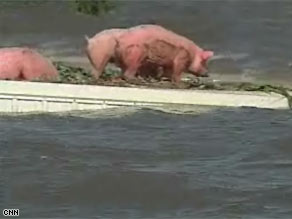
Pigs seek refuge from the floods on top of a farm building near Oakville, Illinois, on Wednesday.

Pigs seek refuge from the floods on top of a farm building near Oakville, Illinois, on Wednesday.

The U.S. Army Corps of Engineers for the Mississippi Valley said water flowed over the top of one levee, but local officials had a different account, reporting that the levee -- near Meyer, Illinois -- breached in two places about 6:20 a.m., pouring water into Hancock and Adams counties.

"It's kind of a sad day," Sheriff John Jefferson of Hancock County said. "People put in a lot of manpower [to build up the levees], and all was lost."

The floodwaters will cover thousands of acres of farmland from Warsaw to Quincy, about a 25-mile stretch of the river.

"There's a lot of wheat fields down here just about ready to be harvested, and they're going to lose all that," Jefferson said. "The corn crop, the bean crop that's up, is all going to be lost. And the real work's going to come after the flood recedes. It'll take years to get this ground back into shape to farm it."

All residents in the area had been evacuated, Jefferson said. Video Watch why Illinois breach helps Iowa »

Another levee in Adams County was breached about 1:30 a.m. Wednesday, said David Rudduck, spokesman for Illinois Gov. Rod Blagojevich.

On Wednesday, the White House asked Congress for $1.8 billion in emergency aid for the flooded region, The Associated Press reported.

The levees are about 45 miles south of another levee that was breached Tuesday morning near the small village of Gulfport, Illinois, prompting about 400 people to leave their homes in Henderson County.

The water flooded acres, shut down a train station and ruined crops.

Farmer Jim Olsen said his crop of beans and corn was ruined.

"It is not going to be a farm this year," he said, staring at his damaged land. "It is a total loss."

Near Oakville, Illinois, floodwaters covered about 21 square miles of corn and soybean fields, including Richard Siegle's farm.

All that was visible of the house Siegle built in 1972 was the roof and an American flag on a tall pole waving in the submerged front yard. On a nearby farm building, pigs clustered on the roof, eating whatever they could find that floated down the river. Video Watch pigs stranded on roof »

"Who ever thought that we'd see water this deep here?" Siegle asked. "It's unreal.

"You don't know where to start," Siegle said. "It just depends on what Mother Nature does, when the water goes out, whether they get the levee repaired. There's not any assurance that we'll get the levee repaired."

Authorities on Tuesday closed the Great River Bridge connecting Illinois to Iowa, according to the sheriff's office of Henderson County.

Across the Mississippi in Burlington, Iowa, water levels have "dropped a bit," but they may rise again, according to David Miller, administrator for the Iowa Homeland Security and Emergency Management Division.

"The good news is, the floodwater is receding in much of the state," Miller said. "The bad news is, we're still in a flood fight."

He said officials are also monitoring flooding at Keokuk, a riverside town, where water levels are expected to crest by Thursday.

Levees elsewhere along the Mississippi were being topped with sandbags as the river, fed by its flooded tributaries, continued to rise.

In Clarksville, Missouri, five blocks were under water, but National Guard members, inmates and students were sandbagging to save other parts of the historic artists' town, AP reported.

"We fix one thing, and it breaks," Mayor Jo Anne Smiley told AP. "Sewers are plugged up. We have leaks in walls and people who need things. We're boating in food to people."

President Bush plans to visit Cedar Rapids, Iowa, on Thursday to see the flood-damaged regions, according to White House Deputy Press Secretary Tony Fratto

Japan 24-hour shops hit by emission limits

From: Reuters

/pollution/article/37433

TOKYO (Reuters) - Japan's 24-hour convenience stores, already struggling with lagging sales and growth, may soon face yet another threat -- moves to limit business hours and close the stores late at night.

The prefecture of Saitama, which borders Tokyo, may follow in the footsteps of the western city of Kyoto and urge convenience stores to close during late night hours in an effort to limit carbon dioxide emissions, Japanese media reported.


Kyoto, a former capital, wants to persuade convenience and other 24-hour stores to close late at night so as to improve evening views of the city and cut down on energy use. The Nikkei business daily said closures could last from 11 p.m. to 7 a.m.

The move is strongly opposed by the industry, which fears a withering impact on an already troubled sector also grappling with the specter of a higher tobacco tax, which could hit overall sales.

"Even if we only operate the stores for 16 hours, we can't stop the refrigerators," said Toshiro Yamaguchi, the president of Seven-Eleven Japan Co, which is owned by Seven & I Holdings Co Ltd, at a news conference in Saitama on Tuesday.

He said such cuts in operating hours would reduce each store's profit by 20 percent. "If this happens, our current business model will lose its foundation."

As of April, Japan had 41,360 convenience stores, according to the Japan Franchise Association.

Some city areas are so saturated that competing stores may be located within a block of each other, while others are located in rural areas so sparsely populated that the stores can be a lonely outpost of light amid the rice fields after dark.

Analysts said that while it is difficult to estimate the potential impact of the move without a concrete plan, their overall impression was that it was likely to be negative.

"This could cut profits and lead to less efficient operations and the increased loss of opportunities," said Masafumi Shoda, an analyst at Nomura Securities.

"But it depends on the store -- urban stores do better than others. There are some in the countryside that are inefficient."

Others said the impact would depend on what hours stores were forced to close.

"Closing convenience stores at 11 p.m. might be a bit too early -- they should wait until after the last commuter train runs, say until around 1 a.m. or so," said Koichi Ogawa, chief portfolio manager at Daiwa SB Investments, adding that many businessmen who return home at that hour drop by to pick up a snack after an evening of drinking.

"But how many people really shop in the middle of the night? Staying open 24 hours means paying to employ part-time workers, which raises overall costs for the sector quite a lot."

Both said that if governments were sincere about reducing carbon emissions there were much more efficient methods, such as cutting back on the huge number of automatic vending machines.

Seven & I Holdings posted its first drop in full-year operating profit in six years this April but forecast a recovery this year as it closes unprofitable stores.

Shares of Lawson Inc were down 0.6 percent on Wednesday, while Seven & I rose 0.3 percent. FamilyMart Co Ltd fell 1.4 percent.

The global food crisis deepens

From: Tehran Times

/ecosystems/article/37434

The list of countries on the brink of disaster because of the global food crisis is growing by the week. Terrorism and security experts predict widespread social and political unrest and violent conflict in the second and third world.

Last week the United Nations’ World Food Program announced it is to provide U.S. $1.2 billion (£600 million) in additional food aid in the 62 countries hit hardest by the food and fuel crisis.


And Save the Children Sunday launched an emergency appeal to help children in Ethiopia who are suffering from increasing levels of hunger. The charity said a combination of drought and escalating food prices has left 4.6 million people urgently in need of food. In scenes reminiscent of the famines of the 1980s, about 736,000 of these are children under the age of five, a group which is particularly vulnerable to the effects of malnutrition.

More so than terrorism or global warming, food security will become so critical it will change global governance and result in civil unrest and food wars.

“It is clear which countries are going to be at risk,” Graham Hutchings of Oxford Analytica Daily Brief, which provides country-specific daily risk analysis to political leaders, academics, businesses and NGOs, told the Sunday Herald.

“Those who are net importers of food and those with weak governments will fall, in all likelihood. The overthrow of the leader in Haiti in April over food prices is the shape of things to come.

“Those which have come across our radar are Cambodia, parts of India, the Philippines, central Asian countries such as Uzbekistan and Tajikistan and African countries such as Senegal, Cameroon, Burkina Faso and the Ivory Coast. There have been food riots in Egypt, Yemen and Malaysia.”

Hutchings warned there is a very real risk of an angry popular and political backlash against the globalization and international capitalism from the world’s growing hungry. It is understood that one of the major drivers of the food crisis is financial speculation by the West. Capital flight from the subprime market into secure commodities such as wheat futures has pushed the price of food beyond the reach of the developing world.

Article continues: http://www.tehrantimes.com/index_View.asp?code=170999

Hit by fuel price, which way will motorists turn?

From: Reuters

/business/article/37431

With oil prices near $140 a barrel, motorists are starting to look seriously at both alternative fuels and electric vehicles as a way to be able to keep driving their cars.

But experts say it will take five to 10 years for these alternatives to take root, given the capacity challenge for an auto industry that is adding 65 million new cars a year to a fleet of 1 billion.

In the meantime, car and parts makers, oil companies and even electricity generators are left guessing which way motorists will turn and what technology will win.

"We don't know at the moment whether it's battery-based electricity technology or sustainable biofuels that will be successful," said James Smith, chairman of Shell UK Ltd, speaking at a climate change seminar hosted by Reuters.

"The strategic issues confronting us are very significant."

A range of options will emerge as motorists pick between "plug-in" electric cars, longer-range gasoline-electric "hybrids," or simply downsized, more efficient gasoline and diesel models, and as governments, worried by global warming and energy security, give more or less support for biofuels.

Hybrid vehicles, which have both a conventional internal combustion engine and electric motor and battery, are already popular. Toyota Motor Corp has sold 1.5 million Prius hybrids since 1997 and it wants hybrids to reach one tenth of its total sales by 2011.

In a hybrid, the electric battery and motor aid stop-start city driving, while the gasoline engine allows longer trips, together cutting energy use and carbon emissions.

Hybrids accounted for 3 percent of U.S. car sales in 2007. Makers absorb most of the extra $5,000 engine cost, leaving the street price only $1000 to $2000 higher.

Hybrids could be "broadly present" in the auto industry in five years, said Vlatko Vlatkovic, head of electrification research at GE, which has much to gain from widespread electrification of road transport.

Paul Nieuwenhuis, automotive researcher at Cardiff University in Wales, said that hybrids like the Prius are soon likely to be overtaken by plug-in hybrids, which will have the extra option to charge from the grid.

General Motors Corp wants its plug-in hybrid, the Chevy Volt, to reach showrooms in 2010. European brands including Mercedes, Volkswagen and BMW and Japan's Honda plan rivals.

Pure plug-in electric cars, meanwhile, have no combustion engine at all and have struggled to shake off a quirky image -- with tiny sales of fabulous cars at prohibitive prices or else economy-sized "golf carts," both with limited range.

Tesla Motors of San Carlos, California, advertises a Roadster with a top speed of 125 miles per hour (200 kmh) and a range of 220 miles. But Linda Nicholes, president of electric car pressure group "Plug in America," is still awaiting delivery two years after ordering hers at a price of

$100,000.

"We've been waiting eagerly ever since. I've been told September (2008)," said Nicholes, who is nonetheless still excited. "It's sleek, snazzy. All will be forgiven."

For those who can't wait, Monaco's privately held Venturi is marketing a 297,000 euros ($460,900) electric car with a top speed of 160 kilometres per hour (100 mph), called 'Fetish'.

"It's the pleasure to drive which will make it someone's favorite object," a spokeswoman said, explaining the name and adding it had sold five models on an expected 25-unit run.

Meanwhile, specialist car producer Think, based in Oslo, plans a run of 8,000 full electric cars in 2009 at 20,000 euros ($30,860) each.

And a Renault-Nissan alliance plans to start deploying full electric cars from 2010.

Electric car developments hinge on batteries which are light but pack enough power to travel more than 100 miles (160 km). Aggressive conversion of the global fleet to electric alternatives may take 30 years, said Charles Gassenheimer, chairman of lithium-ion battery supplier Ener1, based in Fort Lauderdale, Florida.

Alternatively, you can keep your car but switch the fuel, up to a point. Sugar-based biofuels are making serious headway against gasoline in Brazil, where nearly 90 percent of new cars have flex-fuel engines, which burn any combination of the two.

In the United States, tax breaks help biofuels made from corn supply about 2 percent of the domestic fuel mix.

But biofuels made from crops such as corn aren't the near-term replacement for gasoline, either. A finite supply of farm land has pitted them against food, inflating grain prices.

A tank of standard, U.S. corn biofuel blend, called E10, contains enough calories to sustain an adult man for 11 days. That underlines the problem of using food to make car fuel while 850 million people in the world are hungry.

Limited scope for global crop yields improvements will limit such "first generation" biofuels. Further off, sustainable biofuels which come from algae or woodchips and don't compete with food, may reach 10 percent of U.S. road fuel by 2022.

While some experts say that cars fueled by hydrogen fuel cells, which rely on the conversion of hydrogen and oxygen into water and which don't have harmful emissions, are promising, the technology is still in its infancy.

Honda Motor Co, began production on June 16 of a new fuel-cell car, the FCX Clarity, but has plans to sell only 200 in the United States and Japan in the next three years. The biggest hurdles for proliferation of hydrogen cell vehicles are a lack of fuelling stations and the high cost of development.

(Reporting by Gerard Wynn; Additional reporting by Ran Kim in Tokyo; Editing by Eddie Evans)

Friday, June 13, 2008

Calif. gov declares water emergency in farm area

/ecosystems/article/37384

Following his declaration last week of a drought in California, Gov. Arnold Schwarzenegger proclaimed on Thursday a state of emergency in nine counties in the state's farm-rich Central Valley.

"Just last week, I said we would announce regional emergencies wherever the state's drought situation warrants them, and in the Central Valley an emergency proclamation is necessary to protect our economy and way of life," the Republican governor said in a statement.

"Central Valley agriculture is a $20 billion a year industry. If we don't get them water immediately the results will be devastating," he added. "Food prices, which are already stretching many family budgets, will continue to climb and workers will lose their jobs -- everyone's livelihood will be impacted in some way."

His declaration covers Sacramento, San Joaquin, Stanislaus, Merced, Madera, Fresno, Kings, Tulare and Kern counties and directs California's Department of Water Resources to work with the U.S. Bureau of Reclamation to deliver more water through the State Water Project to where it is most needed.

The Department of Water Resources also is directed to transfer groundwater, tested for public safety, through the California Aqueduct to farmers and for the State Water Resources Control Board to review transfers as quickly as possible.

California has had two years of below-average rainfall and its water woes are being compounded by a federal court order to limit water pumping from the San Joaquin-Sacramento River Delta, the state's fresh-water hub, to protect a fish species.

Even before Schwarzenegger's drought declaration, many California water districts had imposed restrictions on water use and many farmers had prepared fields and orchards for reduced water allocations.

The city of Long Beach in Southern California, the city of Roseville in Northern California and the East Bay Municipal Utility District, which serves 1.3 million people in the San Francisco Bay area, have ordered water rationing.

The Metropolitan Water District of Southern California, which supplies water for 26 cities and water agencies serving 18 million people in six southern counties, has declared a water supply alert to sustain their reserves.

State officials are aiming for reduced water use locally and regionally through this year in anticipation of lower water supplies next year.

Schwarzenegger, as he did last week, called for lawmakers to back a "comprehensive solution" to the state's water woes by expanding water infrastructure, specifically public works to capture excess water in wet years to store for dry years.

Schwarzenegger has urged an $11.9 billion bond to finance water projects. Lawmakers are negotiating plans for $9.5 billion to $12 billion in debt for new water infrastructure, but Democrats who control the legislature and its Republican minority are at odds over the need for new dams.

(Reporting by Jim Christie; Editing by Leslie Adler)

The cost of cleaning up fossil fuels - and the price of doing nothing

· World's experts focus on trial in West Virginia
· Britain slow in developing projects, say critics

The 500ft cooling tower at the Mountaineer power station in New Haven, West Virginia, does not look much different from the scores that dot the British countryside. It might need a second look to notice that, in its shadow, there is a hole in the ground that goes two miles deep into the rock next to the Ohio river.

Next spring, the attention of scientists, engineers and policymakers from around the world will be focused on this power plant as engineers there try to crack one of the most urgent technological questions facing humans today: how to remove the carbon dioxide from the fossil fuels we burn and safely bury it where it cannot warm the planet.

Mountaineer is a modest project, aiming to trap just 100,000 tonnes of CO2 a year, the equivalent of a 20MW power station which could power 20,000 homes. But if it works, the plant's place in the history books, as the first successful trial of a complete carbon capture and storage (CCS) unit attached to a power station, will be assured.

CCS has the potential to make a big impact in reducing global carbon emissions - and the components of the technology all exist. At its best, CCS could prevent 90% of the CO2 emitted by power stations from getting into the atmosphere. Better still, it could be a vital tool for developing countries, such as China, where the government's economic growth and poverty reduction targets depend on building huge numbers of coal-fired power stations.The EU commissioner for energy, Andris Piebalgs, is unequivocal about the need for technology to bridge the gap until large-scale and more climate-friendly sources of energy become viable.

"CCS is absolutely necessary to reach climate change goals: there is no other way we could do it," he told a meeting of experts organised by the Norwegian environmental group Bellona.

The case for action on climate is compelling. Since the dawn of the industrial revolution, the world has burned the equivalent of 500bn tonnes of carbon, raising the atmospheric concentration of the gas from 280 parts per million to 387ppm today.

Last year the Intergovernmental Panel on Climate Change said that global emissions of greenhouse gases must peak by 2015 for the world to avoid dangerous climate change and have any chance of limiting the expected temperature rise to 2C. But the International Energy Agency predicts the world's use of power will increase by 50% by 2030, with 77% of that coming from fossil fuels.

Despite the urgency, governments and power companies are locked in a wrangle over who will pay. Individually, the technologies needed to capture, transport and bury CO2 have been developed and are used in oilfields and chemical plants. But no one has built an entire system attached to a power station. No one wants to be the first to pay the bills for the expensive set of demonstrations needed. Estimates of the average cost of retro-fitting Britain's aged power stations are around £1bn each, with pipes to transport the CO2 to suitable burial sites costing around £1m per mile.

"From an engineering point of view, we can do it," said John Loughhead, executive director of the UK Energy Research Centre. "We know how to do it but the cost frightens us. It comes down to how seriously the government takes reducing CO2 emissions." There are three broad approaches to CCS:

· removing the CO2 before combustion by treating the coal;

· scrubbing it from exhaust gases after combustion;

· or burning the fuel with extra oxygen to produce an almost pure CO2 exhaust.

The CCS process itself uses energy and it is estimated that between 10% and 40% of a power station's energy output could end up being used to run the scrubbing and transport systems.

Projects to demonstrate parts of the CCS chain are already under way. Norway's state oil company has been stripping CO2 out of the natural gas extracted from the Sleipner oil field in the North Sea for over 10 years. About 1m tonnes of CO2 is now injected into the sandstone aquifer under the seabed every year. BP runs a similar scheme at In Salah in Algeria while at Weyburn, Saskatchewan, 1m tonnes of CO2 a year is buried, piped in from a chemical plant 400 miles away in North Dakota.

The project in West Virginia, due to begin next year, will be the first of the pilot plants to put all the pieces of the CCS technology together, a testbed for a more ambitious plan to capture and store emissions from a coal-fired power station in Oklahoma which should begin operations early next decade, trapping and burying 1.5m tonnes of CO2 a year in a nearby oilfield.

Another project nearing the pilot phase is Swedish energy company Vattenfall's plan to build a €1bn (£800m) CCS demonstration plant in Brandenburg, Germany, testing the post-combustion and high oxygen burning methods. Further CCS projects have also been announced in Norway, Australia, the United States and Canada. The EU aims to have 12 demonstration plants running by 2015.

In the UK, however, critics argue that plans are too small-scale and too slow, despite government claims that the country is in a perfect place for CCS due to the easy access to suitable burial sites for CO2 in the North Sea.

Last year, the government announced a competition to fund the construction of a 400MW CCS demonstration project that would go on line in 2014. Officials will announce a shortlist of potential sites for the demonstration plant later this month, with a leading candidate for the award a proposed 1.6GW coal-fired power station at Kingsnorth in Kent.

There are no official details of cost but a spokesman for the Department for Business, Enterprise and Regulatory Reform indicated that funding could be hundreds of millions of pounds over 15 years.

Stuart Haszeldine, a geologist and CCS specialist at the University of Edinburgh, has said the government's "incoherence and timidity" in policy had caused a dramatic slowdown of CCS development in the UK. In 2007, there were 10 test projects in the pipeline, covering a range of CCS technologies, which together could have cut the UK's emissions by 20%. Half have been abandoned, mainly because they did not fit the criteria for the UK's competition.

A senior energy industry source said the government's decision to allow only post-combustion CCS technology to enter the competition had been a mistake. "The problem with CCS is that it's often seen as a sticking plaster that allows the coal industry to carry on as normal."

Even for those environmentalists who support CCS, the post-combustion approach reinforces all that is wrong with coal. Keith Allott, head of climate change at WWF, is concerned that it legitimises a "build now, retrofit later" mindset in the power industry. "We have up to eight new coal-fired power stations being considered in the UK - if those power stations are built without carbon capture and storage, then it will blow our chances of meeting reduction targets out of the water."

The energy minister, Malcom Wicks, said the choice of technology was intended to take into account the future energy generation plans of countries such as India and China. The UK government is part-funding a project with China that will use a pre-combustion method to trap CO2 in a plant near Tianjin, to help in addressing China's emissions, which will be more than 5bn tonnes a year by 2030.

Whichever technology wins out, the largest obstacle to implementation remains money. Commercial operators point out that electricity from power stations with expensive CCS kit attached could never compete on the open market. It is therefore unsurprising that companies are biding their time.

Gardiner Hill, CCS technology director at BP, said that the cost of building CCS into power plants should eventually be borne by a higher price for carbon in markets such as Europe's emissions trading scheme, meaning that it would be too expensive to build power stations without CCS. One potential source of money is to use cash raised by governments across Europe from the auction of permits to emit CO2 from the third phase of the ETS scheme in 2013.

In their CCS policy, released today, the Conservatives have promised to do exactly that to fund up to three full-scale demonstration plants. The Labour government has rejected any hypothecation of cash raised by the ETS auction.

The cost of inaction could also be high. Paal Frisvold, chair of environmental group Bellona Europa, pointed to an impact assessment report by the European commission. "It points out that, if we don't use CCS for reaching our climate goals, the price tag is going to be €40bn more expensive. Here are some good reasons to deal with the finances of it now."

Some environmentalists remain opposed to CCS. Gavin Edwards, of Greenpeace International, wants to see governments take a second look at renewable sources of energy and energy efficiency.

Jon Gibbins, an energy technologist at Imperial College London, sees CCS as an insurance policy.

Generating power from zero-carbon renewable sources is good, he said, but to genuinely protect the climate, you have to ensure that no one releases CO2 by burning coal or other fossil fuels for centuries ahead.

Gibbins said the UK had a moral leadership role on the global stage: "With CCS you're asking people to stuff money down a hole in the ground for the sake of the climate. If we're not prepared to do it, we can't ask anyone else to do it."

· This article was amended on Friday June 13 2008. An editing error meant that we said that fossil fuel burning has released 500m tonnes of CO2 since the dawn of the industrial revolution; in fact we had meant that the world had burned 500bn tonnes of carbon. This has been corrected.

China's carbon emissions soaring past the US

China's carbon emissions are soaring past those of the US, new figures reveal, making it the dominant country in the global warming debate.

Chinese carbon dioxide pollution rose by 8% in 2007 and was responsible for two-thirds of the year's total increase in global CO2 emissions, according to experts at the Netherlands Environmental Assessment Agency.

Cement production to meet China's demand for infrastructure to support its booming economy was a large factor: half of all global cement production now takes place in China, and the industry is responsible for a fifth of Chinese CO2. Rebuilding roads and homes after the Sichuan province earthquake is expected to increase demand further.

According to the figures, China is now responsible for 24% of global carbon dioxide emissions, followed by the US with 22%. The EU produces 12%, India 8% and the Russian Federation 6%.

Per head of population, China is still far behind the US, which remains the biggest polluter per person by a large margin. US citizens produce an average of 19.4 tonnes of CO2 each year, while those in China produce just 5.1 tonnes each. Russians produce 11.8 tonnes each, the agency says, with the figure for the EU at 8.6 tonnes, and India just 1.8 tonnes per person.

The Netherlands researchers used new data on worldwide energy consumption and cement production in 2007 prepared by the oil giant BP. Last year, the same team surprised analysts when it said that China had already overtaken the US as chief producer of CO2.

Des Moines being evacuated

DES MOINES, Iowa (AP) -- Officials on Friday issued a voluntary evacuation order for much of downtown Des Moines, Iowa, and other areas bordering the Des Moines River.

art.hospital.ap.jpg

Floodwater laps at the doors of Mercy Medical Center in Cedar Rapids, Iowa, on Friday.

Officials recommended that downtown residents and businesses evacuate parts of downtown on both sides of the river by 6 p.m. Friday. Included are all areas in Des Moines' 500-year floodplain.

The alert was prompted by rising river levels expected to peak at 8 p.m. Friday.

Des Moines Mayor Frank Cownie said officials chose "to err on the side of citizens and residents."

The evacuation should begin immediately and be completed by 6 p.m., the mayor said.

In Cedar Rapids, a downtown hospital was evacuated as the Cedar River flooded 400 city blocks.

Residents of more than 3,000 homes fled for higher ground and a railroad bridge collapsed.

The hospital's 176 patients, including about 30 in a nursing home facility, were being transferred to other hospitals in the region.

The Cedar Rapids evacuation started late Thursday night and continued Friday morning in the city of 124,000 residents.

"Some are frail and so it's a very delicate process with them," said Karen Vander Sanden, a hospital spokeswoman. Video Watch how folks are coping in Cedar Rapids »

Water was seeping into the hospital's lower levels, where the emergency generator is located, said Dustin Hinrichs of the Linn County emergency operations center.

"They proactively and preventatively started evacuation basically guessing on the fact they were going to lose power," he said.

Dave Koch, a spokesman for the Cedar Rapids fire department, said the river will crest Friday at about 31.8 feet. It was at 30.9 feet early in the morning. In a 1993 flood, considered the worst in recent history, it was at 19.27 feet. iReport.com: Teen takes pics during sandbagging run

"We are seeing a historic hydrological event taking place with unprecedented river levels occurring," said Brian Pierce, a meteorologist with the National Weather Service in Davenport, Iowa. "We're in uncharted territory -- this is an event beyond what anybody could even imagine." Video Watch how weather is bludgeoning the Midwest »

Flooding also closed Interstate 80 from east of Iowa City to Davenport. The flooded Cedar River crosses the interstate in Cedar County, about 20 miles east of Iowa City.

Iowa Gov. Chet Culver declared 83 of the state's 99 counties state disaster areas. Nine rivers are at or above historic flood levels. Amtrak's California Zephyr line was suspended across Iowa because of flooding along the BNSF Railway.

No deaths or serious injuries were reported in Iowa, but two men died in their cars in southern Minnesota and western lower Michigan.

In Wisconsin, amphibious vehicles that carry tourists on the Wisconsin River were used to evacuate homes and businesses in Baraboo, north of Madison. Hundreds of people lost power in Avoca, west of Madison, and were "strongly encouraged" to evacuate due to flooding, said Chief Deputy Jon Pepper of the Iowa County Sheriff's Department. iReport.com: Duck boats to the rescue

The rising Fond du Lac River forced hundreds from homes in Fond du Lac.

Violent thunderstorms Thursday and Friday brought widespread flooding to Michigan's Lower Peninsula that authorities say left some roads and bridges unstable or impassable. Authorities in Mason County advised drivers to stay off the roads unless it was an emergency, and the county closed or barricaded more than a dozen roadways.

People in several northern Missouri communities, meanwhile, were piling up sandbags to prepare for flooding in the Missouri River, expected to crest over the weekend, and a more significant rise in the Mississippi River expected Wednesday.

Despite all the water in Cedar Rapids, there was precious little for toilets, cleaning, or drinking.

Koch said the city is at critical levels and only one of the city's six wells was operating.

"If we lost that one we would be in serious trouble. Basically we are using more water than we are producing," he said. "We really need to reduce the amount of water we are using ... even using paper plates, hand sanitizer."

Similarly, the town of Lawrenceville, Illinois, grappled with a broken water system that left businesses with no usable tap water, forcing them to close.

In Cedar Rapids, rescuers had to use boats to reach many stranded residents, and people could be seen dragging suitcases up closed highway exit ramps to escape the water.

"We're just kind of at God's mercy right now, so hopefully people that never prayed before this, it might be a good time to start," Linn County Sheriff Don Zeller said. "We're going to need a lot of prayers and people are going to need a lot of patience and understanding." Video Watch what Iowa has to look forward to »

Prisoners had to be moved from the Linn County jail, including some inmates who had been transferred from the Benton County jail in Vinton because of flooding. The sheriff's office also was underwater, Zeller said.

The surging river caused part of a railroad bridge and about 20 hopper cars loaded with rocks to collapse into the river. The cars had been positioned on the bridge in hopes of weighing it down against the rising water.

advertisement
In Austin, Minnesota, the Cedar River crested 7.4 feet above flood stage. The river went about 5 feet higher in a 2004 flood that caused major damage in the city.
"It seems like we're having the hundred-year flood every four years. It's absurd," said Mark Dulitz, who had 4 inches of water in his basement and a ring of sandbags around his house.

NorCal wildfires destroy homes, force thousands to flee

Firefighters work along Neal Road to contain the Humboldt... Thick dark smoke rises over the valley floor as firefight... Firefighters work to contain the Humboldt Fire, which has... Butte County firefighter Janet Upton talks on her phone w...

(06-13) 10:38 PDT Paradise, CA (AP) --

Firefighters battled several fast-growing wildfires across Northern California, including a wind-whipped blaze in Butte County that destroyed at least 20 homes and forced thousands of residents to evacuate.

Authorities in Butte County on Thursday closed all roads to Paradise, a town of about 30,000 residents some 90 miles north of Sacramento, and ordered 9,000 residents to leave their homes. An evacuation shelter was set up in nearby Chico.

The fire, which started Wednesday, had grown to more than 20,000 acres and threatened 4,600 structures, according to the California Department of Forestry and Fire Protection. Twenty homes were confirmed to be destroyed, but officials said that number likely could double once crews were able to better assess the damage.

More than 1,500 firefighters were trying to contain the blaze, which was only 16 percent contained by Friday morning. Five firefighters have sustained minor injuries.

Fed by strong, erratic winds on Thursday, the fire spread to the hills of the Butte College campus, where officials had set up an incident command center, said Cal Fire spokesman Joshpae White.

"The winds have calmed down significantly," White said Friday morning. "Hopefully we'll be able to make significantly progress today."

Firefighters, however, needed to move quickly. Winds from the southwest were expected to pick up in the afternoon, which could push the flames closer to Paradise, said White, who was one of the firefighters injured a day earlier.

White said he was escorting reporters through the fire area in a pickup truck when the flames quickly began closing in. After safely evacuating the reporters, he helped nearby firefighters escape and was forced to drive through a wall of fire.

"It looked like a million blowtorches across the road," White said. "We were taking significant heat. The heat was so intense, the windshield began cracking."

White and another firefighter were treated for minor burns.

In recent days, hot temperatures, steady winds and tinder-dry vegetation have fueled a series of destructive blazes from Butte County to the San Francisco Bay area to the Los Padres National Forest.

But 900 firefighters in Santa Cruz County caught a break Friday as cooler temperatures and increased cloud cover helped them battled a wildfire that had destroyed at least 10 homes in the Bonny Doon community, according to Cal Fire. It was 25 percent contained Friday morning and had scorched 600 acres — a revised estimate from 700 acres, after crews were able to map the blaze.

More than 1,500 residents have been told to evacuate their homes in the heavily forested hills about 10 miles northwest of Santa Cruz since the fire broke out Wednesday afternoon. The fire flared just two weeks after another blaze two miles away scorched 4,200 acres and destroyed at least three dozen homes in the Santa Cruz Mountains.

James Eason, 28, a full-time caretaker for his quadriplegic dad Jim Eason, 63, said they spent Thursday hanging out with other evacuees in a supermarket parking lot after spending the night in a Red Cross shelter in Felton, several miles from the blaze.

On Wednesday, they evacuated their $1,300-a-month yurt, a nearly uninsulated wooden-framed structure covered in canvas where they have lived for the past three months. They weren't able to check on their home Thursday and planned to spend another night at the shelter, which was moved to a middle school in nearby Scotts Valley.

"It's stressful and frustrating. It makes you anxious not knowing if you're going to have a place to go back to," James Eason said. "All of a sudden, with the fire, the yurt doesn't seem so bad. We've started to like it a whole lot."

Gov. Arnold Schwarzenegger declared a state of emergency in Santa Cruz County early Thursday to free up additional firefighting resources. He declared one in Butte County late Wednesday.

Farther south, another wildfire had charred more than 18,600 acres in the Los Padres National Forest in Monterey County. It was nearly 40 percent contained Friday.

That fire had spread east to a remote part of the Army's Fort Hunter Liggett base Thursday, but winds were driving the flames away from inhabited areas of the military base, said Manny Madrigal, a spokesman for the U.S. Forest Service.

Four families with homes near the base were evacuated, but the 5,000 military personnel who live there were not in immediate danger, said Fort Hunter Liggett spokeswoman Helen Elrod.

Several firefighters have suffered injuries while fighting the wind-stoked fires over the past few days.

Three firefighters were burned near Lincoln, about 25 miles northeast of Sacramento, when they were caught in a 65-acre grass fire burning in a dry rice field.

All three were taken to the University of California, Davis Medical Center regional burn center. Two of them had moderate to severe burns to their faces and arms.

"They are both stable and able to communicate. They have significant swelling," said Battalion Chief Greg Guyan. "They'll probably be in the burn unit another week."

The third was released from a hospital after treatment for minor facial burns.

The burn center was also treating a firefighter who was severely burned Tuesday while trying to protect a mobile home near a wind-blown grass fire southeast of Sacramento. Capt. Steven J. Eggiman, a 21-year veteran of the Sacramento Metropolitan Fire District, was in good condition Thursday after undergoing surgery burns to his hands, arms and nose.

___

Associated Press Writers Terence Chea and Jason Dearen in San Francisco and Don Thompson in Sacramento contributed to this report.

Monday, June 9, 2008

The end of abundance: Food panic brings calls for a second 'green revolution'

From: , Organic Consumers Association, More from this Affiliate

/agriculture/article/37340

By 1968 the jump in farm productivity was so clear - India, for example, harvested a record wheat crop, as did the Philippines for rice - that William Gaud, administrator of the US Agency for International Development, said the world was witnessing the "makings of a new revolution".

"It is not a violent red revolution like that of the Soviets, nor is it a white revolution like that of the Shah of Iran," Gaud said in a speech 40 years ago. "I call it the green revolution," he added, coining a term that has long survived him.

Yet, like its counterparts elsewhere on the spectrum, the green revolution eventually lost momentum. Today, the world stands on the brink again as agricultural commodity prices surge, triggering food riots in countries from Haiti to Bangladesh. This time, however, efforts to increase supply - and the political backing in Washington and other capitals - appear far weaker. The task of raising productivity is meanwhile rendered more difficult by record oil prices, which make fertiliser more expensive.

In dozens of interviews with agriculture officials and experts, a consensus emerges: even if the current food crisis is the result of multiple factors, such as biofuel demand or extreme weather, its roots are in the waning green revolution. "The foundation of the current crisis is the slowdown in farm productivity," says Lennart BÃ¥ge, president of the United Nations' International Fund for Agriculture Development in Rome.

The green revolution was in many respects a victim of its own success. The increase in food production from the early 1960s was so great that it not only staved off global hunger but also opened the way to almost 40 years of cheap and abundant food supplies. Wheat yields per hectare, for example, jumped from less than 500kg to nearly 3,000kg today. Indeed, for most of the 1990s the problem was too much food, with much talk in Europe of grain "mountains" and "lakes" of milk and wine.

Akinwumi Adesina, vice-president of the Alliance for a Green Revolution in Africa, says this cornucopia of inexpensive food generated a profound sense of complacency. "People started thinking that support into agriculture research was no longer necessary to boost productivity further, as there was already more than enough food and prices were falling."

As a result, investment in agricultural research and infrastructure declined sharply. Multilateral organisations such as the World Bank and individual rich donor countries cut the share of agricultural spending in their development assistance to less than 3 per cent in 2004, down from a peak of 18 per cent in 1979, according to the Organisation for Economic Co-operation and Development. In money terms, even adjusted for inflation, farm aid more than halved to about $3bn in 2004 from $8bn in 1979.

Although private sector funding for agricultural research grew, low food prices on world markets meant this work generally focused on innovations that reduced costs rather than enhanced yields. It was always publicly funded research that was more likely to concentrate on innovations that would increase yields and production, particularly in parts of the world where farmers are unable to pay royalties for new varieties of seeds, says Ronald Trostle of the US Department of Agriculture's economic research service.

Less investment translated into slowing productivity growth. According to the USDA, crop yields increased at an annual rate of 1.1 per cent on average between 1990 and 2007, compared with the 2 per cent rate achieved in 1970-90. The impact on yield growth in important staples such as wheat and rice was even more acute, slowing to about 1 per cent per year from annual rates of as high as 10 per cent in the early 1960s.

The decline in productivity growth could scarcely have come at a worse time. Food demand has been rising this decade as the world's population expands and a swelling middle class in countries such as China consumes more proteins such as meat and milk. The development of the biofuels industry further increased demand, accounting this year for one-third of the US corn crop.

Now, for the first time since the 1970s, the world is slowly depleting its food stocks, each year consuming more than it produces. Also as a result of climate upsets including droughts, inventories are at record lows and prices are rocketing. "It was an accident waiting to happen," Mr Adesina says.

Policymakers are waking up to the urgency of the situation. Manmohan Singh, India's prime minister, recently declared that "there is persistent feeling that the first green revolution has run its course". He went on to say that the world needs a second such transformation if it is to resolve the food crisis: "The global community and global agencies must fashion a collective response that leads to a quantum leap in agricultural productivity and output, so that the spectre of food shortages is banished from the horizon once again."

That will be high on the agenda of the United Nations' Food and Agriculture Organisation summit, which begins on Tuesday in Rome and is due to be attended by more than 40 heads of state and government. Jacques Diouf, head of the FAO, says this a rare moment: "For the first time in 25 years, a fundamental incentive - high food commodity prices - is in place for stimulating the agricultural sector. Governments, supported by their international partners, must now undertake the necessary public investment and provide a favourable environment for private investments." Or as Ed Schafer, the US agriculture secretary, recently put it: "If countries do not increase yields...people are going to go hungry. It's that simple."

Yet replicating the first green revolution will be difficult. Each of the three pillars on which it was built - seed technology, irrigation and the ample use of fertilisers and pesticides - now look rather less sturdy. Again, that largely reflects the legacy of how the problem was tackled the first time round.

As millions of lives were at risk from hunger and results were needed fast, scientists and policymakers focused on increasing production at whatever cost. Tom Mew, who worked as the principal scientist at the International Rice Research Institute at Los Banos in the Philippines in the 1960s, acknowledged that bias a few years ago in a speech: "It was a tough choice, so we focused on high-input agriculture that would ensure that everyone got fed."

The result is a global agricultural system that today is highly intensive and is predicated on the availability of cheap, readily available energy, for use in every part of the production chain: both directly as fuel and indirectly to manufacture fertilisers and pesticides. But with oil prices rising, the cost of certain fertilisers has surged to more than $1,000 (€643, £505) a tonne from about $300 a tonne two years ago. On top of that, the use of chemical fertilisers and pesticides faces public opposition.

The original green revolution also required vast amounts of water for irrigation - a resource that is becoming scarcer because of climate change and the rapid growth of cities and industrial operations, particularly in the developing world.

Last, the 1960s improvements in seed technology achieved higher yields as well as an improved resistance to drought and insects. Scientists are approaching the limits of what they can do through natural techniques. The next step - the use of genetically modified organisms - faces strong opposition, particularly in Europe but also, for instance, in some African countries.

In short, the easy gains have already been made, except in Africa. Shivaji Pandey, who was involved in the first green revolution and now heads the plant production division at the FAO in Rome, says the world now needs a "smarter" green revolution. "We will need to increase farm production with less water and a more efficient use of fertilisers," he says. Alexander Evans, a fellow at New York University's Center on International Co-operation, says the key is making the green revolution "greener". He argues: "It needs to be much more input-efficient."

To do that, experts argue, water management should move from the relatively cheap flood irrigation widely used in south-east Asia to much more expensive sprinkler and drip systems. Those would require investments that developing countries could afford only with donor support, officials say. "Water will be a limiting factor," says Mr Adesina.

Fertilisers pose a bigger challenge. The FAO thinks it is possible to economise on their use, particularly in some south-east Asian countries, through programmes that educate farmers on how much they need to drop on their fields and when. But in the long term, experts say, fertiliser use will increase, particularly in Africa, meaning that donor countries would probably need to subsidise chemicals for poor countries.

Some experts, such as Tom Lumpkin, director of the International Wheat and Maize Improvement Center in El Batan, Mexico, add that countries will need to reconsider their opposition to genetically modified organisms in the light of the crisis. "We need science to come back to farming," Mr Lumpkin says.

Already 100m hectares, or about 8 per cent of the world's cultivated land, are sown with genetically modified organisms. The technology's supporters, such as the US and Brazil, are likely to press their point ever more firmly that embracing GM crops could help resolve the problem. Gaddi Vasquez, the US ambassador to the FAO in Rome, says that to increase crop yields, "one of the most promising ways is through GM".

The World Bank said this year that agriculture was poised for another technological revolution, this time using the tools of biotechnology. "But there is considerable uncertainty about whether this revolution will become a reality for food production in the developing world because of low public investment in these technologies and controversies over their possible risks," it warned.

On top of the problems with seeds, fertilisers and irrigation, the political climate today is less conducive to massive cash transfers from the rich to the developing world. No one now fears a communist takeover; the investment required would have to come as an simple attempt to improve the lives of millions.

Whatever the course that policymakers chart this week at the FAO summit, officials and experts agree that the world needs to move fast to ease the crisis - and to prevent another in a few years. The OECD and FAO last week said in their joint Agricultural Outlook 2008-2017 that public and private investments in innovation and increasing farm productivity "would greatly improve supply prospects by helping to broaden the production base and lessen the chance of recurring commodity price spikes".

But time is something else in short supply. Robert Zeigler, director of the International Rice Research Institute, says it would take up to a decade to develop the seed varieties and build the infrastructure required for a second green revolution. "In reality, we should have started 10 years ago to avoid today's problems," he says.

Video

"Manufactured Landscapes" SEE THIS BRILLIANT MOVIE! You'll never have the same shopping experience again.