Wednesday, August 13, 2008

Oil and gas projects in western Amazon threaten biodiversity and indigenous peoples

From: Public Library of Science

/ecosystems/article/37915

The western Amazon, home to the most biodiverse and intact rainforest left on Earth, may soon be covered with oil rigs and pipelines.

According to a new study, over 180 oil and gas "blocks" — areas zoned for exploration and development — now cover the megadiverse western Amazon, which includes Bolivia, Colombia, Ecuador, Peru, and western Brazil. These oil and gas blocks stretch over 688,000 km2 (170 million acres), a vast area, nearly the size of Texas. The study appears in the August 13 edition of the open-access journal PLoS ONE.


For over three years, researchers from two U.S. non-profit organizations — Save America's Forests and Land Is Life — and scientists from Duke University tracked hydrocarbon activities across the region and generated a comprehensive map of oil and gas activities across the western Amazon. The result is an alarming assessment of the threats to the biodiversity and indigenous peoples of the region.

"We found that the oil and gas blocks overlap perfectly with the most biodiverse part of the Amazon for birds, mammals, and amphibians," said study co-author Dr. Clinton Jenkins of Duke University. "The threat to amphibians is of particular concern because they are already the most threatened group of vertebrates worldwide."

The study also found that the oil and gas blocks are concentrated in the most intact part of the Amazon. Even national parks are not immune; exploration and development blocks cover the renowned Yasuní National Park in Ecuador and Madidi National Park in Bolivia.

"The most dynamic situation is unfolding in the Peruvian Amazon," warned lead author Dr. Matt Finer of Save America's Forests.

The study reports that 64 oil and gas blocks cover approximately 72% of the vast Peruvian Amazon (~490,000 km2 or ~121 million acres), an area much larger than California. All but eight of these blocks have appeared since 2003, when Peru launched a major effort to boost exploration across the Amazon. National parks are off limits to hydrocarbon activities in Peru, but oil and gas blocks do overlap a variety of other types of protected areas.

Many of the oil and gas blocks in the western Amazon overlap titled lands of indigenous peoples and encroach on the territories of indigenous peoples in voluntary isolation. These isolated peoples have chosen to live in the forests without contact with the outside world. They are extremely susceptible to outside illnesses due to lack of natural resistance.

In the second part of the study, the researchers delve into the most cutting policy issues related to oil and gas activities in the Amazon.

The authors highlighted new access roads as the greatest single threat from hydrocarbon development. Roads trigger deforestation, colonization, overhunting, and illegal logging in previously remote areas.

"The elimination of new oil access roads could significantly reduce the impacts of most projects," said Finer, echoing one of the studies' main conclusions.

The analysis points out that the current environmental assessment process is inadequate due to a lack of independence in the review process and a lack of comprehensive analyses of the long-term, cumulative, and synergistic impacts of multiple oil and gas projects across the wider region. The authors stress the need for regional Strategic Environmental Assessments in order to correct this situation.

The study also addresses the complex policy issues related to indigenous peoples.

"The way that oil development is being pursued in the Western Amazon is a gross violation of the rights of the indigenous peoples of the region" said Brian Keane of Land is Life, "International agreements and Inter-American human rights law recognize that indigenous peoples have rights to their lands, and explicitly prohibit the granting of concessions to exploit natural resources in their territories without their free, prior and informed consent."

The authors also detail the growing conflict of hydrocarbon activities slated for the territories of indigenous peoples in voluntary isolation.

Finally, the study highlights the role of the international community. Growing global energy demand is driving the search for more oil and gas in the Amazon and companies from the U.S., Canada, Europe, and China are carrying out most of the development.

"Filling up with a tank of gas could soon have devastating consequences to rainforests, their peoples, and their species" remarked co-author Dr. Stuart Pimm of Duke University.

Ecuador's innovative Yasuní-ITT Initiative is held up as a potentially precedent-setting example of how the global north and south can collaborate on both protecting the Amazon and combating climate change. The initiative is the Government of Ecuador's limited-time offer to keep its largest untapped oilfields unexploited in exchange for financial compensation from the international community.

Sunday, August 10, 2008

Birds head north as climate heats up

From: SUNY College

Birds head north as climate heats up

/sci-tech/article/37881

A study by researchers at the SUNY College of Environmental Science and Forestry (ESF) has documented, for the first time in the northeastern United States, that a variety of bird species are extending their breeding ranges to the north, a pattern that adds to concerns about climate change.


Focusing on 83 species of birds that have traditionally bred in New York state, the researchers compared data collected in the early 1980s with information gathered between 2000 and 2005. They discovered that many species had extended their range boundaries, some by as much as 40 miles.

“They are indeed moving northward in their range boundaries,” said researcher Benjamin Zuckerberg, whose Ph.D. dissertation included the study. “But the real signal came out with some of the northerly species that are more common in Canada and the northern part of the U.S. Their southern range boundaries are actually moving northward as well, at a much faster clip.”

Among the species moving north are the Nashville warbler, a little bird with a yellow belly and a loudly musical two-part song, and the pine siskin, a common finch that resembles a sparrow. Both birds have traditionally been seen in Northern New York but are showing significant retractions in their southern range boundaries, Zuckerberg said.

Birds moving north from more southern areas include the red-bellied woodpecker, considered the most common woodpecker in the Southeastern United States, and the Carolina wren, whose “teakettle, teakettle, teakettle” song is surprisingly loud for a bird that weighs less than an ounce.

“There are a wide spectrum of changes that are occurring and those changes are occurring in a relatively short amount of time. We’re not talking centuries, we’re talking decades,” said William Porter, an ESF faculty member and director of ESF’s Adirondack Ecological Center, who worked with Zuckerberg on the study.

“New York citizens need to recognize that these changes are occurring,” Porter said. “Whether they are good or bad, whether they should be addressed, whether we should adapt to them, whether we should try to mitigate some of this, those are questions that really, rightfully, belong in the political arena.”

The study compared data collected during the state Department of Environmental Conservation’s Breeding Bird Atlas census, which engaged thousands of citizen volunteers to observe and report the birds they could identify. The first atlas was created between 1980 and 1985; the second was done between 2000 and 2005.

New York was the first state to complete two breeding bird atlases, Zuckerberg said, making it the only state that is able, at this point, to produce this kind of research.

Zuckerberg said similar changes were found in birds that breed in forests and those that inhabit grasslands, in both insectivores and omnivores, and even in new tropical migrants that are typically seen in Mexico and South America.

“What you begin to see is a systematic pattern of these species moving northward as we would predict with regional warming,”

Big Dry' claims River Murray lakes

Big Dry' claims River Murray lakes

After seven years of drought, flooding with seawater may be river system's only hope

Australia's epic drought is tightening its grip as a deepening ecological crisis unfolds in the south of the country. After seven years of the Big Dry, water levels in lakes at the mouth of the mighty Murray river have fallen by up to 50cm below sea level and environmental damage is spreading on a massive scale, according to conservationists.

At Bottle Bend Lagoon, drought and over-use of water by farmers for irrigation has left swaths of riverbed exposed, producing a toxic chemical reaction that is spreading. The banks are lined with poisonous aluminium and manganese salts and the water is dun-coloured, smells like rotten eggs and is as corrosive as battery acid. Fish have died in their thousands and red gum trees and plants are also dying.

The same environmental disaster is happening in nearby Lakes Albert and Alexandrina, internationally recognised wetlands that are home to a wide range of migratory birds. Australia's water minister, Penny Wong, has said the lakes may be beyond salvation. But she dismissed calls for more fresh water to be allowed to flow down the Murray - the river is controlled by dams, weirs and locks - saying dwindling supplies were needed for essential human demands.

Now, a controversial option of flooding the area with seawater is being considered. Professor Tim Flannery, Australia's best-known climate-change commentator, said that the action would be 'risky and probably unpopular', but that it could help save the dying eco-system by preventing the exposed lake bed from turning irreversibly acidic and toxic. A weir would be constructed to prevent salt or acidic water contaminating Adelaide's drinking water supply.

Peter Cosier, of the pressure group Concerned Scientists, is leading the opposition to the plan, saying it would alter the ecosystem beyond recognition. 'The advice I have is that, once the salt water's in there, it's next to impossible to get out,' he said.

The Murray Darling Basin Commission manages the vast river system that provides water to Australia's 'food bowl', a vast expanse of land that runs down the continent's eastern coast. It is studying options for the endangered lakes and is due to report to ministers on the seawater plan by October.

The crisis has come about because Australia is in the grip of the worst drought in a century. Years of scant rainfall have left vast areas parched and last month it was predicted that up to a million people could face a shortage of drinking water if the drought continues. The report from government officials warned that there could be problems supplying drinking water from the Murray Darling in 2008-2009 unless there is significant rainfall soon.

Another report by scientists predicted that Australasia would experience a tenfold increase in heatwaves as a result of climate change. Exceptionally hot years, which used to occur once every 22 years, would come every one or two years, making drought a part of the landscape. Water in public storage in the basin is at only 21 per cent capacity.

Arlene Buchan, director of the Australian Conservation Foundation, said the lakes need 300 to 400 gigalitres of water - a gigalitre is equivalent to 1,000 Olympic-sized swimming pools - before the year's end. 'Unless we get that water, we are facing an ecological disaster.'


Friday, August 8, 2008

Climate change catastrophe by degree

Bob Watson rightly warns us to prepare for 4C global warming. To avoid that, we must make drastic CO2 cuts now

Mark Lynas

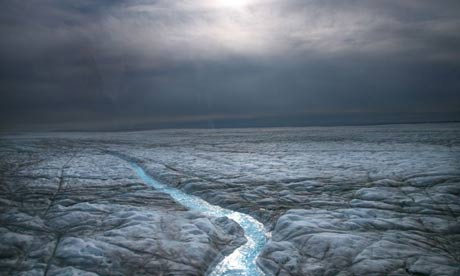
Melting ice caps in Greenland

Melting ice caps in Greenland. Photograph: Uriel Sinai/Getty Images

Unfortunately, Professor Bob Watson is not speaking out of turn in telling the world to prepare for four degrees of global warming. "Mitigate for two degrees; adapt for four" has long been the catchphrase among climate negotiators and campaigners. Translated, that means: try to reduce emissions to stay below two degrees of warming, but also prepare for the worst.

And Bob Watson should know – he is the former chair of the Intergovernmental Panel on Climate Change (IPCC), but was kicked out at the behest of the Bush administration for being too vocal about the threat presented by global warming. (Any sceptic reading who thinks that the IPCC is a conspiracy of environmentalists take note: it is a creature of government as well as of science.) He has long made clear his own personal passion and commitment to tackling the issue – often without mincing his words. He is also someone with a very wide-ranging perspective: after leaving the IPCC, Watson chaired the Millennium Ecosystem Assessment, a landmark UN study published in 2005 looking at the totality of human impact on the planet's natural systems. (The news wasn't good.)

The problem with the "mitigate for two degrees; adapt for four" strategy is that it is doomed to fail. Yes, we should certainly prepare for the worst as far as possible – with flood defences, drought-resistant crops and strategies to ameliorate the loss of wildlife, at the very least – but a look at the likely impact of a four-degrees temperature rise suggests that such a dramatic change would probably stretch society's capacity for adaptation to the limit, not to mention having a disastrous effect on the natural ecosystems that support humanity as a whole.

By the time global temperatures reach four degrees, much of humanity will be short of water for drinking and irrigation: glaciers in the Andes and Himalayas, which feed river systems on which tens of millions depend, will have melted, and their rivers will be seasonally running dry. Whole weather systems like the Asian monsoon (which supports 2 billion people) may alter irrevocably. Deserts will have spread into Mediterranean Europe, across most of southern Africa and the western half of the United States. Higher northern latitudes will be plagued with regular flooding. Heatwaves of unimaginable ferocity will sear continental landscapes: the UK would face the kind of summer temperatures found in northern Morocco today. The planet would be in the throes of a mass extinction of natural life approaching in magnitude that at the end of the Cretaceous period, 65m years ago, when more than half of global biodiversity was wiped out.

Four degrees of warming would also cross many of the "tipping points" which so concern climate scientists: the Amazon rainforest would likely collapse and burn, as part of a massive further release of carbon from terrestrial ecosystems – the reverse of the current situation, where trees and soils absorb and store a good portion of our annual emissions. Most of the Arctic permafrost will lie in the melt zone, and will be steadily releasing methane, accelerating warming still further. The northern polar ice cap will be a distant memory, and Greenland will be melting so rapidly that sea level rise by the end of the century will be measured in metres rather than centimetres.

Hence the current effort – led by scientists, in the main – to drop the two degrees target and talk instead about getting carbon dioxide concentrations in the atmosphere back down to less dangerous levels. This year's CO2 concentration is 385 parts per million (ppm) – now a campaign is forming to get them back down to 350ppm, about the level they were at in the mid 1980s. This isn't just about reducing emissions, it is about getting emissions quickly down to zero (by 2050 or earlier), and then removing some of the excess carbon that humanity has already dumped into the atmosphere. The planet will still get warmer, but on nothing like the scale currently predicted.

The harsh truth is that the latest science shows that even two degrees is not good enough, never mind four. And since four degrees would be a catastrophe that many of us, or our children, would not survive, it is surely our absolute duty to do everything in our power to avoid it.

Climate protesters arrested after gluing themselves to bank

Two environmental activists who glued themselves to the front doors of a bank in London today have been arrested for a breach of the peace, police said.

A group of four protesters calling themselves Rising Tide held a banner outside the Royal Bank of Scotland reading: "RBS - cashing in on coal" and handed out leaflets.

The protest was part of the week-long camp for climate action, taking place outside Kingsnorth power station in Kent.

Protesters are campaigning against a new generation of coal-fired electricity plants.

The activists staged the demonstration at the entrance to the RBS oil and gas division to highlight the relationship between the financial sector, the fossil fuel industry and climate change.

In another protest, the Eon-sponsored Lego model of Kingsnorth power station at the Legoland Park in Windsor was "occupied" by tiny Lego eco-activists with a banner reading: "Stop climate change."

The actions followed a series of protests yesterday when green campaigners blockaded a biofuel depot in Essex, unfurled banners at Gatwick airport and staged a "die-in" at the RBS headquarters by lying in a pool of oil outside the building.

Around 1,500 people have now converged on the climate camp site amid a heavy police presence to prepare for tomorrow's day of mass action.

Protesters have planned an assault by land, water and air to "shut down" Kingsnorth.

One group of campaigners will lead a procession to the power station's main gates, while another will reach it through undergrowth.

A third aims to make a secret air approach, while a fourth plans to stage a "great rebel raft regatta" despite moves by police to ban the flotilla on health and safety grounds.

Some politicians have expressed concerns over policing at the climate camp, which has been described as "heavyhanded" by protesters.

The Green party MEP for the south-east, Dr Caroline Lucas, the Liberal Democrat MP for Lewes, Norman Baker, and the Morley and Rothwell Labour MP, Colin Challen, have written to Kent police calling for action to resolve the "increasingly threatening confrontation".

They said the escalating situation had been caused, in part, by "a disproportionate police response".

The comments came as Kent police extended stop and search powers for officers policing the protests yesterday.

How coal came back into fashion

Terry Macalister
guardian.co.uk,
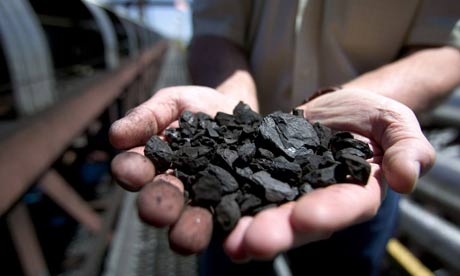
Clean coal in Gillette, Wyoming

Coal makes up a quarter of total energy consumption and generates 40% of the world's electricity. Photograph: Robert Nickelsberg/Getty Images

The protest at Kingsnorth may appear to be a battle over a coal-fired power station in an obscure corner of Kent, but it represents part of the frontline in a global rush for coal.

There are now over 100 similar schemes in various stages of design, planning or construction around the world and foreign governments are watching closely to see what decision is taken in the UK.

In particular, they want to know whether a government that has talked tough at climate summit debates will allow power generator E.ON to build the Kingsnorth station with or without carbon capture and storage (CCS) technology that could hold a key to "clean coal" and the fight against global warming.

Coal already makes up a quarter of total energy consumption and generates 40% of the world's electricity. The last couple of years has seen a massive swing towards king coal after decades when it looked doomed to be phased out, because of acid rain and then greenhouse gases, of which it is a huge emitter. Its use in US power stations alone is responsible for 1.5bn tonnes of CO2 emissions a year.

Despite mounting fears about carbon pollution, coal has returned to fashion because rival energy sources such as gas are soaring in price and being depleted faster than expected. Coal reserves are also often located in politically stable countries such as the US, South Africa and Australia.
Coal, which has traditionally been a cheap power source, is also prized as a fuel for electricity generation because it does not have the problem of intermittency of supply associated with solar or wind, and plants do not have to be kept running all the time as they do with nuclear power.

A major study published recently by the Massachusetts Institute of Technology, called The Future of Coal concluded: "We believe that coal use will increase under any foreseeable scenario because it is cheap and abundant. Coal can provide usable energy at a cost of between $1 and $2 [£0.52 to 1.04] per million British thermal units (MMBTU) compared to $6 to $12 per MMBTU for oil and natural gas."

Coal reserves worldwide are as high as 909bn tonnes, according the BP Statistical Review of World Energy 2007, which at the current rate of production of less than 6bn tonnes per year, would last for over 150 years.

But Energy Watch Group, a German association of independent researchers has questioned the reliability of coal statistics and suggested they are often too high because they are out of date. " Peak production could be reached as soon as 2025," the group argues.

Fast-developing nations such as China have long been dependent on large domestic coal reserves, but China has increasingly looked to foreign suppliers as demand grows. China is traditionally an exporter of coal, but imported 50m tonnes in 2007, 34% up on the previous year, and is now opening the equivalent of two new coal-fired power stations every week.

At least half of the 100 coal-fired power stations being prepared worldwide are in China with at least 10 more in Germany, another 10 in the US, and 12 in South Africa.

In Britain, a host of other power companies have outlined plans for coal-fired stations and are waiting to see what happens to E.ON at Kingsnorth. This list includes RWE which is talking about plants at Tilbury, Essex, and Blyth, Northumberland, plus Scottish Power at Longannet, Fife, and Scottish and Southern Energy at Ferrybridge, West Yorkshire.

The new interest in coal is also pushing up prices of a commodity that comes in a range of different qualities both in terms of its heat capacity and pollution. Lignite, "brown coal" is the least valuable but still an important part of production in Germany, Russia and Romania.

The rising price of coal has seen a dramatic profits upturn at UK Coal, the country's main mining group and successor of the state-owned National Coal Board. Barely 12 months ago, UK Coal had been trying to drum up City investment by presenting itself as a property developer - keen to boast about the value of a land portfolio based around former pits.

But now the company is focusing on coal as well as land, spending £55m extending the life of the Kellingley mine at Knottingley, West Yorkshire, to 2017 plus a similar amount at Thoresby, Nottinghamshire, and even considering whether to reopen a mothballed mine in the county at Harworth.

Despite the proposed increase in output, Britain currently imports 73% of the coal it burns, almost half of it from Russia. Associated British Ports has been spending millions of pounds developing new dockside facilities to handle new supplies at places such as Immingham, Lincolnshire, just miles from where the huge Selby coalfield in North Yorkshire - once the biggest in Europe - was closed by UK Coal.

Kingsnorth climate camp: Police and protesters prepare for action

Kingsnorth climate camp: Police and protesters prepare for action

Climate Camp near Kingsnorth Power Station

A protester wearing a caricature of prime minister, Gordon Brown, is searched by police at the climate camp near Kingsnorth power station in Kent. Photograph: Gareth Fuller/PA

Police and demonstrators expect clashes tomorrow as 1,400 officers from 26 forces try to prevent up to 2,000 climate change activists from closing down the Kingsnorth coal power station, run by energy company E.ON in Kent.

Today neither group would say how they were planning to outwit the other. A spokeswoman for Kent police said: "We are expecting the unexpected. Our preparations are constantly changing."

The campaigners have spent the last week encamped near the power station preparing for the direct action protest against plans for a new coal power station at Kingsnorth.

They intend to approach the power station by air, sea and land. One group intends to head up the road directly to the main gate of the power station. Another will approach through the undergrowth in small groups. A third will be making an airborne approach by means that have as yet remained secret. And people on rafts and boats will be sailing up the estuary in an armada to lay aquatic siege.

But the authorities yesterday tightened their squeeze on the protests by formally banning the flotilla. Medway Ports Authority, using bylaws, declared the water-borne protest illegal on safety grounds.

The campaigners argue that because coal produces significantly more carbon dioxide than other means when generating electricity, the station at Kingsnorth coal must not be given the go-ahead. It would be the first new coal station in 30 years and herald a new generation of stations. Supporters of the plans say the UK faces a huge energy gap if coal stations are not allowed and that future carbon capture and storage technology can bury up to 90% of emissions.

Earlier today, 12 protesters stuck themselves with superglue to the offices of the Department for Business, Enterprise and Regulatory Reform, (DBerr) the government department that has been backing coal expansion in Britain.

Others, saying that the proposed new Kingsnorth power station will produce twice as many climate-harming emissions as the proposed third runway at Heathrow, demonstrated at the Royal Bank of Scotland. A third group went to Windsor where power company E.ON sponsors a Lego model of Kingsnorth power station. Other protests have been held at Gatwick airport and at a biofuel depot at Thurrock.

The climate camp has been marked by angry accusations that the police have used aggressive stop and search powers to disrupt the camp and "smear" the protesters. Yesterday, MEP Caroline Lucas and MPs Norman Baker and Colin Challen wrote to the Kent police pleading with assistant chief constable Gary Beautridge, in charge of the police operation, to resolve "an increasingly threatening confrontation".

"Climate change must be a wholly legitimate subject of protest and demonstration. But if it is met by an arbitrary, destructive and aggressive police response, the consequences will undoubtedly be a continued alienation between police and many decent, law abiding people, particularly the young", said the politicians.

On Thursday, police had stop and search powers extended to the whole of the Hoo peninsula, where Kingsnorth is sited. Kent police said the decision had been taken because officers continued to find people carrying potential weapons, a charge that was angrily denied by the camp.

"What we are doing is part of a long tradition of civil disobedience" said Maria Romero, one of the camp press team. "We're not blasé about breaking the law, but the threat that new coal poses to our future on this planet more than justifies the actions we are taking."

Tensions between police and protesters have been growing throughout the week, with activists angry with what they said were disproportionate searches causing queues of up to two hours to get on site. With helicopters flying low overhead, Paul McLeish, 41, a lawyer and legal observer at the camp, said police had confiscated items including kitchen equipment, children's chalk and crayons, blots for constructing toilets and piping for water on the camp.

"The searches have been absurdly over the top with everything from 26-foot banners to disabled access ramps taken away," said McLeish. " It's a concerted attempt to demonise people and alienate members of the public so they don't think it is safe to come here. It's a depressing a chilling attack on the right to freedom of expression and assembly."

Challen, Labour MP for Morley and Rothwell and chair of the cross-party climate change group, visited the site today. "The climate change debate in the workshop was of a higher calibre than in the House of Commons", he said.

It also emerged that the campers intend to make Kingsnorth a permanent camp. "From the moment the first concrete is poured [to build the proposed new power station] there will be a rolling blockade," said one protester following a large meeting of the camp.
Additional reporting by Alexandra Topping

Tuesday, July 29, 2008

Peru mountain glaciers 'receding rapidly'

rom: , Science and Development Network, More from this Affiliate

/sci-tech/article/37794

by Zoraida Portillo

[LIMA] Climate change-induced glacier melts have cost northern Peru's mountains 26 per cent of their surface area in the last 33 years, satellite images have confirmed.

The reduction is equivalent to 188 square kilometres of the Cordillera Blanca, the highest tropical mountain chain in the world. The mountain range is home to more than seven hundreds glaciers, with the glacier Huascaran declared a world heritage site by UNESCO.

Marcos Zapata, head of the glaciology unit at the National Institute of Natural Resources (INRENA), says that the glaciers are melting by around 20 metres per year — compared to a rate of nine metres per year recorded until 1977.

Zapata was a speaker at the Cycle of Conferences on Glaciological Research in Peru, organised by INRENA in Lima earlier this month (18 July).

"At present, there are more melting glaciers and therefore there is a relative increase in flows in rivers and streams", Nelson Santillán, a researcher at the INRENA glaciology unit, told SciDev.Net.

Santillán says that, while this currently does not have any significant negative effects, people must be warned about the correlation of this with the increased glacier melting and the future halt in water flow. INRENA estimates this could be as soon as 2020.

This could have severe consequences since the population and number of agricultural areas near the glaciers is growing at higher rates than three or four decades ago, Santillán says.

Andean scientists have suggested the Paramos ecosystem in the northern Andes as an alternative source of water for communities when the glaciers disappear. The ecosystem retains and absorbs water in wetland areas.

"The Paramos can act like a big sponge to contain [excess water from] the melting of the glaciers," says Jorge Recharte, director of the Andes programme at the Mountain Institute in Peru. "If they are conveniently managed they could provide an alternative [source of water]."

A 2002 study by Recharte indicated that the Paramos is a source of drinking water for thirteen million Peruvians who live on the coast.

"Given the difficulty of controlling glacier melting, it is definitely important to work in the conservation of grasslands and high forests located in the upper basins of the Andes to keep some water availability in the coming years," Recharte wrote.

US environmental agency silences employees on climate change

Amid intensifying scrutiny of its failure to act on climate change, the US environmental protection agency (EPA) has ordered employees not to talk to internal auditors, Congress or the media, according to a leaked email released yesterday by green campaigners.

The EPA has refused repeated requests from Congress to explain its December denial of California's request to regulate greenhouse gas emissions - a move that overruled the agency's own career scientists.

Three Democratic senators have scheduled a press conference today to discuss the controversy.

On June 16, after an email from the campaign group Public Employees for Environmental Responsibility (Peer), the EPA told its enforcement officials not to answer questions on the issue - even those from the agency's in-house auditors.

"If you are contacted directly by the [auditors'] office or [congressional investigators] requesting information of any kind … please do not respond to questions or make any statements," the email said.

Enforcement officials were told to refer all questions to specific EPA representatives.

The issue is whether White House officials, including aides to vice-president Dick Cheney, improperly influenced the process by pressuring the EPA to reject California's bid to regulate emissions.

Peer, a non-profit group founded to fight political influence on government scientists, called the email proof of a "bunker mentality" at the agency.

"Inside the current EPA, candour has become the cardinal sin," Peer's executive director, Jeff Ruch, said.

"The clear intention behind this move is to chill the cubicles by suppressing any uncontrolled release of information."

Peer questioned whether the email could be a illegal obstruction of the EPA inspector general (IG), which conducts independent audits of the agency. IG auditors are given broad freedom under US law to examine internal policies at government agencies.

The EPA spokeswoman Roxanne Smith said the email was partly a response to a 2007 report by agency auditors on how to streamline communications. That report made no specific suggestions about how the EPA could make its process more efficient, however.

"There is nothing in the procedure that restricts conversation" between EPA staff and investigators, Smith said via email. "The procedure simply ensures timely responses and assists in tracking and record-keeping obligations."

One of the senators set to discuss the issue today, the environment committee chairman Barbara Boxer, accused the EPA chief, Stephen Johnson, of kowtowing to industry opponents of carbon regulations.

"Stephen Johnson is turning the EPA into a secretive, dangerous ally of polluters instead of a leader in the effort to protect the health and safety of the American people," Boxer, from California, said.

Eaten up

Raj Patel's book Stuffed and Starved predicted the current global food crisis - spiralling food prices, starvation and obesity. Ed Pilkington meets the soothsayer of agro-economics and talks about what will happen when all the food finally runs out
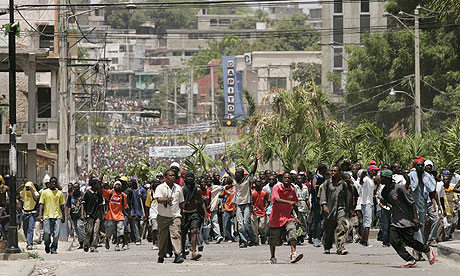
Haiti food riots

Residents protest on the streets in Port-au-Prince. Photograph: Eduardo Munoz/Reuters

There is a passage towards the end of Raj Patel's book, Stuffed and Starved, which elevates its author to the rank of soothsayer. He wrote it at the beginning of 2007, well before the roar of anger about rising food prices that resounded across the planet and that he so uncannily and accurately predicted.

The passage begins with Patel's summary of earlier sections of the book in which he depicts the wasteland, as he calls it, of the modern food system. It is a system that destroys rural communities, poisons poor city dwellers, is inhumane to animals, demands unsustainable levels of use of fossil fuels and water, contributes to global warming, spreads disease and limits our sensuousness and compassion. As if that litany wasn't enough, he then adds this: "Perhaps most ironic, although it is controlled by some of the most powerful people on the planet, the food system is inherently weak. It has systemic and structural vulnerabilities that lie close to the surface of our daily lives. All it takes to expose them is a gentle jolt."

When he wrote that passage, Patel had in mind his native Britain and its occasional history of food crises. There was the oil crisis of 1973 that prompted panic-buying in the shops. Or 2000, when protesting truckers blockaded the oil refineries and the shelves again came close to emptying. Those events inspired Patel to contemplate a startling question: "What would have happened," he wrote, "had all the food on the shelves run out?"

He left that question dangling in the book. But he got thinking about it again as he was on a tour of Australia last August promoting the book. As he travelled from Perth to Melbourne and then Sydney he kept being asked the same question: how did the drought that by then was already biting hard on Australian farmers as well as on consumers who were suffering rising prices, fit into his critique of modern food production? As he faced his audiences, it began to look to Patel, in a tentative, creeping way, that the gentle jolt he had written about was really happening.

"What was weird was that the stories I was hearing about drought and farmers in desperation were very similar to the stories that had been told to me in India a couple of years before. They were all about small independent farmers up to their eyeballs in debt. They had borrowed hugely to make a go of it, and then there'd been a shock - in Australia it was drought, in India it might be harvest failure, in Britain foot-and-mouth. It only takes one small shock."

And then the agricultural slurry really hit the fan. The first intimations of something truly out of the ordinary came in Mexico in early 2007, before he had finished writing Stuffed and Starved. There were reports of unrest in some of the larger cities about rising food prices, partly related to the decision of the US government to divert huge quantities of corn to ethanol production, in an attempt to reduce dependence on foreign oil. Then early this year some eight months after Patel had finished writing about the risk of gentle jolts - the so-called "silent tsunami" began. Food prices appeared to be out of control, spiralling up by 68% in the case of rice in the first four months of this year alone. Wheat and corn almost doubled in a year.

Such hikes on the costs of the basics of life hit the urban poor in the cities of the developing world hardest, and the misery was soon made manifest in the form of unrest. Impromptu protests grew into angry marches and then erupted into food riots. In Haiti six people died and the prime minister was ousted from power. Two days of rioting ensued in Egypt and 24 people died in Cameroon. The pattern repeated itself right across the developing world, from Guyana and Bolivia to Ivory Coast, Surinam and Senegal, Yemen, Uzbekistan, Bangladesh and South Korea. Wild events in turn prompted wild official responses. Vietnam introduced a night curfew on harvesting machines to stop illegal raiding of the fields; any Filipino caught hoarding rice was threatened with life in jail, Malaysia cancelled all public building works and switched instead to stockpiling food. Even the rich western world was hit. Food prices in the UK have risen almost 7% year on year, shaking the government's economic confidence. And if any doubts remained about the severity of this crisis, Wal-Mart, the supermarket goliath that stands at the pinnacle of the modern food system, announced it was imposing a four-bag limit for rice on its cash-and-carry customers to stop a run on supplies.

For millions of people around the world the soaring prices have spelt disaster - the World Bank has put the number of people who have been pushed into hunger at 100 million. But for one person, the impact has been strangely and paradoxically counter-factual. When Stuffed and Starved - Patel's first book - came out last August, he and his publishers imagined it would at best enjoy a specialist readership among globalisation activists attuned to issues of corporate greed and exploitation. But the food crisis has turned it from being a niche read into the literary equivalent of a crystal ball. As a result, the demand has in Patel's words "gone bonkers". Reprints have been ordered in Britain, the US and Spain, deals done for editions in Italy, China and South Korea and half a dozen translations are under discussion. "If I had been this popular at school I'd be a different man today," he quips. His analysis of the crisis, as the author of the book that predicted it all, is now hotly sought after. Or as Patel, who has the savvy Londoner's gift for self-deprecation, puts it: "Spank me, and call me Cassandra!"

We meet for lunch in a restaurant within a Big Mac's throw from Capitol Hill in Washington. It's trivial I know, but it's impossible not to be curious - a little intimidated even - about what Patel will order from the menu. He points out in his book that the livestock industry is responsible for 18% of greenhouse gas emissions, more than cars. So will he go for the hanger steak?

He asks for a pizza with goat's cheese and mushrooms, but when I ask whether his choice was politically or ethically motivated, he laughs. "I haven't had a steak in my life. Growing up in a Hindu household, I clamoured for hamburgers like any other kid and my parents said: 'Oh, if you must.' But they drew the line at steak."

Patel sees in himself, and his eating habits, a tale in microcosm of the globalisation he writes about. His family on his mother's side were civil servants in Kenya, and tin miners in Fiji on his father's side. They both were drawn to the mother country, arriving in London in the 60s, where they met. It later became a cliche, but they were among the first to open up "Mr Patel's corner shop", working 18-hour days in an era before 24-hour supermarkets. The earliest memories of their son, who was born in 1972, are of playing among the fags, mags and sweets in the shop in Golders Green. It would be too neat, I hazard, to suggest that his parents were forced to close down the shop because of competition with the supermarkets? "My dad did very well for himself," he replies, speaking with a high-velocity stammer. "But they were certainly driven out. You can't compete any more, the corner shop is a dying industry."

Despite those difficulties, the Patels did proud by their son, sending him to a north London grammar school, then to Oxford where he studied PPE, and finally to Berkeley in California. Along the way, he became interested in, and engaged with, the anti-globalisation movement. He was among the thousands who protested in Seattle against the World Trade Organisation (WTO) in 1999, and it was there that he came face to face with what he calls the "march of the farmers' movement" in the form of arguably the world's largest network of independent organisations, La Via Campesina, which represents around 150 million farm workers and smallholders across the globe. "I was struck by their sophisticated and detailed critique of the WTO. Seven years before Seattle they had already translated the draft text of the Dunkel report [on trade] into Kannada and were distributing it in the fields."

He began delving more deeply into the subject of trade, food policy and agricultural resistance as an analyst at Food First, a radical thinktank in Oakland, where an idea for a book emerged. It began life as a meditation on choice, or the lack of it - Coke v Pepsi, McDonald's v Wendy's. Its working title was Choice Cuts. Over the next three years he travelled to research the book from South Africa, Europe and South Korea to Brazil, Mexico and the US. In the process the thesis grew bigger in scope and more refined. Its focus was no longer just a lack of consumer choice, it embraced an entire world food system that can consign 800 million - more than one in 10 people on earth - to hunger while simultaneously inflicting obesity on an even greater number, 1 billion people. Hence the book's new, and in his opinion better, title.

His analysis shows how communities around the planet have been disempowered by a system that appears to offer an abundance of cheap food, but in reality dictates unhealthy and limited choices to an overworked and underpaid workforce that cannot afford any better. "The figure that often stuns people outside the US when I tour with the book is that 20% of American fast-food meals are eaten in cars. People are incredulous and ask: is that because Americans so love their cars? But living here you see how hard people work, for a pittance, with no healthcare, no decent education, not even a hint of a pension - so it's not surprising that the one hot meal you eat a day you eat off your lap. That's where the food system becomes a lifestyle."

Much of the broad argument in Stuffed and Starved will be familiar to those who have followed the debate on globalisation - how the liberalisation of trade has created a vast global market for heavily subsidised American and European agricultural products at the expense of local growers in the developing world; how relentless pressure to drive down food prices over 30 years has seen rich ecosystems replaced by monocultures that rely on oil-powered machines, chemical fertilisers and pesticides to drive up yields; and how international corporations and supermarkets that control the flow of technologies and of food itself have been the beneficiaries. It is a portrait of the agro-economics of the madhouse. "While we think our food is made for us, we are in fact being made for our food," he says.

Take India, which he describes as a storm of contradictions. "India has the most people in the Forbes top 10 billionaires list, but in the past decade the average calorie intake of the poorest has fallen. There are levels of hunger we haven't seen since the British left, combined with the world's highest levels of type 2 diabetes from the pressure of eating too much of the wrong kinds of food."

Or take the UK, where food producers are now less than one per cent of the workforce. The government may be committed to reducing global warming emissions, but meanwhile a quarter of all trucks on UK roads are carrying food and the average British family is driving 136 miles a year to buy it.

Or America. This is the country whose farmers, food giants and supermarkets benefit most from the global system. Such is the might of US food corporations that the double arches of McDonald's are more widely recognised as a symbol than the cross. Wal-Mart is the largest private employer not only in the US, but also in Mexico where Walmex takes in three out of every 10 pesos Mexicans spend on food. Yet amid such largesse 35 million Americans don't know where their next meal is coming from. "You are hearing these amazing stories of working American families adopting coping strategies that I learned about in development sociology - skipping meals, growing their own fruit and vegetables, giving up on meat. That's happening right here right now."

Which brings us back to the current food crisis. What surprised him, he says, is not that the food system felt a gentle jolt - after all, he predicted it - but that it has been pummelled all at once by a perfect storm of troubles. "We could have seen it coming because of the biofuels policy, which has always struck me as absurd, or the rising price of oil, or increased consumption of meat, or weird things happening with climate. But all these things happened at once, and that sent food prices through the roof."

And this time, there were none of the safeguards of grain stores, strategic food reserves, or import barriers that used to protect vulnerable economies from the vagaries of world markets. They had all been removed in the liberalisation craze of the past few decades.

His prognosis is that in the short term at least the crisis will carry on biting. Major institutions such as the World Bank persist, he says, in responding to events with the same failed policies of liberalisation of markets. "There's no reason why food prices should come down significantly. And if they don't, and there's no real impetus for governments to redistribute spending power, people will continue to take to the streets."

In the medium term, he's confident that change is in the air. He detects a growing seriousness and willingness to embrace new ideas in some unexpected quarters. The reason we are chatting in a DC restaurant is that Patel has just that morning been giving testimony before a Congressional committee investigating the World Bank's approach to food and development. With representatives from the World Bank, UN, Monsanto and other monoliths listening in, he told the committee that industrial agriculture could no longer be relied upon to feed the world and that we need a shift towards less fossil-fuel dependent farming and a return to rich ecosystems based on natural crop rotations and organic fertilisers. "Those are the kinds of things that are anathema to the World Bank and development analysts at the moment, and Congress normally doesn't want to hear them. That they called on someone like me is very weird, but very heartening."

In the longer term, though, even the current food crisis may seem mild. The world population is set to rise from about six billion today to nine billion by 2050. Global warming is likely to disrupt growing patterns and extend drought across Africa and the American south-west. Water resources for irrigation will be depleted. If we are already in a perfect storm, then we lack the terminology to describe what lies ahead.

I put it to him that any attempt to change world food production is like a game of poker with extraordinarily high stakes: it not only has to meet the massive yield of industrial farming - and say what you like about the modern food system, the one thing it has done is churn out mountains of the stuff relatively cheaply - it also has to raise it to support three billion extra hungry mouths. Can his alternative model achieve that?

"We've got an energy problem, a fuel problem, a water problem and global warming all coming at us," he replies. "Monoculture is heavily C02-emitting, water and fossil-fuel dependent. Clearly we can't carry on as we are. We can and we must meet this challenge with something new. So the question is what?"

That's not entirely an answer to my question. There is a slightly starry-eyed quality to Stuffed and Starved that is also striking about its author in the flesh. When he talks of alternative farming techniques that offer a way forward, the examples he chooses come from Cuba, Venezuela and a project in Oakland that follows in the footsteps of the Black Panthers. That's hardly going to play well with sceptical American policy-makers.

The other element that is lacking from his prognosis is any role for science and technological innovation in the search for solutions. Where technology does appear it is in the role of villain - GM crops are a ruse by Monsanto and others to secure corporate profits at the expense of the rural poor.

But isn't there a place for responsibly directed science in steering us through the coming maelstrom? Couldn't GM, for instance, prove to be crucial in developing drought-resistant crops as global warming tightens its grip?

"I'm big on science, married to a neuroscientist, I love it," he insists, protesting perhaps a little too much. "I like the way Cuban science approaches the problem. They say you can have GM crops if you can prove there's no better way of doing things. So they don't have GM crops, because there always is a better way."

Not exactly a ringing endorsement for the value of science. But then that is not where Patel's heart lies. For that you have to look to politics, and political resistance. The soothsayer's next book, he says, will be a look at the individuals and communities who are refusing to bow down to the current global system. He will soon be starting another journey to meet them. On his list: the slum-dwellers of Durban and the homeless Americans who run the University of the Poor. He sees in them a lesson for us all. "We are victims," he says as he polishes off his pizza and prepares to fly back to San Francisco where he now lives. "If we are choosing between Coke or Pepsi, Burger King or McDonald's, that's not choice. We should stop feeling guilty about that. We should start feeling angry".

· Stuffed & Starved is published by Portobello and available from the Guardian bookshop at £8.99 + p&p

US environmental agency silences employees on climate change

Amid intensifying scrutiny of its failure to act on climate change, the US environmental protection agency (EPA) has ordered employees not to talk to internal auditors, Congress or the media, according to a leaked email released yesterday by green campaigners.

The EPA has refused repeated requests from Congress to explain its December denial of California's request to regulate greenhouse gas emissions - a move that overruled the agency's own career scientists.

Three Democratic senators have scheduled a press conference today to discuss the controversy.

On June 16, after an email from the campaign group Public Employees for Environmental Responsibility (Peer), the EPA told its enforcement officials not to answer questions on the issue - even those from the agency's in-house auditors.

"If you are contacted directly by the [auditors'] office or [congressional investigators] requesting information of any kind … please do not respond to questions or make any statements," the email said.

Enforcement officials were told to refer all questions to specific EPA representatives.

The issue is whether White House officials, including aides to vice-president Dick Cheney, improperly influenced the process by pressuring the EPA to reject California's bid to regulate emissions.

Peer, a non-profit group founded to fight political influence on government scientists, called the email proof of a "bunker mentality" at the agency.

"Inside the current EPA, candour has become the cardinal sin," Peer's executive director, Jeff Ruch, said.

"The clear intention behind this move is to chill the cubicles by suppressing any uncontrolled release of information."

Peer questioned whether the email could be a illegal obstruction of the EPA inspector general (IG), which conducts independent audits of the agency. IG auditors are given broad freedom under US law to examine internal policies at government agencies.

The EPA spokeswoman Roxanne Smith said the email was partly a response to a 2007 report by agency auditors on how to streamline communications. That report made no specific suggestions about how the EPA could make its process more efficient, however.

"There is nothing in the procedure that restricts conversation" between EPA staff and investigators, Smith said via email. "The procedure simply ensures timely responses and assists in tracking and record-keeping obligations."

One of the senators set to discuss the issue today, the environment committee chairman Barbara Boxer, accused the EPA chief, Stephen Johnson, of kowtowing to industry opponents of carbon regulations.

"Stephen Johnson is turning the EPA into a secretive, dangerous ally of polluters instead of a leader in the effort to protect the health and safety of the American people," Boxer, from California, said.

Haiti: Mud cakes become staple diet as cost of food soars beyond a family's reach

With little cash and import prices rocketing half the population faces starvation

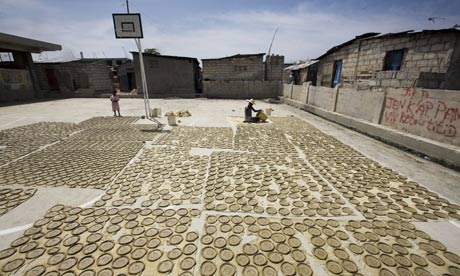
Mud cakes in Haiti

In Cité Soleil, one of Port-au-Prince's worst slums, making the clay-based food is a major income earner. Mud cakes are the only inflation-proof food available to Haiti's poor. Photograph: David Levene

At first sight the business resembles a thriving pottery. In a dusty courtyard women mould clay and water into hundreds of little platters and lay them out to harden under the Caribbean sun.

The craftsmanship is rough and the finished products are uneven. But customers do not object. This is Cité Soleil, Haiti's most notorious slum, and these platters are not to hold food. They are food.

Brittle and gritty - and as revolting as they sound - these are "mud cakes". For years they have been consumed by impoverished pregnant women seeking calcium, a risky and medically unproven supplement, but now the cakes have become a staple for entire families.

It is not for the taste and nutrition - smidgins of salt and margarine do not disguise what is essentially dirt, and the Guardian can testify that the aftertaste lingers - but because they are the cheapest and increasingly only way to fill bellies.

"It stops the hunger," said Marie-Carmelle Baptiste, 35, a producer, eyeing up her stock laid out in rows. She did not embroider their appeal. "You eat them when you have to."

These days many people have to. The global food and fuel crisis has hit Haiti harder than perhaps any other country, pushing a population mired in extreme poverty towards starvation and revolt. Hunger burns are called "swallowing Clorox", a brand of bleach.

The UN's Food and Agriculture Organisation predicts Haiti's food import bill will leap 80% this year, the fastest in the world. Food riots toppled the prime minister and left five dead in April. Emergency subsidies curbed prices and bought calm but the cash-strapped government is gradually lifting them. Fresh unrest is expected.

According to the UN, two-thirds of Haitians live on less than 50p a day and half are undernourished. "Food is available but people cannot afford to buy it. If the situation gets worse we could have starvation in the next six to 12 months," said Prospery Raymond, country director of the UK-based aid agency Christian Aid.

Until recently this Caribbean nation, which vies with Afghanistan for appalling human development statistics, had been showing signs of recovery: political stability, new roads and infrastructure, less gang warfare. "We had been going in the right direction and this crisis threatens that," said Eloune Doreus, the vice-president of parliament.

As desperation rises so does production of mud cakes, an unofficial misery index. Now even bakers are struggling. Trucked in from a clay-rich area outside the capital, Port-au-Prince, the mud is costlier but cakes still sell for 1.3p each, about the only item immune from inflation. "We need to raise our prices but it's their last resort and people won't tolerate it," lamented Baptiste, the Cité Soleil baker.

Vendors of other foods who have increased prices have been left with unsold stock. In the Policard slum, a jumble of broken concrete clinging to a mountainside, the Ducasse family tripled the price of its fritters because of surging flour prices. "Our sales have fallen by half," said Jean Ducasse, 49, poking at his tray of shrivelled wares.

The signs of crisis are everywhere. Aid agency feeding centres reported that the numbers seeking help have tripled. At a centre in the Fort Mercredi slum rail-thin women cradled infants with yellowing hair, a symptom of malnutrition. "Now we're having to feed the mothers as well as the babies," said Antonine Saint-Quitte, a nurse.

In rural areas the situation seems even worse, prompting a continued drift to the slums and their mirage of opportunities. Lillian Guerrick, 56, a subsistence farmer near Cap Haitien, yanked her seven grandchildren from school because there was barely money for food let alone fees. "I've no choice," she said, a touch defensive, amid wizened corn stalks.

Anecdotal evidence suggests school attendance nationwide has dropped and that those who do make it to class are sometimes too hungry to concentrate. "I use jokes to try to stimulate my students, to wake them up," said Smirnoff Eugene, 25, a Port-au-Prince teacher.

Border crossings to the Dominican Republic are jammed with throngs of merchants hunting lower prices in their relatively prosperous neighbour.

"Beep beep, out of the way!" yelled one teenage boy, sweating, veins throbbing, as he heaved a wheelbarrow impossibly overloaded with onions through a crowd at Ouanaminthe's border bridge.

Haiti's woes stem from global economic trends of higher oil and food prices, plus reduced remittances from migrant relatives affected by the US downturn. What makes the country especially vulnerable, however, is its almost total reliance on food imports.

Domestic agriculture is a disaster. The slashing and burning of forests for farming and charcoal has degraded the soil and chronic under-investment has rendered rural infrastructure at best rickety, at worst non-existent.

The woes were compounded by a decision in the 1980s to lift tariffs, when international prices were lower, and flood the country with cheap imported rice and vegetables. Consumers gained and the IMF applauded but domestic farmers went bankrupt and the Artibonite valley, the country's breadbasket, atrophied.

Now that imports are rocketing in price the government has vowed to rebuild the withered agriculture but that is a herculean task given scant resources, degraded soil and land ownership disputes.

There is a hopeful precedent. A growing franchise of localised dairies known as Let Agogo (Creole for Unlimited Milk) has organised small farmers to transport and market milk, generating jobs and income and cutting Haiti's £20m annual milk import bill.

President René Préval has hailed the scheme as a model but Michel Chancy, a driving force of Veterimed, a non-governmental organisation which backs the dairies, was wary. "For 20 years politicians have been talking about reviving agriculture but didn't actually do anything. If this food crisis forces them to act then it is a big opportunity." That was a big if, he said.

Walk along a beach in the morning and you find Haitians gazing at the azure ocean horizon, dreaming of escape. They are fiercely proud of their history in overthrowing slavery and colonialism but these days the US, the Bahamas, the Dominican Republic - anywhere but home - seems the best option.

The only thing stopping an exodus are US coastguard patrols, said Herman Janvier, 30, a fishermen on Cap Haitian, a smuggling point. "People want out of here. It's like we're almost dead people."

The last time Janvier tried to flee he was intercepted and interned at Guantánamo Bay. "I offered to join the American army. I offered to clean their base. They said no. So I am back here, on a boat with no motor, doing what I can to survive."

Video

"Manufactured Landscapes" SEE THIS BRILLIANT MOVIE! You'll never have the same shopping experience again.