Wednesday, April 23, 2008

An Appeal to Reason: A Cool Look at Global Warming

Fuelling the debate on climate change


Nigel Lawson's An Appeal to Reason highlights some important questions about climate change, although he offers few answers, says Richard Lambert

Saturday April 19, 2008
The Guardian


Climate change is a highly complex global problem, and one plagued by major uncertainties. Despite much progress in recent years, our knowledge about the physical processes underlying global warming is still far from complete. And its possible economic impact depends on a huge number of unpredictable variables, such as how well society might adapt to change, and at what cost.

So it is important to keep testing the consensus view that has emerged in the past few years, which is, to quote from an IMF report this month, that "climate change is a potentially catastrophic global externality and one of the world's greatest collective action problems."

To this extent, Nigel Lawson's short book is to be welcomed. Along with the polemics, he makes some sensible points. For example, he is right to raise the alarm about the impact of biofuels on food prices, and about the huge costs and inefficiencies of imposing arbitrary targets for the production of renewable energy. He is right to warn about the dangers of trade protectionism that could result from imposing trade barriers against countries that do not cut their greenhouse gas emissions. And he is right to scoff at those who claim that unusual weather conditions in recent years represent clear evidence that disaster is on the way.

But when it comes to the big picture, he is very likely to be wrong. Lawson's view is that what he calls the new religion of global warming contains a grain of truth and a mountain of very damaging nonsense. He believes that "We appear to have entered a new age of unreason, which threatens to be as economically harmful as it is profoundly disquieting."

Never one to suffer from an excess of humility, he is happy to attack the scientific might of the UN's Intergovernmental Panel on Climate Change, a "global quasi-monopoly" whose judgment and integrity he finds open to question. But he reserves his special contempt for the Stern review, which at various points in the book he describes as alarmist, cockeyed, scare- mongering, politically inspired and lamentable.

This abuse has a purpose. Lord Stern's central message is that provided the world acts quickly enough to curb greenhouse gas emissions, we won't have to make the painful choice between averting climate change on the one hand, and economic development on the other. The longer we delay, the more costly the necessary actions.

Lawson has to shoot this down in order to sustain his own argument, which is that given all the uncertainties and the difficulties in securing a sharp cut in emissions, it makes much more sense to go with the flow and adapt to climate conditions if and when they change.

His message is based on two dangerous assumptions. One is that the risks of rapidly accelerating greenhouse gas emissions in the atmosphere are not as great as the consensus would suggest. The other is that the costs and difficulties of curbing these emissions are too great to contemplate.

Repeated throughout the book is the view that, even on the most pessimistic calculation, the people of the developing world a hundred years hence will not be that much worse off than otherwise would have been the case - and they will still be a lot better off than they are today.

It's true that the impact of major economic shocks can be made to seem trivial if they are spread over a wide enough geography and a long enough time horizon. This is the kind of analysis you might have deployed in 1913 to tell the people of western Europe not to get too fussed about the threat of imminent war. And it leads to all kinds of airy generalisations.

For example, Lawson states that if global warming results in water shortages, the obvious remedy is sensible conservation measures, including in particular the pricing of water. Tell this to the almost one billion people in Africa and Asia who, according to the IMF, face water shortages by 2080 as a result of climate change.

When it comes to the potential costs of mitigation, Lawson resorts to the kind of hyperbole that would make the most fanatical environmentalist blush. At one point, he suggests that it would mean unwinding the industrial revolution and returning to a pastoral society - and that would only be the start.

Of course Stern's conclusions are open to challenge. In particular, respectable economists have argued that his method of calculation understates the economic costs and overstates the benefits of early action to avert global warming. But it is ridiculous to suggest, as Lawson does, that the Stern review has played the same role as Tony Blair's notorious "dodgy dossier".

Where does all this leave those of us who are not scientists, economists, or polemicists? Last year, the CBI brought together a group of business leaders who were none of the above. They concluded that climate change represented a significant risk to society and the economy, and that actions to mitigate the risk were therefore necessary.

These include the creation of a meaningful price for carbon, to spur the necessary cuts in emissions; investment in new technologies; spending on the physical infrastructure that will be necessary to protect against weather changes that are already inevitable; regulatory standards to stimulate new behaviour; and serious efforts to build global agreements for curbing greenhouse gas emissions.

Most people don't expect their house to burn down. But they take out fire insurance, provided it is available at a sensible price, to protect themselves against the possibility. In the light of our current knowledge about global warming, that amounts to a compelling case for action.

· Richard Lambert is director-general of the CBI

Greenland's disappearing lakes leave giant ice sheets largely unmoved

· Meltwater plays only small role in glacier flow
· Study casts doubt on 'lubrication' theory

This article appeared in the Guardian on Friday April 18 2008 on p14 of the UK news section.
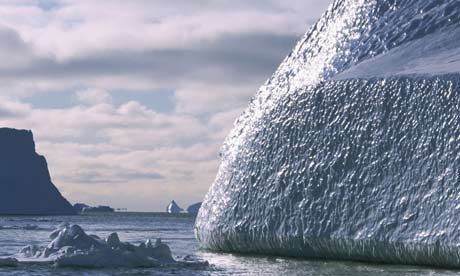
Giant icebergs drift in open water

Greenland’s summer lakes, which can drain away as fast as Niagara Falls, do not seem to contribute towards rising sea levels. Photograph: David McLain/Getty Images/Aurora

Fears that the rapid draining of water from the top of Greenland's ice sheet may be contributing to the rise of global sea levels have been allayed by new research. Though scientists confirmed that the water can drain away faster than Niagara Falls, it did not seem to accelerate the movement of the ice sheet into the ocean as previously thought.

Receding ice sheets are of major concern to climate scientists because the melting water could lead to a rise in sea levels. In addition, the melting can encourage feedback mechanisms that amplify the warming effects of greenhouse gases in the atmosphere: ice and snow reflect sunlight, so less of them means more heat is absorbed by the Earth. Observations have already shown that the speed at which glaciers at the edge of Greenland are moving into the sea has doubled in the past two decades.

Thousands of lakes form on top of Greenland's glaciers every summer due to the increased sunlight and warmer air. Satellite observations have shown that these lakes often disappear, often in as little as a day, but no one knew where the water was going or how quickly it moved.

When these lakes were first discovered in recent years, experts became concerned that the melting water might make its way to the base of the ice and lubricate the Greenland ice sheet's passage into the sea, which would contribute to a global sea-level rise. In a warming world, more lakes are expected to form on Greenland, raising the possibility that the entire ice sheet will melt more quickly than expected.

But the new research, published today in Science, has cast doubt on that theory.

Sarah Das, of the Woods Hole Oceanographic Institution in Massachusetts, led a study that monitored the evolution of two surface lakes on Greenland in the summers of 2006 and 2007. Using aerial surveys and satellite imagery, they monitored the lakes and tracked the progress of glaciers moving toward the coast.

She said the most impressive drainage event occurred in July 2006, when most of a 5.6 sq km lake holding 11.6bn gallons of water emptied in just 90 minutes. The scientists estimated the average flow rate to be more than that of Niagara Falls. Underneath the lake, the ice sheet was raised and began moving horizontally at twice the average daily rate.

But her team also found that, when considered over the whole year, the surface meltwater was responsible for only a few per cent of the movement of the glaciers that they monitored. Even at its peak, it appeared to contribute only 15%, and often less, to the annual movement of the outlet glaciers at the edge of Greenland.

"Considered together, the new findings indicate that while surface melt plays a substantial role in ice sheet dynamics, it may not produce large instabilities leading to sea level rise," says Ian Joughin, a glaciologist at the University of Washington. "There are still other mechanisms that are contributing to the current ice loss and likely will increase this loss as climate warms."

"To influence flow, you have to change the conditions underneath the ice sheet, because what's going on beneath the ice dictates how quickly the ice is flowing," said Das. "If the ice sheet is frozen to the bedrock or has very little water available, then it will flow much more slowly than if it has a lubricating and pressurised layer of water underneath to reduce friction ... It's hard to envision how a trickle or a pool of meltwater from the surface could cut through thick, cold ice all the way to the bed. For that reason, there has been a debate in the scientific community as to whether such processes could exist, even though some theoretical work has hypothesised this for decades."

Glacial ice is second only to the oceans as the largest reservoir of water on the planet, and 10% of the Earth's glacial ice is found in Greenland. The west Antarctic ice sheet is also increasing the rate at which it is losing mass. In a recent interview with the Guardian, leading Nasa climate scientist Jim Hansen said the ice sheets' increased shrinking meant that the world's targets for reduction of carbon emissions were not stringent enough. "If we follow business as usual I can't see how west Antarctica could survive a century," he said.

Hansen said recently that the EU target of 550 parts per million of C02, already the most stringent in the world, should be cut to 350ppm if "humanity wishes to preserve a planet similar to that on which civilisation developed".

Security risk from climate said underestimated

From: Reuters

/climate/article/29896

By Jeremy Lovell

LONDON (Reuters) - Countries around the world have hugely underestimated the potential conflicts stemming from climate change and must invest heavily to correct that mistake, a report said on Wednesday.

The report for Britain's Royal United Services Institute (RUSI) by environment expert Nick Mabey said the response had been "slow and inadequate" and to rectify it spending needed to surge to levels comparable to sums spent on counter-terrorism.

"If climate change is not slowed and critical environmental thresholds are exceeded, then it will become a primary driver of conflicts between and within states," said the report "Delivering Climate Security: International Security Responses to a Climate-Changed World."

"In the next decades, climate change will drive as significant a change in the strategic security environment as the end of the Cold War," said Mabey.

"If uncontrolled, climate change will have security implications of similar magnitude to the World Wars, but which will last for centuries," he added in the report for the RUSI, a leading forum for defense and security issues.

Experts in the sector should identify and analyze climate-induced security hot spots and communicate these findings to world leaders and the public at large.

The report said conflicts over natural resources had been a regular feature of history, but that the changing climatic conditions would exacerbate the problems with hundreds of millions of people displaced by droughts, floods and famines.

This in turn would affect the livelihoods of billions more people with the world's population forecast to climb to nine billion people by mid-century from 6.5 billion now.

The report said that Europe, which is leading the way in tackling global warming caused by burning fossil fuels for power and transport, was only spending the equivalent of 0.5 percent of its combined defense budget on the climate crisis.

It said this was due to a systematic undervaluing of the scale and security implications of extreme climate change.

"A failure to acknowledge and prepare for the worst case scenario is as dangerous in the case of climate change as it is for managing the risks of terrorism or nuclear weapons proliferation," the report said.

"Unless achieving climate security is seen as a vital and existential national interest it will be too easy to delay action on the basis of avoiding immediate costs and perceived threats to economic competitiveness," the report said.

(Editing by Keith Weir)

The Food Crisis: Global Markets and Deregulation Strike Again

From: , Organic Consumers Association, More from this Affiliate

/agriculture/article/35191

You wouldn't know it by watching Congressional debate on C-SPAN, but if you turn on the news, it's clear that the global food system is in crisis. Food prices globally have skyrocketed, in some cases 80%. Food protests and riots from Italy to Yemen have begun capturing worldwide attention, and policymakers are scrambling to point fingers at a litany of culprits-everything from climate change, high oil prices, a weak dollar and the biofuels boom, to meat eaters in China. All of these factors have played a part in the current crisis, but the blame game is also allowing one culprit-the principle protagonist in this story-to get away with not even a mention. It's a character you might have heard of recently for its role in that little unfortunate sub-prime mortgage mess. That's right, deregulation.

Pundits have spent a fair amount of air time describing the deregulated financial markets that sparked the mortgage crisis. But the regulatory state of global agricultural markets is something most policymakers, let alone consumers, haven't given much of a thought. In many ways the dynamics at play are similar: global markets, deregulation and speculative capital don't mix well. However, in two key regards, these markets differ substantially: the scale of deregulation, and the scale of consequences.

First, let's look at the scale of deregulation. Deregulation in agricultural markets, like economic deregulation in many sectors, reached full tilt in the eighties and nineties. Trade and development economists preached the wonders of open markets, unfettered production, and industrial agriculture. The World Bank and International Monetary Fund conditioned loan policies on the elimination of government intervention in agricultural markets. Global commodity agreements, price supports, and other mechanisms which helped keep global supplies and prices stable were dismantled. The World Trade Organization's Agreement on Agriculture, together with multi-lateral and bilateral agreements including the North American Free Trade Agreement (NAFTA), slashed agricultural tariffs in the developing world, and opened up markets for a growing global agribusiness industry.

In the U.S., the 1996 Farm Bill eliminated the last vestiges of domestic price supports for most commodities and replaced them with a massive system of subsidies-the only thing left to prop up a farm economy in perpetual crisis. Market liberalization and the dumping of cheap commodities swamped small farmers here and abroad, pricing them out of local markets. Cheap feed crops fueled industrial livestock production, increasing meat consumption and driving out small producers. The few independent farmers who stayed in farming shifted production to a few commodities including corn and soy that can be stored and shipped to distant markets.

The impact of all this deregulation was to replace local market access for the majority of small producers with global market access for a few global producers. Thanks to non-existent anti-trust enforcement and rampant vertical integration, we've reached a level of concentration in our global agriculture system that would make Standard Oil blush. Three companies-Cargill, Archer Daniels Midland, and Bunge-control the vast majority of global grain trading, while Monsanto controls more than one-fifth of the global market in seeds. Consumers from Sioux City to Soweto are more and more dependent on fewer and fewer producers. By eliminating the breadth and diversity of the system, we've eliminated its ability to withstand shock or manipulation.

Perhaps the greatest evidence of the scale of deregulation of the world agricultural market is the liquidation of reliable grain reserves. Though we've impressively deregulated financial markets, the Federal Reserve and central bankers across the globe still maintain the ability to soften the spikes and plunges of our monetary system. Not so in food markets. For centuries grain reserves have been an essential component of functioning food systems. When prices are high grain reserves can be released on the market, bringing prices down. When prices are low, reserve systems buy up grain, bringing prices back up. In the last two decades, however, the U.S. and most other governments have let reserve systems wither, placing full faith in the free market to self-correct, and eliminating their last emergency response mechanism.

Remember the mortgage crisis? After the mortgage crisis, investors needed a new place to put their money. So they pumped it into commodities, farmland, and the new biofuels boom. Before it became a favorite climate savior, the idea of growing crops for ethanol was sold to U.S. farmers as a way to bail out the rural crisis and channel excess supply, while letting the free market continue to dictate prices. Seeing the volatility in the market and knowing that grain reserves were depleted, the grain traders started withholding supply in hopes of higher prices, playing off currency differentials, and shifting production and investments in search of greater returns. In many cases speculative fear caused the scarcity price effect, more than actual shortage. Investors started hedging their bets, buying grain futures, and driving up prices even more. Though the biofuels boom has exacerbated speculation and high prices, that boom wouldn't have been possible without a deregulated global market.

While farmers in the U.S. may have seen the price for a bushel of corn go from $2 to $6 in the last two years, their inputs, everything from seeds to fertilizer to diesel for tractors, have also multiplied, significantly deflating any increase in income. The difference between a short windfall and long term profit shift is being able to pass on price increases to consumers, something only the big guys have the market power to do. Cargill's third-quarter profits have increased over 86%. General Mills' are up 61%, and Monsanto's are up 45%.

The Cargills and ADMs of the world are traders-similar to financial traders-but in livestock and commodity futures. In an un-regulated global market they've gained enough market share that through buying and selling, they can play off both supply and demand. And their actions can set the direction of global prices. They can send shockwaves through the entire system. Now the unregulated market runs on the principle that capital will work in its best interest, and it's not in agribusiness' best interest to tank the entire agricultural system. But in the recent corn and soy spike, even the multinational livestock producers and food companies have begun to feel the sting. When the stakes get to a certain level, the gambler can make decisions that are against his own self-interest.

So that brings us to the second key difference between the housing crisis and the food crisis: the scale of consequences. When a housing bubble inflates till it pops, people lose their homes. But when a food bubble grows till it bursts, people starve.

The problem with booms is they're almost inevitably followed by busts. Worse news is that what we're seeing right now-skyrocketing food prices and growing hunger-are still the effects of the boom. If the weather turns bad, commodity prices could still double over the next few months. But with the stability of the food and agriculture system left up to the whims of mother nature's next crop yield, or how Cargill, ADM and the venture capitalists spin the roulette wheel, the bust is in the making. If the rural farm economy tanks, we're set to see farm foreclosures, another banking crisis, and global hunger that will make the sub-prime mortgage effects look like a drop in the bucket.

So what are world leaders doing about this impending crisis? Politicians like George Bush and Gordon Brown, in lockstep with the World Trade Organization and the World Bank, are mainly proposing two solutions to the food crisis: food aid, and increased free trade in industrial agriculture. Agribusiness is positioned to cash in on the perceived need to ramp up production globally and to tear down remaining trade barriers. And Monsanto already has policymakers parroting its line of increasing efficiency and yields through investments in genetic engineering and high-tech inputs.

The architects of the failed free market are now prescribing more of the same, and policymakers are swallowing it part and parcel. However, rather than solutions to the problems of the global agricultural system, these are root causes. While urgent measures need to be taken to address acute hunger in places like African countries and Haiti, Bush's $200 million food aid proposal is equivalent to his $300 tax return in terms of actually fixing economic malfunction. At its root, hunger is not about lack of food, it's about poverty and inequity, and the inability to access available food. Just as if middle class Americans had better paying jobs, they wouldn't need a tax refund; if small farmers in Africa had access to land and local markets they wouldn't need food aid. Another gross injustice of our food aid policy is the requirement that the majority of it be purchased and shipped from the U.S. rather than bought from local producers. Where's that food aid going to come from-big agribusiness. Meanwhile, African producers will once again be denied income and shut out of their local market.

Back on C-SPAN, there's a $280 billion Farm Bill mired in political wrangling in the Senate. Unfortunately, those billions don't go to help fix this broken food and farming system. What they do instead is give more biofuels tax breaks and more subsidies for agribusiness. But no provisions for reserves No price management mechanisms No regulation. Once again corporate lobbyists have worked hard for their paychecks.

It's long past time we re-claim a rational economic and agriculture policy in this country and globally, before it's too late. The unregulated free market has proven itself the gambling addict that it is-incapable of self control. We saw it in the sub-prime mortgage crisis and we're seeing it in the current food crisis. The venture capitalists and the ADMs and Cargills have bet both the house and the farm. Now global leaders have a choice: they can either regulate, or leave the fate of our economic and food systems to the next roll of the dice.
********

Sunday, April 20, 2008

Waves of destruction

Rising seas are changing Britain's coast dramatically. Norfolk is the first low-lying area to face a stark and cruel new choice - plough millions into doomed defences, or abandon whole villages to the invading waters. Patrick Barkham reports

This article appeared in the Guardian on Thursday April 17 2008 on p4 of the Comment & features section.
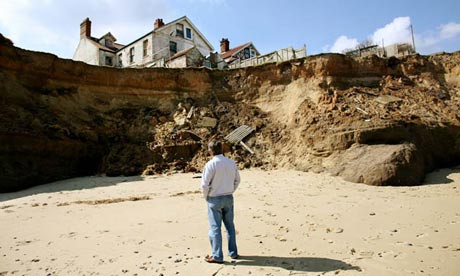
Coastal erosion in Norfolk

Coastal erosion in Norfolk. Photograph: Graeme Robertson

It was the latest in a series of catastrophic floods. Seawater forced its way through sand dunes and spilled miles across the low-lying lands of north-east Norfolk, spoiling farmland and destroying homes. After this flood of 1622, it was proposed that the sea be allowed in for good, as far as the village of Potter Heigham, five miles from the coast. Local people and landowners were horrified. They vowed to defend their livelihoods. Two thousand men were press-ganged into repairing the dunes and repelling "the extordinaire force and rage of the Sea".

The strategy worked and the waves were turned away from this corner of Norfolk for nearly 400 years. Last month, however, a new plan, closely resembling the retreat first proposed in the 17th century, was leaked to the public. Calling for "the embayment" of 25 square miles of low-lying land, the government's environmental body, Natural England, said that nine miles of sea defences between the seaside villages of Eccles and Winterton were unsustainable "beyond the next 20-50 years", creating the possibility of "realigning the coast". What this cold academic language actually means is wiping part of Norfolk off the map: 600 homes, six villages, five medieval churches, four fresh-water Broadland lakes, historic windmills, precious nature reserves and valuable agricultural land would be given up to the rising seas. Britain would have its first climate change refugees.

Outrage has greeted this "secret" plan. Residents complain of an instant property blight on their apparently doomed homes. Farmers speak out against the needless destruction of agricultural land. Politicians point out that no one has been consulted. Conservationists protest at the loss of unique flora and fauna and almost an eighth of the unique Broads national park. But the scientific community is unrepentant. They fear that, unlike in the 17th century, community spirit and construction of new barricades will no longer be enough to hold back the sea.

More than 15 million people live close to Britain's coastline. This small corner of Norfolk is the first to confront what every low-lying community in the country will face in the coming decades: the real cost of increased erosion, storms and sea-level rises exacerbated by global warming. It presents local people and the government with a stark dilemma. Is it worth spending billions on defending homes and livelihoods? Or, faced with inexorable sea-level rise, should expensive coastal defences be abandoned, leading to the evacuation of land and houses?

It is not just old pillboxes from the second world war that make the clifftops at Happisburgh, in Norfolk, resemble a battle scene. The land looks as if it has been bombed by the sea. Neat furrows of winter wheat end abruptly at the cliff edge: this erosion is happening so fast that crops planted last autumn to be harvested this summer have already been lost to the sea. A concrete ramp that once took the lifeboat down the cliff lies in twisted ruins. Dilapidated houses are being deserted as their gardens flop into the sea. On the beach, twists of exposed metal lie across fragments of smashed wooden sea defences and newer boulders lobbed there by the council.

To the south, the defences have been allowed to disappear completely from a half-mile stretch of beach. Here is compelling evidence of what happens when sea defences are abandoned: the sea has blasted a new bay out of farmland and, in less than a decade, marched several hundred metres inland. The authorities have a name for what is happening here in Happisburgh: "managed retreat". It does not look very orderly.

The Norfolk Broads begin on ominously low land a couple of miles south of Happisburgh. They were originally estuary, but since Saxon times have been steadily drained and reclaimed as grazing marsh. Its freshwater lakes were mostly created by peat digging, and for centuries its waterways have been managed by windmills, water pumps and dykes, often based on Dutch engineering. This land has always lived with the water, although one inland village, Hickling, which would be sacrificed to the sea under the new proposals, lost 108 people when it was swamped by sea water in 1287. Dramatic floods returned in 1938 and again in 1953, when a sea surge killed 307 people. This disaster triggered a "never again" attitude and the construction of miles of concrete sea defences to protect the east coast. These are now crumbling.

One Happisburgh resident, Malcolm Kerby, has formed an action group to protect coastal communities. He calls the principle of managed retreat "the government's 'chuck it all away today' philosophy".

"We're not stupid. We know we live on a coast that's been eroding for thousands of years. We know we will never stop the sea," he says. But he points to where the wooden defences remain shakily intact and then the spectacular erosion behind the section where they have disappeared. "What is demonstrated here so clearly is that for a relatively low cost you can reduce the rate of erosion to a manageable level."

The rhetoric of the government and its agencies, however, appears to doubt that. "I think the Norfolk Broads will go. They will definitely salinate," Lady Young, chief executive of the Environment Agency (EA) - responsible for defending Britain's coastline - told a recent climate change conference. Hilary Benn, the environment secretary, has warned that tough choices will need to be made along Britain's coast. "It's very difficult for people living there; for farmers, for communities," Benn has said. "It's partly about how much money we're prepared to spend, but it's also about what nature in the end makes happen."

The Department for the Environment Food and Rural Affairs (Defra) has nearly doubled spending on flood and coastal erosion risk management from 10 years ago to an estimated £600m in 2007-08 and will invest £2.15bn in the next three years. But land is already being abandoned to the sea. The EA says it will not fund long-term defences of the Blyth estuary on the Suffolk coast, leaving local volunteers to rebuild flood barriers. Managed retreat is already happening on a smaller scale at a number of locations including Cley, a bird-watching mecca on the north Norfolk coast, where a protective shingle bank is being allowed to fall into disrepair, leaving the sea to form new salt marshes behind it.

The EA has a policy of "holding the line" for the next 50 years to protect this part of Norfolk. Even then, it will cost between £1.5 and £2m a year just to maintain the nine miles of sea defences between Eccles and Winterton, which protect the 25 square miles that could be flooded. "In economic terms it's well justified," says Steve Hayman, EA coastal manager for East Anglia - but probably not beyond 50 years. "In the longer term there are really difficult questions to answer here and it may not be possible to maintain the coastline as we know it today."

The proposals to sacrifice this chunk of Norfolk were first mooted in environmental circles five years ago. Although they were leaked last month, Natural England clearly wanted them to be published. "By selecting a radical option now, the right message about the scale and severity of the impacts of climate change is delivered to the public," its document said. As well as catastrophic coastal erosion, it predicted "strong political resistance". It has been proved right.

In the affluent, attractive village of Hickling, local residents fear thousands have been knocked off the value of their homes. "It puts a blight on the area," says Harry Purnell, vice-chairman of the parish council. "It's not as if we're going to flood next week." Yvonne Pugh, who runs a B&B in a £700,000 house, says, "The idea of building a sea wall behind us and letting us go to ruin is not nice. What's it going to do for house prices?" Her husband, John, a retired chartered surveyor, says homes in the area are worth £2bn in total; farmers believe land lost would be worth £500m.

In Happisburgh, where erosion is so brutally evident, there is already a blight on houses. Locals claim prices are up to 30% lower than in unthreatened coastal villages. Mark Bradley, 46, lives on Beach Road. It would be worth £200,000 but after two decades of erosion, Beach Road is almost on the beach. When he bought it 23 years ago, he believed the government would continue to defend the coastline. Now, living in a house he can't sell and which may not be standing in a decade, he feels his life is ruined. "I went through a stage when I checked the cliffs every day. I got very upset and very depressed. You feel like a goldfish in a bowl when people come to gawp," he says. "Last year, when the new rocks were put on the beach [as a temporary sea defence], I decorated for the first time in 10 years. Previously I didn't have the heart to spend £100 on wallpaper because you don't know how long you're going to enjoy it for."

It is not just homeowners who are in shock. While local environmental groups such as the Norfolk Wildlife Trust have spoken hopefully of valuable new salt water habitats if this part of the Broads is submerged, many conservationists argue that we must preserve the unique freshwater nature reserves at Hickling and Horsey. "The whole future of the Broads is at stake. We can't possibly just 'let nature take its course'," says Martin George, an ecologist and former chairman of the Broads Society. "It's diverse and very species-rich, with a lot of very rare species. I am apprehensive that some of the naturalist groups are inclined to say how wonderful it will be to have all these new [salt marsh] habitats for birds. I disagree fundamentally. We need to do what we can to save what's there now. But I'm realistic enough to say we may not be able to do that for longer than 20 to 50 years."

George argues that the Broads should be saved for as long as they can be. "A country that has the technological know-how to extract oil and gas from below the North Sea and convey it in pipes to the mainland should surely be capable of finding a way to protect a concrete sea wall against the effects of climate change," he says. "We should accept that ultimately we will get drowned, but to let all these insects and land and communities go into the sea is simply not acceptable. Philosophically, as a conservationist, I believe we should do our damnedest to safeguard our heritage for as long as humanly possible."

Most climate and environmental scientists, however, predict that this corner of the Broads may not last long. "It is very vulnerable. It could go next winter or we might be lucky and several decades pass," says Brian Moss, professor of botany at Liverpool University, who has studied the Broads for 35 years. "Do you wait for it to happen and have another 1953 with potentially a lot of people killed, or say the risk is so high that it goes back to an estuary, you pay compensation and move people out before flooding it? That's the controversial view."

David Viner, Natural England's leading climate change specialist, explains that the plan was a draft series of "scenarios". Defending the coastline has not been ruled out and he insists that it backs the EA's pledge to "hold the line" in Norfolk for the next 50 years. But he says Natural England is showing "good leadership in facing up to the challenges of climate change. It is irresponsible to put your head in the sand and say nothing is happening." Hickling Broad won't survive another 100 years, he says. Even if it is protected with new sea walls, saline intrusion from rising sea levels will irrevocably transform the Broads from a freshwater region into a salty one. Some freshwater species will become extinct in Broadland. "We will have to look at recreating Hickling and the communities around Hickling somewhere else," he says.

While Natural England's plan does not rule out alternative options, such as building new sea defences, many environmental scientists argue against "hard" defences, and not just on the grounds of cost. Research shows that big sea defences can cause as many problems as they solve, stopping the transfer of sand along the coast and causing erosion elsewhere. New defences in north-east Norfolk could increase erosion at Great Yarmouth, which is equally vulnerable to sea-level rise, warns Moss.

As coastal residents become aware that they may outlive their homes, the government faces a huge new dilemma. Malcolm Kerby says that people should be compensated for the loss of their homes to the sea, just as they are if houses are given up for motorways or airports. Here, however, the government is sheltering behind an obscure 1949 law that absolves it of responsibility for homes lost to the sea. The government still won't contemplate the question of compensating our climate change refugees of the future. "We do not offer compensation, in line with previous governments," says a Defra spokeswoman. She says Defra does not intend to examine whether it will in the future. "We are developing a toolkit to help communities adapt to the fact that the coastline is changing, where we cannot get in the way of natural processes - but that's not compensation."

Kerby argues that it is discriminatory to protect some people from rising seas and rivers and not others, so London is saved by its expensive Thames Barrier but tiny Happisburgh is not. The vast bulk of the government's spending on flood defence goes on non-coastal areas, protecting towns and cities from river floods. Defra has asked the EA to ensure that a minimum of £110m - just 5% of its £2.15bn three-year flood defence spend - is reserved for projects by coastal local authorities. "Officials say leave it to natural processes. By all means, remove all the sea defences down the east coast including the Thames Barrier and I'll take my chances with the rest of them, but they are singling us out," says Kerby.

This battle for our future climate change refugees is only just beginning. For some, however, fighting the sea is a familiar story. John Buxton has lived on the Broads for 76 years. His father bought Horsey Hall in 1929, later donating his land to the National Trust. Buxton still helps look after this rich habitat and vividly remembers the flood of 1938, which turned his home into an island. Salt water covered thousands of acres - a disaster for farmers if it could not be removed. There was no question of giving it up to the sea, though: his father travelled to Holland for advice on how to recover the land.

Buxton, and many other locals, feel they should do the same today. Buxton believes that Dutch sea defences - with a slow, gradual slope - are far more effective than the wall-style defences that now protect the Norfolk coast.

"I see it as my responsibility to maintain this land. I'm not King Neptune. I can't keep the sea out, but I can advise on ways of managing the land," he says. "It works, the way we do it. There has always been this danger about the sea coming in but to allow it to do so, or encourage it to come in, is complete nonsense and shows utter ignorance and disdain for what has happened up until now. Taking care of this land has been a life's work. Giving it up would be a waste of my lifetime's efforts".

· There is a gallery to accompany Patrick Barkham's piece: guardian.co.uk/g2

I underestimated the threat, says Stern

This article appeared in the Guardian on Friday April 18 2008 on p15 of the UK news section.

Sir Nicholas Stern has warned that the gloomy predictions of his high-profile review of the future effects of global warming underestimated the risks, and that climate change poses a bigger threat than he realised.

Stern said this week that new scientific findings showed greenhouse gas emissions were causing more damage than was understood in 2006, when he prepared his study for the government. He pointed to last year's reports from the Intergovernmental Panel on Climate Change (IPCC) and new research which shows that the planet's oceans and forests are soaking up less carbon dioxide than expected.

He said: "Emissions are growing much faster than we'd thought, the absorptive capacity of the planet is less than we'd thought, the risks of greenhouse gases are potentially bigger than more cautious estimates and the speed of climate change seems to be faster."

Stern said the new findings vindicated his report, which has been criticised by climate sceptics and some economists as exaggerating the possible damage. "People who said I was scaremongering were profoundly wrong," he told a conference in London.

He said that increasing commitments from countries to curb greenhouse gases now needed to be translated into action. Earlier this week, Rajendra Pachauri, head of the IPCC, said a lack of such action from developed countries could derail attempts to seal a new global climate treaty at a crucial meeting in Copenhagen next year.

The Stern Review was credited with shifting the debate about climate change from an environmental focus to the economic impacts. It said the expected increase in extreme weather, with the associated and expensive problems of agricultural failure, water scarcity, disease and mass migration, meant that global warming could swallow up to 20% of the world's GDP, with the poorest countries the worst affected. The cost of addressing the problem, it said, could be limited to about 1% of GDP, provided it started on a serious scale within 10 to 20 years.

Stern's study was largely based on the previous IPCC report that appeared in 2001. The IPCC raised the stakes last year when it said that steps to curb emissions were needed by 2015 if the worst effects of global warming were to be avoided. Since then, a number of polar experts have warned that the Arctic and Antarctic are losing ice much faster than thought, and that the sea level rise could be more severe than the IPCC suggested. Other studies, focusing on how greenhouse gases are swapped between the land, sea and atmosphere, have suggested that scientists have underestimated the speed and strength with which serious climate change will strike.

Last October, scientists warned that global warming will be "stronger than expected and sooner than expected", after a new analysis showed carbon dioxide is accumulating in the atmosphere much more quickly than predicted. Experts said that the rise was partly down to soaring economic development in China.

Families living on the edge as cliff crumbles away

Property prices in freefall as bungalows demolished to stop them plunging into sea

This article appeared in the Guardian on Saturday April 19 2008 on p15 of the UK news section.

Earlier this week 57 Knipe Point Drive was a two-bedroom bungalow on a clifftop estate worth about £150,000. This morning the house is probably worth next to nothing, even though it boasts a new sea view extending for miles over the woodland and shingle of National Trust-owned Cayton Bay on the Yorkshire coast.

Diggers have demolished two bungalows that stood between number 57 and the cliff edge. The move prevented the houses following in the wake of their well-kept gardens and patios, which plunged 30 metres into the bay below, leaving the hamlet one of the most precarious in the UK. Dramatic landslips caused by unexplained water saturation in the cliff have claimed about seven metres of land at Knipe Point over the past month, and demolition has created a gap in the lines of bright white homes that were worth a total of around £9m.

Just four metres from the edge, Moya and John Green fear the same fate for their three-bedroom detached bungalow which they bought new 28 years ago and which is now one of 10 homes teetering on the brink. "It's magnificent here but the outlook isn't great," says Moya Green, a 72-year-old retired nurse.

Deformed kitchen pipes, crushed breeze blocks and splintered sideboards make up the mangled carcass of the newly-demolished bungalows next door. A digger ladles the broken homes on to a truck. Green shudders with each screech and scrape. "The digger went into number 23 like a big mouth. It went in through the window and there was the sound of glass shattering. It was horrible, and it's sickening to think the same could happen to us," she says.

The couple celebrated their silver wedding in their garden a quarter of a century ago. The garden fence is now slithering down the cliff face to join the neighbours' hedges, bushes and heaps of freshly-exposed soil.

Knipe Point is suffering from the same ailment that reduced the Holbeck Hall hotel, a mile and a half up the coast towards Scarborough, to rubble after a landslip 15 years ago. The soil has become saturated with water, causing the earth to slump and sag under its own weight and the 56 - now 54 - houses on the private estate.

The National Trust commissioned a survey but theories of disturbance from a new bypass, natural underground springs, faulty drainage pipes or merely the heavy rains and rising sea levels resulting from climate change remain conjecture. Whatever the reason, cracks up to half a metre wide appear every day as the boulder clay and its pockets of sand and gravel take on water, causing the earth to slide down among the dead and dying trees and pools of sludge at the base. With about a third of the UK's coastline crumbling, the phenomenon could become increasingly common.

So far nothing has been done to stop the landslips and residents are frustrated. Helen Clarke, of the National Trust, insists the protected great crested newts living in the woods are not taking priority over residents. Until the survey identifies the cause of the water build-up, action would be futile, she says. "The worry is if we do something rash it could be detrimental. The land is saturated and the cliff has literally slumped so there are health and safety issues too.

"Tomorrow a different section of the point could start to crumble away. It's a site of Special Scientific Interest but homes are more important and our priority is to save them. However, we are being quite clear that we don't believe there is a solution - we don't want to give the residents false hope. It's a case of wait and see."

The Greens are prepared for the worst. A 1949 law absolves the government of responsibility and insurance is likely to cover rebuilding costs only. "If your house burns down, rebuilding is an option. How can we rebuild if our land's at the bottom of the cliff?" asks John Green, 73.

Turtles to be climate change canaries

From: WWF

/wildlife/article/34919

Just as canaries help miners monitor underground gases, marine turtles are emerging as excellent indicators of the effects of climate change.

“Turtles are a really good way to study climate change because they depend on healthy beaches as well as mangroves, sea grass beds, coral reefs and deep ocean ecosystems to live”, said Dr. Lucy Hawkes, coordinator of an initiative to develop adaptation strategies for climate change impacts to turtles.

As part of the initiative, WWF launched a new website today, Adaptation to Climate Change in Marine Turtles (ACT).

“Understanding of how climate change may affect the beaches, the reef and the open ocean will not only benefit endangered sea turtle populations, but also the millions of people who live along the coastlines of the world and depend upon marine resources and environmental services.”

The public, educators, conservationists and scientists will be able to share information and projects to try to gain a better picture of how climate change will affect turtles and what might be done to combat the impacts.

According to the latest reports by the International Panel on Climate Change (IPCC), our environment will be altered dramatically over the next years by increasing temperatures, increased severity and frequency of storm events and rising sea levels.

These effects could be devastating within low situated tropical areas, where the majority of the population depends on coastal resources and tourism.

The Caribbean is one such important region that is greatly threatened by climate change and is also host to globally important populations of sea turtles.

By 2010 the project hopes to understand the current state of knowledge about the impacts of climate change on marine turtles and their habitats with a global network of marine turtle and climate specialists, and make management recommendations for their conservation.

It is an initiative of WWF through a grant from the MacArthur Foundation and support from Hewlett Packard.

The website, hosting free downloads, information and latest scientific findings, can be accessed at: http://www.panda.org/lac/marineturtles/act

Freshening of deep Antarctic waters worries experts

From: Reuters

/ecosystems/article/34921

SINGAPORE (Reuters) - Scientists studying the icy depths of the sea around Antarctica have detected changes in salinity that could have profound effects on the world's climate and ocean currents.

The scientists returned to the southern Australian city of Hobart on Thursday after a one-month voyage studying the Southern Ocean to see how it is changing and what those changes might mean for global climate patterns.

Voyage leader Steve Rintoul said his team found that salty, dense water that sinks near the edge of Antarctica to the bottom of the ocean about 5 km (3 miles) down was becoming fresher and more buoyant.

So-called Antarctic bottom water helps power the great ocean conveyor belt, a system of currents spanning the Southern, Pacific, Indian and Atlantic Oceans that shifts heat around the globe.

"The main reason we're paying attention to this is because it is one of the switches in the climate system and we need to know if we are about to flip that switch or not," said Rintoul of Australia's government-backed research arm the CSIRO.

"If that freshening trend continues for long enough, eventually the water near Antarctica would be too light, too buoyant to sink and that limb of the global-scale circulation would shut down," he said on Friday.

Cold, salty water also sinks to the depths in the far north Atlantic Ocean near Greenland and, together with the vast amount of water that sinks off Antarctica, this drives the ocean conveyor belt.

This system brings warm water into the far north Atlantic, making Europe warmer than it would otherwise be, and also drives the large flow of upper ocean water from the tropical Pacific to the Indian Ocean through the Indonesia Archipelago.

If these currents were to slow or stop, the world's climate would eventually be thrown into chaos.

"We don't see any evidence yet that the amount of bottom water that's sinking has declined. But by becoming fresher and less dense it's moving in the direction of an ultimate shutdown."

Rintoul said results of the bottom water samples in the Ross Sea directly south of New Zealand and off Antarctica's Adelie Land further to the west, were a crucial finding.

"We didn't know that before we left but it's now clear that both of those regions are becoming fresher for some reason."

GLOBAL WARMING TO BLAME?

During the voyage, scientists from Australia, Britain, France and the United States measured salinity, carbon dioxide and iron concentrations as well as currents between Antarctica and Australia.

Rintoul said his team are studying if faster melting of icesheets or sea ice is the source of the fresher water but he said it was too early to tell if global warming was to blame.

Over the coming months, his team will study oxygen isotopes collected from water samples.

"Oxygen isotopes act as a tracer of ice melt and that information should help pin down exactly what the cause of the freshening is in the deep ocean," said Rintoul, of the Antarctic Climate and Ecosystems Cooperative Research Centre.

"The leading hypothesis at the moment for why it's freshening is that the floating ice around Antarctica is melting more rapidly than in the past."

He pointed to studies showing winds around Antarctica changing because of global warming and the ozone hole.

"The most likely scenario is that those changes in winds have changed the circulation of the ocean, in particular caused more upwelling of relatively warm water from below and that could have caused the increased melting of ice around Antarctica," he said.

"The next challenge over the coming months and year will be to see just how well we can this pin down."

(Editing by Jeremy Laurence)

Wednesday, April 16, 2008

Hunger. Strikes. Riots. The food crisis bites

Across the world a crisis is unfolding at alarming speed. Climate change, China's increasing consumption and the dash for biofuels are causing food shortages and rocketing prices - sparking riots in cities from the Caribbean to the Far East. Robin McKie and Heather Stewart report on the millions facing starvation - and the growing threat to global security

This article appeared in the Observer on Sunday April 13 2008 on p22 of the Focus section

It is the constant sensation of hunger that makes Kamla Devi so angry. She argues with shopkeepers in New Delhi over prices and quarrels with her husband, a casual labourer, over his wages - about 50 rupees (60p) a day.

'When I go to the market and see how little I can get for my money, it makes me want to hit the shopkeepers and thrash the government,' she says. A few months ago, Kamla - who is 42 - decided she and her husband could no longer afford to eat twice a day. The couple, who have already sent their two teenage sons to live with more prosperous relatives, now exist on only one daily meal. At midday Kamla cooks a dozen roti (a round, flat Indian bread) with some vegetables fried with onions and spices. If there are some left, they will eat them at night. The only other sustenance that the couple have are occasional cups of sugared tea.

'My husband and I would argue every night. In the end he told me it wouldn't make his wages grow larger. Instead we went down to one meal a day to cut costs.'

It is a grim, unsettling story. Yet it is certainly not an exceptional one. Across the world, a food crisis is now unfolding with frightening speed. Hundreds of millions of men and women who, only a few months ago, were able to provide food for their families have found rocketing prices of wheat, rice and cooking oil have left them facing the imminent prospect of starvation. The spectre of catastrophe now looms over much of the planet.

In less than a year, the price of wheat has risen 130 per cent, soya by 87 per cent and rice by 74 per cent. According to the UN's Food and Agriculture Organisation, there are only eight to 12 weeks of cereal stocks in the world, while grain supplies are at their lowest since the 1980s.

For the Devi family, and hundreds of millions of others like them, the impact has been calamitous, as Robert Zoellick, the World Bank President, warned at this weekend's G7 meeting in Washington. Brandishing a bag of rice, he told startled delegates from the world's richest nations that the world was now perched at the edge of catastrophe.

'This is not just about meals forgone today, or about increasing social unrest, it is about lost learning potential for children and adults in the future, stunted intellectual and physical growth,' he said. Without urgent action to resolve the crisis, he added, the fight against poverty could be set back by seven years.

Not surprisingly, these swiftly rising prices have unleashed serious political unrest in many places. In Dhaka yesterday 10,000 Bangladeshi textile workers clashed with police. Dozens were injured, including 20 policemen, in a protest triggered by food costs that was eventually quelled by baton charges and teargas. In Haiti, demonstrators recently tried to storm the presidential palace after prices of staple foods leaped 50 per cent.

In Egypt, Indonesia, Ivory Coast, Mauritania, Mozambique, Senegal and Cameroon there have been demonstrations, sometimes involving fatalities, as starving, desperate people have taken to the streets. And in Vietnam the new crime of rice rustling - in which crops are stripped at night from fields by raiders - has led to the banning of all harvesting machines from roads after sunset and to farmers, armed with shotguns, camping around their fields 24 hours a day.

But what are the factors that led to this global unrest? What has triggered the price rises that have put the world's basic foodstuffs out of reach for a rising fraction of its population? And what measures must be taken by politicians, world leaders and monetary chiefs to rectify the crisis? Not surprisingly, the first two of these questions tend to be the easier ones to answer. Economists and financiers point to a number of factors that have combined to create the current crisis, a perfect storm in which several apparently unconnected events come together with disastrous effects.

One key issue highlighted at the G7 meeting was the decision by the US government, made several years ago, to give domestic subsidies to its farmers so that they could grow corn that can then be fermented and distilled into ethanol, a biofuel which can be mixed with petrol. This policy helps limit US dependence on oil imports and also gives support to the nation's farmers. However, by taking over land - about 20 million acres so far in the United States - that would otherwise have been used to grow wheat and other food crops, US food production has dropped dramatically. Prices of wheat, soya and other crops have been pushed up significantly as a result.

Other nations, including Argentina, Canada and some European countries, have adopted similar, but more restrained, biofuel policies. But without mentioning any countries by name, Zoellick clearly pointed the finger of blame at the US. Everyone should 'look closely at the effects of the dash for biofuels', he said. 'I would hope that countries that, for whatever reason, energy security and others, have emphasised biofuel development will be particularly sensitive to the call to meet the emergency needs for people who may not have enough food to eat.'

This point has also been stressed recently by the UK government's chief scientific adviser, Professor John Beddington. 'It is very hard to imagine how we can see the world growing enough crops to produce renewable energy and at the same time meet the enormous demand for food,' he said. 'The supply of food really isn't keeping up.'

For his part, Hank Paulson, the US Treasury Secretary - asked about the impact of US energy policies on food prices on Friday - tried to bat away the question. 'This is a complex area, with a number of causes,' he told reporters. The first priority, he added, was to get food supplies to people who need them, before considering the longer-term reasons for the rising prices.

It was not a point shared by the chief of staff in the United Nations trade and development division, Taffere Tesfachew, who flew to London last week ahead of a vital meeting of the leaders of the world's poorest nations in Accra, the capital of Ghana. Instead of an agenda designed to achieve economic progress in the developing world, the meeting will instead focus on the pressing issue of food. Tesfachew said that decades of aid has been skewed to ambitious industrialisation programmes and that the World Bank and others have failed to invest in the agricultural sector. 'We believe these high food prices won't disappear in the next two years, so now is the time to redress imbalances in terms of ethanol subsidies,' he said.

Zoellick was also clear that action was now urgently needed. 'In the US and Europe over the last year we have been focusing on the prices of gasoline at the pumps. While many worry about filling their tanks, many others around the world are struggling to fill their stomachs. And it's getting more and more difficult every day,' added Zoellick, who made an impassioned plea to the world's rich nations to provide emergency help, including $500m in extra funding to the UN World Food Programme.

This call was backed by finance ministers from the G24, who represent the leading developing countries, who also demanded extra cash to help cushion the poor against the shock of rising food prices. As well as causing hunger and malnutrition, the rising cost of basic foodstuffs risks blowing a hole in the budgets of food-importing countries, many of them in Africa, they argued.

As to the other factors that have combined to trigger the current food crisis, experts also point to the connected issue of climate change. As the levels of carbon dioxide rise in the atmosphere, meteorologists have warned that weather patterns are becoming increasingly disturbed, causing devastation in many areas. For several consecutive years, Australia - once a prime grower of wheat - has found its production ruined by drought, for example. Scarcity, particularly on Asia's grain markets, has then driven up prices even further.

Some campaigners see climate change as the most pressing challenge facing the world while others now say that biofuels - grown to offset fossil fuel use - is taking food out of the mouths of some of the world's poorest people. The net result will be eco-warriers battling with poverty campaigners for the moral high ground.

On top of these issues, there is the growing wealth of China and its 1 billion inhabitants. Once the possessor of a relatively poor rural economy, China has becoming increasingly industrialised and its middle classes have swelled in numbers.

One impact has been to trigger a doubling in meat consumption, particularly pork. As the country's farmers have sought to feed more and more pigs, more and more grain has been bought by them. However, China has only 7 per cent of the world's arable land and that figure is shrinking as farmland has been ravaged by pollution and water shortages.

The net result has been to decrease domestic supplies of grain just as demand for it has started to boom. Again the impact has struck worst in the Third World, with wheat and other grain prices soaring.

And finally there is the issue of vegetable oils. Soya and palm oils are a major source of calories in Asia. But flooding in Malaysia and a drought in Indonesia have limited supplies.

In addition, these oils are now being sought as bio-diesel, which is used as a direct substitute for diesel in many countries, including Australia. The impact has been all too familiar: an alarming drop in supplies for the people of the Third World as prices of this basic commodity have soared.

One such victim is Kamla Devi. She has already had to abandon dhal, a central, protein-rich dish of lentils that was a key part of her family's diet for several months. Now the cooking of fried food - in particular, pooris: hot, puffed, oil-soaked bread - has had to follow suit for the simple reason that cooking oil has become unaffordable.

'It has affected my health,' she says. 'The rich are becoming richer. They go to shopping malls and they don't need to worry. The problem with prices only matters for the poor people like me.'

· Additional reporting by Amelia Gentleman and Nick Mathiasson

Four key factors behind the spreading fear of starvation across the globe

Growing consumption

Six months ago Zhou Jian closed down his car parts business and launched himself as a pork butcher. Since then the 26-year-old businessman's Shanghai shop has been crowded out - despite a 58 per cent rise in the price of pork in the past year - and his income has trebled.

As China's emerging middle classes become richer, their consumption of meat has increased by more than 150 per cent per head since 1980. In those days, meat was scarce, rationed at around 1kg per person per month and used sparingly in rice and noodle dishes, stir fried to preserve cooking oil.

Today, the average Chinese consumer eats more than 50kg of meat a year. To feed the millions of pigs on its farms, China is now importing grain on a huge scale, pushing up its prices worldwide.

Palm oil crisis

The oil palm tree is the most highly efficient producer of vegetable oil, with one acre yielding as much oil as eight acres of soybeans. Unfortunately, it takes eight years to grow to maturity and demand has outstripped supply. Vegetable oils provide an important source of calories in the developing world, and their shortage has contributed to the food crisis.

A drought in Indonesia and flooding in Malaysia has also hit the crop. While farmers and plantation companies hurriedly clear land to replant, it will take time before their efforts bear fruit. Palm oil prices jumped nearly 70 per cent last year, hitting the poorest families. When a store in Chongqing in China announced a cooking-oil promotion in November, a stampede left three dead and 31 injured.

Biofuel demand

The rising demand for ethanol, a biofuel that is mixed with petrol to bring down prices at the pump, has transformed the landscape of Iowa. Today this heartland of the Midwest is America's cornbelt, with the corn crop stretching as far as the eye can see.

Iowa produces almost half of the entire output of ethanol in the US, with 21 ethanol-producing plants as farmers tear down fences, dig out old soya bean crops, buy up land and plant yet more corn. It has been likened to a new gold rush.

But none of it is for food. And as the demand for ethanol increases, yet more farmers will pile in for the great scramble to plant corn - instead of grain. The effect will be to further worsen world grain shortages.

Global warming

The massive grain storage complex outside Tottenham, New South Wales, today lies virtually empty. Normally, it would be half-full. As the second largest exporter of grain after the US, Australia usually expects to harvest around 25 million tonnes a year. But, because of a five-year drought, thought to have been caused by climate change, it managed just 9.8 million tonnes in 2006.

Farmers such as George Grieg, who has farmed here for 50 years, have rarely known it to be so bad. Many have not even recovered the cost of planting and caring for their crops, and are being forced into debt. With global wheat prices at an all-time high, all they can do is cling on in the hope of a bumper crop next time - if they are lucky.

Food in figures

93,000,000 Acres of corn planted by US farmers last year, up 19 per cent on 2006.

76% Amount of US corn used for animal feed.

8kg Amount of grain it takes to produce 1kg of beef.

20% Portion of US corn used to produce five billion gallons of ethanol in 2006-07.

50kg Quantity of meat consumed annually by the average Chinese person, up from 20kg in 1985.

10% Anticipated share of biofuels used for transport in the EU by 2020.

$500m The UN World Food Programme's shortfall this year, in attempting to feed 89 million needy people.

9.2bn The world's predicted population by 2050. It's 6.6bn now.

130% The rise in the cost of wheat in 12 months.

16 times The overall food consumption of the world's richest 20 per cent compared with that of the poorest 20 per cent.

58% Jump in the price of pork in China in the past year.

$900 The cost of one tonne of Thai premier rice, up 30 per cent in a month.

Caroline Davies

Illegal fishers plunder the Arctic

From: WWF

/wildlife/article/34769

According to Norwegian government figures, more than 100,000 tonnes of illegal cod, valued at €225 million ($US350 million), was caught in the Barents Sea in 2005. Concerted efforts by industry, government and NGOs to clamp down on this illegal activity has seen illegal landings cut by 50 per cent, but illegal fishing for Alaska pollock in the Russian Far-East remains a problem.

While investigation into illegal fishing in the Russian Far-East is less exhaustive than in the Barents Sea, the new report, Illegal Fishing in Arctic Waters, shows that in the Sea of Okhotsk alone, illegal landings of Alaska pollock can reach a value of more than €45 million ($US70 million) annually. The economic loss to the legitimate fishing industry and public purse is estimated at €210 million ($US327 million).

“Illegal fishing in the Arctic is a serious transnational crime crossing European, African, Asian and American borders.” said Dr Neil Hamilton, Director of WWF International’s Arctic Programme. “Cheats are putting short-term profits ahead of the long-term survival of Arctic fisheries.”

About 70 per cent of the world’s white fish supply comes from the Arctic, with the world’s last large cod stock found in the Barents Sea. The Russian Alaska pollock and Barents Sea cod catches analyzed in the report together account for about a quarter of the world’s white fish supply.

Barents Sea cod is taken mainly by Norwegian, Russian and EU fishers, while the bulk of the Alaska pollock catch, fished mainly in the Western Bering Sea and Sea of Okhotsk, is taken by Russian fleets with China the largest buyer. With markets spread across the globe, the distribution of black market cod and pollock is a global problem.

“If you’re enjoying bacalhau in Brazil, fish and chips in the UK, or frozen fillets in Germany you could be unwittingly supporting black-market cod,” said Maren Esmark, Marine Director at WWF-Norway. “Progress in tackling illegal fishing for cod in the Barents Sea should be applauded, but the positive trend may not continue as illegal products can find new ways to international markets.”

WWF is concerned about the ability of Arctic fish to cope with climate change, with illegal fishing being an added stress that can reduce the capacity of fish populations to adapt and survive.

WWF is also alarmed that several EU member states are opposing the current European Commission proposal to address illegal fishing, and the EU risks losing a key opportunity to tackle this problem.

“We urge all EU countries to support the commission’s proposal to deal with illegal fishing, and appeal to processors, retailers and consumers to not support criminality in fishing,” said Esmark, “Companies should not trade with vessels known to fish illegally, and consumers should demand the seafood they buy comes from a sustainable, legal source.”

World must reform agriculture now or face dire crisis: report

From: , The World Business Council for Sustainable Development (WBCSD), More from this Affiliate
Published April 16, 2008 08:23 AM
/ecosystems/article/34761

The world will face social upheaval and environmental disasters if agriculture is not radically reformed to better serve the poor and hungry, a landmark UN-sponsored report said Tuesday.

The warning in the report by the International Assessment of Agricultural Science and Technology for Development (IAASTD) comes amid growing discontent among the world's poorest over rising food prices.

"Continuing with current trends in production and distribution would exhaust our resources and put our children's future in jeopardy," said the report, which was compiled by about 400 international experts.

"And the increasingly globalised food market and ever-increasing food imports mean that no country can assume itself to be immune to the implications," it added.

In a statement, the IAASTD called for a "more holistic view of agriculture." The first of the United Nations' 10 Millennium Goals is to reduce by half the number of people suffering from hunger by 2015.

But the new report stressed that agriculture as is practised today was the source of deep inequalities and that the number of malnourished people worldwide was continuing to grow.

"Although considered by many to be a success story, the benefits of productivity increases in world agriculture are unevenly spread," it said.

"Often the poorest of the poor have gained little or nothing, and 850 million people are still hungry or malnourished with an additional four million more joining their ranks annually," the report went on.

The report said the world's agricultural expertise "should be targeted toward strategies that combine productivity with protecting natural resources like soils, water, forests, and biodiversity."

"To argue, as we do, that continuing to focus on production alone will undermine our agricultural capital and leave us with an increasingly degraded and divided planet is to reiterate an old message," the IAASTD said.

"But it is a message that has not always had resonance in some parts of the world. If those with power are now willing to hear it, then we may hope for more equitable policies that do take the interests of the poor into account."

Commissioned by the World Bank and the UN's Food and Agriculture Organisation, the report was considered by 64 governments at an intergovernmental plenary in Johannesburg last week.

Food protests have already been the cause of deadly protests in African countries such as Cameroon, Senegal and Mauritania and riots in Haiti and Indonesia.

The crisis has spurred world leaders into action, with the United States on Tuesday pledging 200 million dollars to help governments address the problems of rising food prices.

Earlier, UN chief Ban Ki-moon warned that the food crisis could trigger political upheavals and security risks.

Video

"Manufactured Landscapes" SEE THIS BRILLIANT MOVIE! You'll never have the same shopping experience again.