Sunday, November 18, 2007

Australians named as world's worst polluters

Australians named as world's worst polluters

· Countries ranked by power station output
· Americans in second place and Britons come ninth

Australians are the world's worst individual greenhouse gas polluters if emissions are calculated from the output of the country's power stations, according to new analysis.

Each Australian produces nearly 11 tonnes of CO2 power sector emissions, the United States follows on nine tonnes per person, while Britain is ranked ninth at 3.5 tonnes and China - heavily criticised by the international community for its rapid development of coal-fired power stations - produces only two tonnes a year per person. Indians emit about half a tonne of CO2 per person.

The data was compiled by the Centre for Global Development, a Washington-based thinktank. It found that the US had nearly one in six of the world's power stations, and emitted nearly 25% of the world's total CO2 emissions.

The analysis is embarrassing for the Australian government, which is fighting a general election on November 24. Climate change has been high on the election agenda after the conservative prime minister, John Howard, behind in the polls, consistently refused to sign the Kyoto climate pact. He has argued it would harm Australia's economy, which relies for most of its power on old coal-fired stations.

One surprise in the data, said the report, was that the world's biggest emitters of CO2 in absolute terms are no longer in the rich world but in rapidly emerging economies with enormous coal-fired plants. Five of the world's most polluting companies are in China and three in the US.

"High US emissions are partly the result of high living standards but they also reflect differences in government policy. Europeans with comparable living standards emit less than half the power sector CO2 of the average American," said Nancy Birdsall, one of the report's authors.

Power stations are the most concentrated source of greenhouse gases. The report found that the world's worst is Taichung in the Taiwanese city of Lung-Ching, which emits 41.3m tonnes of CO2 per year. By comparison, the Drax power station in Selby, North Yorkshire, which was named as the biggest UK polluter producing 23.7m tonnes of CO2, is a relative minnow, the world's 23rd worst.

The US produces 2.79bn tonnes a year and China slightly less with 2.7bn. They are followed by Russia with 661m tonnes; India 583m tonnes; Japan 400m tonnes; Germany 356m tonnes; Australia 226m tonnes; South Africa 222m tonnes; the UK with 212m tonnes and South Korea with 185m tonnes.

We behave as if there is no penalty for our luxurious consumption

We behave as if there is no penalty for our luxurious consumption

Climate scientists are warned to avoid words like 'disaster' - they lead to apathy and fatalism

In 1784, Robert Burns described a disturbing local phenomenon in a letter to a friend. A band of religious fanatics were roaming the countryside of south west Scotland, led by a woman who gave people the spirit of the Holy Ghost by breathing on them "which she does with postures & practices that are scandalously indecent." Their tenets, Burns wrote, were "a strange jumble of enthusiastic jargon" and their behaviour offensive enough to have them run out of several towns. Men and women "lodge and lye all together" and believed they could commit no moral sin. All in all, it was to Burns "one of the many instances of the folly in leaving the guidance of sound reason, & common sense in matters of religion."

These were the Buchanites, an obscure branch of Scottish theological history that died with its last adherent in the 1840s. Their leader, Elspeth 'Lucky' Buchan, had abandoned husband and children to become a religious voluptuary who imagined herself to be "the Woman Clothed with the Sun" in the prophecies of Revelations. As the end of the world was nigh, there was no point in celibacy or marriage and children. Infanticide and unusual degrees of sexual liberty were rumoured. Then, after more than three years of prophecy and rough sleeping, the Buchanites threw away what valuables they possessed (watches, rings, shoes) and obeyed Mrs Buchan's instruction to climb Templand Hill in Dumfries-shire. There, in July, 1786, they built a platform and stood singing and wailing on it to await their transfer to heaven.

A storm blew up. The platform collapsed. The disconsolate Buchanites tramped downhill through the mud. There was amusement from the watching crowd. Lucky Buchan never recovered from the ignominy and died five years later, when her remaining followers buried her in feathers so she would be in good condition for her resurrection, which was expected to be soon.

Consider the Buchanites on the hill that day in the summer of 1786, looking up to what they hoped would be the face of God. What was the proportion of carbon dioxide in the atmosphere up there beyond the clouds? Probably not much more than 280 parts per million (ppm), the figure we now judge to be its pre-industrial level, which in the records of climatology ended in 1750. But even in 1786 it was changing, thanks primarily to one of Buchan's fellow Scots. James Watt's improved steam engines were already draining mines of water and blowing iron furnaces and soon their rotary motion would be powering textile, corn and paper mills, breweries and distilleries. As Buchan roamed around Scotland she might see a pillar of smoke from a lonely coal pit, not realizing (as nobody else did for the next two hundred years) that its carbon particles contained a different prescription for the world's end to that in Revelations.

According to the Intergovernmental Panel on Climate Change (IPCC), the level of carbon dioxide in the atmosphere was 379ppm in 2005 and rising at just under 2ppm annually. Add methane and nitrous oxide, and the current total of greenhouse gases expressed as carbon dioxide equivalents, stands at 459ppm. The European Union's ambition is to halt growth at 550ppm of carbon dioxide, and greenhouse gases in total at 666ppm. Even if this target proves achievable, it offers no hope that the world will stay much the same. "Dangerous" climate change is reckoned to be a rise in the global average temperature of more than 2C; the Stern Report says that a rise of 3C is more likely than not when greenhouse gases reach 650ppm.

The latest IPPC predictions are no more cheerful. No matter what we do to stabilize emissions in future, "anthropogenic warming and sea level rise would continue for centuries due to the time scales associated with climate processes and feedbacks." We can mitigate future consequences by cutting the growth in emissions and adapt to them by building sea walls, but about some things we can do nothing. During the rest of this century, coral will continue to bleach and species to die, there will be more droughts and wildfires, glaciers will melt, the Arctic will shed much more ice, coast will crumble. Sub-Saharan Africa, the big Asian deltas, low-lying islands: these are not places you would want to be. If the Greenland ice sheet disappears entirely - which at present rates of shrinkage is likely - then seas already swollen thermally could rise by another seven metres and the world would assume the shape of the inter-glacial epoch 125,000 years ago.

We should be frightened. Perhaps we are. But fear finds odd expression. The popularity of Cormac McCarthy's doomsday novel, The Road, may be a symptom of fear as entertainment, the make-believe of the story strengthened in our heads by the knowledge that, yes, it may well end like this. Elsewhere, there is what Leo Hickman warned against in the Guardian this week: "eco-fatigue". He quoted Professor Mike Hulme, formerly director of the Tyndall Centre for Climate Change Research, who told scientists and the media to steer clear of hyperbole - words such as "disaster", "apocalypse", "catastrophe" - when they were describing climate change predictions because it led to apathy and fatalism. Also, and never to be underestimated in a society that always demands new fashions, there is gathering irritation with the consumers of "green lifestyle choices" and their apparent belief that by driving to farmers' markets to buy organic carrots they have done their bit.

Mainly, we do nothing. No, worse than that, we behave as though there is no tomorrow, no penalty attached to our luxurious consumption, as thought the world's resources were infinite. London shops may ban free carrier bags, but the bar at Claridge's has introduced a specialism in bottled water: thirty expensive brands of it, with Berg from melted icebergs in Newfoundland selling at £30 a litre. What are we, the well off, prepared to renounce? Bottled water, air travel, cars, wage rises, profits, house price increases, central heating? The answer seems to be none of these things. In the last century the king of renunciation, the great advocate of restricting want, was MK Gandhi, who is the kind of figure that the struggle against climate change badly needs (unlike Al Gore, he practised what he preached). But it should be noticed that his followers tended to adopt the easier of his injunctions: chucking western clothes on to a bonfire was one thing, cleaning one's own latrine another.

I suppose we are in that state called denial, though that word suggests a refusal to acknowledge what Hulme wants us to stop calling a looming catastrophe. But a catastrophe is what it is, and our behaviour may be a reaction to that knowledge rather an avoidance of it; we may, in fact, be full and overflowing with acknowledgment. Future historians, should they exist, will surely look back on our time and see in its manic excesses the evidence of a society gathering its rosebuds while it may. At a conference on climate change last year I heard someone say that the fear of global warming was like the fear of death: always there but impossible to dwell on.

Lucky Buchan and her followers were very certain of heaven. That is their distance from the rest of us, then and now. In other ways, however, so many of us are Buchanites. We sense an inevitable apocalypse, live accordingly, and hope that our grandchildren have a high hill to live on, somewhere relatively wet and unpeopled like Scotland, and have learned to use a gun.

U.N. panel releases comprehensive research on global warming

If the nations of the world continue to pump tons of carbon dioxide into the atmosphere from smokestacks and tailpipes, the world will suffer catastrophic droughts and heat waves and rising seas that could kill millions of people, according to the most exhaustive work ever done on planetary climate change.

The arid and semi-arid lands, including the western United States, would be hit by runaway wildfires, have less drinking water from shrinking snowpacks, and face unpredictable ocean conditions that would upset the feeding cycles of krill, fish and other sea life.

But if the United States and China, the two top greenhouse gas producers, work with other countries to improve energy efficiency and invest in alternative technologies, the worst effects of global warming could be forestalled on Earth, according to a Nobel Peace Prize-winning U.N. science panel that released its final report Saturday.

The Intergovernmental Panel on Climate Change, a group of 2,000 scientists from 140 countries, has over the past several months been releasing volumes of its work on global warming. The report released Saturday is the synthesis of that work, a six-year endeavor to measure most of what is known about global warming and its effects on human health, the oceans, wildlife and how the world might adapt, among other topics. The first of the five-year assessments came out in 1990 and was used as the basis for the U.N. Framework Convention on Climate Change.

The summary report released Saturday is geared toward policymakers who will meet in Bali, Indonesia, next month to begin forging a treaty to replace the Kyoto Protocol, which expires in 2012.

Since 1970, global greenhouse gas emissions have grown by 70 percent, and are causing global warming, according to the report.

Maintaining today's rate of emissions from power plants, factories, vehicles and other sources could raise global temperatures 10 degrees by the end of the century. That would mean the extinction of more than half of the world's plant and animal species, creation of super-intensive hurricanes and melting of glaciers, according to the panel.

To limit the increase in global temperatures to 4 degrees - which would limit sea level rise to between 15 and 55 inches over the century - the world needs to cut emissions by 50 to 85 percent by 2050, the panel said. That reduction is close to what California law requires.

Over the past century, global temperatures rose 1 to 2 degrees, and the global average for sea level rise was 6 inches.

Some of the effects of global warming, such as melting land and sea ice, intense hurricanes and an increase in wildfires, are happening now and can occur with greater intensity as temperatures rise even a few degrees, the scientists said.

That should send a strong, clear message to policymakers around the globe, said climatologist Stephen Schneider, co-director of Stanford University's Center for Environmental Sciences and Policy. He was returning to the Bay Area on Saturday from the five-day panel sessions in Spain.

"The warming of the 20th century is unequivocal," Schneider said.

"The warming in the last 40 to 50 years is very likely due to human activities, mostly from our smokestacks and tailpipe waste and deforestation activities, which have increased carbon dioxide by 35 percent" since the Industrial Revolution, he said. "Although some risks are already unavoidable, there is still time to reduce the likelihood of really catastrophic impacts like melting ice sheets and massive species extinction."

Possible solutions include enlisting private industry to develop alternative technologies that are less emitting, according to the report. Government officials also could use tax incentives and subsidies, levy a tax on companies or people who emit greenhouse gases, or develop market-based systems in which people pay extra for the right to emit more greenhouse gases than otherwise allowed, the summary report said.

Despite the exhaustive work by the U.N. panel, much is still not known, the scientists said.

For example, it is not clear whether the planet is more likely to be 2 to 3 degrees or 10 degrees warmer by the end of the century. Other unknowns are the amount of sea level rise and how precipitation will be affected in different parts of the world.

The Carnegie Institution at Stanford University compared cities' annual average temperatures to get a feel for what a temperature increase would mean: Tucson is an average 10 degrees hotter than San Francisco, and Santa Barbara is, on average, 2.2 degrees warmer than San Francisco.

Because a significant portion of carbon dioxide from industrial emissions will remain in the atmosphere for decades to centuries, "it's going to get warmer," said Jonathan Overpeck, professor of geosciences and director of the University of Arizona's Institute for the Study of Planet Earth. Overpeck was the coordinating lead author for a section of the U.N. report.

"We're going to continue to see sea levels go up, to see a continued dwindling of mountain snowpack in the spring when we need it most, and a drying out of the semi-arid West. Water resources are likely to become more limited," Overpeck said.

The summary emphasizes the uncertainty over sea level rise, he said.

"It's clear that scientists couldn't define the upper end of sea level rise by the end of the century. The ice sheets in Greenland and Antarctica are changing very rapidly in ways we still don't understand," Overpeck said.

Scientists expect a better estimate within the next five years. "An increasing number of scientists are saying we could have a meter or more by the end of the century" if the melting of glaciers in Greenland and other areas is considered, he said.

Kevin Trenberth, head of the climate analysis section at the National Center for Atmospheric Research in Boulder and a coordinating lead author for part of the summary report, said the scientists also look for improvements in the way that they can predict ocean conditions or precipitation.

Refining and improving predictions is crucial, he said, in helping policymakers make decisions regarding fisheries, forests, water and agriculture.

Trenberth wasn't optimistic that policymakers would take the cautionary advice of the scientists and make deep cuts in emissions.

The United States leads in per capita emissions but has not actively participated in scientific assessments to pull together all that is known about global warming. In some cases, the U.S. government has at times sought to block such science, Trenberth said.

"The U.S. needs to play a substantial leadership role in Bali, and I just don't see that happening with this administration. If they do, I think other countries will be more inclined to follow. China and India are not going to lead in this," Trenberth said.

"The U.S. has the responsibility to lead but has not been doing so in recent years, in my view."

Online resources

Read the report:

www.ipcc.ch

Key findings

Some important findings from

the U.N. Intergovernmental Panel on Climate Change:

-- Global warming is unequivocal. Temperatures have risen 1.3 degrees in the last 100 years. Eleven of the past 12 years are among the warmest since 1850. Sea levels have gone up by an average 0.07 of an inch per year since 1961.

-- About 20 to 30 percent of all plant and animal species face the risk of extinction if temperatures increase by 2.7 degrees . If the thermometer rises by 6.3 degrees, between 40 and 70 percent of species could disappear.

-- Human activity is largely responsible for warming. Global emissions of greenhouse gases grew 70 percent from 1970 to 2004. The concentration of carbon dioxide in the atmosphere is much higher than the natural range over the past 650,000 years.

-- Climate change will affect poor countries most, but will be felt everywhere. By 2020, 75 million to 250 million people in Africa will suffer water shortages, residents of Asia's large cities will be at great risk of river and coastal flooding, Europeans can expect extensive species loss, and North Americans will experience longer and hotter heat waves and greater competition for water.

Source: Associated Press

Oil leaders' private debate televised by mistake

Tim Webb in Riyadh
The Observer

'Kill the cable, kill the cable,' shouted the security guard as he burst through the double doors into the media room at the Intercontinental Hotel in Riyadh, followed by Saudi police. It was too late.

A private meeting of Opec leaders, gathered this weekend in Riyadh for the cartel's third meeting in its 47-year history, had just been broadcast to the world's media for more than half an hour after a technician had mistakenly plugged the TV feed into the wrong socket. The facade of unity that the cartel so carefully cultivates to a world spooked by soaring oil prices was shattered.

Sometimes, such innocent mistakes can have far-reaching economic and political consequences. Commodity and currency traders said this weekend that oil prices would surge again tomorrow - possibly breaking the $101 per barrel record set in the late 1970s - while the already battered dollar would fall further on the back of the unintentional broadcast.

On Friday night, during what the participants thought were private talks, Venezuela's oil minister Venezuela Rafael Ramirez and his Iranian counterpart Gholamhossein Nozari, argued that pricing - and selling - oil using the crippled dollar was damaging the cartel.

They said Opec should formally express its concern about the weakness of the dollar when the cartel makes its official declaration at the close of the summit today. But the Saudis, the world's largest oil producers and de facto head of Opec, vetoed the proposal. Saud al-Faisal, the Saudi foreign minister, warned that even the mere mention to journalists of the fact that leaders were discussing the weak dollar would cause the US currency to plummet.

Unfortunately his words and those of everyone at the meeting were being broadcast via a live television feed to a group of astonished reporters. 'I couldn't believe it,' said one who was there. 'When I realised they didn't know they were being broadcast live, I frantically started taking notes.'

Opec only realised that the leaders' row was being broadcast to the world when the Reuters news agency put out a report of the argument.

The weakness of the dollar is one reason why oil prices are so high, as cartel members seek to compensate for their lower earnings. This means a further drop in the dollar is likely to be accompanied by a rise in oil prices.

Friday, November 16, 2007

Coal Creates Legacy for China’s Past, Future

From: Julia Tier, Worldwatch Institute

/pollution/article/25126

Acid rain and air pollution, mainly from the burning of coal, have contributed to the degradation of more than 80 percent of China’s 33 designated World Heritage sites, according to the Associated Press. Across the nation, particulates from smokestacks have stained historic structures and statues black, including the 17-meter Leshan Giant Buddha, a sandstone landmark that has stood in Sichuan Province since the 7th century.

But China’s rising energy demand isn’t just leaving its mark on the country’s heritage. Every 30 seconds, an infant with birth defects is born in China, according to Jiang Fan, deputy head of the country’s National Population and Family Planning Commission. The rate of birth defects nationwide has soared 40 percent in the past five years, from 105 defects per 10,000 births in 2001 to nearly 146 in 2006. The problem now affects nearly 1 in 10 Chinese families, the Commission stated in a recent report.

Birth defect rates are highest in the northern province of Shanxi, an area that is also home to some of China’s richest coal resources. “The incidence of birth defects is related to environmental pollution,” An Huanxiao, director of Shanxi’s provincial family planning agency, told Xinhua News. “The survey’s statistics show that birth defects in Shanxi’s eight large coal-mining regions are far above the national average.”

Currently, as much as 70 percent of China’s primary energy comes from coal, compared with less than 25 percent in the United States and Japan, according to the Worldwatch Institute, which just released a new report, Powering China’s Development: The Role of Renewable Energy. Coal is used to satisfy a wide range of domestic energy needs, including electric power and heating, and is the source of 80 percent of China’s electricity, the report notes. Coal also provides energy security to the nation, which has many decades of reserves, and is less expensive than other energy sources, write authors Eric Martinot and Li Junfeng.

At the same time, China is pursuing a wide range of new energy options, including energy efficiency measures and the use of renewable resources like wind and solar power. China is likely to meet and even exceed targets to obtain 15 percent of its energy and 20 percent of its electricity from renewables by 2020, Worldwatch reports.

Climate witnesses demand climate solutions

From: WWF

Climate witnesses demand climate solutions

/climate/article/25125

Valencia, Spain – Real problems for real people caused by climate change demand real solutions, says the latest research from WWF, as it presents a new tool for concerned citizens to register and verify their observations of global warming.

The WWF initiative documents the experiences of people who are witnessing the impacts of climate change on their local environment and lifestyles.

"Around the world, people are witnessing the impacts of climate change and what they see is consistent with many of the findings of the IPCC’s latest global climate report," says Hans Verolme, Director of WWF's Global Climate Change Programme.

The testimony of these “Climate Witnesses” is reviewed by a member of the programme’s Science Advisory Panel to establish if the impacts reported are consistent with known trends, and if these stories can be placed in the context of climate change. Over 100 leading climate scientists from around the world have so far joined the panel.

“Climate change is still viewed by some as an abstract and distant threat,” Verolme adds.

“The Climate Witness Programme shows that it’s something that’s happening now and affecting the lives of people around the globe.”

Eye witness accounts

According to the IPCC, there have been eight mass bleaching events on the Great Barrier Reef since 1979, triggered by unusually high sea surface temperatures.

“Aside from my concern about the impacts on the health of the reef, my thoughts turned to the impacts that coral bleaching may have on my business and community,” says John Rumney, a dive business owner in Australia.

“I have lost about 10 per cent of my dive sites in the past four years and I know what’s happened in the Caribbean and the Maldives. If that happens here, what will we show the guests?”

Climate research indicates that there will be higher temperatures and more precipitation, particularly in winter, in northern Norway. Icing, but also deeper snow cover, in mid-winter will probably cause problems for such activities as reindeer herding.

“The snow gets icy from the rain so that the reindeer cannot get through down to the food which they depend on to survive in the winter,” says reindeer herder Olav Mathis from Eira, Norway.

“I have three sons. One of them will hopefully keep to the family tradition of reindeer herding. But it is no longer a good life. It is an insecure future.”

By collecting these stories WWF wants to increase the awareness of people around the world that changes are already happening in many places. The global conservation organization also wants to impress upon decision-makers and the public the need for urgent and serious action to stop climate change.

Pump pain heats up pressure for new energy law

From: Chris Baltimore -Reuters

/energy/article/25122

WASHINGTON (Reuters) - Pressure for the U.S. Congress to pass new legislation to increase vehicle fuel efficiency and hike renewable fuel use is mounting as a surge in oil prices sends consumer fuel costs toward fresh records.

Democrats have been pushing for an energy policy rewrite since they took majority control of Congress this year.

But progress has been stymied by auto industry states on fuel efficiency standards and by oil producing states on energy industry taxes.

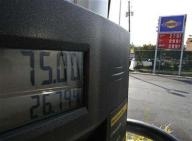
Experts say members of Congress may now get an earful as they return home for the Thanksgiving holiday next week to voters facing forecasts that average U.S. gasoline prices will hit new records above $3.20 a gallon.

"The pressure that is mounting on Congress is tremendous," said Tim Greeff, deputy legislative director for the League of Conservation Voters. "With oil prices where they are, they are going to hear about it from constituents."

Concerns about supplies ahead of the Northern Hemisphere winter helped push oil prices up more than 40 percent since mid-August to near $100 a barrel.

The run-up means consumers in the world's biggest economy -- already on shaky footing from the growing subprime credit crisis -- will likely face another rise in fuel costs, with home heating oil prices hitting a record $3.21 a gallon on Thursday.

Democratic congressional leaders, who want to pass the legislation by the end of the year, say the issue is taking on greater urgency as the economic impact of U.S. oil dependence adds to environmental concerns.

"For all the reasons that relate to our environment and global warming, well that's one thing," House Speaker Nancy Pelosi told reporters. "Now this is a pocketbook issue as well."

ECONOMIC WORRIES

Though plans were fluid, Democratic leaders were likely to try to pass identical energy bills in the House of Representatives and Senate to avoid the bruising House-Senate bargaining process that has kept talks frozen so far.

The bill was likely to include a tax package that could divert billions of dollars of incentives away from major oil and gas companies toward renewable energy sources, said Sen. Max Baucus, chairman of the Senate Finance Committee.

The shape and size of the tax package was still fluid. Analysts said it was closer in size to a $16 billion package passed by the House in August than a $32 billion tax bill Senate Democrats dropped from their bill in June.

The Senate energy bill is also seeking to increase the fuel efficiency of cars and light trucks by 10 miles per gallon to 35 mpg by 2020, in what would be the first substantive increase in 30 years.

Critics charge the bill could prove a drag on the U.S. economy. According to a study commissioned by the American Petroleum Institute from CRA International, the plans could cause a net loss of $1 trillion to U.S. economic output and reduce U.S. crude oil production by more than 6 percent by 2015.

"With $100 a barrel oil and gasoline prices going through the roof, you would expect that the leadership of Congress would be trying to do something to help bring down those prices at the pump," said Sen. Jon Kyl, an Arizona Republican.

Bangladesh cyclone kills more than 600

Randeep Ramesh in Delhi
Friday November 16, 2007
Guardian Unlimited


Relief workers today struggled to reach devastated parts of Bangladesh after a powerful cyclone ripped through the country, leaving a trail of destruction that claimed more than 600 lives.

Cyclone Sidr hit the country's south-west coast yesterday after racing up the Bay of Bengal at a speed of 150mph. The winds triggered a five metre (15ft) high tidal wave that washed away three coastal towns.

The government's disaster agency put the confirmed number of dead at 606, but there were fears the death toll would rise considerably.

United News of Bangladesh - which has reporters deployed across the devastated region - said its own count in each affected district took the toll to 1,100.

More than 600,000 people were forced to evacuate their homes to escape the winds and driving rain.

The fury of the cyclone levelled villages, destroyed crops and sent telephone poles whirling into the sky across a dozen districts abutting the sea.

According to reports, many towns in the countryside - where homes are often shacks made of bamboo and tin - were blown away in the cyclone.

Power and telephone lines were cut across the country for most of yesterday, hampering relief operations.

"I cannot describe how devastating it was," Mollik Tariqur, a businessman in the south-western district of Bagerhat, one of the worst-hit areas, told the AFP news agency.

"It was like doomsday, the most frightening five hours of my life. I thought I would never see my family again. There is a trail of destruction everywhere. We can't even detect where our houses were - only a few are left and they do not have roofs."

Aid agencies struggled to get relief to the devastated areas, even though much of Sidr's strength had dissipated. Late last night, the country's meteorologists had downgraded the cyclone late last night to a tropical storm, its wind speed falling to 37mph.

Heather Blackwell, the head of Oxfam in Bangladesh, said the cyclone would hit poorest people hardest.

"Many people live on sandbanks in the river delta, which can be easily flooded by tidal surges," she said. "A cyclone this strong can wash away the sandbanks, forcing families to abandon their homes, livestock and crops".

Vince Edwards, the Bangladesh director of the Christian aid group World Vision, told Reuters debris from the storm had blocked roads and rivers, making it difficult to reach all the areas that had been hit.

"There has been lot of damage to houses made of mud and bamboo, and about 60% to 80% of trees [in affected parts] have been uprooted," he said.

The UN Office for the Coordination of Humanitarian Affairs told reporters 1,000 fishermen were missing.

The Bangladesh navy has launched a search and rescue operation, while helicopters have begun ferrying relief supplies to offshore islands, according to the defence ministry.

The UN World Food Programme has started to distribute 98 tonnes of high-energy biscuits to storm victims.

Bangladesh, a low-lying delta region, is used to floods and cyclones. Entire villagers had been moved to safety in preparation for Sidr.

It may have benefited from experience. Sidr was considered similar in strength to a 1991 storm that killed an estimated 130,000 people. Twenty years earlier, half a million people had died in a storm.

Last night, Bangladesh's main port, Chittagong - which handles 80% of external trade - reopened after two days. "We have [resumed] normal operations at the port as the storm crossed the coast overnight," a senior official told Reuters.

In the country's capital, Dhaka, Zia international airport reopened after 20 hours as the subsiding cyclone moved towards Assam, in India.

Bangladesh's enormous neighbour escaped the worst of the storm. Mortaza Hossain, a government minister in West Bengal, said just 100 mud houses in a forest close to Bangladesh had been damaged.

Around 100,000 villagers in coastal areas of West Bengal would return home after being evacuated to 69 temporary camps, he added.

Thursday, November 15, 2007

Millions to evacuate as cyclone slams into Bangladesh

CNN.com

DHAKA, Bangladesh (AP) -- A powerful cyclone slammed into Bangladesh on Thursday night, tearing down flimsy houses, toppling trees and power poles, and forcing hundreds of thousands to flee their homes in the low-lying nation.
art.cyclone.ap.jpg

Residents of Barisal, Bangladesh, shelter against the rain Thursday as Tropical Cyclone Sidr approaches.

Tropical Cyclone Sidr swept in from the Bay of Bengal packing winds of 149 mph (240 kilometers per hour), buffeting southwestern coastal areas within a 155-mile radius of its eye with heavy rain and storm surges predicted to reach 20 feet high.

Sidr's eye crossed the Khulna-Barisal coast near the Sundarbans mangrove forests around 9:30 p.m. (11:30 a.m. ET), the Bangladesh Meteorological Department said. It was centered over the Baleshwar River in Barguna district.

In the coastal districts of Bagerhat, Barisal and Bhola, residents said the storm flattened thousands of flimsy straw and mud huts, and uprooted trees and electric poles.

"We sitting out the storm by candlelight," resident Bishnu Prashad said by phone from Bagerhat.

At least 620,000 people had moved into official shelters and 3.2 million people were expected to be evacuated in all, said Ali Imam Majumder, a senior government official in Dhaka. Video Watch rush to evacuate as Sidr approaches »

No casualties were immediately reported, but rescue teams were on standby, forest official Mozharul Islam said in Khulna.

Communications with remote forest areas and offshore islands were temporarily cut off.

"We have taken all precautions," Majumder said.

Bangladesh, a low-lying delta nation, is prone to seasonal cyclones and floods that cause huge losses of life and property. The coastal area bordering eastern India is famous for the mangrove forests of the Sundarbans, a world heritage site that is home to rare Royal Bengal Tigers.

The Meteorological Department had put the country's three major maritime ports -- Chittagong, Mongla and Cox's Bazar -- on the highest level of alert.

Ferry service and flights were halted across the coastal region.

Ships were warned to return to shore. Volunteers helped evacuate villagers to cyclone shelters, built of concrete on raised pilings. Some took refuge in "mud forts" built along the coast to resist tidal surges.

Schools, mosques and other public buildings were also turned into makeshift shelters.

Many of the fishing boats in the region's coastal waters put down anchor at nearby shoals and islets that dot the South Asian country's shoreline.
The sea resort of Cox's Bazar was deserted after Wednesday's warning. Dozens of tourists were stranded in the offshore coral atoll of St. Martins as rough seas forced cruise boats and ships to stay ashore.

Court tosses new fuel standards for SUVs, trucks, cites threat of global warming

SF Chronicle

Matthew Yi, Chronicle Sacramento Bureau


(11-15) 12:23 PST Sacramento - --

The Ninth U.S. Circuit Court of Appeals today tossed new federal fuel economy standards for some sport utility vehicles, minivans and light trucks, arguing that regulators failed to properly assess the risk of global warming and that the new rules didn't include larger SUVs and trucks.

The decision is a huge win for several environmental groups and 11 states that argued that the National Highway Traffic Safety Administration's new fuel economy standards, announced in March 2006, ignored the effects of carbon dioxide emissions.

Currently, those vehicles are required to achieve 22.2 mpg for 2007 models. The new standards would have boosted that requirement to 24.1 mpg by 2011.

But the Center for Biological Diversity petitioned the federal appeals court a month after the new standards were revealed, arguing that a38 mpg benchmark can be readily achieved by 2015.

Since then, other environmental groups, including Sierra Club, and 11 states led by California have joined the petition asking the federal regulators to come up with a new standard that considers global warming impacts.

"The court decision is a rebuke to the Bush administration and its refusal to make meaningful steps to reduce global warming pollution from our automobiles," said Pat Gallagher, director of environmental law at Sierra Club. "The decision tells the National Highway Traffic Safety Administration that it can't monkey the numbers when it sets fuel economy standards by ignoring the cost of carbon emissions."

The court decision is the latest evidence of mounting pressure on the White House to address global warming.

Last week, Gov. Arnold Schwarzenegger filed a lawsuit against the U.S. Environmental Protection Agency in an effort to force the federal agency to grant a waiver that would allow the Golden States to require automobile manufacturers to sell more fuel efficient vehicles starting next year.

E-mail Matthew Yi at myi@sfchronicle.com.

Ships' CO2 'twice that of planes'

By Matt McGrath
Environment reporter, BBC News

Tanker in Singapore
Some 90,000 ships ply the world's oceans
Global emissions of carbon dioxide from shipping are twice the level of aviation, one of the maritime industry's key bodies has said.

A report prepared by Intertanko, which represents the majority of the world's tanker operators, says emissions have risen sharply in the past six years.

Previous International Maritime Organisation estimates suggested levels were comparable with those of planes.

Some 90,000 ships from tankers to small freighters ply the world's oceans.

Clampdown considered

Intertanko says its figures are the most realistic estimation of the current levels of CO2 from ships.

Its estimate suggests that the world's shipping uses between 350 and 410 million tonnes of fuel each year, which equates to up to 1.2 billion tonnes of carbon dioxide emissions.

Intertanko says that growth in global trade coupled with ships burning more fuel to deliver freight faster has contributed significantly to the increase.

Dragos Routa, the technical director of Intertanko, told the BBC the figures were a work in progress but the levels of emissions had risen sharply.

While there are few accurate measures and even fewer restrictions on the amounts of carbon dioxide that ships can emit at present, governments in many parts of the world are considering a clampdown as part of their efforts to tackle global warming.

But Mr Routa argued that the much greater tonnage carried by each vessel, compared with aircraft, meant that shipping was still a much greener form of transporting freight around the globe.

Unravelling the sceptics

By Richard Black
Environment correspondent, BBC News website

Rubik's cube. Image: AP
Deciphering the positions of climate sceptics can be a puzzle
What do "climate sceptics" believe?

You might think that you know the answer, having heard, seen and read numerous counter-blasts aimed at the Intergovernmental Panel on Climate Change (IPCC) over the course of this year, as the three components of its landmark climate assessment were published.

Despite having reported on climate change for more than a decade, I realised at the beginning of the year that I was not entirely sure.

On a sceptic's blog I would read "global warming isn't happening". Then I would read an op-ed saying "warming is happening but it's entirely natural". Later, someone would tell me "it is happening, it is caused by greenhouse gases, but the effect is so small it won't matter".

Either there was a genuine divergence in the views of the sceptical science community, I concluded, or their analyses were somehow getting scrambled in transmission through blogs, newsletters, and the mainstream media.

I hope it will scotch the view that sceptical scientists generally believe the Earth's surface is not getting warmer

What sceptics believe is an important question, because their voices are heard in governments, editors' offices, boardrooms, and - most importantly - the street.

Their arguments sway the political approaches of some important countries, notably the US, which in turn influence the global discussions on whether to do anything about rising CO2 levels.

So I decided I had better try to find out.

Into the ether

The best approach seemed to be the simplest - just ask them. But first I had to define who I meant by "them".

Rather than choosing a group of people myself, I decided to use a group which had already been compiled by sceptics' organisations.

In April 2006, a group of 61 self-styled "accredited experts in climate and related scientific disciplines" wrote an open letter to Canada's newly elected prime minister, Stephen Harper, asking his government to initiate hearings into the scientific foundations of the nation's climate change plan.

The letter, complete with a list of signatories, was published in Canada's Financial Post newspaper.

Many, though not all, of the signatories were indeed scientists active in fields relating to climate science. And the group was large enough to suggest I might receive a workable number of replies.

So I compiled a questionnaire about their views on climate change science, with a dose of politics thrown in, and mailed it out.

I cannot guarantee that all 61 received it; I was unable to obtain contact details for one person, and was less than certain that I had correct details for three of the others.

On the other hand, I was fairly sure that the questionnaire would be spread through the blogosphere and - what should we call it? - the emailosphere? - which turned out to be so.

Filling in

I went into this exercise not completely knowing what to expect; I guessed I would receive a wide variety of responses, and I was right.

Fourteen of the group filled in the questionnaire, in varying degrees of detail; another 11 replied without filling it in.

Of these, some sent links to articles explaining their position. Some replied with academic papers, for which I am grateful, especially to Doug Hoyt who mailed a number of references that I had not previously seen.

Some said this was a worthwhile exercise. Some, in circulated emails, said the opposite, in terms which were sometimes so frank that others of the group apologised on their behalf.

Down to details

London city scene

So to the results. Ten out of the 14 agreed that the Earth's surface temperature had risen over the last 50 years; three said it had not, with one equivocal response.

Nine agreed that atmospheric levels of greenhouse gases such as carbon dioxide, methane and nitrous oxide had risen over the last century, with two saying decidedly that levels had not risen. Eight said that human factors were principally driving the rise.

Twelve of the fourteen agreed that in principle, rising greenhouse gas concentrations should increase temperatures.

But eight cited the Sun as the principal factor behind the observed temperature increase.

And nine said the "urban heat island" effect - where progressive urbanisation around weather stations has increased the amount of heat generated locally - had affected the record of historical temperatures.

Eleven believed rising greenhouse gas concentrations would not result in "dangerous" climate change, and 12 said it would be unwise for the global community to restrain production of carbon dioxide and the other relevant gases, with several suggesting that such restraint would bring economic disruption.

Ice core.  Image: L. Augustin/LGGE

One of my more gracious respondents, Arthur Rorsch, suggested that rising CO2 might help "green" the world, with increases in food supply.

There was general disdain for the Kyoto Protocol, with respondents split roughly equally between saying it was the wrong approach to an important issue, and a meaningless exercise because there was no point in trying to curb emissions.

There was general agreement, too, that computer models which try to project the climate of the future are unreliable. Several respondents said the climate system was inherently unpredictable and therefore impossible to model in a computer.

The other questions produced sets of responses which I could not boil down into anything approaching a consensus view.

Warm agreement

I do not think that anyone would take this exercise as a comprehensive assessment of the views of climate sceptics, which is probably an impossible task.

They are a disparate community, and if you put any two together they would surely disagree on some aspect of the science - just as would any two researchers you picked out from any discipline.

NEC's Earth Simulator supercomputer (Image: NEC)

But I hope it provides a snapshot of where the scientific disagreements that sceptics have with the IPCC begin and end - for one thing, scotching the view (prevalent in my in-box) that sceptical scientists generally believe the Earth's surface is not really getting warmer.

The IPCC and many of the world's climate scientists would, of course, profoundly disagree with the conclusions evidenced by this small group, and I have linked to some articles which detail some of the science behind their disagreement.

This exercise would not be complete without discussing some of the non-scientific comments and responses to my mailout, which represent a window into the suspicion, indignation and politicisation surrounding climate science today.

That, though, is for later in the week.

Video

"Manufactured Landscapes" SEE THIS BRILLIANT MOVIE! You'll never have the same shopping experience again.