Thursday, November 15, 2007

NASA Sees Arctic Ocean Circulation Do an About-Face

rom: NASA - JPL

/climate/article/25109

PASADENA, Calif. – A team of NASA and university scientists has detected an ongoing reversal in Arctic Ocean circulation triggered by atmospheric circulation changes that vary on decade-long time scales. The results suggest not all the large changes seen in Arctic climate in recent years are a result of long-term trends associated with global warming.

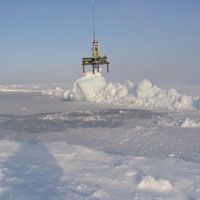
The team, led by James Morison of the University of Washington's Polar Science Center Applied Physics Laboratory, Seattle, used data from an Earth-observing satellite and from deep-sea pressure gauges to monitor Arctic Ocean circulation from 2002 to 2006. They measured changes in the weight of columns of Arctic Ocean water, from the surface to the ocean bottom. That weight is influenced by factors such as the height of the ocean's surface, and its salinity. A saltier ocean is heavier and circulates differently than one with less salt.

The very precise deep-sea gauges were developed with help from the National Oceanic and Atmospheric Administration; the satellite is NASA's Gravity Recovery and Climate Experiment (Grace). The team of scientists found a 10-millibar decrease in water pressure at the bottom of the ocean at the North Pole between 2002 and 2006, equal to removing the weight of 10 centimeters (four inches) of water from the ocean. The distribution and size of the decrease suggest that Arctic Ocean circulation changed from the counterclockwise pattern it exhibited in the 1990s to the clockwise pattern that was dominant prior to 1990.

Reporting in Geophysical Research Letters, the authors attribute the reversal to a weakened Arctic Oscillation, a major atmospheric circulation pattern in the northern hemisphere. The weakening reduced the salinity of the upper ocean near the North Pole, decreasing its weight and changing its circulation.

"Our study confirms many changes seen in upper Arctic Ocean circulation in the 1990s were mostly decadal in nature, rather than trends caused by global warming," said Morison.

"While some 1990s climate trends, such as declines in Arctic sea ice extent, have continued, these results suggest at least for the 'wet' part of the Arctic -- the Arctic Ocean -- circulation reverted to conditions like those prevalent before the 1990s," he added.

The Arctic Oscillation was fairly stable until about 1970, but then varied on more or less decadal time scales, with signs of an underlying upward trend, until the late 1990s, when it again stabilized. During its strong counterclockwise phase in the 1990s, the Arctic environment changed markedly, with the upper Arctic Ocean undergoing major changes that persisted into this century. Many scientists viewed the changes as evidence of an ongoing climate shift, raising concerns about the effects of global warming on the Arctic.

Morison said data gathered by Grace and the bottom pressure gauges since publication of the paper earlier this year highlight how short-lived the ocean circulation changes can be. The newer data indicate the bottom pressure has increased back toward its 2002 level. "The winter of 2006-2007 was another high Arctic Oscillation year and summer sea ice extent reached a new minimum," he said. "It is too early to say, but it looks as though the Arctic Ocean is ready to start swinging back to the counterclockwise circulation pattern of the 1990s again."

Morison cautioned that while the recent decadal-scale changes in the circulation of the Arctic Ocean may not appear to be directly tied to global warming, most climate models predict the Arctic Oscillation will become even more strongly counterclockwise in the future. "The events of the 1990s may well be a preview of how the Arctic will respond over longer periods of time in a warming world," he said.

Grace monitors tiny month-to-month changes in Earth's gravity field caused primarily by the movement of water in Earth's land, ocean, ice and atmosphere reservoirs. As such it can infer changes in the weight of columns of ocean water. In contrast, the pressure gauges installed on the sea floor in 2005-2006 directly measured water pressure at the bottom of the ocean. Gauge data were remotely recovered during the first year of the study.

"The close agreement between the North Pole pressure gauges and Grace data demonstrates Grace's potential for tracking world ocean circulation," said study co-author John Wahr of the University of Colorado, Boulder.

"Satellite altimeters, such as NASA's Jason, are ideal for studying ocean circulation but can't be used at Earth's poles due to ice cover," said study co-author Ron Kwok of NASA's Jet Propulsion Laboratory, Pasadena, Calif. "Our results show Grace can be a powerful tool for tracking changes in the distribution of mass in the Arctic Ocean, as well as its circulation."

Grace is a partnership between NASA and the German Aerospace Center (DLR). The University of Texas Center for Space Research, Austin, has overall mission responsibility. JPL developed the twin satellites. DLR provided the launch, and GeoForschungsZentrum Potsdam, Germany, operates Grace. For more on Grace: http://www.csr.utexas.edu/grace/ .

The study was funded by the National Science Foundation.

Other media contacts for this study include: Peter West, National Science Foundation, Arlington, Va., 703-292-7761, pwest@nsf.gov ; and Jim Scott, University of Colorado, 303-492-3114, Jim.Scott@colorado.edu .

Researchers Name the World's Dirtiest Power Plants, Introduce Website

http://www.commondreams.org


by Haider Rizvi

NEW YORK - A new study by an independent think tank names and shames the power companies responsible for high levels of carbon dioxide (CO2) emissions in the United States and abroad.1115 03

Releasing its findings Wednesday, the Washington, DC-based Center for Global Development (CDG) said that electricity generation is responsible for one quarter of the world's total CO2 emissions - the main cause of global warming - and U.S. power plants account for fully 25 percent of the emissions generated by the power sector worldwide.

A dozen power plants in the United States were singled out as the "worst" CO2 emitters; six of which are located in just three states - Georgia, Texas, and Indiana. All 12 are coal-fired plants.

Based on the first-ever inventory of the world's 50,000 power stations, the Center's research shows that in the United States the biggest CO2 emitter is Southern Co., which annually releases 172 million tons into the atmosphere.

The second largest polluter is American Electric Power Company Inc., followed by Duke Energy Corporation and AES Corporation. The Center has listed all the other names on its new Carbon Monitoring for Action (CARMA) Web site.

"CARMA makes information about power-related CO2 emissions transparent to people throughout the world," said Dr. David Wheeler, a senior researcher at the Center and leader of the team that compiled the data on power stations.

Wheeler hopes that investors, insurers, lenders, and environmental experts will use the CARMA data to encourage power companies to turn to renewable and clean energy sources, such as wind and solar.

"It is unique, one of a kind - a world standard," said CGD president Nancy Birdsall of CARMA. "Never before has this kind of information been made available on a global scale. Not only it is likely to catalyze action to cut emissions now, it also strengthens the knowledge base for monitoring any future market-based agreement."

Birdsall may be right, as the Center's early research is already being used by environmental communities and lenders in the power sectors in large developing nations, such as Indonesia and China.

CARMA reveals that, on a per capita basis, Australia has become the world's number one carbon emitter in the power sector, although, in overall terms, the United States still remains the largest polluter.

The list of emitters shows that, on average, each individual in the United States is responsible for no less than 9 tons of emissions per year, whereas the average Australian's emissions amount to about 11 tons in the same span of time.

According to the CARMA database, populous developing nations have far lower per capita emissions than the richest countries. For example, the average Chinese citizen produces just 2 tons of CO2 emissions from power generation annually, and Indians emit only half a ton per person per year.

In terms of total CO2 output, however, China is the only country to approach the 2.8 billion tons of CO2 produced annually by the U.S. power sector.

Following China (2.7 billion tons) on the list are Russia (661 million tons); India (583 million tons); Japan (400 million tons); Germany (356 million tons); Australia (226 million tons); South Africa (222 million tons); the UK (212 million tons); and South Korea (185 million tons).

Though the United States and Australia are, in their respective categories, the world's largest emitters of CO2, both countries remain reluctant to join any international pact to agree on definite cuts in emissions. Neither has signed nor seems willing to endorse the 1997 Kyoto treaty, which is due to expire in 2012.

That, despite the fact that there is no longer any serious doubt among climate scientists that greenhouse gas emissions from human activity are altering the Earth's climate.

In fact, now there is also broad consensus that controlling emissions will require so-called "carbon pricing," a market-based system whereby carbon polluters are charged a fee and those who help clean carbon from the atmosphere reap economic benefits.

CGD's Wheeler said he wants to see the world community set up an institution to collect, verify, and publicly disclose information about emissions from all significant global carbon sources.

In his view, this would help implement a market-based system to regulate emissions from every source worldwide. "This would help reduce carbon emissions by focusing stakeholder pressure on major emitters and providing reputational rewards for clean producers."

© 2007 One World

OPEC Must Tackle Climate Change: U.N. Official

/health/article/25108

RIYADH (Reuters) - OPEC oil exporters must take climate change seriously at a summit meeting this week, ahead of a key meeting to tackle global warming in Bali next month. a leading U.N. climate change official said on Thursday.

"I encourage OPEC to contribute to climate change abatement and to play an important role in history to drive forward sound solutions to a global problem," Yvo de Boer, executive secretary of the United Nations Framework Convention on Climate Change, told an OPEC forum in the Saudi capital.

"They should continue to take climate change seriously," he said of OPEC heads of state, due to meet in Riyadh on Saturday and Sunday. "International action on climate change is a war against emissions, not a war against oil."

The Organization of the Petroleum Exporting Countries includes many of the world's top oil producers, whose economies are booming as world energy prices soar to record levels.

De Boer said December's U.N. climate change conference in Bali, where negotiations on a new international climate change regime are to be launched, will be a make-or-break point for international efforts to stop the planet heating up.

"If things go wrong in Bali then we really are in deep trouble. If you get a wake-up call from science now and don't act on it then that means you are in trouble," he said, describing climate change as the most complicated issue facing the international community.

"There are strong signals that countries are willing to advance negotiations in Bali and come to a negotiating agenda."

But the U.N. climate chief said a solution must not cripple the developing world economies and that nuclear energy would be key to handling the problem.

"I really feel we have to accept economic growth and the desire to eradicate poverty as a reality," he said.

"I have not seen a credible scenario to reverse climate change that doesn't involve nuclear," he said, citing the future energy needs of China and India, which each have populations of over one billion.

(Reporting by Andrew Hammond)

Monday, November 12, 2007

Volcanoes could have caused dinosaur deaths

Growing body of evidence suggests extinction came from climate change

New research suggests that volcanoes that erupted between 63 million to 67 million years ago may have contributed to a mass dinosaur extinction.

Nicolle Rager / National Science Foundation

By Charles Q. Choi

Instead of being driven to extinction by death from above, dinosaurs might have ultimately been doomed by death from below in the form of monumental volcanic eruptions.

The suggestion is based on new research that is part of a growing body of evidence indicating a space rock alone did not wipe out the giant reptiles.

The Age of Dinosaurs ended roughly 65 million years ago with the K-T or Cretaceous-Tertiary extinction event, which killed off all dinosaurs save those that became birds, as well as roughly half of all species on the planet, including pterosaurs. The prime suspect in this ancient murder mystery is an asteroid or comet impact, which left a vast crater at Chicxulub on the coast of Mexico.

Another leading culprit is a series of colossal volcanic eruptions that occurred between 63 million to 67 million years ago. These created the gigantic Deccan Traps lava beds in India, whose original extent may have covered as much as 580,000 square miles (1.5 million square kilometers), or more than twice the area of Texas.

Arguments over which disaster killed the dinosaurs often revolve around when each happened and whether extinctions followed. Previous work had only narrowed the timing of the Deccan eruptions to within 300,000 to 500,000 years of the extinction event.

Now research suggests the mass extinction happened at or just after the biggest phase of the Deccan eruptions, which spewed 80 percent of the lava found at the Deccan Traps.

"It's the first time we can directly link the main phase of the Deccan Traps to the mass extinction," said Princeton University paleontologist Gerta Keller.

Clues in other life forms
Keller and colleagues focused on marine fossils excavated at quarries at Rajahmundry, India, near the Bay of Bengal, about 600 miles (1,000 kilometers) southeast of the center of the Deccan Traps near Mumbai. Specifically, they looked at the remains of microscopic shell-forming organisms known as foraminifera.

"Before the mass extinction, most of the foraminifera species were comparatively large, very flamboyant, very specialized, very ornate, with many chambers," Keller explained. These foraminifera were roughly 200 to 350 microns large, or a fifth to a third of a millimeter long.

These showy foraminifera were very specialized for particular ecological niches.

"When the environment changed, as it did around K-T, that prompted their extinction," she added. "The foraminifera that followed were extremely tiny, one-twentieth the size of the species before, with absolutely no ornamentation, just a few chambers." As such, these puny foraminifera serve as very distinct tags of when the K-T extinction event started.

The researchers found these simple foraminifera seem to have popped up right after the main phase of the Deccan volcanism. This in turn hints these eruptions came immediately before the mass extinction, and might have caused it.

Double trouble
Both an impact from space and volcanic eruptions would have injected vast clouds of dust and other emissions into the sky, dramatically altering global climate and triggering die-offs. Keller's collaborator, volcanologist Vincent Courtillot at the Institute of Geophysics in Paris, noted upcoming work from her collaborators suggests the Deccan eruptions could have quickly released 10 times more climate-altering emissions than the nearly simultaneous Chicxulub impact.

Keller stressed these findings do not deny that an impact occurred around the K-T boundary, and noted that one or possibly several impacts may have had a hand in the mass extinction. "The dinosaurs might have faced an unfortunate coincidence of a one-two punch—of Deccan volcanism and then a hit from space," she explained. "We just show the Deccan eruptions might have had a significant impact — no pun intended."

Although paleontologist Kirk Johnson at the Denver Museum of Nature and Science called these new findings "significant," he noted a great deal of evidence connected a single massive impact with the K-T extinction event. He suggested that advances in radioisotope dating could now hone down when the Deccan eruptions occurred to within 30,000 to 65,000 years. "That could help put to bed some of the disputes regarding the issue," he said.

Keller and her collaborator Thierry Adatte at the University of Neuchatel in Switzerland detailed their findings Oct. 31 at the annual meeting of the Geological Society of America in Denver.
© 2007 LiveScience.com. All rights reserved.

The profitable business of CO2 offsets

By Lisa Kassenaar

Nov. 7 (Bloomberg) -- Bill Townsend, a one-time Texas oilman, gazes
up at a dark-red smokestack jutting from the cracked clay of southern
Colorado and shakes his head. The chimney is connected to a small
plant that processes natural gas from the surrounding plains. About
25 percent of the gas is methane, which is separated out and sold to
Colorado Interstate Gas Co. Most of the rest is carbon dioxide,
which, on this August morning, climbs the stack and pours into the
cobalt-blue sky.
This plant, the brainchild of Townsend and his partner, Greg Spencer,
is ready to sell its CO2, a major cause of global warming. Yet $7
million in new equipment to ship the gas sits idle because oil
company BP Plc has yet to open part of a 400- mile (644-kilometer)
pipeline that will take it to West Texas.
There, Townsend and Spencer's plan is to bury the CO2 in aging oil
wells. ``All our money now is going up that pipe,'' Townsend says.
Townsend and Spencer, who met in a Utah Bible study group in 1985,
are wildcatters of the CO2 era. Like American oil prospectors of a
century ago, they comb the country for environmental projects that,
one day, may gush profit.
The two Christian capitalists say they've found their mission: They
help companies cut greenhouse gas emissions and then take a cut of
the profit. They've signed contracts with more than a dozen companies
giving them a share of earnings when captured emissions, mostly CO2,
sell in the fledgling U.S. carbon trading market.
Buying `Offsets'
In that market, greenhouse gases that have been diverted from the
atmosphere are packaged as pollution credits, known in the U.S. as
``offsets,'' and are bought or sold by the metric ton. Since 2001,
Townsend and Spencer's company, Salt Lake City- based Blue Source
LLC, has quietly amassed the largest collection of offsets in the
country, about 270 million metric tons.
They have projects in 45 states, including efforts to bury CO2 from
power plants, capture methane from rotting pig waste and mountains of
garbage and curb pollution from trucks by shifting cargo to railroads.
``There's a biblical mandate to care for the planet that we have
failed, as a culture and as followers of Christ, to do effectively,''
Spencer, 50, says. ``This opportunity is a privilege. The success is
a blessing.''
Offsets trade in the U.S. even though President George W. Bush in
2001 pulled the country out of the Kyoto Protocol, a climate
agreement that creates a cap-and-trade program to reduce global
carbon emissions. In cap and trade, governments allow polluting
companies a set level of annual emissions. Companies then may buy
offset credits -- representing tons of emissions that haven't gone
into the atmosphere -- to atone for any additional pollution.
Voluntary Market
U.S. companies, though not burdened by federally mandated caps, trade
pollution credits to meet their own environmental goals, according to
EcoSystem Marketplace, a Washington-based research group. The
voluntary market grew 200 percent in 2006 to about $91 million, the
group says. As public concern about climate change ramps up, the U.S.
Congress is considering 12 bills proposing a federally regulated
cap-and-trade system.
Blue Source, which both builds physical infrastructure to create
offsets and sells them to other companies, marks a new wave of U.S.
carbon entrepreneurship. The big money is already moving in:
Blackstone Group LP's advisory unit signed Blue Source as one of its
smallest clients in April 2006, the day after hearing Townsend and
Spencer's story.
``Bill and Greg are the real deal,'' says Erik Katz, senior managing
director at the New York-based firm. ``Blue Source is well positioned
to be a key architect in the development of the carbon highway. They
have been able to thread the needle between financial gain and social
conscience.''
First Reserve Buys In
Katz hooked up Blue Source with First Reserve Corp., the world's
biggest energy-focused private equity firm, which acquired 50 percent
of the company for an undisclosed sum in September 2006.
As part of the agreement, First Reserve will make up to $1 billion
available to Blue Source for new projects. Already, Tyson Foods Inc.,
the biggest U.S. meat and poultry processor, and trucker J.B. Hunt
Transport Services Inc. are on Blue Source's client list.
As of October, forward sales contracts were up 350 percent from a
year earlier, and profit for 2007 will be about $5 million, Spencer
says. ``We feel we have a lead on how this is going to be done,''
Townsend says. ``The carbon economy is going to happen on a grand
scale.''
Nonprofit Registry
Blue Source's offsets exist as numbers on a computer screen, much
like money looks in a bank account. About 45 million metric tons are
on registries such as Washington-based Environmental Resources Trust
Inc., a nonprofit that lists credits from more than 20 sources,
including News Corp. and Nike Inc.
The rest are managed out of Blue Source's office in a Salt Lake City
business park with little more than a spreadsheet identifying offsets
by date and category: energy and power, transportation, agriculture.
Offset verification, which confirms that an activity avoided
pollution, is typically shown with an engineering report.
Customers who come to Blue Source usually sign up to buy groups of
credits over time, Spencer says, and Blue Source's supply agreements
guarantee that it will have new offsets flowing in until 2022. Buyers
include New York-based securities firm Cantor Fitzgerald LP and New
Orleans-based Entergy Corp., the second-biggest U.S. operator of
nuclear power plants.
One large financial services firm that phoned Blue Source in early
October wants to secure prices now for offsets to be delivered after
2012, Spencer says. Blue Source now usually sells its offsets for
$4-$6 a ton.
$30 Per Credit
That price could shoot up to $30 or more, in line with trading in
Europe's government-regulated market, if Washington caps U.S.
emissions, says Jon Anda, a former Morgan Stanley vice chairman who
heads the Environmental Markets Network for New York-based
Environmental Defense.
``It'll be like lighting a match to methane,'' says Anda, who, as a
banker, worked on Google Inc.'s initial public offering. ``The
dollars invested now will go to the moon.''
In Washington, more Republicans now recognize climate change as an
issue in the 2008 race for the White House, says Blythe Masters, head
of JPMorgan Chase & Co.'s global commodities group. She testified to
a Senate committee on the subject in July.
California and 11 Northeast states are discussing their own
cap-and-trade programs. Charlotte, North Carolina-based Duke Energy
Corp. and San Francisco-based PG&E Corp., two of the biggest U.S.
utilities, have said they want a plan too. ``The biggest emitters are
holding up business decisions waiting to see what the rules are going
to be,'' Anda, 50, says. ``They want something soon.''
Sequestration
For Blue Source, the gamble is huge. More than half of its banked
offsets stem from reducing CO2 in the air by burying it underground,
a storage system called geologic carbon sequestration. The process is
not currently a source of tradable offsets under the Kyoto Protocol.
In addition, Blue Source has been collecting credits for six years,
and buyers are more interested in pollution credits that represent
recent saved emissions, Townsend says. That's because verification
rules are constantly evolving. Also, creators of all manner of carbon
credits in the U.S. are at the mercy of lawmakers in Washington,
who'll decide what constitutes a tradable offset.
``If only half our offsets end up qualifying, it would be a
disappointment,'' Spencer says. ``But we're positioned to do well
unless offsets aren't allowed at all.''
A `Pre-compliance' Market
Investment banks, including Goldman Sachs Group Inc. and Merrill
Lynch & Co., are already adding traders and designing securities to
sell in what they call the ``pre-compliance'' market, meaning trading
before regulations are passed. Credit Suisse, the second-biggest
Swiss bank, is so sure the global carbon market, now centered in
London, will include the U.S. that it located its main trading desk
in New York, says Paul Ezekiel, a managing director who runs the
carbon trading operation.
``People see the possibility of profit and of enormous risk,''
JPMorgan Chase's Masters says. She spends about 25 percent of her
time on building the firm's environment-related businesses. ``The
most dangerous position to be in is one of ignorance,'' she says.
Blue Source was once almost alone in the field. Now, competition is
moving in. Credit Suisse in June bought 10 percent of Dublin-based
Eco Securities Group Plc, which is working on more than 400 projects
around the world to create offsets. Some 20 of its staff are now
focused on the U.S., up from none a year ago, U.S. country director
Eron Bloomgarden says. In January, Morgan Stanley bought 38 percent
of Miami- based MGM International, which has offset projects in
China, Mexico and South America and is also accumulating credits in
the U.S.
Investing in Solar, Wind
Private equity firms, hedge funds and banks have billions of dollars
earmarked for energy projects that may generate tradable offset
credits. They're investing in solar and wind power, ethanol
production and plants that capture methane. In March, First Reserve
raised a $7.8 billion fund, of which about 10 percent will go to
alternative energy, says Glenn Payne, who oversees those deals for
the Greenwich, Connecticut-based company.
Payne helped negotiate First Reserve's Blue Source purchase, which
left Townsend, the chief executive officer, and Spencer, the
president, with 25 percent each. ``The green has George Washington on
it,'' Payne says. The timing looks even better than it did in 2006,
says Payne, an Australian who formerly worked at McKinsey & Co. ``We
thought something would shake free in Washington in the middle of the
next decade, but the discussion has started already.''
In Colorado, Blue Source is working with Manzano LLC, a gas
exploration company based in Roswell, New Mexico. Mike Hanagan, a
co-owner of Manzano, met Townsend at an oil industry conference in
Midland, Texas, in 2003, when he was designing his facility.
`A Big Picture Guy'
``Bill's a very big-picture kind of guy,'' Hanagan says. ``They kept
pushing that the big picture was greenhouse gas emissions credits.''
Hanagan was persuaded to spend an extra 30 percent on the plant,
which cost about $35 million. The additional $7 million bought a CO2
compressor and 16 miles of pipeline to funnel his CO2 into a network
that goes to Denver City, Texas. Hanagan's CO2 will be used by oil
companies to flush thick, sticky oil out of older wells, and then it
will remain underground. Blue Source consulted on the engineering and
lined up sales contracts for both the CO2 and the offsets.
On a midsummer Tuesday, Townsend and Spencer fly in and greet Hanagan
on the runway of a broken concrete airstrip outside La Veta,
Colorado, a town of 924 people. In the distance lie the Spanish
Peaks, landmarks of the Southwest that Native Americans call
Wahatoya, or ``breasts of the Earth.'' The three hop into a white
pickup truck and drive to Hanagan's plant, about three miles away.
Wasting CO2
Fourteen months after Hanagan's facility was finished, CO2 still
spills into the air. Manzano and Blue Source have been calling
everyone they know at BP to try to get the gas flowing. The
London-based oil company has been slow to respond. Says Spencer,
waving at the chimney, ``If you believe in the science of climate
change, it's hard to look at that and have it not make you sick.''
One day earlier, in 92-degree Fahrenheit (33-degree Celsius) heat,
Townsend and Spencer drive 20 minutes into a canyon north of their
Salt Lake City office for lunch on the balcony of the Silver Fork
Lodge, a 60-year-old log hotel decorated with old snowshoes and
stuffed black bears.
Brisket and Cola
On the way, they point out sheer Rocky Mountain cliffs they've
climbed over the years with their adult children. At the table, they
both order beef brisket and Coca-Cola. Then they tell their tale.
They talk for three hours, sometimes finishing each other's sentences.
Townsend, 53, grew up in Baton Rouge, Louisiana. His father worked
for Ethyl Corp., a gasoline additives company, and read the Bible
every day, Townsend says. At 18, Townsend headed to Purdue University
in West Lafayette, Indiana, and earned bachelor's degrees in
microbiology and mechanical engineering. He met his future wife,
Andrea, at Purdue. All three of their children, now aged 29, 27 and
23, are also Purdue grads.
In 1978, Townsend joined Houston-based Conoco Inc. and rose to manage
the company's Gulf Coast crude oil and liquid products pipeline
systems. Seven years later, at age 31, he joined the senior
management of Petro Source Co., a crude-oil blending company with $70
million in annual sales, and moved his family to Salt Lake City.
Among his first tasks was building Petro Source's business in refined
oil products. He laughs now about an early project selling
grass-scented green asphalt to Rocky Mountain golf clubs.
CO2 Repository
As Petro Source added oil refining and transportation to its
repertoire over a dozen years, sales rose to more than $1 billion,
Townsend says. In 1995, he took on the company's CO2 division,
pushing to spend $17.6 million on an 82-mile pipeline to carry carbon
dioxide from four natural gas plants near Val Verde, Texas, to Denver
City, the main CO2 gathering center for the U.S. domestic oil
industry.
Townsend wasn't looking to create offsets when he initiated the Val
Verde project, he says, although he did consider the environmental
gain in reusing the CO2. His long experience in the petroleum
business had taught him that one of the few commercial uses of CO2,
the bete noire of climate change, was right in front of him. For
three decades, the biggest oil companies operating in Texas,
including Exxon Mobil Corp., had been tapping the ground and building
pipelines to gather CO2 from geologic formations.
Flushing Old Oil
They shoot the gas deep into aging wells, where it adheres to trapped
oil, lowers its viscosity and helps flush it out in a process called
enhanced oil recovery, or EOR. EOR could help recover 240 billion
barrels of U.S. oil left in the ground by conventional drilling,
according to the U.S. Energy Department. Kim Gerard, an oil industry
engineer, was working in Chicago when Townsend phoned in 1997 for
help with the Val Verde pipeline.
They had been colleagues at Conoco (now ConocoPhillips), where he was
a fast-rising star, she says. She quit her job and moved to Midland,
Texas, to work for him. ``In this industry, you have to make huge
leaps of faith,'' says Gerard, who talks with a Texas twang and wears
oversized belt buckles engraved with horses and bulls.
Midland, now at the center of the U.S. oil industry, was a sleepy
West Texas rail town until May 1923, when an oil gusher blew 70 miles
away. Midland turned out to be in the heart of the Permian Basin,
which contains 22 percent of U.S. oil reserves. Former President
George H.W. Bush worked in the oil business in Midland, and his son
George W., the current president, grew up there, as did his wife
Laura.
Meeting in Midland
Gerard recalls a late night in a Midland hotel conference room in
December 1998 with Townsend and Steve Melzer, an oil industry CO2
consultant. They talked about how the Earth was heating up because of
carbon dioxide.
``At the time, there were companies that said climate change was
bull,'' Gerard says. ``We thought we could just capture this stuff
and actually make money off capturing it. It was one of those times
when you start discussing something and the juices start flowing, and
you reach a point where you go, 'This thing could become huge.' It
went on and on.''
The Val Verde pipeline was the U.S. oil industry's first system using
so-called anthropogenic, or man-made, carbon dioxide, for EOR. Buyers
were wary at first because the supply was potentially inconsistent,
Townsend says. His first sale was to Exxon at a 20 percent discount
to the market.
``We built out $13 million of the $17 million project before we had a
physical CO2 sale,'' he says. ``We were way out on a limb with the
investment and had absolutely no flow through the pipeline. It was a
very white-knuckle time.''
Cap and Trade
Concerned about revenue, Townsend took the project further. He knew
that the offset market was developing and had talked about it with
Carlton Bartels, a managing director at Cantor Fitzgerald's
environmental brokerage unit. The Kyoto Protocol was gathering
signatures, and Europe was working on developing a cap-and-trade
market.
Townsend reckoned he could earn pollution credits because his
pipeline kept CO2 from flying into the atmosphere. At the time, no
standards or contracts existed for carbon capture and storage
offsets, he says.
After a year of meetings, Townsend and Bartels secured a deal to sell
1 million tons of offsets from Val Verde to Ontario Power Generation
Inc., a Canadian public utility. ``We were inventing as we went
along,'' Townsend says. ``It was exciting and scary.''
In November 2000, the two men announced their Ontario trades at a
United Nations conference on climate change in The Hague. Townsend
expected the crowd of environmentalists to cheer, he says. Instead,
hecklers were so noisy that some were escorted out.
`We Got Booed'
``We got booed,'' Townsend says. ``People were still thinking that
selling offsets was just about moving money around. Europe still
wasn't sold on carbon trading at that point.''
As Petro Source grew, Townsend became increasingly active in Salt
Lake City's Christian community. He and Spencer belong to the
Evangelical Free Church, which sees the Bible as the inspired, final
word of God. Their church connections forged their friendship.
They raised $2 million together for Salt Lake's Intermountain
Christian School, an elementary school attended by Spencer's two
sons. Townsend was chairman of Life@Work Companies, a group advising
Christians on bringing their faith into the workplace. Spencer served
as a legal and financial adviser to the board.
Townsend is now on the board of K2 The Church, a Salt Lake City-based
congregation founded in 2002 and named for the world's second-highest
mountain, in the Himalayas. K2 attracts outdoorsy congregants with a
rock-climbing wall, pool tables and a jeans-wearing pastor who
podcasts his sermons. Spencer belongs to the Mountain Life
Evangelical Church in Park City, Utah, the ski town 31 miles from
Salt Lake City that hosted the 2002 Winter Olympics' giant slalom
competition.
M&A Lawyer
Spencer moved to Utah from Colorado as a college student because he
loved skiing in the powdery snow, he says. At the University of Utah,
he earned a bachelor's degree in environmental science and a law
degree.
In 1983, he joined American Stores Co., a food and drug retailer; 10
years later, he joined its mergers and acquisitions team. In 1999, he
took part in selling American Stores to rival Albertsons Inc. in an
$8.7 billion deal. Then he was let go, along with other senior
managers.
Spencer doesn't call himself an environmentalist. ``You don't have to
be either an environmentalist or a capitalist now,'' he says.
``There's a new concept of sustainability.'' Americans should be able
to drive SUVs and use air conditioners, he says, if they are willing
to pay for it, including accounting for the pollution they create.
Christian Connection
While Townsend brought CO2 experience to Blue Source, Spencer brought
a relentless ability to network. Shortly after founding the company
in 2001, he called Steve Graves, an Arkansan who led Life@Work, to
help land a meeting at J.B. Hunt, a Lowell, Arkansas-based
transportation company with 12,000 truckers on American highways.
In the corner office of John Roberts, a J.B. Hunt division president,
Townsend and Spencer made their pitch: They would help reduce the
trucker's carbon emissions and then pay to verify and market offset
credits they created. When the offsets were sold, they would get a
percentage of the profit.
``John was curious,'' Spencer says. ``But he was also thinking, 'Why
are you in my office talking about a market that doesn't yet
exist?''' It took 18 months to sign a contract, Spencer says. J.B.
Hunt signed on partly because the risk to the company was so low, he
adds. ``They had nothing to lose,'' he says.
Road to Rail
Blue Source began looking at the company's use of trains, which emit
only a third the carbon of trucks. By shifting long- haul shipping to
rail, J.B. Hunt soon saw an environmental benefit, says Gary Whicker,
a senior vice president in charge of engineering. Blue Source also
came up with ideas for restructuring so-called empty-mile operations,
when trucks travel with no cargo, and for reducing the amount of time
drivers' trucks stand idling -- and spewing CO2 into the air.
Once a few emission-cutting ideas were put in place, J.B. Hunt's
extensive data collection system started showing big declines in
energy use, Whicker says. The company sold its first offset credits
in partnership with Blue Source in 2005 and is now earning about
$100,000 a year from credit sales.
``Is it a big moneymaker for J.B. Hunt?'' Whicker asks. ``No. But it
opened our eyes. They gave us a free education in the carbon world.''
J.B. Hunt's customers increasingly want details of its environmental
record. ``If Blue Source hadn't been here, we'd be clueless as to
what to do in this area,'' Whicker says.
Pig Waste
In 2001, Blue Source also picked up a client in northern Arkansas:
Springdale-based Tyson. The company had already started capping the
vast pools of waste from its beef, chicken and pork slaughterhouses
with plastic covers, says Kevin Igli, Tyson's chief environmental
officer.
The system steers methane gas from the waste to a central collection
area, where some is used to power Tyson plants and the rest is flared
off. Blue Source helped Tyson do an offset trade in 2004, Igli says,
and is now advising on new projects to capture methane.
By mid-2005, Townsend and Spencer were examining dozens of potential
carbon capture projects and rapidly building their offset portfolio.
They still had just four employees. They'd funded small jobs
themselves and otherwise sought project financing. They decided they
needed a backer. ``So we called Blackstone,'' Townsend says.
Once again, Spencer's contacts were critical. While negotiating
Albertsons' buyout of American Stores in 1998, he'd worked with Katz.
Spencer arranged a meeting in New York on a Monday to get some
friendly advice. By Tuesday afternoon, Blue Source was a client.
Eager Investors
In their initial meeting in early 2006, Katz told Townsend and
Spencer they could raise more money than the few hundred million they
anticipated, says Townsend, declining to offer more specific figures.
``There has been no shortage of interest,'' Katz says. The banker set
up about 10 meetings with potential investors, including First
Reserve.
With the private equity firm's backing, Townsend and Spencer have the
resources to provide both technical and financial help to people like
Mike Hanagan, who are willing to take a chance on the future market
for pollution offsets.
For his part, Hanagan finally has his project under way. In early
September, BP allowed him to open the valve that lets his CO2 gas
stream south. The project took longer than expected to be completed
safely, according to BP spokeswoman Sarah Howell.
For Townsend and Spencer, the connection means tons of new pollution
credits to sell to future customers -- and more fuel for their
mission to make money and save the planet.
To contact the reporter on this story: Lisa Kassenaar in New York at
lkassenaar@bloomberg.net
Last Updated: November 7, 2007 00:06 EST
Six of 8 bear species at risk of extinction: group

From: Alister Doyle -Reuters

/animals/article/24387

OSLO (Reuters) - Six of the world's eight bear species are under threat of extinction after the addition on Monday of the sun bear, the world's smallest type of bear, to a "Red List" which says China's panda is most at risk.

The sun bear is threatened partly by poachers who sell its gall bladder bile in China as a traditional medicine, said the World Conservation Union which runs the list of threatened wildlife.

"Things are getting worse for all the bear species except the American black bear which is unquestionably increasing," said Simon Stuart, senior species adviser for the Union.

The addition of the sun bear to the authoritative Red List after a major review means the American black bear and the brown bear, found from Europe to Alaska, are the only two of eight species still considered robust.

The sun bear, found in Asia from Bangladesh to Borneo and weighing up to about 70 kg (150 lb), was rated "vulnerable" by experts at the Union, which comprises more than 80 governments, conservation groups and scientists.

The sun bear, named after a yellow crescent on its chest, had not previously been listed because of a lack of data. The Union said there were several thousand sun bears in the wild.

"We estimate that sun bears have declined by at least 30 percent over the past 30 years ... and continue to decline at this rate," said Ron Steinmetz, head of the Swiss-based Union's sun bear expert team.

Scientists did not change the level of threat to any other bear species. Deforestation, loss of habitat to roads and cities and poaching are among risks.

The Asiatic black bear, the sloth bear and the Andean bear were all reaffirmed as vulnerable after the reassessment of land-living bears. The polar, the only species not reassessed, is separately rated as vulnerable.

BAMBOO

Pandas were reaffirmed as endangered, one step closer to extinction than vulnerable, despite China's protection efforts for the bamboo-eaters. There are an estimated 1,000-2,000 in the wild, fewer than any other bear species.

"Even though some people have claimed that panda populations are on the rise, we still consider them endangered because too much uncertainty exists to justify changing their status to vulnerable," David Garshelis, co-chair of the Union's bear specialist group, said in a statement.

"The fact that six of eight bear species are under threat is bad news for species that are generally resilient and hang on under human pressure," Stuart told Reuters. Many bears were unfussy eaters and could live in a wide range of habitats.

The brown bear, including grizzly bears, and the American black bear are listed as of "least concern," meaning populations are robust. There are more than 900,000 black bears -- more than twice as many as all other species of bears combined.

Disaster in Black Sea as storm sinks tanker

Guardian, UK

Map: Where the spill happened

A bird covered in fuel oil

A bird covered in fuel oil sits on the shore 7km from Russia's southern port of Kavkaz. Photograph: Pavel Shevtsov/Reuters

The Black Sea region suffered its worst environmental disaster in years after an oil tanker sank in stormy weather last night.

The bodies of five seamen have been recovered and up to 18 are still missing after the storm struck 10 ships in the Strait of Kerch, which links the Black Sea and the Sea of Azov.

Crewmen aboard the Russian oil tanker, the Volganeft-139, were rescued. It split in two and spilled at least 1,300 tonnes of oil. The severe weather prevented emergency workers from collecting the oil, which authorities said was sinking to the seabed.

Another storm in the area is forecast, prompting a ban on tankers docking at the Black Sea port of Novorossiisk.

Birds covered in thick oil are being recovered on the shore.

The Ukrainian prime minister, Viktor Yanukovich, said the spill raised questions about maritime safety in the Kerch Strait.

"In the Bosphorus straits, it's not possible to use tankers without double hulls. How is the Kerch Strait different? It isn't," Reuters quoted him saying at a news conference.

Vladimir Chuprov, head of the energy department at Greenpeace, told the RIA Novosti news agency: "As a result of the oil spill into the sea, heavy elements of fuel oil will settle on the seabed and cause hydrocarbons to permeate the Sea of Azov. This will lead to a shortage of oxygen in the water, and the unique fauna will suffer greatly."

In total, 10 ships sank or ran aground in the storms, including a Russian freighter carrying metal near the port of Sevastopol. Two members of its 16-man crew drowned, and one was still missing.

Two barges loaded with fuel oil also ran aground in the area but did not leak.

Two of the freighters that sank were carrying around 6,500 tonnes of sulphur, the Russian emergency situations ministry said.

Oleg Mitvol, the head of Rosprirodnadzor, the state environmental safety watchdog, told the Russian television channel Vesti 24 that, although the sulphur did not present an environmental danger, the two freighters could leak fuel oil from their tanks, adding to the pollution.

However, Sergei Baranovsky, the president of the Green Cross environmental group, said sulphur could potentially be even more hazardous to the environment than the oil, Novosti reported.

Maxim Stepanenko, a regional prosecutor, told Vesti 24 that captains had been warned about the stormy conditions on Saturday.

He said the sunken oil tanker — designed during Soviet times to transport oil on rivers — had not been built to withstand a fierce storm.

Saturday, November 10, 2007

Spain shown perils of climate change

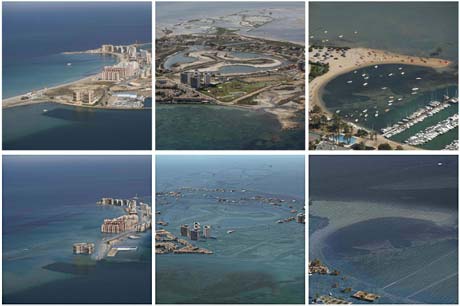
La Manga del Mar in Murcia.

Digitally retouched picture of La Manga del Mar in Murcia to show before (top) and after (below) a rise in sea level. Photograph: Pedro Armestre/AFP/Getty Images

It's an apocalyptic view of the future, a stark warning to Spain of what the country could look like if action is not taken to reduce the effects of climate change.

The warning comes in a book, Photoclima, launched this week by Greenpeace in which images of some of Spain's most emblematic places have been altered to show what they could look like in the future. Using statistics from the UN panel on climate change and a touch of digital makeup Greenpeace hopes to scare Spain into taking action.

We see the Ebro river in Zaragoza as a dried-up riverbed in 2070, by which time the fields of Valencia, which have provided Spain with oranges for centuries, will have all but disappeared. Perhaps the most dramatic image is that of La Manga de Mar Menor in Murcia, where hotels and apartment blocks abut the Mediterranean. In a few decades, according to Greenpeace, most of this will be underwater.

According to the group's director in Spain, Juan López de Uralde, the intention was not to use "scientific rigour" but to "create alarm and a call to action". Mr Uralde is highly critical of the level of debate on climate change in Spain, where he says the last few weeks have seen a "frivolous" discussion on "marginal aspects" of climate change.

For example, when Al Gore visited Spain last month to highlight the dangers of climate change, the leader of the opposition People's party, Mariano Rajoy, openly questioned his judgment.

"Listen," said Mr Rajoy, "I've brought here 10 of the world's most important scientists and not one of them can guarantee what the weather will be like tomorrow ... How can anyone say what will happen to the world in 300 years?"

Carbon output rising faster than forecast, says study

· Global warming 'will come sooner and be stronger'
· Chinese growth and loss of natural 'sinks' highlighted

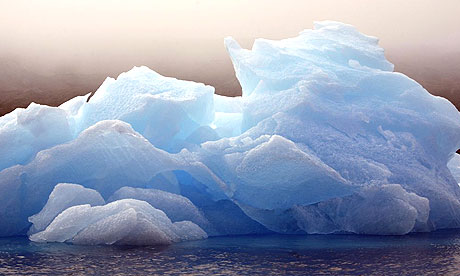
An iceberg off Ammassalik island, Greenland

Changing landscape - an iceberg off Ammassalik island, Greenland. Native people are being forced to retrain as their traditional livelihood disappears along with the ice. Photograph: John McConnico/AP

Scientists warned last night that global warming will be "stronger than expected and sooner than expected", after a new analysis showed carbon dioxide is accumulating in the atmosphere much faster than predicted.

Experts said that the rise was down to soaring economic development in China, and a reduction in the amount of carbon pollution soaked up by the world's land and oceans. It also means human emissions will have to be cut more sharply than predicted to avoid the likely effects.

Corinne Le Quere, a climate expert at the University of East Anglia and British Antarctic Survey, who helped conduct the study, said: "It's bad news because the increase in atmospheric carbon dioxide has accelerated since 2000 in a way we did not expect. My biggest worry is people are discouraged by this and do nothing. I hope political leaders will act on this, because we need to do something fast."

The study worsens even the gloomy predictions of this year's report from the Intergovernmental Panel on Climate Change. The IPCC, which shared the Nobel peace prize this month with Al Gore, said there were only eight years left to prevent the worst effects of global warming, by acting to curb emissions.

Dr Le Quere said: "We are emitting far more than anticipated when the IPCC scenarios were drawn up in the late 1990s." Global carbon dioxide emissions from fossil fuel burning has risen by an average 2.9% each year since 2000. During the 1990s the annual rise was 0.7%.

The new study explains abnormally high carbon dioxide measurements highlighted by the Guardian in January. At the time, scientists were puzzled why dozens of measuring stations across the world were showing a CO2 spike for 2006, the fourth year in the last five to show a sharp increase in the greenhouse gas.

Carbon dioxide concentration in the atmosphere is measured in parts per million (ppm); from 1970 to 2000, the concentration rose by about 1.5ppm each year; since 2000 the annual rise has leapt to an average 1.9ppm.

The new study, published in the US journal Proceedings of the National Academy of Sciences (PNAS), says three processes have contributed to this increase: growth in the world economy, heavy use of coal in China, and a weakening of natural "sinks" - forests, seas and soils that absorb carbon.

Pep Canadell, executive director of the Global Carbon Project, which carried out the research, said: "In addition to the growth of global population and wealth, we now know that significant contributions to the growth of atmospheric CO2 arise from the slowdown of natural sinks and the halt to improvements in the carbon intensity of wealth production."

The overall growth of the economy is the only one of the three factors accounted for in scientists' forecasts of climate change, which means the growth in atmospheric CO2 is about 35% larger than they expected. About half of this is down to the Chinese reliance on coal, which has forced up the carbon intensity of the overall world economy since 2000, reversing a trend of increasing energy efficiency since the 1970s. The rest of the rise is explained by the weakening of the natural carbon sinks.

Scientists assume about half of human carbon emissions are reabsorbed into the environment, but computer models predictincreased temperatures will reduce this effect. The PNAS report is the most convincing evidence so far that the global sinks have weakened over the last 50 years, though the large natural variations in carbon exchange between the earth and the atmosphere mean the team can be only 89% certain they have found an effect, short of the usual 95% confidence required to publish scientific findings.

Legal framework for carbon emission cuts

Britain will become the first country in the world to introduce legally binding targets to reduce carbon emissions in a bill announced in the Queen's speech today.

The climate change bill would create a long-term legal framework to reduce the UK's C02 emissions up until 2050.

"My government is committed to protecting the environment and to tackling climate change, both at home and abroad," the Queen said. "A bill will be brought forward to make the United Kingdom the first country in the world to introduce a legally binding framework to reduce carbon dioxide emissions."

The bill would enforce reductions of greenhouse gas emissions of at least 60% by 2050 and 26-32% by 2020, and introduce a new system of five-year carbon budgets.

It would also establish a new independent committee on climate change, which would advise the government on achieving the 2050 target and set out a sustainable programme of adaption.

The government said the bill would increase confidence and certainty for business planning and the investment in technology needed to move towards a low-carbon economy.

It would "create a new approach to managing and responding to climate change in the UK through setting ambitious targets, taking powers to help achieve them, strengthening the institutional framework, and establishing clear and regular accountability to parliament".

The introduction of the bill would enhance the operation of the Renewable Transport Fuels Obligation (RTFO), which is expected to deliver significant carbon savings from the road transport sector by increasing the use of bio fuels, the government said.

It would also provide a power to pilot local authority incentives for household waste minimisation and recycling, and "provide a strong, sustainable framework for adapting to the impacts of climate change in the UK".

Environmental groups welcomed the introduction of the legislation but urged the government to go even further and look to make cuts of 80% by 2050.

Friends of the Earth director, Tony Juniper, said: "We're delighted that the UK is set to become the first nation to introduce legislation to cut its contribution to climate change. But the government must strengthen its proposed legislation if it is to be truly effective and deliver the scale of action that scientists are now calling for."

He called for yearly targets for cuts which would deliver at least an 80% reduction in CO2 emissions by 2050, and include Britain's share of emissions from international aviation and shipping.

"If Gordon Brown toughens up this legislation, his visions of becoming a world leader in developing a low-carbon future can become a reality."

The Campaign to Protect Rural England (CPRE), which is a member of Stop Climate Chaos coalition, said that although this legislation would allow the government to set "meaningful and measurable targets", ministers should be bolder.

"Gordon Brown's announcement that the climate change committee will be asked to examine the case for an 80% cut in UK emissions by 2050 is a good start," a spokesman said. "We support the calls of a wide coalition of environmental NGOs for the climate change bill to include the UK's share of emissions from international aviation and shipping in its targets for emission reductions, and to set annual targets for reducing carbon dioxide emissions, rather than five year 'carbon budgets' as currently proposed."

The Green party's principal speaker, Caroline Lucas, said: "It's criminally irresponsible to adopt a target that not only flies in the face of science, but also undermines the UK's commitment to making a fair contribution to limiting average global temperature increases to no more than two degrees - scientists say anything higher will have catastrophic consequences.

"Whilst I welcome proposals to create a legal framework to reduce the UK's carbon dioxide emissions, low level targets that we are not likely to meet do not constitute radical action on climate change."

Colin Butfield, the head of campaigns at WWF UK, said: "The government now has an opportunity to prove its commitment to fighting climate change by setting more ambitious targets in the climate change bill. It is vital that the UK follows the lead of the Scottish government and commits to reducing emissions by at least 80% by 2050.

"All the science - including the government's own assessments - tell us that this is what is needed to avoid the most devastating impacts of climate change."

The Queen's speech also included an energy bill, which the government said is intended to help reduce emissions while providing the UK with a secure supply of energy.

The bill would facilitate private investment in offshore gas supply projects and carbon capture and storage, and strengthen the renewables obligation to boost renewable energy in the UK.

The energy bill also has provisions to fund the decommissioning and waste management of nuclear power stations if a decision is taken to allow private investment in new facilities.

The climate change bill is expected to be put before parliament later this month.

UN climate panel to meet, add pressure for action

From: By Alister Doyle, Environment Correspondent

/ecosystems/article/24360

OSLO (Reuters) - About 130 governments meet in Spain next week to agree a stark guide to the mounting risks of climate change that the United Nations says will leave no option but tougher action to fix the problem.

The U.N. climate panel, winner of the 2007 Nobel Peace Prize with former U.S. Vice President Al Gore, will meet in Valencia from November 12-17 to condense 3,000 pages of already published science into a 20-page summary for policy makers.

A draft blames human activities for rising temperatures and says deep cuts in greenhouse gas emissions, mainly from burning fossil fuels, are needed to avert ever more heatwaves, melting glaciers and rising seas.

"There is no reason to question the science any longer," said Achim Steiner, head of the U.N. Environment Programme, who said states should act "in the collective interest of humanity."

"Valencia will add further momentum in the mind of the public around the world that governments ... have no option but to move forward" with tougher policies, he told Reuters on Friday by telephone from Lisbon.

The Intergovernmental Panel on Climate Change (IPCC) comprises both government officials and scientists who will edit and agree a text that draws on work by 2,500 experts to give the most authoritative U.N. overview of global warming since 2001.

He said the world's environment ministers should approve a two-year timetable to work out a successor to the U.N.'s Kyoto Protocol, the main U.N. plan to curb warming until 2012, when they meet on the Indonesian island of Bali next month.

U.N. Secretary-General Ban Ki-moon will attend the final day of the IPCC talks in Valencia.

PEOPLE TO BLAME

Kyoto obliges 36 industrial nations to cut emissions by at least 5 percent below 1990 levels by 2008-12. A new deal would aim to involve outsiders led by the United States and China, the world's top two emitters which have no Kyoto goals.

The draft summary, obtained by Reuters, says global warming is already under way and will be negative overall.

"Warming of the climate system is unequivocal, as is now evident from observations of increases in global average air and ocean temperatures, widespread melting of snow and ice, and rising global average sea level," it starts.

It says there is still time to slow warming, and even the toughest targets for curbing emissions would cost less than 0.12 percent per year of world gross domestic product until 2030.

Environmentalists expressed concern that some governments may seek to water down the IPCC conclusions to stall action. "We must allow scientists to present the unvarnished truth," said Hans Verolme of the WWF conservation group.

Some experts say the IPCC has been conservative in estimates of carbon dioxide emissions or rising sea levels, while a 2007 summer thaw of Arctic sea broke records.

"Some trends are at the upper part of the IPCC projections," said Eystein Jansen of Norway's Bjerknes Centre for Climate Research and an IPCC author.

(For accompanying factbox please click on

-- For Reuters' latest environment blogs click on:

http://blogs.reuters.com/environment/

(Editing by Caroline Drees)

U.N.'s Ban says global warming is "an emergency"

From: Juan Jose Lagorio, Reuters
Published November 10, 2007 06:00 PM /climate/article/24368

EDUARDO FREI BASE, Antarctica (Reuters) - With prehistoric Antarctic ice sheets melting beneath his feet, U.N. Secretary General Ban Ki-moon called for urgent political action to tackle global warming.

The Antarctic Peninsula has warmed faster than anywhere else on Earth in the last 50 years, making the continent a fitting destination for Ban, who has made climate change a priority since he took office earlier this year.

"I need a political answer. This is an emergency and for emergency situations we need emergency action," he said during a visit to three scientific bases on the barren continent, where temperatures are their highest in about 1,800 years.

Antarctica's ice sheets are nearly 1.5 miles thick on average -- five times the height of the Taipei 101 tower, the world's tallest building. But scientists say they are already showing signs of climate change.

Satellite images show the West Antarctic ice sheet is thinning and may even collapse in the future, causing sea levels to rise.

Amid occasional flurries of snow, Ban flew over melting ice fields in a light plane, where vast chunks of ice the size of six-story buildings could be seen floating off the coast after breaking away from ice shelves.

"All we've seen has been very impressive and beautiful, extraordinarily beautiful," he said late on Friday. "But at the same time it's disturbing. We've seen ... the melting of glaciers."

MELTING

Ban is preparing for a U.N. climate change conference in Bali, Indonesia, in December, which is expected to kick off talks on a new accord to curb carbon emissions after the Kyoto Protocol expires in 2012.

Ban has focused strongly on the environment and held a climate change summit at the United Nations on the eve of the annual General Assembly gathering of world leaders.

On Saturday, he continued his South American tour at Chilean national park Torres del Paine, taking a helicopter tour over Patagonian ice fields that scientists say are melting fast. Ban was flown over a glacier marked by large cracks from ice that has melted and broken away.

"(Climate) change is progressing much faster than I had thought," he said, calling on developed countries in particular to do more.

Ban, the first U.N. chief to visit Antarctica, was also due to visit the Amazon rain forest in Brazil, a leading force in developing biofuels from crops as an alternative to fossil fuels. Fears about climate change have fueled a boom in biofuels.

Despite the controversy of diverting food crops into fuel production, Ban has said alternative energy sources are vital to addressing climate change.

Antarctica -- a continent with only about 80,000 temporary residents -- is 25 percent bigger than Europe and its ice sheets hold 90 percent of the fresh water on the Earth's surface.

© Reuters2007All rights reserved

Video

"Manufactured Landscapes" SEE THIS BRILLIANT MOVIE! You'll never have the same shopping experience again.