San Francisco Chronicle
(11-08) 11:03 PST San Francisco - --
Heavy-duty bunker fuel oil from the 58,000 gallons that spilled from a container ship when it rammed the Bay Bridge has washed up on several San Francisco beaches and the Marin Headlands, officials said today.
Some 8,000 gallons of oil have been contained since Wednesday's accident, U.S. Coast Guard Capt. William Uberti said this morning. Large patches are still floating in the bay. Birds coated in the oil have been rescued from some beaches.
Oil began leaking into the water after the 65,131-ton Cosco Busan, an 810-foot-long container ship, crashed into the base of a tower of the Bay Bridge's western span in heavy fog at about 8:30 a.m. Wednesday.
It was the first time in memory that an oceangoing ship had run into the bridge, which did not suffer major damage.
Authorities shut down Baker Beach, China Beach, Crissy Field and Fort Point in San Francisco after oil washed up on them Wednesday night. Alcatraz Island and Kirby Cove on the Marin Headlands coast have also been closed because of the oil.
A Golden Gate National Recreation Area ranger, stationed at a roadblock near the Point Bonita lighthouse on the Marin Headlands, said, "This area is all full of oil. You can smell it. This whole area is closed."
Chris Godley, emergency services manager for Marin County, said slicks had appeared in the water near the North Bay shoreline.
One slick, 50 yards long and 20 yards wide, was seen off Paradise Drive in Tiburon. Another was seen in Richardson Bay near Bayfront Park in Mill Valley, Godley said.
Representative from 13 agencies met this morning at Fort Mason to discuss the next steps.
Until 9 p.m. Wednesday, the Coast Guard said only 140 gallons had spilled from the vessel. That estimate came from the ship's owners, Uberti said, and the Coast Guard realized later after checking the bay that the magnitude was far greater.
Although the agency did not announce that news until well after sundown, Uberti said the initial cleanup response was appropriate.
The ship's owners called in a private cleanup company, O'Brien's Group of Southern California, immediately after the accident, Uberti said.
Barry McFarland, incident commander with the company, said that in addition to the fouled beaches, cleanup crews are concentrating on three main sheens of oil in the bay - one west of Treasure Island, a second north of the Bay Bridge and a third south of Angel Island.
Five vessels are in the bay and three are outside the Golden Gate looking for additional oil patches, he said. The company has laid down about 18,000 feet of containment boom, and about 115 people are at work in the field scooping up the oil.
McFarland could not say how long the effort would take.
"It's too early to tell any timeline," he said. "We'll be here for quite some time."
Wildlife officials said finding birds and other animals covered in oil is a high priority.
The spill threatens to coat the birds' feathers, making it impossible for them to stay warm when they get into the chilly bay water, said Dr. Mike Ziccardi, director of the Oiled Wildlife Care Network. The UC Davis program organizes the wildlife aid response for the state Department of Fish and Game. The Marine Mammal Center in Sausalito is also part of the network.
The most common species feeding at the Golden Gate at this time of year are western grebes and scoters.
"The birds' first response is to get out of the water (during a spill)," Ziccardi said. "They have a high metabolism and need to eat frequently. Because they're out of the water, they can't eat. They can become severely debilitated and can die unless brought into rehabilitation."
At the International Bird Rescue Research Center in Fairfield, "we get them warm, we get them rehydrated and we get the oil off of them. The more quickly we can respond, the better it will be," Ziccardi said.
Residents who spot birds covered with oil should call (877) 823-6926.
Thursday, November 8, 2007

Tuesday, November 6, 2007
Most ready for 'green sacrifices'
BBC, UK
Most people are ready to make personal sacrifices to address climate change, according to a BBC poll of 22,000 people in 21 countries. 

Most people are ready to make personal sacrifices to address climate change, according to a BBC poll of 22,000 people in 21 countries.
Four out of five people indicated they were prepared to change their lifestyle - even in the US and China, the world's two biggest emitters of carbon dioxide.
Opinion was split over tax rises on oil and coal - 44% against, 50% in favour.
Support would rise if the cash was used to boost efficiency and find new energy sources, the poll suggested.
BBC environment reporter Matt McGrath says the poll suggests that in many countries people are more willing than their governments to contemplate serious changes to their lifestyles to combat global warming. 
 Americans talk about how to address climate change

 In pictures
Overall, 83% of respondents throughout the world agreed that individuals would definitely or probably have to make lifestyle changes to reduce the amount of climate-changing gases they produce.
In almost all countries in Europe, and in the US, most people said they believed the cost of fuels that contribute most to climate change would have to increase.


The only exceptions were Italy and Russia, where significant numbers of people believed that increases in the price of energy would not be needed.
The pollsters suggested that high energy costs in both countries could have put people off the idea of increasing prices even further.
Attitudes to rising energy costs in Asia and Africa were more varied.
Large majorities in China said higher energy costs were necessary - although the BBC's Dan Griffiths, in Beijing, pointed out that people interviewed over the telephone were unlikely to contradict official policy.
In South Korea and India, the majorities in favour of higher prices were much smaller.
And in Nigeria, 52% of the respondents said they did not think higher fuel costs would be necessary to combat global warming.
Green China?
Opinions were divided on proposals to increase taxes on fossil fuels.
READ THE FINDINGS Most computers will open these documents automatically, but you may need Adobe Reader
Worldwide, 50% are in favour and 44% are opposed.
The Chinese are the most enthusiastic when it comes to energy taxes - 85% of those polled saying they were in favour, 24 percentage points more than in the next most-supportive countries.
In the rest of the world, narrow majorities - and sometimes minorities - favoured higher energy taxes.
However, when people opposed to energy taxes were asked whether their opinion would change if the revenue from the taxes were used to increase energy efficiency or develop cleaner fuel, large majorities in every country were in favour of higher taxes.
And when those opposed to higher taxes were asked whether they would change their minds if other taxes were reduced in order to keep their total tax burden the same, the survey again discovered large majorities in every country in favoured of higher green taxes.
"This poll clearly shows that people are much more ready to endure their share of the burden than most politicians grant," said Doug Miller, director of Globescan, the polling company that conducted the survey on behalf of the BBC.
Globescan interviewed 22,182 people in the UK, Australia, Brazil, Canada, Chile, China, Egypt, France, Germany, India, Indonesia, Italy, Kenya, Mexico, Nigeria, the Philippines, Russia, South Korea, Spain, Turkey, and the United States.
Interviews were conducted face-to-face or by telephone between 29 May 29 and 26 July 2007.
Sunday, November 4, 2007
Greenland sees bloom in agriculture and collapse of ice caps

| By James Painter BBC News, southern Greenland |

Top scientist Professor Minik Rosing was stunned to hear the news from his native Greenland a few days ago.
The main weekly newspaper, Sermitsiaq, was highlighting a quarrel between shop owners and farmers about the price of potatoes.
"The price of potatoes was a headline," says Professor Rosing. "That would have been a hilarious joke in Greenland a few years ago."
Professor Rosing is one of his country's most famous sons, after discovering the earliest traces of life in rocks in West Greenland, that are more than 3,800 million years old. Like his fellow countrymen, he is deeply concerned about global warming, and particularly the effects of rapidly melting ice on the traditional life of hunters in the north of the country. 
But higher temperatures are also bringing some benefits to the sub-Arctic south part of the island.
"I could buy broccoli in the shops for the first time this year," says Buuti Pedersen, a 52-year-old artist who was born and lives in the southern town of Qaqortoq. "And the potatoes are big, fresh and tasty - much better than the ones that come from Denmark."
Pace of change
Potatoes have been grown in southern Greenland for several years, but because of global warming they can be planted earlier, which means better yields. Local farmers are now selling a surplus to the rest of the country. 
 I come from a hunting family. Five of my uncles were hunters - now only two are

Aleqa Hammond, Minister for Finance and Foreign Affairs.
"There's been an explosion of potatoes," says Lene Holm, a member of the Inuit Circumpolar Council, which is overseeing a project studying how climate change is affecting local communities.
"There are also many more flowers, like the Alaska Lupin. You can see more green further up the mountains as the glaciers retreat. People are ringing up the national radio station about birds they had never seen here before."
Lene Holm is worried, though, about the sheer pace of the changes, which have happened in the past five to 10 years. Local people, she says, are very confused about the weather. Their perception is that winds are unpredictable; the ocean is warmer and its currents more variable, while the sea ice conditions are changing rapidly.
Ice melt
Preliminary results suggest that Greenland's ice cover has shrunk to a record low this summer. Dr Bob Corell, chairman of the Arctic Climate Impact Assessment, told a symposium of scientists and religious leaders in Greenland, which finished this week, that the acceleration of the Arctic ice melt was now "massive".

Dr Corell has been monitoring one particular glacier near the western town of Ilulissat, which was probably the source of the iceberg which sunk the Titanic. It is now flowing into the sea at a rate of 15 km per year - about four times faster than 10 years ago.
He is predicting that the best bet for the year in which the Arctic will be totally free of summer ice is now 2040, "give or take a decade". Not so long ago, scientists were projecting the end of the century.
The government of Greenland is worried about the human impact of the ice melt.
"There is sea ice for two to three months less every year," says Aleqa Hammond, Minister for Finance and Foreign Affairs. "For the communities in the north who live solely off hunting and fishing, it's like your boss taking away your pay for a couple of months without giving you notice."
Ms Hammond reckons that the number of Greenlanders living only off hunting could have dropped by as much as 6,000 in the past 10 years, from 8,000 to only 2,000 now. That's a significant social change in a country with a population of around 56,000. "I come from a hunting family," she says. "Five of my uncles were hunters. Now only two are."
'Political independence'
While Ms Hammond is very concerned about how quickly northern communities will have to adapt to climate change, she is also optimistic about the positive developments it could bring. She points to the greater volumes of halibut being caught off the west coast due to warmer sea temperatures, and the return of cod to some areas.
In addition to achieving more self-sufficiency in food products, she wants to develop hydroelectric power, oil and gas exploration, and the mining of Greenland's rich mineral deposits. All of this could become technically easier as the ice melts.
Greenland has signed a memorandum of understanding with the US company Alcoa to build a huge aluminium smelter using the country's plentiful water reserves.
"All of this can help us to reduce our economic dependence on Denmark," says Ms Hammond, "and could eventually lead to political independence."
Denmark currently gives about US$600m a year to Greenland, equivalent to about half its budget. Since 1979 Greenland has had home rule, but not full independence.
So will Greenland be a net beneficiary or a loser from climate change? On the one hand, it could lose a proud Inuit heritage of dog sleds and whale hunting, walruses, seals and polar bears. But on the other it may gain economically.
"You are not really comparing like with like," says Professor Rosing. "Loss of cultural identity and economic benefits are two different categories. You can't quantify the loss of our traditions. The real problem is that we are having to adapt so quickly."Ships' CO2 'twice that of planes'
Matt McGrath  Some 90,000 ships ply the world's oceans
BBC News
Global emissions of carbon dioxide from shipping are twice the level of aviation, one of the maritime industry's key bodies has said.
A report prepared by Intertanko, which represents the majority of the world's tanker operators, says emissions have risen sharply in the past six years.
Previous International Maritime Organisation estimates suggested levels were comparable with those of planes.
Some 90,000 ships from tankers to small freighters ply the world's oceans.
Clampdown considered
Intertanko says its figures are the most realistic estimation of the current levels of CO2 from ships.
Its estimate suggests that the world's shipping uses between 350 and 410 million tonnes of fuel each year, which equates to up to 1.2 billion tonnes of carbon dioxide emissions.
Intertanko says that growth in global trade coupled with ships burning more fuel to deliver freight faster has contributed significantly to the increase.
Dragos Routa, the technical director of Intertanko, told the BBC the figures were a work in progress but the levels of emissions had risen sharply.
While there are few accurate measures and even fewer restrictions on the amounts of carbon dioxide that ships can emit at present, governments in many parts of the world are considering a clampdown as part of their efforts to tackle global warming.
But Mr Routa argued that the much greater tonnage carried by each vessel, compared with aircraft, meant that shipping was still a much greener form of transporting freight around the globe.Thousands perched on rooftops in Mexico floods
From: Alberto Fajardo and Luis Manuel Lopez, Reuters
VILLAHERMOSA, Mexico (Reuters) - Thousands of people perched on roofs in southern Mexico on Saturday, desperate to be evacuated from flooding caused by heavy rains that has left most of Tabasco state under water and 800,000 people homeless.
Many were set to spend another night on their rooftops, with tens of thousands already crammed into emergency shelters struggling to provide enough hot meals and dry beds.
One group stranded on a roof held a banner reading: "Enough. There are children, pregnant women, sick women. Send the police."
"We need help," one woman told Reuters Television after being rescued by helicopter from the roof of a school in the swampy southern Gulf of Mexico state.
"There are a lot of people up there, there are pregnant women, children. They didn't want to leave their homes but there's now no other option. We've lost everything," she said.
Local navy commander Sergio Lara said 28,000 people had been evacuated as army and navy teams worked through Saturday to airlift people out or reach them by boat, despite problems with fog and rain and with flood victims trying to grab onto hovering helicopters.
"What can complicate things is the weather. (And) today a helicopter almost fell down because of the people desperate to reach provisions," said Jorge Camacho, a civil protection director from the northern state of Nuevo Leon.
Only one death has been reported in Tabasco so far. But in the largely impoverished southern state of Chiapas, local media said four people had died after rain-swollen rivers burst their banks, damaging 5,000 homes and 16 bridges.
FOOD, WATER RUNNING OUT
In Tabasco, tempers ran short as people searched for family members and fought over dwindling food and drinking water supplies. A supermarket in the state capital Villahermosa was looted as many stores ran out of stocks.
With electricity and drinking water cut off in much of the state, and fixed-line and cellular telephone networks down, several thousand Tabascans fled on buses on Friday to the neighboring states of Veracruz and Campeche.
Authorities said on Saturday they had started restoring drinking water to parts of the state.
Tabasco Gov. Andres Granier, who opened up his government offices as a refuge, said river levels were going down slightly despite more rain overnight that left floodwaters moving swiftly.
People and livestock swam through streets in neck-high, murky brown water on Friday after floodwaters burst through sandbag barriers into Villahermosa, home to about half a million people.
The Grijalva River that winds through the city swelled over its banks earlier in the week after days of heavy rains that triggered some of the worst flooding the low-lying region has seen in half a century.
President Felipe Calderon called the situation critical as flood levels reached 19 feet in some areas, and food supplies were trucked in from across the country.
The storms also disrupted Mexico's oil shipments to the United States for most of the week, although state energy monopoly Pemex reported no impact on its oil wells in Tabasco.
Granier said more than 1 million people, about half of the state's population, were affected by the flooding. On Saturday he imposed a temporary ban on alcohol sales in parts of the state because of the disaster.
© Reuters2007All rights reserved
Saturday, November 3, 2007
The West "exporting emissions" to China
UK 'exporting emissions' to China
The UK's increasing dependence on Chinese goods is contributing to a rise in carbon emissions, a report suggests.  China's rising coal consumption is partly to make western goods
The New Economic Foundation (Nef) says such reliance is adding to CO2 levels because China's factories produce more CO2 per item than British ones.
The report also says many similar goods are both imported and exported, adding needlessly to CO2 output in transport.
Over the last year, UK imports from China rose by 10% nearing 6.5 million tonnes, Nef reports.
This is the second year that the London-based think-tank has produced an "Interdependence Day" report on the extent to which Britain's economy is tied up with imports from, and impacts on, the developing world.
Last year Nef found that global consumption levels pushed the world into "ecological debt" on 9 October; this year, it says, we are in debt three days earlier. Every time we hear a government minister talking about climate change, they seem to be scapegoating China and its rising emissions
Andrew Simms
Ecological debt means that our demands exceed the Earth's ability to supply resources and absorb the demands placed upon it.
Polluter pays?
The organisation calculates that Chinese factories produce about one-third more carbon than European ones for making the same product; and more CO2 will be produced in transporting the goods.
"Every time we hear a government minister talking about climate change, they seem to be drawn towards scapegoating China and its rising emissions," said Nef's policy director Andrew Simms.
"But a big factor in that rise is that China has become the major factory for the western world, so their greenhouse gas emissions are largely driven by higher levels of consumption in the west." 
Two years ago, US researchers calculated that 14% of China's carbon dioxide emissions were accounted for by exports to the US.
Nef believes that international negotiations on climate change should move towards a system where emissions are attributed to the end user rather than the country producing the goods.
It points out that rising production of consumer goods in China and other developing countries also contributes to local pollution, depletion of water supplies, and deforestation.
'Wasteful trade'
Nef also said the international trade pattern prompted higher greenhouse gas emissions from transport but had little discernible benefit for the consumer.
During 2006, the UK exported 15,845 tonnes of chocolate-covered waffles and wafers, but imported 14,137 tonnes.
During the same period, 20 tonnes of mineral water were exported by the UK to Australia, while the UK imported 21 tonnes. And thirty-four tonnes of vacuum cleaners went from the UK to Canada, with 47 tonnes travelling the other way.
"Why would that wasteful trade be more the rule than the exception?" asked Andrew Simms.
He suggested that a pricing system that reflected carbon produced in transport would be an effective way of curbing this two-way trading, by making local goods cheaper.Friday, November 2, 2007
Mexican floods leave 300,000 stranded
aroon Siddique and agencies
Friday November 2, 2007
Guardian Unlimited, UK
Rescuers were today using boats and helicopters to try to evacuate 300,000 people trapped by the worst floods to hit the Mexican state of Tabasco in 50 years, amid fears of further rainfall.
A week of heavy rains, which caused rivers to overflow, has left at least 70% of Tabasco and 80% of the state capital, Villahermosa, under water.
The floods, which have affected more than 1 million people according to state officials, showed no signs of abating despite a break in the rainfall yesterday. The Tabasco governor, Andrés Granier, warned the situation could get even worse, as forecasters said a new cold front could bring more rain over the region.
The homes of an estimated 700,000 people were flooded and potable water supplies in Villahermosa were exhausted, he said. At least one death was reported.
Rescue workers in boats and helicopters have been plucking desperate residents from their rooftops and have led thousands to shelters, but many remained trapped.
Mr Granier said police, soldiers and military workers were still trying to reach people.
The rain stopped yesterday, but weather forecasters predicted more in the coming days.
"The situation is extraordinarily grave. This is one of the worst natural disasters in the history of the country," said the president, Felipe Calderón, in a televised address last night.
The Grijalva river, one of two large waterways ringing Villahermosa, has risen two metres above its "critical" level, causing it to gush into the city centre. Authorities said some of the rivers were continuing to rise.
Dozens of survivors anxious about relatives and friends gathered outside government offices in Villahermosa seeking assistance.
Others waded through waist-deep water or wandered along highways leading out of the capital.
"We lost everything," said Manuel González, whose house was swallowed by the floodwaters early yesterday. "I left without one peso in my pocket and I can't find my siblings."
The flooding was not related to tropical storm Noel, which triggered heavy rains, flooding and mudslides in the Caribbean and left at least 115 people dead.
The state of Chiapas, which borders Tabasco to the south, also reported serious flooding, with an estimated 100,000 people affected, according to officials.
Mr Calderón called on Mexicans to contribute bottled water, canned goods, nappies and other vital supplies to donation centres around the country.
"Nobody can stand around with his arms crossed," said Mr Calderón. "We can't and won't abandon our brothers and sisters in Tabasco."
Thursday, November 1, 2007
Plea for Plan B in Southern drought saga
- Washington(CNN) -- Governors of three drought-ridden Southern states met with federal officials to address water usage issues for two river basins Thursday, as the Army Corps of Engineers is expected to present a plan meant to relieve regions dangerously low on water.

Boat docks are idle last week at this marina on Lake Martin in Alexander City, Alabama.

Earlier this month, Georgia Gov. Sonny Perdue declared a water supply emergency in north Georgia, and asked a court to require the Corps of Engineers to restrict water flows from Lake Lanier and other reservoirs.
Asked whether the litigation would continue in light of the revised Corps plan, Perdue said a determination has not yet been made, but added he would rather solve the issue through negotiations than through the courts.
"The current Corps of Engineers operating plan, with regard to the drought, is inadequate," said Interior Secretary Dirk Kempthorne, who attended the meeting to examine the dispute involving Georgia, Alabama and Florida.
A revised plan, Kempthorne said, will be turned over to the U.S. Fish and Wildlife Service by midnight Thursday. Fish and Wildlife can take up to 135 days to review the plan but has pledged to get it done in 14 days, he said.
The plan adds flexibility to the existing Corps of Engineers operating procedure, said Gen. Robert Van Antwerp, Corps commander. "We will be looking at all needs, all users, and we want to create a balance," he said.
The recommendations call for gradually reducing the amount of water released from the Jim Woodruff Dam in Chattahoochee, Florida -- which would keep more water in Georgia -- while studying the effects at each step, Van Antwerp said. Also, they offer options for when rain does fall, including where to store water until reservoirs return to the proper level, he said.
"We want to be able to test the systems," he said. "We will go down through different stages so we can assess what's going on at each stage."
Georgia, Alabama and Florida have been wrangling over water usage from the two river basins -- the Alabama-Coosa-Tallapoosa and the Apalachicola-Chattahoochee-Flint -- for years. Meanwhile, the population of metropolitan Atlanta, Georgia, has doubled to more than 4 million since 1980.
Water from the Chattahoochee watershed in Georgia cools major power plants in Florida and Alabama, and helps keep alive freshwater mussels and sturgeon protected under the Endangered Species Act.
The recommendations to be turned over to the Fish and Wildlife Service include a biological assessment, Van Antwerp said.
Earlier this month, Perdue blasted what he called "silly rules," noting that even if the South gets much-needed rain, Georgia cannot by law conserve it, but must release 3.2 billion gallons a day downstream.
"You can't have a plan of contingency for running out of water for 4 million people," he said Thursday. "Those plans don't exist. ... You cannot wait until you get to the last drop in the barrel to begin a contingency plan."
Alabama Gov. Bob Riley said, "No one in Alabama wants to deprive the state of Georgia or Atlanta of their drinking water."
But, he added, "we have to make sure all of the reservoirs are treated equally."
Kempthorne said, "We're fortunate that we have these three governors with their professionalism, their dedication, their skills and their camaraderie to sit down and to really tackle this. If it were easy, it would have been done 18 years ago. It won't be solved in 18 days."
The governors have committed to a permanent agreement by mid-February, he said, and plan to meet again in December. The Corps of Engineers will use the governors' agreement to craft an addendum to their operating procedure.
Perdue, Riley and Florida Gov. Charlie Crist were optimistic that an agreement would be reached.
"Failure is not an option," Riley said. "We are in the middle of the most severe drought we've ever had, and it's going to be incumbent on each one of us to put aside the geographic boundaries and do what's best for the region."
Rainfall in north Georgia, which includes the Atlanta metropolitan area, is 16 inches below normal for this time of year. That follows a series of drier-than-normal years. Georgia has already imposed a mandatory ban on outdoor water use by homeowners in the region.
Global warming opens Arctic seabed to the search for oil and gas
By Patricia Brett
International Herald Tribune, France
PARIS: As the ice retreats, nations try to advance their undersea borders and resource claims
The Arctic is rich in natural resources, including hydrocarbons, and rapid thawing due to global warming could make exploiting those mineral resources feasible relatively soon.
Large, discovered oil and natural gas reserves totaling 233 billion barrels of oil or its equivalent can be found in the Arctic Basin, according to a recent study by two British consulting firms, Wood McKenzie and Fugro Robertson, "with potential additional resources estimated at 166 billion barrels of oil equivalent."
The study, "The Future of the Arctic," found that natural gas accounted for 80 percent of all available reserves, and that 69 percent of it belonged to Russia.
The study focused on areas within defined jurisdictions, primarily on the continental shelf, said David Parkinson, an upstream consultant at Wood Mackenzie.
Most of what the study found is exploitable. "The technology is there" he said. There is also speculation that additional reserves may exist farther out at sea.
"The Arctic is not an homogenous zone," and research in the area is difficult because of the extreme conditions there, Parkinson said. Ice floes impede navigation while the extreme cold causes machinery to freeze and instruments to malfunction.
Viewed in this light, the planting of a titanium Russian Federation flag on the floor of the Arctic Sea this summer was something of a technical feat - a fact that got lost in the political fallout as some of Russia's Arctic neighbors reacted to what they saw as an attempted land grab.
Russia has denied that it was staking out rights, saying that it was simply trying to prove that its continental shelf "stretches up to the North Pole."
But if Russia's continental shelf were to stretch to the North Pole, that would reinforce its claim of jurisdiction over the area. In 2001, Russia made a submission to the Continental Shelf Commission of the Law of the Sea Treaty, stating that the Lomonosov Ridge - an underwater oceanic ridge stretching 1,800 kilometers, or 1,100 miles, under the Arctic Ocean and the North Pole - was actually an extension of the Eurasian Continent.
Under the treaty's provisions a coastal state's jurisdiction includes its continental shelf. Countries submit data to prove how far the shelf extends. The data are then approved, or not, by the commission. The commission, however, does not determine who has jurisdiction over the shelf. That is a political decision made through negotiations between countries with overlapping claims.
Last year, Norway made a submission that would extend its continental shelf by 250,000 square kilometers, or 96,500 square miles, including an area under the Norwegian Sea known as the Banana Hole. If the commission agrees that a continuous continental shelf extends in the area, three countries, Norway, Iceland and Denmark, would have overlapping claims to sort out.
The three countries cooperated over Norway's submission because it would be in their mutual interest to determine the extent of the shelf. "After that it would be up to us to sit down and set the boundaries," said Rolf Einar Fife, the director general of the legal department at Norway's Foreign Ministry.
In this case the three countries have already agreed on how to set the boundaries. Negotiations, meanwhile, between Norway and Russia over rights in the Barents Sea, including an area called the Loop Hole, are ongoing.
The flag-planting episode, characterized as grandstanding by some and ill-considered by others, created the impression that a fight for the North Pole was in full swing. That is because some countries are running out of time to demonstrate the extent of their continental shelves, Fife said.
Countries have a 10-year deadline, after ratifying the treaty, to make that demonstration. Russia and Norway joined the treaty 10 years ago, in 1997, while Canada and Denmark ratified in 2003 and 2004 respectively, giving them more time to document their claims.
It is easier to clarify the outer limits of the continental shelf, and negotiate seabed boundaries on the basis of prospective resources, before knowledge of confirmed reserves gets in the way of compromise, Fife said, even if "such assessments may ultimately also prove to be inaccurate or misleading."
As an example, he cited the case of the North Sea, where boundaries were set without jurisdictional disputes at a time when potential oil and natural gas fields were vastly underestimated and were commercially and technically impossible to exploit under then-existing conditions.
Exploration of the deep Arctic is unprofitable under present conditions but global warming could change that. Not only is the planet warming but it is warming faster in the Arctic region, which is a vast container of carbon and greenhouse gases. These are being released into the atmosphere as the ice and snow melt, speeding up the warming process.
Permafrost in particular contains more organic carbon than is currently in the atmosphere and is especially rich in methane, one of the most potent greenhouse gases.
Polar ice cover shrank to a record summertime low this year of 4.13 million square kilometers, compared with an average ice cover of 6.74 million square kilometers between 1979 and 2000, according to the U.S. National Snow and Ice Data Center, in Boulder, Colorado. The difference between the area that remained covered this summer and the previous record low in 2005 was equivalent to five times the area of the United Kingdom, the center said.
Not only could shrinking ice cover cut the cost of energy exploration, but the receding ice pack could also reduce transport costs significantly by opening up currently frozen maritime routes.
"Export makes up a significant percentage of the overall costs of developing Arctic resources, in many instances greater than 50 percent," Parkinson said. For shipping in general, cutting across polar waters through the Northern Passage could shave 5,000 miles off a voyage between northern Europe and East Asia.
But climate change is also having a negative impact on some existing energy sources. Hydrocarbon shipments from northern oil and natural gas fields often pass through on-shore infrastructures that depend for a solid foundation on the permafrost's deep, permanently frozen layers. The permafrost active layer, however, the part that thaws in the summer and freezes in the winter, is expanding downward and, in some areas, no longer re-freezes in winter.
Structures constructed to polar norms are unfit for the marsh lands that are swiftly replacing them. According to a study, the Arctic Climate Impact Assessment, released in 2005 by the intergovernmental Arctic Council and the International Arctic Science Committee, global warming is already a threat to pipelines, pile foundations, bridges, dikes, erosion protection structures and to the stability of open pit mines in polar and sub-polar regions.
In Siberia, the study found, nearly 50 percent of all buildings were considered to be in poor condition, and one major oil-producing district, the Khanty-Mansi autonomous region of western Siberia, had recorded 1,720 pipeline accidents with spills in a single year, contaminating 640 square kilometers of land.
In Alaska, the number of days during which temperatures were cold enough to allow the use of ice roads on the fragile tundra had fallen to 100 from 200 per year since 1970, the study said. Platforms in the Beaufort Sea would require more stringent norms to withstand the increased force of waves, it warned.
Melting ice and snow are causing sea levels to rise, while less sea ice has resulted in increased wave action, said Joan Eamer, the manager of the polar program of the global resource information database established by the United Nations Environmental Program. That, together with more frequent and more violent storms is accelerating coastal erosion, particularly in areas where tidal waves due to storm activity are now more common. "There will be a rise in the frequency and the strength of storms at sea," she said.
The rise in sea level is now occurring at a pace of 3.1 millimeters, or 0.1 inch, a year, compared with a 20th-century average of 1.7 millimeters a year. The Intergovernmental Panel on Climate Change has estimated that in the course of this century, sea level could rise by 80 centimeters, but recent data indicate that this could be a conservative estimate, Eamer warned. Melting ice and snow account for a third of the rise, with the rest resulting from increased surface run-off of rainwater caused by erosion, construction and other factors.
Climate change models have not taken into account the rapid rate of deterioration of the ice and snow. "We've realized that things don't move in a linear fashion," Eamer said. "The melting leads to chunks of ice falling off and these melt faster than if they'd not fallen, and the acceleration phenomenon is increased.
"There's a quantum leap forward each time we reach a certain point."
While the breakup of the ice pack may open shipping lanes, it could increase the iceberg hazard for tankers and rigs in northern waters. There is evidence that icebergs are becoming more unpredictable, calving out of season and following erratic travel patterns that are harder to track, just as shipping numbers in polar waters are increasing.
Tensions over the control of northern navigation routes have flared in the past and are likely to get worse as access to the Arctic becomes easier.
No real alternative to oil: Rise in demand seems unavoidable
By Matthew Saltmarsh
International Herald Tribune, France
During the early 1930s, when oil prospecting in the Gulf was in its infancy, George Lees, chief geologist for the Anglo Persian Oil Company, proclaimed that he would drink all the commercial oil that might be discovered in Bahrain.
In recent years, Bahrain has produced around 185,000 barrels a day - modest by regional standards, but not easy to drink.
The story resonates with those who are optimistic about the prospects for future oil supply.
Energy demand is surging as robust growth in developing economies offsets slower demand in the West. At the same time the scientific warnings are becoming ever starker over the global warming caused by more carbon emissions from fossil fuels.
Interest in alternative, sustainable energy sources has never been stronger.
Yet, despite accelerating investment, the output capacity of these energy forms remains barely more than embryonic. Fossil fuels, reliable and accessible, will continue to provide more than 90 percent of global commercial energy needs to 2030, according to the Organization of Petroleum Exporting Countries.
Leo Drollas, an executive director at the Center for Global Energy Studies in London, shares the assessment. "Oil will be the world's most important energy source for some time," he said. "Many times we hear that it's the end of oil, it's the end of the world. It's never happened."
Oil provides about 40 percent of the world's primary energy, according to both OPEC, the exporter's cartel, and the International Energy Agency, in Paris, which advises consumer governments.
Another 20 percent comes from natural gas, with the remainder coming mainly from coal, with relatively minor inputs from nuclear, biomass, hydro-power and other renewable sources.
By 2030, oil's share in the energy mix will barely have declined, to 36.5 percent, according to OPEC. Similar forecasts have been made by Washington.
"Hydrocarbon Man," wrote Daniel Yergin in "The Prize," a history of oil published in the early 1990s, relies on oil for transport, power, textiles, industrial products and even fertilizers used to grow food.
In July, the International Energy Agency forecast that global oil demand would rise by an average 2.2 percent a year to 2012. Production slowdowns, it said, could lead to a supply crunch as OPEC's spare capacity dwindled.
Looking farther ahead, the U.S. Energy Information Administration, in its international energy outlook published this year, predicted a 58 percent rise in oil consumption from 2004 to 2030, to 118 million barrels per day. To feed consumption, it projected that production would increase by 34 million barrels per day over the period.
Demand is being led by transportation, factories in developing countries and U.S. consumers. Energy consumption in less-advanced economies should grow 2.6 percent a year through 2030, the energy administration forecast. In the developed world, where consumption growth fell last year for the first time since the early 1980s, energy use is projected to grow 0.8 percent a year.
There is a caveat to such projections: China, which has leapfrogged Japan to become the second largest user behind the United Sates, heavily subsidizes oil - as does India. Demand could moderate if those governments should decide that their consumers must pay more.
With that in mind, gauging the remaining viable life span of the world's oil reservoirs is one of the most vexing questions in energy policy.
"You can arrive at any number of estimates," Drollas said. "What counts is not estimates but what's extracted. And here, factors like investment, economics, recovery rates and technology come in."
"Reserves" are usually classed as oil in a reservoir that can be extracted at a specific assumed cost.
Estimates of global proven reserves are constantly revised; for example 157 billion barrels at the end of 1954 became 1.317 trillion barrels as of January, according to Oil & Gas Journal. At current rates of extraction, those would last 42 years, Drollas said.
According to the journal, 56 percent of proven reserves are in the Middle East. Since 2000, the largest net increase has been in Canada, with the addition of 174 billion barrels from oil sands. Iran and Kazakhstan have also had upward revisions.
"It's not that the oil's not there," said Paul Stevens, professor at the University of Dundee in Scotland. "It's whether there's the investment to get it out. The issues are geopolitical and economic."
The largest reservoirs, or "super giants," are the cheapest to develop, in terms of cost per barrel. But the last true super giants were discovered in 1967 and 1968, according to a paper by Robert Hirsch, Roger Bezdek and Robert Wendling that has become seminal to "peak oil" theorists, who argue that reserves will soon peak at a maximum production rate, and decline thereafter.
The 2005 paper, "Peaking of World Oil Production" collated estimated dates for the peak, ranging from last year to beyond 2025. It concluded that government intervention to slow demand was required, "because the economic and social implications of oil peaking would otherwise be chaotic."
Peak oil theory is controversial. A study released last November by Cambridge Energy Research Associates, a U.S. consultancy, estimated the remaining oil base at 3.74 trillion barrels, well above peak theorists' estimates.
There have been significant recent discoveries, in Kashagan and Tengiz in Kazakhstan, Angola, Brazil, Rajasthan and the Gulf of Guinea.
But, as the easiest oil reservoirs have been found, the major oil companies have had to invest in increasingly inaccessible sites, like the Arctic Ocean, or in expensive forms, like shale.
The scarcity of rigs, other equipment and engineers, alongside the nationalism in producer countries like Venezuela and Russia, and the scramble for deals by the state oil importers in China and India, have all combined to create a sense of an industry on the edge.
Still, "this is the fifth time that the world is said to be running out of oil," said Yergin, the chairman of Cambridge Energy. Each time, "technology and the opening of new frontier areas has banished the specter of decline. There's no reason to think that technology is finished this time."
Although the drawdown on reserves should make for a more expensive barrel, and oil's climb toward $100 per barrel has appeared to add weight to the argument, prices tend not to follow consensus for long. Fundamentals of supply lead prices for a while, then economics or geopolitics takes over.
Many current oil bulls may forget that prices were below $10 a barrel as recently as 1999, when the Asian financial crisis crimped demand. The world was awash in oil, reports said at the time, and several hundred million barrels of oil were said to be "hiding," waiting for prices to rise.
"The truth is, no one really knows where prices are going," said John Hall, of John Hall Associates, a British energy consultancy. "People who predict $100 are talking the market up."
Stevens, of the University of Dundee, said the most likely scenario in the next five to 15 years was for oil to stay above a floor of $60 a barrel. Ultimately, that will trigger a demand response, as the price trims consumption in China and India and as biofuels win market share. At that point, the floor might be tested.
In April, a UBS economist, Jan Stuart, estimated a long-term price of $50, below which oil would fail to yield returns that would encourage investment in production capacity growth.
HSBC has a similar long-term forecast. Its analysts, Paul Spedding and David Phillips, have just raised their 2010 forecast to $55 from $47, which "should preserve oil's competitive position in the energy stakes, slowing competition from natural gas and coal." "It should also be sufficient to meet the financial needs of most OPEC countries," they said.
Within the exporter group, there are differences on pricing strategy. Those with large reserves, especially Saudi Arabia, want crude to remain competitive. But the majority are keen for prices to stay above $50 as their own consumption - mostly heavily subsidized - expands and they become increasingly reliant on oil and gas revenue to feed budgets swollen by development and demographic pressures.
UBS estimates the "breakeven" price for major producers in a range from $23 for Kuwait to between $50 and $55 in Venezuela, where production costs are high, and Iran, which has a big population relative to production and reserves.
Whatever the price, the role of OPEC is in flux, altered by unconventional resources and the emergence of Russia and Mexico as major global suppliers. According to the Energy Information Administration in Washington, the OPEC producers' share of world oil supply fell to 41 percent by 2004, from 52 percent in 1973.
According to the Oil & Gas Journal, Canadian oil sands now represent 50 percent to 70 percent of reserves that are not off-limits to international oil companies because of government restrictions on operators. Canada is a welcoming and stable host - but production is expensive and twice as energy-intensive as normal oil extraction because of the energy needed to separate the bitumen from the surrounding sand.
Will other fuels to step in to meet demand?
According to estimates by Goldman Sachs, nonconventional fuels like oil sands and shale, ethanol and biomass liquids, coal and natural gas will meet 3.5 percent of demand by 2015, up from 2.8 percent in 2006, and the share could rise to 10.6 percent by 2030. That is a considerable change, but not enough to plug the oil wells.
In recent decades, more processes have emerged to synthesize liquid hydrocarbons from natural gas and coal. There is no shortage of supply - 65 years of proven gas reserves and 150 years for coal, compared with 40 years for oil, according to BP - but it means using one high-emission fossil fuel to create another.
After oil, coal is the No. 2 source of energy. Growth is driven mainly by developing countries; every week to 10 days, a coal-fired power plant opens in China. But coal combustion needs rail, water and power lines, and it also produces more carbon dioxide per unit of energy than oil from conventional sources.
Projects that convert natural gas to petroleum products, like Shell's Pearl project in Qatar, have proved more complex and expensive than planned. The same is true of so-called coal-to-liquids, although analysts suggest that this may be a feasible option for China, given that country's vast coal reserves, modest capital cost assumptions and soaring demand for oil.
In terms of renewable sources, there have been bold steps by governments, including an EU plan to generate 20 percent of all EU energy from renewable sources by 2020.
The largest nonfossil energy source is biomass. Liquid fuels from biomass - mainly ethanol - have grown but still contribute only about 1 percent of the energy provided by oil. Wind and solar energy produce about 1 percent of the world's energy, a share that U.S. government forecasters predict will rise modestly.
Hydro power, which supplies about 2 percent of world energy, is not likely to grow significantly, outside of China and other developing Asia-Pacific areas. Nuclear power contributes about 6 percent of energy, and could expand its share if concerns over safety, security and waste disposal can be overcome.
In all of these areas, there will be advances. But squaring the needs of global economic growth with the imperative of curbing global warming will also depend on major long-term changes in consumption behavior.
Meanwhile, oil's pride of place looks assured. Prices will rise and fall, reserves will run dry and be discovered. But the thirst will continue, and will continue to be quenched.
Energy: a Special Report
A two-part series looks at the prospects for oil, and its alternatives . For more, read Energy, Part Two, Wednesday, October 31 at www.iht.com
Storm warning in Florida as Noel edges northward
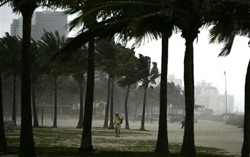
MIAMI (Reuters) - Southeast Florida came under a storm warning on Thursday as Tropical Storm Noel edged northward off the peninsula's Atlantic coast after dumping days of torrential rain in the Caribbean and killing at least 91 people.
The storm had grown in size and some of its outer winds could reach coastal areas of Miami and Fort Lauderdale, U.S. forecasters said, but the worst of its fury was expected to rumble over the northwestern Bahamas as strong westerly winds carried Noel eventually to the northeast.
The storm's winds were "close enough to the Florida coast that any deviation to the left of the forecast track would bring them on to the Florida coast," hurricane expert Jack Beven at the U.S. National Hurricane Center wrote in a report.
"Thus a tropical storm warning is being issued at this time for the immediate coastal area of Miami-Dade and Broward counties."
A tropical storm warning means tropical storm conditions with top sustained winds of at least 39 miles per hour can be expected within 24 hours.
Noel's top winds were holding steady at 60 mph by 8 a.m. EDT, and it was projected to reach a peak intensity over the Bahamas just short of the 74 mph wind speed level at which tropical storms become hurricanes.
TRAIL OF DESTRUCTION
The storm left a trail of waterlogged destruction and death in the Caribbean after slamming the Dominican Republic, Haiti and Cuba with unrelenting downpours.
At least 56 people died in the Dominican Republic, many of them swept away in muddy floodwaters after two rivers burst their banks and tore through the village of Villa Altagracia outside Santo Domingo.
At least 27 more were listed as missing and more than 50,000 people had been driven from their homes by chest-high floods, emergency operations officials said.
Dozens of communities were cut off by mudslides and downed bridges and the Dominican government appealed to other countries to send helicopters so that people could be rescued in isolated communities. President Leonel Fernandez declared a state of emergency.
Haiti, which shares the island of Hispaniola with the Dominican Republic and is even more vulnerable to flash floods and mudslides because most of its trees have been cut down to make charcoal, reported at least 24 deaths. In Jamaica, one person died when a house collapsed because of heavy rain.
In Cuba, thousands were evacuated from vulnerable areas and reservoirs overflowed, but no deaths were reported.
U.S. forecasters projected the 14th named storm of the 2007 Atlantic storm season would veer northeast over the Bahamas on Thursday, well clear of U.S. oil and gas installations in the Gulf of Mexico.
A hurricane watch was issued for the northwestern Bahamas in case Noel strengthened into a minimal Category 1 hurricane on the five-step Saffir-Simpson scale of hurricane intensity.
The storm was located about 110 miles southwest of Nassau in the Bahamas, and 175 miles southeast of Miami at 8 a.m., the hurricane center said, and it was drifting slowly northward.
© Reuters2007All rights reserved
Fishes in Europe threatened
From: Reuters

GENEVA (Reuters) - More than a third of freshwater fish species in Europe face extinction due to overfishing, pollution and dams which have caused rivers to dry up, a scientific study said on Thursday.
The continent's 522 freshwater fish species are under a much higher level of threat than birds or mammals, according to the study "Handbook of European Freshwater Fishes," published in collaboration with the World Conservation Union (IUCN).
"With 200 fish species in Europe facing a high risk of going extinct, we must act now to avoid a tragedy," said William Darwall, senior program officer at IUCN's species program.
Twelve species are already extinct following a century of development which has had a devastating impact, the study said.
The European eel, which reproduces only once on average at around 20 years, is critically endangered, it said. The number of juvenile eels reaching European coasts has dropped dramatically in the past three decades.
The jarabugo, found in southwestern Spain and Portugal, is also endangered as its population has declined by more than 50 percent in the past 10 years.
"Large dams built for irrigation, flood control and power generation have had major impacts upon species in large rivers and have led to local extinction of numerous migratory species," the Swiss-based IUCN said.
This has led to some rivers drying up in the summer months, a phenomenon which was "becoming more acute with the impacts of climatic changes," it said.
Areas subject to the highest levels of threat include the lower reaches of the rivers Danube, Dniestr, Dniepr, Volga and Ural, the Balkan peninsula and southwestern Spain, it added.
Subscribe to:
Posts (Atom)
