Thursday, September 27, 2007

Australian grains chief warns of global wheat crisis

Philip Hopkins
The Age, Melbourne, Australia
Selling forward, going backwards.

Selling forward, going backwards.
Photo: James Davies

AS GLOBAL wheat prices continue to break records, Victoria's grains chief has warned of a crisis that could put the state's wheat sector back a decade.

Wheat surged to a record $US9.16 ($A10.48) a bushel early yesterday as Ukraine said it would cut exports, and importers elsewhere sought more supplies, squeezing worldwide inventories already at a 26-year low.

Wheat futures in Chicago reached as high as $US9.3925 a bushel and have more than doubled in the past year.

In Victoria, growers, grain companies and marketers are preparing for a crucial meeting next week to discuss the dire situation facing many grain farmers hit by the dry weather and their hedging arrangements.

Victorian Farmers Federation grains group president Geoff Nalder said farmers had made losses last year from the drought.

Now, many growers had sold their crop forward on expectations of a good harvest, and now faced potential ruin as the dry weather destroyed the grain in their paddocks. They would still have to meet their contract commitments.

"This is really serious," Mr Nalder said. "It will set the industry back a decade."

Mr Nalder said it appeared 50 per cent of Victorian grain producers had taken some form of forward position. This was up to 80 per cent in some areas.

But it was unclear what percentage of their crop these farmers had sold forward. "The usual advice is never go beyond 50 per cent," he said.

Mr Nalder said it could be different this year because farmers had hoped to reap rewards after last year's drought.

The season had started well, and official forecasts were for a wet spring, so farmers had sold forward their crop earlier this year when prices were comparatively high, he said.

The meeting in Birchip next Friday will bring together farmers, grain companies and legal representatives, with some growers talking about launching a class action against the grain companies.

Mr Nalder said the concept of hedging had been growing in farmers' minds for the past four or five years, and had been strongly promoted by banks and marketers.

"A contract is a contract. But a problem shared is a problem halved," he said.

Australian Crop Forecasters head Ron Storey said he did not think any company could forgive a contract. "Companies are not just buying grain — they bought and sold it," he said. "But they also do not want to bite the hand that feeds them. They want to see good, profitable farmers."

Mr Storey said farmers would have gone into a contract with their eyes open.

"The grains trade is well governed. A verbal contract is a contract," he said.

While many farmers could be affected, Mr Storey said he did not believe their output would constitute a significant proportion of the entire crop.

Australian farmers who had a crop and had not sold too far forward would reap the benefits of high prices.

ProFarmer analyst Richard Koch said Australia was the last major exporting nation with a crop problem.

The international market was expecting an Australian wheat crop of 12-16 million tonnes.

"We believe it will be difficult for the Australian crop to move under 13 to 14 million tonnes, which makes the crop better than last year," he said. Mr Koch said Australia only needed to help the world out with exports until mid-2008.

Despair over Greek fire aftermath

Rare species of animals and plants lost in flames
·Anger rises as developers move in on stricken areas


Helena Smith in Athens
Friday September 28, 2007
The Guardian, UK


Two percent of the surface area of Greece was destroyed by forest fires this summer, including some of Europe's lushest nature reserves. The extent of the damage wrought by the infernos is much larger than initially thought, with rare species of reptiles, mammals and endemic plants being lost, according to the conservation group WWF.

"The destruction by far exceeds our expectations, and is more dramatic and extensive than we imagined," Dimitris Karavellas, who heads the WWF in Greece, said. "These fires were not only the worst on record, they ravaged everything. Very few patches of life, patches that are now refuges for various animal species, were left behind," he said.

Aided by satellite maps, environmentalists have established that in six weeks the flames consumed roughly one-tenth of the country's forests, with large swaths of land inside EU-protected areas also being burned. Among the designated areas was Mount Taygetos, one of Greece's most spectacular nature reserves, which had just begun to recover from devastating blazes in 1998.

The destruction - exacerbated by the hottest summer in 50 years - will doubtless worsen if a winter of heavy rainfall follows, Mr Karavellas said.

The group's grim assessment came a month after fires erupted in the southern Peloponnese, killing 67 men, women and children, many of whom were burned alive as they tried to flee the flames.

The report's release will put further pressure on the recently re-elected conservative government, the popularity of which was badly hit by accusations of ineptitude during the conflagrations.

Alongside mounting anger over the scale of the damage, indignation is rising over the rehabilitation methods officials are resorting to in affected areas. "Everyone, it seems, wants to exploit the situation economically," Nikos Bokaris, the president of the Panhellenic Union of Foresters, said in an interview. "I have been to the stricken region and seen with my own eyes that there is absolutely no coordination of relief efforts. The confusion that allowed the fires to rage uncontrollably is now raging uncontrollably in those areas."

Greeks have been incensed by evidence that investors, scenting profit, are moving in to the Peloponnese, one of the last parts of Greece to have escaped mass tourism.

Ecologists point to a deal that paves the way for construction on up to 10 miles of virgin coastline around the southern seaside town of Zacharo. The deal, signed by the former deputy finance minister Petros Doukas and the mayor of Zacharo, Pantazis Chronopoulos, appears to have gone through, despite the region being on a list of protected sites drawn up by the EU.

The approximately 6,000 people who were made homeless by the fires have also been encouraged to ignore otherwise stringent environmental rules when they apply for housing subsidies. In the absence of a land registry and forest maps, Greeks invariably have been able to build with impunity in areas that would normally be protected.

Trail of destruction

· 300,000 hectares were burnt.

· 30,000 hectares of this were within protected areas.

· Seven designated nature reserves were affected.

· 55% of the razed area consisted of forests and other areas of vegetation.

· Habitats of rare species of golden jackals and red deer were among those destroyed.

· The fires caused a severe degradation of soil and water balance, increasing the risk of flooding.

Wednesday, September 26, 2007

Arctic sea ice reaches record minimum - 22% loss since 2005

By Mark Rainer
26 September 2007

On September 16, the Arctic sea reached its minimum extent for 2007 at 4.13 million square kilometers, breaking the record set on September 21, 2005 of 5.32 million square kilometers. The difference between the previous record and the present one, 1.19 million square kilometers, represents roughly the same area as Texas and California combined. It is a 22 percent loss in extent since 2005.

Every year Arctic sea ice extent grows during the winter months and shrinks during the summer months. At the end of the summer melt season, usually in September, the sea ice reaches a minimum.

This summer saw an unprecedented rates of loss, with large portions of the Arctic opening up that were previously covered by perennial (permanent) sea ice. The Northwest Passage—the sea route across the Arctic Ocean along the northern coast of North America—has opened as a consequence, and several small islands have been discovered.

Contributing to the record losses this year were unusually clear skies in the Arctic during June and July, and high-pressure patterns bringing warm air into the Arctic. The dramatic loss of ice cover this season is also the result of longer-term trends and processes in effect since the 1970s and before.

Global warming is a primary driver of the climate change in the Arctic. Warmer global temperatures caused by greenhouse gasses have accelerated the melting process. The melting process itself is enhanced by the ice-albedo feedback effect—surfaces covered by ice are replaced by open water, which absorbs more solar radiation, which in turn causes warmer global temperatures.

The melting of Arctic ice is also evident in the thinning of ice that has not melted. Earlier this month, scientists at the German-based Alfred-Wegener Institute for Polar and Marine Research reported that large areas of sea ice are presently only one meter thick—a thinning of approximately 50 percent since 2001. Scientists speculate that the replacement of older thicker perennial sea ice with newer thinner ice began in 1970s. Maintenance of the older thicker ice is essential to the stability of perennial sea ice cover.

Measurements of sea ice thickness have been less systematic then sea ice extent. Most large-scale measurements have come from the sonar of military submarines. Nonetheless, there has been a significant observable decline in sea ice thickness seen in this data and other measurements. Using data from submarine cruises, Drew Rothrock, a scientist at the University of Washington, and others estimated that sea ice thickness declined an average of 1.3 meters over the past 30 to 40 years.

Another factor in the decline of sea ice is change in the phase of Arctic oscillation, a see-saw pattern of alternating atmospheric pressure at polar and mid-latitudes. The positive phase produces a strong polar vortex and shifts the mid-latitude jet stream northward. From 1989 to 1995, the Arctic oscillation entered a strong positive pattern that is thought to have flushed out older thicker sea ice from the Arctic.

There is debate among scientists about the amount of sea ice cover that can be expected in the future. A study by the federal National Oceanic and Atmospheric Administration (NOAA) from earlier this month estimates that the sea will shrink by 40 percent by 2050. The climate models accepted for the study, however, only took into account observations from 1979 through 1999. The study does not take into account the more rapid decline in sea ice extent seen in the past seven years, and in particular the very rapid decline witnessed this year.

However Mark Serreze, a scientist at the University of Colorado’s National Snow and Ice Data Center, recently told the Associated Press that based on the latest observations, summer Arctic sea ice could disappear completely by 2030.

The projections of future sea ice extent have a strong impact on the modeling of features of the Arctic, such as the future polar bear population. A series of studies released by the United States Geological Survey (USGS) this month gives projections of the future polar bear populations. The study notes that the overriding factor in determining the projections is the decline in ice habitat—the decline in sea ice extent.

The USGS study estimates a loss of two-thirds of the world’s polar bear population within 50 years based on more conservative models of sea ice loss. The study predicts the extinction of 19 polar bear populations by 2050, and another three by 2075. As striking as these figures may be, in actuality the extinction of all polar populations could occur much sooner, taking into account the more rapid decline in sea ice seen recently.

The USGS study was produced at the request of the secretary of the interior to aid the US Fish and Wildlife Service in determining whether the polar bear should be considered an endangered species. This decision, which will be made in January, will affect other federal agencies in activities such as the approval of oil and gas leases.

The decline in sea ice extent this year signals a shift that is taking place in the climate system. The rapidity with which the ice is melting, exceeding previous projections, is an indication that global warming could have even more severe and immediate consequences than current models project.

Diplomats accuse Bush of attempting to derail UN climate conference

·President goes ahead with own environment meeting
·Fear that US will again reject limit on emissions

President George Bush was yesterday criticised by diplomats for attempting to derail a UN initiative on climate change by pressing ahead with his own conference, which starts in Washington today.

One European diplomat described the US meeting as a spoiler for a UN conference planned for Bali in December. Another, who spoke to the Guardian on condition of anonymity, claimed that the US conference was merely a way of deflecting pressure from other world leaders who had asked at the G8 summit this year for the US to make concessions on global warming.

They predicted that Mr Bush, who is to address the meeting tomorrow, will stress the need to make technological advances that can help combat climate change but will reject mandatory caps on emissions.

The British government shares the frustration of other European governments with the lack of urgency on the part of the Bush administration. The British assessment of Mr Bush's conference is reflected in the level of representation - Phil Woolas, a junior environment minister.

Mr Bush invited 15 countries, plus all EU members.

The highest-ranking representative from outside the US is the German environment minister, Sigmar Gabriel. He said yesterday he did not expect the US or other nations attending the conference to budge. "One cannot expect concrete results."

One of those attending said the conference reflected "political hardball" on the part of the Bush administration, aimed at undermining the UN, for which it holds long-term suspicion. Another said the conference was aimed at domestic politics, with Mr Bush seeking headlines and television coverage implying that he was doing something about climate change while, in fact, doing almost nothing.

There was criticism too from within the US. Philip Clapp, president of the National Environmental Trust, described the conference as "a sidelight, not a process that leads to anything". He accused the White House of seeking "an alternative to a binding treaty ... you're seeing the Bush administration make this up as they go along."

European diplomats say they detect a change in recent months in the Bush administration, with some - though not necessarily Mr Bush - accepting that humans are responsible for climate change. But they add that this has not so far turned into a willingness to abandon resistance to mandatory limits on emissions or reliance on fossil fuels.

Connie Hedegard, the Danish environment minister, who is attending the conference, told members of Congress that she and other European leaders "are getting a bit impatient, not on our own behalf, but on behalf of the planet".

She added: "We need the support of the US. China, India and the other industrialising countries, they will not do anything unless the US is moving."

John Ashton, the special envoy of the British foreign secretary, David Milliband, told the UN Foundation on Tuesday that he and others would judge the conference on whether it produced a concrete commitment rather than a voluntary pledge.

"The question on the mind of everybody heading into those meetings ... will be, is this talking about talking, or deciding about doing?" he told the audience.

Kristen Hellmer, of the White House Council on Environmental Quality, said in an interview with the Washington Post that the president did not object to other countries committing themselves to mandatory curbs on carbon emissions but rejected that strategy for the US. Mr Bush preferred a "portfolio" of approaches that included higher efficiency standards for appliances and alternative fuels.

In New York, at the annual Clinton Global Initiative conference, Charlie Crist, the governor of Florida, joined Bill Clinton to announce plans by Florida Power & Light to build a solar power plant as part of a $2.4bn (£1.19bn) clean energy programme. "This is a huge deal for America and I think potentially a huge deal for people all around the world who want to do this," Mr Clinton said.

Indonesia urges incentives for forest conservation

From: Reuters

UNITED NATIONS (Reuters) - Indonesia, host of a major climate change conference in December, called on rich countries on Tuesday to compensate poor states which preserve their rainforests to soak up greenhouse gases.

"Countries that seek to enhance their carbon sinks -- through forestation, afforestation, avoided deforestation -- should be given incentive and rewarded fairly for doing so," President Susilo Bambang Yudhoyono told the U.N. General Assembly.

Speaking a day after a one-day high-level U.N. meeting on climate change, Yudhoyono said he was optimistic about a meeting scheduled in Bali, Indonesia, for December aimed at jump-starting talks to find a successor to the Kyoto Protocol, which seeks to curb climate-warming emissions.

But he said the 189 countries that are expected to gather in Bali for the U.N.-led conference must "think outside the box" to forge a consensus on tackling global warming.

"While the developing countries strive to protect and enhance their environment and its biodiversity, the developed countries must extend support," Yudhoyono said.

"They must lighten the burden of developing countries in carrying out that immense task -- through incentives and the transfer of environmentally sound technology," he added.

Indonesia has mobilized nations with most of the world's tropical rainforests -- Brazil, Cameroon, Congo, Costa Rica, Gabon, Malaysia and Papua New Guinea -- ahead of the Bali talks to get rich countries to pay the world's tropical nations not to chop down rainforests.

China warns of catastrophe from Three Gorges Dam

From: Reuters

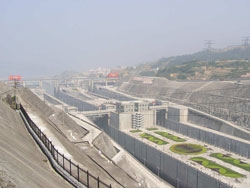
BEIJING (Reuters) - China's huge Three Gorges Dam hydropower project could spark environmental catastrophe unless accumulating threats are quickly defused, senior officials and experts have warned.

The dam in southwest China, the world's biggest hydropower project, has begun generating electricity and serving as a barrier against seasonal flooding threatening lower reaches of the Yangtze River, Xinhua news agency reported late on Tuesday, citing a forum of experts and officials.

But even senior dam officials who have often defended the project as an engineering wonder and ecological boon now warn that areas around the dam are paying a heavy, potentially calamitous environmental cost.

"There exist many ecological and environmental problems concerning the Three Gorges Dam," the senior officials were quoted as saying. "If no preventive measures are taken, the project could lead to catastrophe."

The $25 billion dam, whose construction flooded 116 towns and hundreds of cultural sites, is still a work in progress, but state media have said it could be completed by the end of 2008, just after the Beijing Olympic Games.

Wang Xiaofeng, director of the administrative office in charge of building the dam, told the forum that it was time to face up to the environmental consequences of constructing the massive concrete wall across the country's biggest river.

"We absolutely cannot relax our guard against ecological and environmental security problems sparked by the Three Gorges Project," Wang told the meeting, according to Xinhua.

"We cannot win passing economic prosperity at the cost of the environment."

LITANY OF THREATS

Wang cited a litany of threats, especially erosion and landslides on steep hills around the dam, conflicts over land shortages and "ecological deterioration caused by irrational development".

The strikingly frank acknowledgement of problems comes weeks before a congress of the ruling Communist Party that is set to consolidate policies giving more attention to environmental worries after decades of unfettered industrial growth.

Wang revealed that Premier Wen Jiabao had used a cabinet meeting earlier this year to discuss the environmental problems surrounding the dam.

Tensions over residents resettled to steep hills where good farmland is scarce had been reduced and water quality in the dam was "generally stable", Xinhua said.

But the officials and experts were worried about the landslides threatening densely populated hill country.

"Regular geological disasters are a severe threat to the lives of residents around the dam," senior engineer Huang Xuebin told the forum.

Huang described landslides into the dam waters making waves dozens of meters high that crashed into surrounding shores, creating even more damage.

The dam has displaced 1.4 million people and is retaining huge amounts of sediment and nutrients, damaging fish stocks and the fertility of farmland downstream, researchers say.

Tuesday, September 25, 2007

Heavy rain cripples South West Bengal, India

Bahrain Tribune

Kolkata (IANS)
The death toll from three days of incessant rainfall in southern West Bengal touched 10 with a youth dying of electrocution in Kolkata yesterday afternoon, even as the districts reeled under a flood-like situation despite a let-up in the downpour.
The police said a youth died at Ultadanga in north Kolkata after he came in contact with a live electric wire, which had got detached from its post and fell into a waterlogged area.
Many low-lying areas in southern, central and north Kolkata went under knee-deep water, while adjoining districts, Howrah, Hooghly and East Midnapore are threatened with flood situation with the Damodar Valley Corporation (DVC) releasing huge volume of rainwater from the Panchet and Mithan dams.
Official sources said the DVC is releasing 350,000 cusec of water to reduce pressure on its dams. According to media reports, the situation in Burdwan, Birbhum and Hooghly districts also worsened after DVC released its water. The Damodar and Ajoy rivers are flowing above the danger level.
About 40,000 people have been affected in the deluge in southern Bengal. The West Bengal government has sanctioned Rs. 80 million for relief to the flood-affected people in the state.
Meanwhile, Alipur met officials said there was no further forecast of heavy rain in the state. A low-pressure belt, which intensified into a depression over west central Bay of Bengal, which caused the downpour, moved towards Madhya Pradesh yesterday. The met office however predicted some more light to medium rainfall in Kolkata and its neighbouring district, in the next 48-hours.
Train services had virtually collapsed in Howrah and Sealdah divisions.

Flattened by hurricane, Mosquito Coast faces hunger

Destruction of rainforest heralds long-term misery for impoverished villagers

Rory Carroll in Li-Dakura, Nicaragua
The Guardian UK


A man stands outside his ruined house in Sahsa
A man stands outside his ruined house in Sahsa. Photograph: Susan Schulman


It is no longer a rainforest but a tree cemetery. As far as the eye can see there are uprooted, bare and broken trunks. The canopy, a roof of foliage so lush you could walk over it, is gone. The few remaining bits of green are no bigger than broccoli.

This is the aftermath of Hurricane Felix along Nicaragua's Mosquito Coast. A smell of decay shrouds the landscape. Crops and livestock have vanished into swamps. So much earth and debris have washed into rivers that they resemble caramel sludge.

Downriver the destruction worsens. Houses built on stilts lean drunkenly and have gaping holes. Many have missing roofs and walls. When you reach the ocean you see they have been spun into the air, Wizard of Oz-style, before smashing and splintering.

Three weeks ago the world watched the hurricane howl towards central America and braced for the worst. It was category five, a monster storm, and a cataclysm seemed inevitable.

But the hurricane changed course and missed big population centres. Instead of cities and tourist resorts it hit this remote wilderness, home to a few fishing and farming communities. A few dozen casualties were reported. The story seemed to be over. The world's gaze shifted elsewhere.

A tour through the affected region last week however showed that for Miskito Indians, one of the most impoverished and isolated communities in the Americas, the story is just beginning. Up to 160,000 people are facing an ecological and humanitarian crisis - and it is getting worse.

"It's very possible the aftermath will kill more than the hurricane itself," said Heriberto Cespedes, a surgeon at the main hospital in Puerto Cabezas. "I think in one or two weeks the avalanche of sickness will begin."

The residents of hundreds of shattered villages are at risk from hunger, exposure, contaminated water and disease spread by rats and mosquitoes, according to relief agencies. Infants have started succumbing to malaria, dengue and diarrhoea.

The longer term fear is that the destruction of the forests - 1.5m hectares (nearly 6,000 square miles) were shredded, including conservation areas - will pollute the water supply and damage the region's economy and ecology for generations. "The few trees that are standing don't even have leaves or branches," said Jaime Guillen, of the Rainforest Alliance, an advocacy group. "The forests are the principal livelihood of the indigenous communities. This environmental disaster risks turning into permanent damage."

Of all the figures prompted by Felix - more than 100 confirmed dead, more than 80% of homes destroyed or damaged, more than 15 years for forests to recover, a UN emergency appeal for nearly $40m - the most striking is the speed of the winds, 160mph. Previous hurricanes wrought devastation through rains, floods and landslides but in the case of Felix it was mainly the extraordinary force of the wind. It churned the Atlantic into a maelstrom that engulfed unprepared coastal communities.

The wind and waves came so fast that about 80 lobster fishermen from Li-Dakura and nearby villages had no time to make for land. Some clung to cayos, flimsy shacks on stilts in the sea, others lashed skiffs together. Neither strategy worked. The cayos and skiffs were obliterated. At least 30 drowned, with bodies washing as far north as Honduras. The survivors clung to debris for two days before being rescued.

"I'm scared to go back out," said Anpinio Adams, 32, gazing out to sea from an uprooted tree trunk. "But there's nothing else for us here, just lobsters."

In fact for the next few months there is not even that. The sea is so contaminated, not least by human remains, that there is a moratorium on lobster fishing.

Nicaragua's Sandinista government, backed by aid from the US, Cuba and Venezuela, among others, has mounted an energetic but at times uncoordinated relief effort. Suspicion of official corruption and mismanagement has prompted some ordinary Nicaraguans to buy aid and deliver it themselves to the coast.

Li-Dakura had received some water and food from the government but no materials to improvise shelters. "This hurricane has hit me up bad, I can't do anything," said Rodney Badin, 75, a barefoot, haunted figure in the shell of his home. He lost two sons, two daughters and a grandson to the storm. His most immediate needs were food, clothes and a blanket. "Something to wrap me up."

As it surged inland Felix weakened to category three but even then it retained enough force to topple mahogany and other hardwood trees and exposed their pale Medusa-like roots.

From the air the landscape resembles a vast, chaotic lumber yard. The tangled wreckage of one forest was so dense that villagers in Sahsa could not even search for missing relatives who had been panning for gold. "There's no way in, we can't reach them," said Bernaldo Lopez, 50, a distraught farmer.

If enough seeds and tools were supplied the maize and manioc crops which had been wiped out could be replanted within six months, said Dr Gerardo Antonio Gutiérrez, of Acción Medica Cristiana. "But the forests are like deserts. They could take one or two generations to recover." The region still bore scars from 1988's Hurricane Joan, he added.

Trees crushed houses and the region's basic infrastructure but experts warn that the more serious damage could come from rotting, putrid vegetation seeping into the water table.

"The trees are sacred to us," said Edith Morales, a relief coordinator. "And now they're dead. And making things worse." She shook her head. "We never imagined this."

11 new species discovered in remote Vietnam

By Emily Beament

The independent, UK

Two types of butterfly and a red-spotted snake are among 11 new species discovered in tropical forests in Vietnam, it was revealed yesterday.

The species, which include five orchids and three other plants, are exclusive to the remote forests in the Annamites Mountains of Thua Thien Hue, commonly known as Vietnam's "green corridor".

Another 10 kinds of plant, including four orchids, are still being examined and are also thought to be new species.

The discoveries have come in the same province where several mammal species were discovered in the 1990s, and could represent the "tip of the iceberg" said Chris Dickinson, WWF's chief technical adviser in the area.

"You only discover so many new species in very special places and the 'green corridor' is one of them," he added.

The new snake is called the white-lipped keelback and has a yellow-white stripe along its head with red dots covering its body. It lives by streams and catches frogs and other small animals.

Three of the new species of orchid have no leaves and live on decaying matter, like fungi, while the other new plants include an aspidistra with almost black flowers, and a yellow-flowered species of arum with funnel shaped leaves.

One of the new butterflies, which is among eight to have been discovered in the province since 1996, is a skipper which has quick, darting flight habits. All the new species were discovered in the past two years.

But the WWF warned that endangered species in the area, which is one of the last remaining lowland wet evergreen forests in the south-east Asian country, are under threat from illegal logging, hunting, extraction of natural resources and development.

The "green corridor" is home to many threatened plants and animals, including one of the world's most endangered primates, the white-cheeked crested gibbon, the WWF says.

It is also considered to be the best place to conserve the Saola – a unique type of wild cow which was discovered by scientists only in 1992.

Hoang Ngoc Khanh, director of Thua Thien Hue provincial forest protection department, said: "The area is extremely important for conservation and the province wants to protect the forests and their environmental services, as well as contribute to sustainable development."

Climate shift is biggest security risk: Australia

From: Rob Taylor -Reuters
Published September 25, 2007 07:50 AM

CANBERRA (Reuters) - Climate change, not war or terrorism, will be the century's biggest security challenge with China unlikely to be able to feed its vast and growing population as a result, Australia's top policeman has warned.

With predictions climate shift could slash agricultural output in Asia, and bring more droughts and flooding, climate refugees "in their millions" may be on the move within decades, Australian Federal Police Commissioner Mick Keelty said.

China, its population tipped to reach 1.5 billion from the current 1.3 billion by 2030, had particular challenges, Keelty said, although instability would hit the entire Asia-Pacific.

"We could see a catastrophic decline in the availability of fresh water. Crops could fail, disease could be rampant and flooding might be so frequent that people, en masse, would be on the move," Keelty said in a speech late on Monday.

"Even if only some and not all of this occurs, climate change is going to be the security issue of the 21st century."

Climate shift and a growing population mean China could face a food shortfall of 100 million metric tons by 2030, the country's top meteorological official said recently.

Temperature rises of up to 3 percent, rising sea levels and shrinking glacial runoff is expected to reduce runoff into major Chinese river arteries like the Yangtze and Pearl, while land for grain and rice production could be reduced by 30 per cent.

"In their millions, people will look for new land and they'll cross borders to do it," Keelty said.

"The existing cultural tensions may be exacerbated as large numbers of people undertake a forced migration."

Police, Keelty said, would struggle to cope with the impact of global warming and should be involved in the regulation of emerging carbon trading schemes, which could open the door to corruption on a massive scale.

Australia, along with the United States, has refused to ratify the Kyoto Protocol, which requires 36 industrial nations to cut greenhouse emissions, arguing the pact would unfairly impact its energy export-reliant economy.

Monday, September 24, 2007

California seabirds dying in record numbers

Dead murres, auklets washing ashore with little in their stomachs

Originally published Tuesday, April 3, 2007

Common murres have been washing ashore along the West Coa... Tufted puffins such as this one are among the birds that ... Field biology intern Heather Lapin holds a rhinoceros auk...

West Coast seabirds are dying, apparently from a lack of food -- and some researchers think the phenomenon may be linked to global climate change.

This is the third year that scientists have found unusually large numbers of marine birds -- mainly common murres, but also rhinoceros auklets and tufted puffins -- washed up on beaches in California, Oregon and Washington. In 2005, the first year of the phenomenon, large numbers of Cassin's auklets also died.

Hannah Nevins, the coordinator for Moss Landing Marine Laboratories beach survey program, said 253 dead murres were recovered on 11 Monterey Bay beaches during the first week of March. During the past nine years, an average of nine dead birds were collected on the same beaches during the same week, she said.

About 180,000 breeding murres live along the West Coast, so it is unlikely the recent spate of deaths is enough to drastically harm the overall population.

"But if this continues for multiple years, then we could have real problems," Nevins said.

Most of the casualties were young birds that had just gone through their first winter.

"They were all in poor condition, and generally had empty stomachs," she said. "Either they were not finding food, or they were unable to capture the food they did find."

Bill Sydeman, the director of marine ecology at PRBO Conservation Science, a Bay Area group that specializes in avian research, said the deaths are worrisome because it now appears they are not isolated events. In the two past years, the winter deaths were followed by less successful breeding at the Farallon Islands, one of the West Coast's most productive seabird rookeries, he said.

"I would not be surprised to see the same thing this year," Sydeman said.

Sydeman said the trend appears to be linked to changes in the California Current -- a vast oceanic stream that delivers cold, nutrient-rich water from the Gulf of Alaska to the continental West Coast. Plankton thrives in this water, forming the basis of a food web that sustains everything from small fish to whales.

Fluctuations in the current in recent years appear to have resulted in regions of warmer water that support less plankton, Sydeman said. That can also reduce upwelling, a seasonal phenomenon that results in the replacement of warmer water along the Pacific Coast with cold, nutrient-laden offshore water.

Yet Howard Freeland, a research scientist with the Institute of Ocean Sciences in Sidney, British Columbia, said the California Current generally has remained strong during the past two years, though he said there have been some fluctuations.

But Julia Parrish, an associate professor in the school of aquatic and fisheries science at the University of Washington, said the North Pacific Ocean appears to be in major flux. During the past two years, she said, offshore upwelling did not begin off the continental Pacific Coast until summer, two months later than usual.

That was bad news for the birds because the warm water provided them little food during the height of the breeding season, Parrish said.

The once generally predictable North Pacific currents, she said, are "swinging like a pendulum." For example, in summer 2006, an unexpected "super upwelling" happened off the Oregon coast, sucking in vast quantities of abyssal water that was so low in oxygen that a temporary dead zone formed along the coast.

In typical years, said Parrish, very few horned puffins -- a bird that breeds in Alaska and winters offshore as far south as California -- are found dead on West Coast beaches.

"But during the last three years, we have found tens of them each season," she said. "That may not seem like a lot, but it is very significant, considering past statistics. More of them may be dying, or the currents may be shifting so that more are washed up on the beach instead of sinking. We don't know - but we do know things are changing, and that there are casualties."

Sydeman said the anomalies could be linked to global climate change.

"What's clear is that during the past decade, there's much more variability out there than there was during the preceding 40 years," he said.

"That probably causes some disability in the ecosystem to recover from human-caused impacts such as pollution, coastal development and fishing," he said.


Affected populations

For the third year in a row, large numbers of seabirds are dying off the California coast -- probably due to starvation. Scientists think fluctuating currents in the North Pacific are delaying or weakening the influx of cold, nutrient-rich water to the coastal areas of the western continental United States, resulting in less zooplankton and fewer small fish, the staple of marine birds.

Common murre: Duck-size, penguin-like birds that nest on rocky ledges along the California coast. They consume small fish and krill, and have suffered from population declines even before the recent die-offs.

Cassin's auklet: A small seabird that feeds heavily on krill and nests in burrows or crevices. They breed from Alaska to Baja, including the Farallones. Although these birds had a large die-off in 2005, scientists are also worried about them this year.

Rhinoceros auklet: Larger than the Cassin's auklet and smaller than the common murre, this bird is distinctive for a small "horn" on its bill. It eats krill and small fish and breeds largely in Alaska and northern British Columbia, though some are found year-round in Washington, Oregon and California.

Horned puffin: A distinctively marked bird that generally stays out to sea, the horned puffin subsists on small fish. Dead puffins seldom wash up on beaches; recent discoveries of horned puffin carcasses in Oregon have led to worries that mortality for the species may be increasing.

Source: Chronicle research

E-mail Glen Martin at glenmartin@sfchronicle.com.

The climate canaries

Photo: A

The fate of many penguin breeds may offer startling warning of the dangers of climate change. Andrew Darby reports.

The Age, Melbourne, Australia

IN YEARS past, a songbird upturned in a cage was the first warning of deadly gas in a mine. Above ground, an age of fossil fuels later, there are different signs - and disturbing silences - warning of climate change carnage.

In the sub-Antarctic, king penguins fledge fewer chicks if the parents must forage in warming seas. Rising waters are swamping limited nesting space for African penguins in Namibia. And because climate change's legacy varies capriciously, little penguins in Bass Strait seem to do better when the water temperature is up.

But it's on the west coast of the Antarctic Peninsula that the signal is clearest. The raucous cacophony of Adelie penguins has disappeared from the landscape as whole colonies collapse.

"On top of a single high rock I see an unbearably poignant tableau," recounts science writer Meredith Hooper in her book The Ferocious Summer: Palmer's penguins and the warming of Antarctica. She is witnessing the demise of a colony.

"One fluffy chick is standing, very still, on its pebble nest, with one adult. A skua stands next to them. Waiting. Death openly in attendance."

Ocean temperatures off the peninsula's west coast are up 1 degree in 50 years. Annual mean temperatures on the peninsula have risen three degrees - or 10 times the global rate. It is there, scientists have discovered, that humans are making weather - ozone depletion and greenhouse gases have strengthened the westerly winds.

It was in this part of the world, too, that the 3250 square kilometre Larsen B ice shelf, stable for 12,000 years, collapsed so spectacularly over just eight days in early 2002.

Earlier that summer 160 kilometres west across the peninsula from Larsen B, Hooper had arrived at the US Palmer station with longtime Adelie biologist Dr Bill Fraser who concluded that the breeding season at Palmer had gone to hell.

Adelies breed in summer on the few outcrops of Antarctic rock. In 2001-02 on an island cluster near Palmer, the rookeries were at first buried under repeated snowfalls. Then in high summer came the rarest of polar weather: rain.

Hooper watched as the snowstorms belted in. "If birds stand up to shift position, snow falls on the eggs to melt into a puddle. Eggs are crushed or kicked out of nests as birds try to deal with the snow. Or the eggs lie cold, flooded out."

Then after the surviving chicks fledged, the rain came.

"Cold doesn't affect the chicks. It's the rain, soaking their down, forcing them to shiver, using up vital calories in an attempt to keep warm."

Reproduction in the Palmer study area collapsed. An average long-term breeding success rate of 1.34 chicks per pair was measured by Fraser as collapsing to 0.55 chicks.

On one of the islands, Litchfield, 1000 pairs of Adelies nested 50 years ago. That summer, 12 chicks hatched - all to be taken by the crowding, predatory skuas.

"There are no sounds but the wash of the sea, the occasional calls of skuas," Hooper observed. "Every penguin is gone, the nests are abandoned. Listen to the silence. The silence of absence. The sound of failure."

Trouble for the Adelies didn't end at the breeding colony.

These are birds of the pack ice. Underneath it, swimming in meagre twilight, they find their food in winter. But along the western edge of the Antarctic peninsula, there is also a decline in sea ice.

Adelies are being displaced from their former ranges by more adaptable penguins usually seen in the sub-Antarctic: chinstraps and gentoos.

Hooper caught sight of a lone gentoo standing on the stubby station pier at Palmer. "I used to joke that gentoos were estate agents checking out potential property," Hooper ruminated. "Now here is a gentoo. Symbolically waiting."

These are real-time climate changes, not predictions for the future. They are unfolding in a matter of a few years.

In Hobart this month at the sixth International Penguin Conference as more scientists reported their worries the birds' value as sentinels for climate change became clearer.

"They depend on the ocean for survival, but they come on land to relatively easily monitored colonies," said Dr Susie Ellis, a former vice-president of the US organisation Conservation International, who surveyed the global state of the penguin at the conference.

"From there we can track what is happening out at sea."

This is what happens at the Crozet Islands in the far southern Indian Ocean, a refuge for more than 1 million king penguins. Data loggers fixed to kings follow them as they swim in as far as the polar ice edge, their spidery tracks building seasonal webs of their movements.

Researcher Celine le Bohec said the kings' breeding success depended on cooler seas. In the warmer El Nino years, it was lower because food that the deep-diving kings depended on was reduced.

A rise of just 0.3 degrees in water temperature coincided with a 10 per cent reduction in population survival.

Le Bohec saw this as a serious warning. "The king penguin population might be under heavy extinction risk in scenarios put forward by the International Panel on Climate Change," she said.

These risks also face a relatively tiny penguin population: the 70,000-strong African.

Jessica Kemper of the University of Cape Town scrambled over cramped coastal islets off Namibia that these birds use to nest and counted the hatching failures in places with a high risk of being swamped.

The scrappy little African's most important food basket, the Benguela current, also produces less for them when it is warm, and many birds do not make it back from their first year at sea.

Of all the threats that bedevil penguins, those of the temperate world are most imminent. Among the southern hemisphere's 17 species, 12 are red-listed by IUCN, the World Conservation Union, their populations tending to fall, and the most threatened are in temperate zones.

Competition from over-fishing and net entanglement, human disturbance, introduced predators and pollution are damaging the temperate small populations and challenging wildlife officials who would protect them. Two species of southern New Zealand, the yellow-eyed and erect-crested are listed as endangered, along with the northern-most penguins in the world, the Galapagos.

The conference heard of dozens of innovative ways of tackling these threats.

In Peru, saving Humboldt penguins meant controlling the digging of their ancient breeding grounds for guano. In Cape Town, industrial-scale cleaning methods have been developed to save African penguins from persistent oil pollution. And in western Victoria, a Maremma guard dog has successfully protected little penguins from foxes and cats.

But as Ellis surveyed the conservation of penguins, climate was clearly the most difficult challenge. At its predicted change rates, she said it was guaranteed to put greater pressure on penguins in the future.

There may be a silver lining for some. Australian biologist Lynda Chambers found that among the shallow roaming little penguins, the warmer water years tended to produce more chicks that were heavier. For these birds, higher-quality food was available closer to the breeding colony.

"Some species are taking advantage of the switch," acknowledged the conference's convener, Eric Woehler. "But clearly the over-arching concern at the moment is the uncertainties to do with climate change.

"It's our role to be able to document what is going on. We need greater understanding and in some places there isn't a lot of time."

The Ferocious Summer. Palmer's penguins and the warming of Antarctica by Meredith Hooper is published by Profile Books. London 2007.

Video

"Manufactured Landscapes" SEE THIS BRILLIANT MOVIE! You'll never have the same shopping experience again.