Thursday, October 23, 2008

Melbourne's spring drought set to send rainfall records to a new low

The Age, Melbourne, Australia
Peter Ker
October 24, 2008
Low levels in the Thomson Dam.

Low levels in the Thomson Dam.

Advertisement

MELBOURNE is closing in on a number of unwelcome records, as the severe lack of spring rain continues to worry scientists and water officials.

The city could yet achieve the lowest rainfall for the first two months of spring, and in an extreme case, could still record its lowest yearly rainfall result.

The dry conditions are reviving debate about how the Government can best secure Melbourne's water supply.

A political storm erupted yesterday after comments by Melbourne Water chairwoman Cheryl Batagol about the uncertainty of future supplies.

The Bureau of Meteorology's head of climate analysis, Dr David Jones, said the 11.6 millimetres recorded at the cental Melbourne station during October was "just woeful" compared to the monthly average of 67 millimetres.

"October used to be the wettest month of the year, but also probably the most reliable, so you had this double benefit," he said.

After last month was crowned Melbourne's driest-ever September, Dr Jones said the first eight weeks of spring had yielded a "shocking" 23.8 millimetres.

The lowest result for the first two months of spring was 35.2 millimetres in 1914, while the average for the two months combined is 124 millimetres.

Dr Jones said Melbourne was likely to get some rain over the last week of October but there was a strong chance of the combined September and October record being broken.

"Almost any rain we get from now on, it's not going to do any good in terms of run-off unless we get astonishing falls … our soils are as dry as what you would expect in mid-summer."

Melbourne has received 309 millimetres in 2008, meaning that — although unlikely — a new record could be set below the 332 millimetres experienced in 1967.

Melbourne Water said storages were now 104 billion litres lower than at the same time last year, which equates to about 100 days of typical water consumption.

Ms Batagol told The Age this week that the Government's $4.9 billion water plan — which includes a desalination plant and the north-south pipeline — might not be enough to secure supply for the next 50 years.

But she backed away from her comments on radio yesterday, saying she was confident there would be enough supply for the next 50 years.

Victorian National Party leader Peter Ryan said Ms Batagol's concerns supported the Opposition's doubts over the amount of water available for the north-south pipeline.

But acting Water Minister Gavin Jennings said the continuing low rainfall highlighted the importance for Victoria of desalination — which does not rely on rainfall.

Green routes to growth

Recession is the time to build a low-carbon future with the investment vital for economy and planet

There are two crucial lessons we must learn from the financial turbulence the world has been facing. First, this crisis has been 20 years in the making and shows very clearly that the longer risk is ignored the bigger will be the consequences; second, we shall face an extended period of recession in the rich countries and low growth for the world as a whole. Let us learn the lessons and take the opportunity of the coincidence of the crisis and the deepening awareness of the great danger of unmanaged climate change: now is the time to lay the foundations for a world of low-carbon growth.

High-carbon growth - business as usual - will by mid-century have taken greenhouse gas concentrations to a point where a major climate disaster is very likely. We risk a transformation of the planet so radical that it would involve huge population movements and widespread conflict. Put simply, high-carbon growth will choke off growth. To manage the climate, we must cut world emissions by at least 50% by 2050, as recognised by the G8 earlier this year. Given that rich countries' emissions are far above the world average, their cuts should be at least 80%, acknowledged in Europe and the UK, with the adoption of that target last week.

In recent days, Bank of England governor Mervyn King and Gordon Brown have indicated that Britain is heading into recession. We do not know how long it will last, but it is unlikely to be short. The relevant policies are being put in place to avoid plunging the UK further into crisis and to start constructing a more robust financial system. But as banks rebuild balance sheets and look for higher capital ratios they will have to restrict lending. Monetary policy alone, important though it is, is unlikely to pull us out of the recession quickly: fiscal policy to expand demand must play a role. But increased government spending should be focused not just on boosting short-term demand. We must promote growth that can be sustained.

The coming period of growth can be firmly based in the low-carbon infrastructure and investments that will not only be profitable, with the right policies, but also allow for a safer, cleaner and quieter economy and society. And if, as we must, we halt deforestation - the source of 20% of greenhouse gas emissions - at the same time we can also protect and enhance our biodiversity and water systems.

The International Energy Agency estimates that world energy infrastructure investments are likely to average about $1 trillion a year over the next 20 years. If the majority of this is low-carbon, and some of it is brought forward, it will be an outstanding source of investment demand. So too will be the investments for energy efficiency, many of which can be labour-intensive and are available immediately.

It is surely clear that a programme can be put together which both boosts demand in the short term and prepares for efficient, strong and sustainable growth in the medium term. It must be structured carefully with the public and private sectors working together. It will be the private sector that makes most of the investments, but the public sector must shape the incentives and the investment climate that allows the investment to take place. That will mean working with the EU and the UN Framework Convention on Climate Change in Copenhagen to sustain a price for carbon, by use of carbon trading and taxation. It means regulation, for instance, on car emissions to give clear signals that allow economies of scale and reduce uncertainty.

It is not, however, just a matter of the right motivation for the private sector and the appropriate scale and structure of public spending. The investment climate must be right, too. There could be a clear limit on time for planning decisions and a national energy strategy that shapes decisions. We should have a very open-minded attitude to technology and let the markets decide which to choose, without putting obstacles in the way that might arise from an antipathy to a particular technology. Demonstration of carbon capture and storage for coal and gas on a commercial scale in electricity generation should be a special priority, given the likely prevalence of coal in the future growth of many countries. Reform of the grid structure will be necessary to allow decentralised and local decisions for generation such as wind, solar and combined heat and power. And the energy strategy must factor in energy security and peak-load supply. With sound policies all this is possible, consistent with low-carbon technologies.

The next few years present a great opportunity to lay the foundations of a new form of growth that can transform our economies and societies. Let us grow out of this recession in a way that both reduces risks for our planet and sparks off a wave of new investment which will create a more secure, cleaner and more attractive economy for all of us. And in so doing, we shall demonstrate for all, particularly the developing world, that low-carbon growth is not only possible, but that it can also be a productive and efficient route to overcome world poverty.

• Lord Stern is IG Patel professor of economics and government at the LSE and leader of the Stern Review 2006 on the economics of climate change

On our present course, the bold new carbon target is worthless

The decision by Ed Miliband, the energy and climate change secretary, to commit Britain to cutting its greenhouse gas emissions by 80 per cent by 2050 is welcome. Recent research has made it clear that the government's previous target of a 60 per cent reduction would be insufficient to help halt profound climate change this century. New measures were required.

But we should note that setting goals is the easy part of fighting global warming; implementing them is harder. This point is demonstrated in the report in The Observer today on Britain's wind energy programme. This is supposed to ensure that a third of all UK electricity is generated by onshore and offshore turbines by 2020. But it is now facing collapse, a victim of rising costs, planning blockages and poor investment. Government action is falling well short of its rhetoric.

The failure to insist that carbon capture devices be fitted to the proposed new coal-fired power plant at Kingsnorth provides another example. Without such machinery, vast amounts of carbon dioxide will be pumped into the atmosphere, making nonsense of the UK's commitment to combat global warming. Transport policy is similarly unenlightened. The government backs motorway construction schemes and continues to call for cuts in petrol prices, ignoring the environmental implications. It also refuses to include aviation fuel in its climate change calculations - as if ignoring its consumption means it will no longer be heating the planet. Likewise, a commitment to the expansion of UK airports seriously undermines our claim to be climate change champions.

The government must establish a consistent attitude to global warming and back this with significant investments. It should provide a national electricity grid that can carry power from remote wind turbines to cities; develop a wave and tidal power energy programme that will take advantage of our marine expertise; and create carbon capture schemes that will allow us to build a new generation of coal power plants.

It is also clear that the world's current economic crisis provides no excuse for failing to make proper investments and hard political decisions. The 2006 report by Sir Nicholas Stern showed the costs of acting will be vastly outweighed by the costs of not acting. The government must therefore be resolute - and consistent.

Climate crime outbreak may occur: study

From: news.theage.com.au
Published October 23, 2008 09:34 AM

Climate crime outbreak may occur: study

/top_stories/commentary/38471

Australia may need to brace for an outbreak of climate crime as the world warms and greenhouse gas emissions reduction plans are imposed, a new study warns.

The crime could take the form of complex frauds involving carbon trading schemes to water theft and even more hot weather-induced drunkenness and domestic violence.

Also, climate change could provoke violent protests over perceived inadequate government responses, a paper by the Australian Strategic Policy Institute (ASPI) says.

The institute's research director Anthony Bergin and a former analyst Ross Allen said there was an emerging body of literature relating to the impact of climate change on national security.

But there has been little work on the effect on policing, either in Australia or abroad.

There was potentially a wide range of areas in which police could be involved, with significant implications for their activities and resourcing.

So far, major environmental law-enforcement activity has related to "greenwashing", where companies exaggerate the environmental friendliness of products.

The federal government's planned multi-billion dollar Carbon Pollution Reduction Scheme, set to begin in 2010, could provide opportunities for serious fraud.

"In a booming market there's always a high possibility of fraud by a green-shoe brigade," Dr Bergin and Mr Allen said.

Investigations into carbon markets overseas highlight some of the possible avenues for deception.

But climate crime need not be complex, high-tech or even lucrative.

"Exceptionally hot days and exceptionally low rainfall days are expected to increase in frequency.

"We may, therefore, see increases in a range of water thefts: individuals stealing water, the use of fraudulent water trucks to steal public water for private gain, more incidences of siphoning from river systems for irrigation and illegal damming of rivers.

"If water becomes increasingly precious, the lengths to which individuals will go to protect their water assets, including violence, will increase."

Climate change could also make more vulnerable sections of the community even more vulnerable with the less well off already relocating into drought-affected towns.

"Some communities risk being caught in a vicious cycle of poor economic prospects and associated social ills, including increased crime against both persons and property," they said in the report.

Educating Australian communities about the role of law enforcement in event of future climate disasters would be an important step towards improving Australian resilience to the impact of climate change, Dr Bergin and Mr Allen said.

"And while we may not see the early introduction of climate change squads in Australian police forces, there will be an increasing requirement for Australian law-enforcement agencies to consider how they will need to adapt to the challenges posed by the severity and impact of climate change."

China warns of huge rise in emissions

From: New Scientist

/pollution/article/38477

China is famously reticent with its greenhouse gas emissions data. But a new report penned by researchers at the Chinese Academy of Sciencessays China's greenhouse gas pollution could more than double in two decades.

Beijing has not released recent official data on greenhouse gas from the nation's fast-growing use of coal, oil and gas. The latest information held by the UN Framework Convention on Climate Change, which administrates the Kyoto protocol, dates back to 1994.

Foreign estimates, most originating in the US, suggest the nation emitted greenhouse gases equivalent to 5.1 billion tonnes of carbon dioxide in 2005, still short of the 7.2 billion tonnes emitted by the US.

In 2007, the International Energy Agency saidChina could outstrip the US by the end of the year, and some believe that milestone was reached. But until China releases its latest data, such numbers remain estimates.

Now, in a break with official reticence, researchers from the Chinese Academy of Sciences and other major state-run institutes say that without dramatic counter-steps their nation's emissions will at least match US emissions by 2020.

Environmental consequences

The report, China Energy Report 2008, says that, by 2020, China's burning of fossil fuels could emit between 9.2 and 10.6 billion tonnes of CO2, depending on varying scenarios for development and technology.

By 2030, those emissions may reach 11.4 to 14.7 billion tonnes, it says. Global carbon emissions in 2007 were estimated to be about 31.2 billion tonnes.

The report does not give its own estimate of China's current CO2 emissions, but cites data from a US Department of Energy institute that put them at 5.1 billion tonnes in 2004. The US Oak Ridge National Laboratory, a government lab, recently estimated that the US emitted about 5.9 billion tonnes of carbon in 2007, while China emitted 6.6 billion tonnes.

The report warns that inaction in the face of this projected growth in emissions will have drastic environmental consequences. Yet it also says economic development must not be hobbled.

"No matter how historical responsibility is defined, our country's development path cannot repeat the unconstrained emissions of developed countries' energy use," states the Chinese-language report. "We must soon prepare and plan ahead to implement emissions reduction concepts and measures in a long-term and stable energy development strategy."

The main author, Wei Yiming, was not immediately available for comment on the findings and why they appeared now.

Article Continues: http://www.newscientist.com/article/dn15011-c

Monday, October 13, 2008

Credit crunch: A good time to cause trouble

As the markets crash and the world goes to hell in a handcart, environmental protesters need to get active, not just hide under the sofa

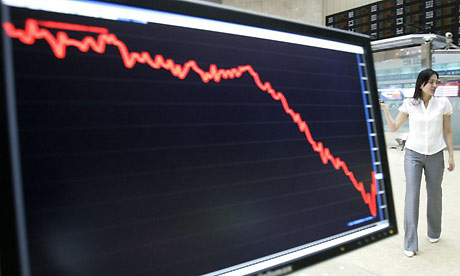
Asian stock markets fell again. Photograph: Ahn Young-Joon/AP

Stock markets fall again. Photograph: Ahn Young-Joon/AP

Today, a bunch of women are going to attempt to remind the government about climate change - a subject which appears, frankly, to have slipped its mind lately. The Climate Rush is modelled on the "rush" on parliament 100 years ago by the Suffragettes.

On Friday a group of protesters targeted the Royal Bank of Scotland for its aggressive pro-fossil fuel investment policies. And by Saturday the organisers of the London Anarchist bookfair will be hoping that "capitalism will have already collapsed in a global financial meltdown! Hooray!"

Now, if you're an environmental activist what are you thinking at the moment? Are you thinking, ooh, those poor wee strongholds of the capitalist system have had a terrible week, I'll leave them alone and give them a chance to pull themselves together? I'm sure when they've had a nice cup of Oolong tea and a sitdown they'll get round to thinking about those melting ice caps again. Or are you thinking: Wahey! Get in! Pour sugar in their petrol tanks while they're still scratching their heads in the boardrooms!

Hopefully you're going to say the latter.

Take Climate Rush. In honour of the Suffragettes, the Climate Rush - organised by a woman-only collective which includes members of Plane Stupid - is planning to gather outside the Houses of Parliament, hear some speeches, and then … get up to something. What precisely is not clear.

Now, if this is a good bit of action, it will come at the perfect time to remind MPs of their environmental responsibilities. After all, the situation hasn't just lightened briefly to give us a break while we cope with financial meltdown - and the climate bill is due to go for its third reading in the House of Commons soon.

Sure, MPs are nervous and may stampede if goaded too far. But if they're panicked enough, hopefully they'll stampede in the right direction.
And what about targeting businesses like RBS who are already under tremendous strain? Even my stony heart was moved to pity when I saw the RBS share price: it's like looking at a cardiograph at the moment of the arrest, with a long steady history and then a sudden nauseatingly vertical plunge.

Once again, however, hearts must be hardened: there was never a better moment to apply pressure.

For two and half years now environmental groups including Platform and People & PLanet have been targeting RBS's self-applied moniker The Oil and Gas Bank: RBS have been involved in financing projects such as the Baku-Tbilisi-Ceyhan pipeline (a problematic project from the start), and are now (since their ill-fated takeover of ABN/Amro last year anyway) the financiers of Gazprom's stake in the disastrous Russian Sakhalin II project.

Although they're unlikely to divest from much of this stuff at the moment, any bank is going to be terrified of losing customers, and campaigns like this can really begin to eat in to the vital student market. In the 1980s Barclays finally pulled out of South Africa after a leaked memo revealed that the long-running boycott was cutting student sign-ups, which is the key to the future customer base of any bank: climate change is certainly a subject which will appeal to students as much as apartheid.

RBS just can't afford to lose the future when everything looks so dubious in the present, so at the very least if this pressure carries on they will have to do more than make soothing noises.

And as for the anarchist book fair this weekend? (A brilliant gig by the way - you always learn something new, even if it's only how to set up your own radical feminist tantric massage collective.) It's only fair enough really. As the anarchist house mag Schnews said this week: "Blimey, you spend 15 years struggling against global capitalism and then the bloody thing collapses of its own accord".

I imagine the mood will be cheerful.

A waste of time

We need a proper cost analysis of the time we are now required to spend recycling, compared with its benefits: is it worth it?

The government thinks that your time is worth nothing. At least, that's the implication of this written answer in the Commons last week.

The UKip MP, Dr Bob Spink, asked the environment secretary "what estimate he has made of the average time per year spent by a household in sorting and recycling rubbish." An important question of course, for that time spent sorting items to be recycled is obviously a cost of such recycling schemes. The answer came back from Jane Kennedy, minister of state in the department, "No such estimate has been made".

An answer that means that, quite simply, we do not know whether recycling is a good idea or not. For we don't in fact know whether it costs us more to do it than we save by doing it ... for those who have imposed it upon us have not considered one of the major costs associated with doing it.

Starting from the very beginning: your time has a value. This isn't restricted to your working hours either: the time you spend cuddling your inamorata, building a model railway or in contemplation of a pint of Old Wallop has a value to you. That is why you do these things, because you value them. If, by law, we are going to insist that you give up some of that time, to do something we tell you to do, we need to value the time you're being forced to give up. Quite what value we can put on it is a little fraught. It might be that £10 an hour, something like the average wage across the country, is the right number. It might be £5.73 an hour, for that is the minimum wage, the figure below which it is illegal for you to sell your time. But it is some cash amount per hour, for you yourself have already decided that you'd prefer the cuddling, modelling or contemplation rather than working that extra hour for such a sum.

We'd also like to know how many hours you are being asked to give up to aid in the recycling effort, thus the question asked above. I've received a similar response when asking the same department directly: they don't know because they've never bothered to consider the point. There's almost no academic research on this either, the amount of time it takes to prepare to recycle. The best I've been able to find is something from Seattle, showing that it takes a household 16 minutes per week for a simple programme and 45 minutes for one including food and garden waste. We have some 24 million households in the UK, so for a simple system we're asking everyone to give up 6 million hours a week or around 300 million a year. At minimum wage this is a £1.8bn minimum cost of such a system. At the longer estimate of hours for a more complex system and using the average wage, we have a cost of £9bn. These are the numbers we now need to plug into our cost benefit analysis of whether we should in fact be recycling.

Now don't get me wrong, I'm not against all recycling: no one who has bought and sold scrap metal for a living would be so stupid as to say that none of it makes sense. But we do need distinguish between things it is sensible to recycle and things that it is not. Steel, aluminium, copper, yes, clearly so, these make profits even when all of the costs are included and profit is the market's way of working out whether you are in fact adding value in a process. There are also other factors that we might want to include on our benefits side, things that aren't taken account of in market pricing. Say, perhaps, the methane given off from landfills, even the aesthetics of landfills themselves. Fine, add away: then we can work out whether recycling a particular product in a particular way actually makes sense or not. We assign values to all of the costs and to all of the benefits, tot them up and if B is higher than C then it's a good idea. If C is higher than B then it's a bad one for it makes us poorer by doing it.

It's also true that wittering on about "saving resources" doesn't get around this point. For time itself is a resource, one with a value as above. Indeed, it's not a difficult argument to make that time is the only truly non-renewable resource that we have and thus one that we really don't want to waste.

Now I agree that there's a little of tilting at windmills to all of this. Our targets for recycling aren't actually something in the power of our own government to alter. They are fed to us from Brussels, for matters environmental are a sole competence of the European Union. Local councils will be fined if they don't meet the targets and there's an end to the matter.

However, a few more numbers. We were told in the Waste Not, Want Not report that waste disposal was costing us £1.6bn a year and that if we didn't do something this could rise to £3.2bn. We thus needed to recycle more and reduce this cost … but hang on; recycling more also imposes this huge cost of our time. So are we in fact saving resources at all by pushing out our plans to recycle ever more of our waste? Or are we in fact consuming more resources than we're saving?

Here at Cif there are enough environmental and green type authors whose knowledge and brains we can pick. I'm perfectly happy to agree that the numbers I've used for the valuation of our time are back-of-the envelope stuff: however, they're the only attempt so far that anyone has made at all for the UK, as above, even the government hasn't tried to calculate them. So the labour cost alone of a simple recycling scheme is some £1.8bn a year and of a more extensive one, of the type being rolled out, is perhaps £9bn a year. I would say that this is vastly more than any benefits that we receive from that process. It's greater than the resources saved, it's greater than any environmental benefit, greater than any reduction in transport or emissions, greater than any rational calculation of what we get back for what we're being forced to put in.

So how about it? Caroline Lucas, George Monbiot, Oliver Tickell, Mark Lynas, Tony Juniper – there are enough people around here who should be able to prove me wrong. How much time is required to recycle, how should that time be valued, what are the benefits (valued in money please, so that we can compare costs with benefits), whether those benefits are environmental or more direct and, finally, show us that the benefits are greater than the costs. Please do add in CO2 savings for example, using the Stern review's estimate of social cost.

And no, saying that we've a new state religion and that we should all be required to worship Gaia for an appropriate time each week won't cut it. Anyway, it should be easy to provide these numbers – even though the government clearly hasn't done a proper cost benefit analysis, surely those urging us all to recycle more will have done so – won't they?

Exotic climate study sees refugees in Antarctica

From: Reuters

/top_stories/spotlight/38398

OSLO (Reuters) - Refugees are moving to Antarctica by 2030, the Olympics are held only in cyberspace and central Australia has been abandoned as too dry, according to exotic scenarios for climate change on Monday.

British-based Forum for the Future, a charitable think-tank, and researchers from Hewlett-Packard Labs, said they wanted to stir debate about how to avert the worst effects of global warming by presenting a radical set of possible futures.

"Climate change will affect the economy at least as much as the 'credit crunch'," their 76-page report study said.

The scenarios range from a shift to greater energy efficiency, where desalination plants run on solar power help turn the Sahara green, to one where refugees are moving to Antarctica because of rising temperatures.

"We still have the chance to alter the future," Peter Madden, head of the Forum, told Reuters. "This is what the world could be like and some of these options are not very pleasant."

Madden said that most reports about climate change focused on scientific findings about carbon dioxide emissions, mainly from burning fossil fuels, without taking account of psychological or social responses.

"Historians of the future may look back on these as the 'climate change years'," he said. "They will either look back on our generation as heroes or view us with incomprehension and disgust -- as now we look back on those who allowed slavery."

He said the crystal ball survey did not seek to project what was most likely to happen, just some of the possibilities.

HOTTER

It gave the following five scenarios:

EFFICIENCY FIRST - Technological innovation will help solve climate change and spur strong growth and consumerism. The Sahara is green and the eastern seaboard of the United States, for instance, is "protected by eco-concrete wall that generate power from waves and tidal surges."

SERVICE TRANSFORMATION - Sky-high prices for emitting carbon dioxide have led to a shift to a service-based economy. People no longer own cars but use bicycles. "Central Australia and Oklahoma have been abandoned due to water shortages. Athletes stay at home in the world's first virtual Olympics, competing against each other in virtual space with billions of spectators."

REDEFINING PROGRESSS - A global depression from 2009-18 forces people into more modest lifestyles and focus on well-being and quality of life. In the United States, people "do 25 hours of work a week and up to 10 hours voluntary work."

ENVIRONMENTAL WAR ECONOMY - The world has failed to act on climate change, world trade has collapsed after oil prices break through $400 a barrel. Electrical appliances get automatically turned off when households exceed energy quotas. Refugees are moving to Antarctica, with the population set to reach 3.5 million people by 2040.

PROTECTIONIST WORLD - Globalization is in retreat after a poorly coordinated response to climate change. Morocco has been asked to join the European Union in exchange for exclusive access to solar energy supplies until 2050.

(Editing by Richard Balmforth)

Global warming grips Greenland, leaves lasting mark

From: Toledo Blade

/top_stories/article/38391

ILULISSAT, GREENLAND — Beyond the howl of sled dogs echoing across this hilly coastal village is the thunderclap of ancient icebergs splitting apart, a deafening rumble you feel in your bones.

There's no mistaking its big, loud, and powerful boom, a sound that can work up to a crescendo like rolling thunder. Or be as sudden as a shotgun blast.

Lifelong Greenland resident Karen Jessen Tannajik said people who live in Ilulissat — an Inuit word for icebergs — notice more about what's been calved by the village's nearby Sermeq Kujalleq
glacier than sights and sounds.

'Right now, they're coming out so quick. There are not so many big ones, but many small ones,' she said with almost a spiritual reverence as she talked about the village's world-famous procession of icebergs.
'When I am tired, I can watch them and feel them and smell them,' she said, pausing for a big breath of air to help make her point. 'It seems like we get our power from them.'

Sermeq Kujalleq is the largest glacier in the northern hemisphere that flows out to sea. The icebergs it calves float along a fjord that was recognized as one of the wonders of the world when it was added to the 2004 World Heritage List by the United Nations, which cited its natural history, geology, and beauty.

Article Continues: http://toledoblade.com/apps/pbcs.dll/article?AID=/20081012/NEWS06/810109858

Global warming getting political cold shoulder in U.S. amid economic woes

From: metro

/ecosystems/article/38393

WASHINGTON - The global economic crisis has thrown a political chill over one of the main initiatives under consideration in the United States to combat global warming: the so-called cap-and-trade plan.

Democratic leaders in the House and the Senate, and both presidential candidates, continue to rank tackling global warming as a chief goal next year.

But the focus on stabilizing the economy probably will make it more difficult to pass a law to reduce carbon dioxide and other greenhouse gases. At the very least, it will push back when the reductions would have to start.

As one Republican senator put it, the green bubble has burst.

"Clearly it is somewhere down the totem pole given the economic realities we are facing," said Tom Williams, a spokesman for Duke Energy Corp., an electricity producer that has supported federal mandates on greenhouse gases.

Duke is a member of the U.S. Climate Action Partnership, an association of businesses and non-profit groups that has lobbied Congress to act.

Just months ago, chances for legislation passing in the next Congress and becoming law looked promising. The presidential candidates support mandatory cuts and a Democratic majority is ready to act on the problem after years of the Bush administration resistance.

But the most popular remedy for slowing global warming, a mechanism know as cap-and-trade, could put further stress on a teetering economy.

Under such a system, the government would establish a market for carbon dioxide by giving or selling credits to companies with operations that emit greenhouse gases. The companies can then choose whether to invest in technologies to reduce emissions to meet targets or instead buy credits from other companies who have already met them.

In an interview with The Associated Press, Representative Rick Boucher (D-Va.), said that in light of the economic downturn, a bill that would give polluters permits free of charge would be preferable.

"The first way we can control program costs is by not charging industrial emitters," said Boucher, who released a first draft of a bill this past week with the chairman of the House energy and commerce committee, Representative John Dingell ( D-Mich.). Giving away right-to-pollute permits was one of the options.

Other Democrats, however, see a cap-and-trade bill - and the government revenues it would generate from selling permits - as an engine for economic growth. Democratic presidential nominee Barack Obama supports auctioning off all permits, using the money to help fund alternative energy.

http://www.metronews.ca/edmonton/world/article/124810

Tuesday, October 7, 2008

Biodiversity: Mass die-off may already be underway, experts warn

From: , The World Business Council for Sustainable Development (WBCSD), More from this Affiliate

/wildlife/article/38334

AFP, 3 October 2008 - Earth's animal and plant species are vanishing at unprecedented rates, evidence that the planet is facing a tsunami of mass extinction, experts gathering for a global conservation conference next week have warned.

Whether through habitat loss, pollution, hunting, or indirectly by global warming, humans are squarely to blame for what may be the first major die-off in 65 million years, they say.

From Sunday, more than 8,000 ministers, UN officials, NGOs, scientists and business chiefs will brainstorm for 10 days in the Spanish city of Barcelona on how to brake this loss and steer the world onto a path of sustainable development.

The World Conservation Congress, held every four years, will also release an update on Monday of the famous "Red List", deemed the global standard for conservation monitoring.

It will include the most comprehensive study ever made on the survival status of Earth's more than 5,000 mammals species.

The new biodiversity "bible" is the fruit of 1,700 experts, and scientists who took part in the effort say it will make for grim reading.

The 2007 edition already shows more than a third of 41,000 species surveyed are facing extinction: a quarter of all mammals, one out of eight birds, one out of three amphibians, and 70 percent of plants.

Our closest evolutionary cousins, primates, are especially vulnerable.

Hunted for food and traditional medicines, their habitat dwindling, more than 70 percent of known species in Asia, for example, are under threat.

Science has identified more than 1.9 million species to date. If microbial organisms are included, this is probably only a tenth of the life forms on Earth.

"Biodiversity is disappearing at an accelerated rhythm and we have to act quickly to slow and prevent the extinction crisis," said Julia Marton-Lefevre, director general of the International Union for Conservation of Nature (IUCN), which organising the October 5-14 congress.

With 11,000 volunteer scientists and more than 1,000 paid staff, the IUCN runs thousands of field projects around the globe to monitor and help manage natural environments.

"No species is superfluous -- each one is the product of millions of years of evolution and plays a role in the ecosystem," explained Wendy Foden, head of the IUCN's climate change and species programme.

There are many reasons to protect the diversity of life on Earth, under pressure from loss of habitat, pollution, climate change and over exploitation, scientists say.

One is the sheer scope of the change underway.

"The evidence is overwhelming -- and we have really good data now -- that what we are seeing is probably a mass extinction," the sixth in 450 million years, said Michael Hoffman, a mammal expert at IUCN who worked extensively on the Red List.

The current pace of dieoff is 100 to 1,000 times higher than the so-called "background rate" of extinction -- the average rate, over millions of years, at which species bite the dust.

"Species extinctions across all these groups will have very far-reaching consequences on human beings," he said.

Large and small mammals, for example, play critical roles in the regeneration of forests and savannahs by spreading plant seeds through their excrement. Forests, in turn, help blunt the impact of global warming.

Marine coral reefs, dying off due to pollution and acidification driven by climate change, support thousands of species of fish upon which hundreds of millions of humans depend for food and livelihood.

"If you have no coral reefs, you have no fish," Hoffman said.

Many plant species provide valuable medicines. Others can act as a buffer against natural disasters.

Many lives could have been saved in the Asian tsunami of 2004 and the typhoon that struck Myanmar last May if protective coastal mangroves had not been ripped up.

"There should also be a moral obligation to conserve biodiversity, if not for ourselves then for future generations," said Hoffman.

He said he was just back from a field trip in the Kruger National Park of South Africa, where he witnessed awe-struck children seeing giraffes and elephants close-up for the first time.

"We should want our children, and their children, to be able to see these giants walking the Earth," he said.

This article is reproduced with kind permission of Agence France-Presse (AFP) For more news and articles visit the AFP website.

One in four mammals risks extinction

From: Reuters

/wildlife/article/38341

BARCELONA, Spain (Reuters) - A quarter of the world's mammals are threatened with extinction, an international survey showed on Monday, and the destruction of habitats and hunting are the major causes.

The report, the most comprehensive to date by 1,700 researchers, showed populations of half of all 5,487 species of mammals were in decline. Mammals range in size from blue whales to Thailand's insect-sized bumblebee bat.

"Mammals are declining faster than we thought -- one in four species is threatened with extinction worldwide," Jan Schipper, who led the team, told Reuters of the report issued in Barcelona as part of a "Red List" of threatened species.

He said threats were worst for land mammals in Asia, where creatures such as orang utans are suffering from deforestation. Almost 80 percent of primates in the region were under threat.

Of the 4,651 mammals for which scientists have data, 1,139 species were under threat of extinction. Schipper said the data was far broader than the previous review of mammals in 1996.

Threats to species including the Tasmanian Devil, an Australian marsupial, the Caspian seal or the fishing cat, found in Asia, were among those to have worsened. At least 76 mammals have gone extinct since 1500.

"Within our lifetime hundreds of species could be lost as a result of our own actions," said Julia Marton-Lefevre, director general of the International Union for Conservation of Nature (IUCN), which compiles the Red List and is meeting in Spain.

IBERIAN LYNX

Of the 2008 total, 188 were listed as "critically endangered," the worst category before extinction, including the Iberian lynx of which there are just 84-143 adults left. Cuba's rat-like little earth hutia has not been seen in 40 years.

Habitat loss and hunting -- for everything from food to medicines -- "are by far the main threats to mammals," Schipper and his team wrote in the journal Science. "The population of one in two is declining," they said.

Among other threats, global warming blamed by the U.N. Climate Panel on human use of fossil fuels, was hitting species dependent on Arctic sea ice such as the polar bear.

But the report, issued during an Oct 5-14 IUCN congress, was not all gloom. Five percent of species were recovering because of conservation efforts, including the European bison and the black-footed ferret, found in North America.

The African elephant was also moved down one notch of risk, to "near threatened" from "vulnerable," because of rising populations in southern and eastern Africa.

And a total of 349 species have been found since 1992, such as the elephant shrew in Tanzania, it said. Schipper said some species may be vanishing before they are even described.

The report focused on mammals but the situation for some other types of animals and plants is even worse, according to the IUCN, comprising governments and conservation organizations.

An updated "Red List" said that 16,928 species, or 38 percent, were threatened out of a total of 44,838. Among animals most at risk are amphibians, such as frogs and toads.

Schipper said governments urgently needed to work out ways to protect life on earth. "Conservation action backed by research is a clear priority," he said.

(Editing by Janet Lawrence)

Video

"Manufactured Landscapes" SEE THIS BRILLIANT MOVIE! You'll never have the same shopping experience again.