WASHINGTON (AP) -- Vice President Dick Cheney's office pushed for major deletions in congressional testimony on the public health consequences of climate change, fearing the presentation by a leading health official might make it harder to avoid regulating greenhouse gases, a former EPA official maintains.
Dick Cheney's office requested that testimony about climate change be cut, an ex-EPA official says.
When six pages were cut from testimony on climate change and public health by the head of the Centers for Disease Control and Prevention last October, the White House insisted the changes were made because of reservations raised by White House advisers about the accuracy of the science.
But Jason K. Burnett, until last month the senior adviser on climate change to Environmental Protection Agency Administrator Stephen Johnson, says that Cheney's office was deeply involved in getting nearly half of the CDC's original draft testimony removed.
"The Council on Environmental Quality and the office of the vice president were seeking deletions to the CDC testimony (concerning) ... any discussions of the human health consequences of climate change," Burnett has told the Senate Environment and Public Works Committee.
The three-page letter, a response to an inquiry by Sen. Barbara Boxer, D-California, the panel's chairwoman, was obtained Tuesday by The Associated Press. Boxer planned a news conference later in the day.
Burnett, 31, a lifelong Democrat who resigned his post last month as associate deputy EPA administrator because of disagreements over the agency's response to climate change, describes deep political concerns at the White House, including in Cheney's office, about linking climate change directly to public health or damage to the environment.
Scientists believe manmade pollution is warming the earth and if the process is not reversed it will cause significant climate changes that pose broad public health problems from increases in disease to more injuries from severe weather.
Senate and House committees have been trying for months to get e-mail exchanges and other documents to determine the extent of political influence on government scientists, but have been rebuffed.
The letter by Burnett for the first time suggests that Cheney's office was deeply involved in downplaying the impacts of climate change as related to public health and welfare, Senate investigators believe.
Cheney's office also objected last January over congressional testimony by Administrator Johnson that "greenhouse gas emissions harm the environment."
An official in Cheney's office "called to tell me that his office wanted the language changed" with references to climate change harming the environment deleted, Burnett said. Nevertheless, the phrase was left in Johnson's testimony.
Cheney's office and the White House Council on Environmental Quality (CEQ) worried that if key health officials provided detailed testimony about global warming's consequences on public health or the environment, it could make it more difficult to avoid regulating carbon dioxide and other greenhouse gases, Burnett believes.
The EPA currently is examining whether carbon dioxide, a leading greenhouse gas, poses a danger to public health and welfare. The Supreme Court has said if it does, it must be regulated under the Clean Air Act.
Nowhere were these White House concerns more apparent than when CDC Director Julie Gerberding, the head of the government's premier public health watchdog, testified about climate change and public health before Boxer's committee last October. The White House deleted six of the original 14 pages of Gerberding's testimony, including a list of likely public health impacts of global warming.
The White House, at the urging of Cheney's office, "requested that I work with CDC to remove from the testimony any discussion of the human health consequences of climate change," wrote Burnett.
"CEQ contacted me to argue that I could best keep options open for the (EPA) administrator (on regulating carbon dioxide) if I would convince CDC to delete particular sections of their testimony," Burnett said in the letter to Boxer.
But he said he refused to press CDC on the deletions because he believed the CDC's draft testimony was "fundamentally accurate."
Burnett, in a telephone interview, said he opposed making the extensive deletions because "it was the right thing to do." He declined to elaborate about White House involvement beyond his July 6 letter to Boxer.
As a Democrat, Burnett, seems to have been an odd choice as a senior policy adviser and key liaison with the White House in Bush administration's EPA.
Over the last eight years, he has contributed nearly $125,000 to various Democratic politicians, starting with Al Gore's 2000 presidential campaign, according to the Center for Responsive Government. He supports Democrat Barack Obama for president.
Burnett caught the attention of Bush administration insiders as a researcher at the Center for Regulatory Study, a joint effort by the American Enterprise Institute and the Brookings Institution, where he co-authored a number of reports on regulation including one criticizing a ban on using cell phones while driving and another criticizing the EPA regulation of arsenic as too expensive with limited benefits.
Tuesday, July 8, 2008

100 months to save the Earth
There isn't much time to turn things around. And today's G8 announcements on climate change set the bar too low.
The informal annual gathering of the world's most powerful leaders emerged after the oil crisis and the subsequent recession in the 1970s. The vested interests of this group in the global economy and access to the world's resources are obvious. The eight countries now forming the group represent between them the bulk of the world's economic activity; they also own most of the world's firepower and consume most of the world's resources.
Given the vested interests you'd think then that the G8 would be focused on climate change: a threat "more serious even than the threat of terrorism" (Sir David King); "the greatest and widest-ranging market failure ever seen", which will cause economic havoc costing more than two world wars and the Great Depression combined (Professor Nicholas Stern). Surely that is just the sort of a challenge that the big boys club ought to be taking on?
Global emissions in 1990 were 40bn tonnes of CO2 equivalent. Estimates put current emissions at around 55bn tonnes of CO2 equivalent a year. If we continue on this path then by 2050 the figure will be a colossal 85 billion tonnes. A 50% cut using a 1990 baseline means getting down to just 20bn tonnes a year by 2050. What's not being talked about is how we get there.
The world's climate experts say that that the world's CO2 output must peak within the next decade and then drop, very fast, if we are to reach this sort of long term reduction. In short, we have about 100 months to turn the global energy system around. The action taken must be immediate and far reaching.
If the G8 wants to be taken seriously it should stop debating what the goal is for 2050 and introduce a moratorium on all new coal fired power stations in their countries. Coal burning is the biggest single cause of CO2 pollution and the greatest threat to the climate. We can live without coal in the developed world and we have better options. They should launch an Apollo programme for renewable energy and start a campaign against energy wastage to secure genuinely clean energy supplies for the coming decades. They must act decisively to finally stop the mass deforestation that on its own accounts for a fifth of the world's greenhouse gas emissions.
According to Professor Stern, climate change is likely to result in droughts and floods that will create 200 million climate refugees and it could make two-fifths of the world's species extinct. Yet to solve it, as challenging as it may seem, would only cost 1 or 2% of global GDP. Roughly what is spent worldwide on advertising. This is pocket change for the G8. Just these eight countries between them account for about 65% of global GDP.
This club is a powerful symbol of global inequality. If the G8 has any role at all, it should be to redress that inequality. That means taking responsibility for the climate impact of the industrialisation and consumption that has made the G8 into the biggest, richest and most powerful set of countries on Earth. The G8 nations are to blame for 62% of the CO2 in the Earth's atmosphere today. Tackling climate change is in their own interests as well as those of the 86% of the world's population not represented at the table in Hokkaido this week
Environmentalists dismiss G-8 emissions target
TOYAKO, Japan (CNN) -- A call from the world's most powerful nations to establish the goal of halving greenhouse gas emissions worldwide by 2050, was criticized by environmentalists Tuesday.

Oxfam members dressed as G8 leaders hold balloons representing the carbon their countries emit per capita.

1 of 3


The agreement by the Group of Eight industrialized economies -- which includes the United States, Japan, Germany, Britain, France, Italy, Canada and Russia -- was struck during the G-8 summit in northern Japan.
The goal must be compatible with "economic growth and energy security," the leaders said in a statement. They also said it must be done with cooperation from all major economies, including China and India.
However critics argued that the 50 percent reduction target was insufficient, and have called for ambitious midterm targets for countries to cut emissions by 2020.
"At this rate, by 2050 the world will be cooked and the G-8 leaders will be long forgotten," Antonio Hill, spokesman for Oxfam International, told The Associated Press.
"The G-8's endorsement of a tepid 50 by 50 climate goal leaves us with a 50-50 chance of a climate meltdown. Rather than a breakthrough, the G-8's announcement on 2050 is another stalling tactic," he said.
Kim Carstensen, Director of the WWF Global Climate Initiative, was equally scathing: "So little progress after a whole year of minister meetings and negotiations is not only a wasted opportunity, it falls dangerously short of what is needed to protect people and nature from climate change."
Ben Wikler of AVAAZ, a group that champions environmental concerns, said: "The failure to act on 2020 targets is a failure to take responsibility, and our members around the world feel that there is a childishness to not taking responsibility."
The European Union is on record as wanting an agreement to require developed countries to cut their emissions by 25 to 40 percent of 1990 levels by 2020. The United States, Japan and Canada oppose those targets.
Previous efforts to prompt coordinated global action on climate change have stalled.
Ten years ago, the U.N. Framework Convention on Climate Change passed the Kyoto Protocol with the goal of limiting greenhouse gas concentrations in the atmosphere. The United States was the only one among 175 parties -- including the European Union -- to reject it.  U.N. Secretary-General Ban Ki-moon gives his view »
Washington has long argued that China and India should be required to address their rapidly rising emissions. President George W. Bush opposed the Kyoto Protocol because it did not include strict emissions limits for China and India.
During the Bali conference on climate change last year, the United States reluctantly signed onto an agreement calling for two years of additional negotiations on reducing carbon dioxide emissions.
"The negotiations must proceed on the view that the problem of climate change cannot be adequately addressed through commitments for emissions cuts by developed countries alone. Major developing economies must likewise act," the White House said in a statement.
The Bali pact is meant as a guide for more climate talks, which will culminate in Copenhagen, Denmark, in 2009.Monday, July 7, 2008
G8 leaders feast at world's top table
After a day spent discussing food shortages, the world's most powerful leaders sat down to a lavish eight course meal
- guardian.co.uk,
- Monday July 7, 2008
As the food crisis began to bite, the rumblings of discontent grew louder - and finally, after a day of discussing food shortages and soaring prices, the famished stomachs of the G8 leaders could bear it no longer.
The most powerful stomachs in the world were today compelled to stave off the great Hokkaido Hunger by lining themselves with an eight course dinner prepared by 25 chefs.
This multi-pronged attack on global leadership pangs was launched only hours after a not inconsiderable lunch - four courses, washed down with Chateau Grillet 2005 — which had clearly fully failed to quell appetites possibly enlarged by agonising over the starving citizens of the world.
The G8 gathering has been described by some as a "world food shortages summit" as leaders seek to combat spiralling prices of basic foodstuffs in the developed world and starvation in the developing world.
But perhaps not since Marie Antoinette was supposed to have leaned from a Versailles palace window and suggested that her breadless peasants eat cake can leaders have demonstrated such insensitivity to daily hardship than at the luxury Windsor Hotel on the northern Japanese island of Hokkaido.
Gordon Brown, who had earlier called on Britons to waste less food, had been spending the day talking about the famine in Africa, among other subjects.
He then joined the other politicians, and five of their spouses, at the social dinner, which began with four bite-sized amuse bouche, featuring corn stuffed with caviar, smoked salmon and sea urchin, hot onion tart and winter lily bulb.
Guests at the summit, which is costing £238m, were then able to pick items from a tray modelled on a folding fan and decorated with bamboo grasses, including diced fatty flesh of tuna fish, avocado and jellied soy sauce and Japanese herb "shisho".
Hairy crab Kegani bisque-style soup was another treat in a meal prepared by the Michelin starred chef Katsuhiro Nakamura, the grand chef at Hotel Metropolitan Edmont in Tokyo, alongside salt-grilled bighand thornyhead, a small, red Pacific fish, with a vinegary water pepper sauce.
The leaders have told their people to tighten their belts for lean times ahead, but you feared for presidential and prime ministerial girdles after the chance to tuck into further dishes including milk-fed lamb, roasted lamb with cèpes and black truffle with something called emulsion sauce.
Finally, there was a "fantasy" dessert, a special cheese selection accompanied by lavender honey and caramelised nuts, while coffee came with candied fruits and vegetables.
The leaders, also troubled by global water shortages, could choose from five different wines and liqueurs, including two brought from France.
Earlier, lunch had included asparagus and truffle soup, crab and supreme of chicken served with nuts and beetroot foam, followed by a special cheese selection, peach compote milk ice cream and coffee served with petits fours.
"The G8 have made a bad start to their summit, with excessive cost and lavish consumption," Andrew Mitchell, the shadow secretary of state for international development, said.
"Surely it is not unreasonable for each leader to give a guarantee that they will stand by their solemn pledges of three years ago ... to help the world's poor. All of us are watching, waiting and listening."
Climate change report like a disaster novel, says Australian minister
- The Guardian,
- Monday July 7, 2008
A new report by Australia's top scientists predicts that the country will be hit by a 10-fold increase in heatwaves and that droughts will almost double in frequency and become more widespread because of climate change.
The scientific projections envisage rainfall continuing to decline in a country that is already one of the hottest and driest in the world. It says that about 50% of the decrease in rainfall in south-western Australia since the 1950s has probably been due to greenhouse gases.
Yesterday, Australia's agriculture minister, Tony Burke, described the report as alarming and said: "Parts of these high-level projections read more like a disaster novel than a scientific report."
The analysis, commissioned by the government as part of a review of public funding to drought-stricken farmers, was published days after another report, by Professor Ross Garnaut, warned that Australia had to adopt a scheme for trading greenhouse gas emissions by 2010 or face the eventual destruction of sites including the Great Barrier Reef, the wetlands of Kakadu and the nation's food bowl, the Murray-Darling Basin.
The prime minister, Kevin Rudd, who swept to victory on a green agenda last November, said the analysis by the Bureau of Meteorology and the Commonwealth Scientific and Industrial Research Organisation was "very disturbing".
The reports will put pressure on him to act swiftly on his pledge for Australia to lead the world in tackling polluters. However, the rising cost of living has dented his government's popularity and his plans for a carbon trading scheme have begun to unnerve voters and industry. Rudd has acknowledged that tough debate lies ahead and has said the government will map out its policy options this month.
Yesterday's report revealed that not only would droughts occur more often but that the area affected would be twice as large as now. The proportion of the country having exceptionally hot years could increase from 5% each year to as much as 95%, according to the projections.
The report says rainfall in Australia has been declining since the 1950s and about half of that decrease is due to climate change. It says the current thresholds for farmers to claim financial assistance are out of date because hotter and drier weather will become the norm.
Burke said it was clear that the cycle of drought was going to be "more regular and deeper than ever before". He added: "If we failed to review drought policy, if we were to continue the neglect and pretend that the climate wasn't changing, we would be leaving our farms out to dry."
Parts of Australia are now in a sixth year of drought, and the report coincided with an announcement that there has been a worsening of the drought in New South Wales. Some 65% of the state is affected, an increase of more than 2.3% on last month, although opinion is divided on whether it can be attributed to climate change.
A plague of locusts is also threatening crops in the state, with farmers on 900 farms reporting finding locust eggs. The government plans to fight the infestation with aerial spraying before the eggs hatch.
Ruthless drought in West Timor puts children in crisis
By Arwa Damon
CNN
CNN
REMOTE WEST TIMOR (CNN) -- Maria's labored breath echoes within the walls of her family's mud hut. Her tiny, bony hands open and close in slow claw-like motions.
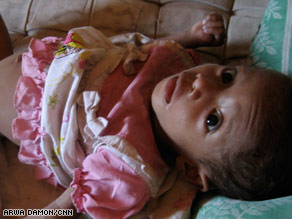
She's 15 months old, but weighs just 10 pounds -- one of countless children under the age of 5 facing severe malnutrition in Indonesia's West Timor. A typical infant weighs about 24 pounds at 15 months.
"Maria sleeps most of the time. Sometimes she cries but not often," her 25-year-old mother Adolphina Fao says softly. Watch how malnutrition devastates region »
Maria is fighting to live, wasting away in her remote village where aid officials say climate change has brought on a severe drought in recent years. It's nearly impossible for residents to live off the land like they have for generations.
"It's hard to feed her," her mother says. "Some are good days, some are bad. Sometimes she eats a whole plate, sometimes nothing."
As Fao speaks, she spoons glutinous rice into Maria's tiny mouth. The baby spits out most of it.
Aid officials say Maria is one example of a chronic crisis that has been worsening in West Timor, the Indonesian portion of the island of Timor that is home to about 1.5 million people.  See photographs of plight in this remote area »
According to a joint survey by aid groups Church World Service, Helen Keller International and CARE, more than 50 percent of children under 5 in West Timor are suffering from malnutrition. In some areas it's as high as 70 percent -- a higher percentage than areas of Africa.
Of those, nearly 1 in every 10 children suffer from acute malnutrition, meaning they are near death, according to organizers. The study also found that 61 percent of the children suffer from stunted growth.
"Stunting is the result of extended periods of inadequate food intake, poor dietary quality, increased morbidity or a combination of these factors," the study says. "This finding indicates that the diet has been very poor quality for a very long time."
Aid groups also warn that the situation is likely to worsen because of rising global food prices.
Here, far-flung villages lie nestled in deceptively lush green landscape, with no real roads, no electricity and no running water. Barely clothed children play in the dirt.
According to the survey, more than 90 percent of households don't have enough food.
Families try to farm the land, but the prolonged drought has destroyed their crops, cutting off their main food supply. That results in less food for each house, further eroding the supply of much-needed nutrition for young children.
"Nowadays the dry season is lasting longer and longer," says Vincensius Surma, the senior program manager for Church World Service, a global humanitarian agency. "In 2006 and 2007, the dry season lasted for a year."
Dry riverbeds around the region are testament to his statement. Villagers have to walk for miles for water.
Surma travels from remote village to remote village just to follow up on cases that his agency is treating.
One of the families he revisits is Salmoun Ton's. Two of his three children are malnourished. His eldest child has stunted growth. At 8 years old, she's barely taller than her healthy 4-year-old sister. His youngest was severely malnourished and is still drastically underweight.
Ton, a corn farmer, says that his crops aren't producing enough to sustain his family.
"It makes me sad, really sad. As a parent, I feel that I can't properly care for them," Ton says.
Further compounding the crisis is a lack of basic education and health care, proper sanitary habits, and inadequate aid, according to humanitarian officials.
On this visit, Surma finds out that Ton sold their fresh eggs -- a major source of protein -- to buy instant noodles. He then tries to explain basic nutrition to the family.
"We're trying to do everything that we can, but for now the results are definitely not enough," Surma says.
Aid organizations have unsuccessfully battled to bring this tragedy into the international spotlight. There are some donations coming in, but the funds and the resources simply aren't enough given the magnitude of the crisis.
Organizations like Church World Service and CARE have established feeding and education centers to try to combat the crisis. The Indonesian government is also trying to address the crisis by supplying vitamin supplements to hard-hit families and other help, but aid groups say there is little cross coordination.
"We can't implement our mid- or long-term plan for this case because ... so many children are casualties of malnutrition in this region," Surma says.
The main fear is that unless something drastic is done now, whole generations could be lost to acute and chronic malnutrition.
Thursday, July 3, 2008
Secret report: biofuel caused food crisis
Internal World Bank study delivers blow to plant energy drive
- The Guardian,
- Friday July 4, 2008
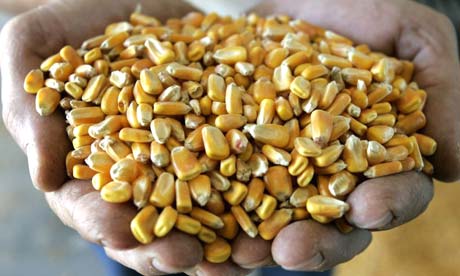
A handful of corn before it is processed. Photograph: Charlie Neibergall/AP
Biofuels have forced global food prices up by 75% - far more than previously estimated - according to a confidential World Bank report obtained by the Guardian.
The damning unpublished assessment is based on the most detailed analysis of the crisis so far, carried out by an internationally-respected economist at global financial body.
The figure emphatically contradicts the US government's claims that plant-derived fuels contribute less than 3% to food-price rises. It will add to pressure on governments in Washington and across Europe, which have turned to plant-derived fuels to reduce emissions of greenhouse gases and reduce their dependence on imported oil.
Senior development sources believe the report, completed in April, has not been published to avoid embarrassing President George Bush.
"It would put the World Bank in a political hot-spot with the White House," said one yesterday.
The news comes at a critical point in the world's negotiations on biofuels policy. Leaders of the G8 industrialised countries meet next week in Hokkaido, Japan, where they will discuss the food crisis and come under intense lobbying from campaigners calling for a moratorium on the use of plant-derived fuels.
It will also put pressure on the British government, which is due to release its own report on the impact of biofuels, the Gallagher Report. The Guardian has previously reported that the British study will state that plant fuels have played a "significant" part in pushing up food prices to record levels. Although it was expected last week, the report has still not been released.
"Political leaders seem intent on suppressing and ignoring the strong evidence that biofuels are a major factor in recent food price rises," said Robert Bailey, policy adviser at Oxfam. "It is imperative that we have the full picture. While politicians concentrate on keeping industry lobbies happy, people in poor countries cannot afford enough to eat."
Rising food prices have pushed 100m people worldwide below the poverty line, estimates the World Bank, and have sparked riots from Bangladesh to Egypt. Government ministers here have described higher food and fuel prices as "the first real economic crisis of globalisation".
President Bush has linked higher food prices to higher demand from India and China, but the leaked World Bank study disputes that: "Rapid income growth in developing countries has not led to large increases in global grain consumption and was not a major factor responsible for the large price increases."
Even successive droughts in Australia, calculates the report, have had a marginal impact. Instead, it argues that the EU and US drive for biofuels has had by far the biggest impact on food supply and prices.
Since April, all petrol and diesel in Britain has had to include 2.5% from biofuels. The EU has been considering raising that target to 10% by 2020, but is faced with mounting evidence that that will only push food prices higher.
"Without the increase in biofuels, global wheat and maize stocks would not have declined appreciably and price increases due to other factors would have been moderate," says the report. The basket of food prices examined in the study rose by 140% between 2002 and this February. The report estimates that higher energy and fertiliser prices accounted for an increase of only 15%, while biofuels have been responsible for a 75% jump over that period.
It argues that production of biofuels has distorted food markets in three main ways. First, it has diverted grain away from food for fuel, with over a third of US corn now used to produce ethanol and about half of vegetable oils in the EU going towards the production of biodiesel. Second, farmers have been encouraged to set land aside for biofuel production. Third, it has sparked financial speculation in grains, driving prices up higher.
Other reviews of the food crisis looked at it over a much longer period, or have not linked these three factors, and so arrived at smaller estimates of the impact from biofuels. But the report author, Don Mitchell, is a senior economist at the Bank and has done a detailed, month-by-month analysis of the surge in food prices, which allows much closer examination of the link between biofuels and food supply.
The report points out biofuels derived from sugarcane, which Brazil specializes in, have not had such a dramatic impact.
Supporters of biofuels argue that they are a greener alternative to relying on oil and other fossil fuels, but even that claim has been disputed by some experts, who argue that it does not apply to US production of ethanol from plants.
"It is clear that some biofuels have huge impacts on food prices," said Dr David King, the government's former chief scientific adviser, last night. "All we are doing by supporting these is subsidising higher food prices, while doing nothing to tackle climate change."
Biodiversity: Some species could be wiped out 100 times faster than feared, say researchers
· Calculations of risk found to be seriously flawed
· Most-endangered may be months from extinction
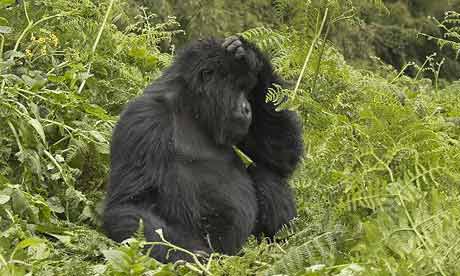
Mountain gorilla in the Virunga Mountains of Rwanda. Photograph: Andy Rouse/Corbis
Endangered species could become extinct 100 times faster than previously thought, scientists warned yesterday in a bleak reassessment of the threats to global biodiversity. They say methods used to predict when species will die out are seriously flawed and dramatically underestimate the speed at which some will disappear.
The findings, presented in the journal Nature, suggest that animals such as the western gorilla, the Sumatran tiger and Malayan sun bear, the smallest of the bear family, may become extinct much sooner than conservationists had feared.
Ecologists Brett Melbourne, at the University of Colorado at Boulder, and Alan Hastings at the University of California, Davis said conservation organisations should use updated extinction models to urgently re-evaluate the risks to wildlife. "Some species could have months instead of years left, while other species that haven't even been identified as under threat yet should be listed as endangered," said Melbourne.
The warning has particular implications for the International Union for Conservation of Nature (IUCN), which compiles an annual "red list" of endangered species. Last year the list upgraded western gorillas to critically endangered, after populations of a subspecies were found to have been badly affected by Ebola virus and the commercial trade in bushmeat.
The Yangtze river dolphin was listed as critically endangered, but could possibly be already extinct.
The researchers analysed mathematical models used to predict extinction risks and found that while they included some factors crucial to predicting a species' survival they overlooked others. For example, models took into account the fact that some animals died from rare accidents such as falling out of a tree. They also included chance environmental threats, such as sudden heatwaves or rainstorms that could kill off animals.
But what the extinction models failed to include was the proportion of males compared with females in a population, and the differences in reproductive success between individuals in the group. When they factored these aspects into risk assessments for particular species they found the danger of extinction rose substantially.
"The older models could be severely overestimating the time to extinction. Some species could go extinct 100 times sooner than we expect," Melbourne said.
The researchers showed that the missing factors - the number of males to females, and variations in the number of offspring - were capable of causing unexpected large swings in the size of a population, sometimes causing it to grow but also increasing the risk that a population crashed and became extinct.
To test the new models, Melbourne's team studied populations of beetles in the laboratory. "The results showed that the old models misdiagnosed the importance of different types of randomness, much like miscalculating the odds in an unfamiliar game of cards because you didn't know the rules," he said.
For some endangered species, such as mountain gorillas, conservationists could collect data on individuals and plug the information into models to predict these animals' chances of survival.
"For many other species, like marine fish, the best biologists can do is measure abundances and population fluctuations," Melbourne said.
Craig Hilton-Taylor, who manages the IUCN red list in Cambridge, said extinction estimates were often inadequate. "We are certainly underestimating the number of species that are in danger of becoming extinct because there are around 1.8m described species and we've only been able to assess 41,000 of those."
The latest study could help refine models used to decide which species are put on the red list, he said. "We are constantly looking at how we evaluate extinction risk, and it may be they have hit on something that can help us."
More than 16,000 species worldwide are threatened with extinction, according to a 2007 report from the IUCN. One in four mammal species, one in eight bird species and one in three amphibian species are on the organisation's red list. An updated list is due to be published in October.
Next week, the IUCN is expected to highlight the dire state of the world's corals after surveying the condition of more than 1,000 species around the world.
McCain, Obama and hot air
By focusing on research and development instead of carbon cuts, the next US president could leave the best possible legacy: a high-income, low-carbon energy world
Whatever the outcome of the United States' presidential election, climate change policy will be transformed. Both candidates have placed great importance on global warming. Republican John McCAin believes that it presents "a test of foresight, of political courage, and of the unselfish concern that one generation owes to the next," while Democrat Barack Obama calls it "one of the greatest moral challenges of our generation".
It remains far from clear, however, whether the shift in rhetoric and policy will move the planet any closer to embracing the best response. Both McCain and Obama could leave future generations lumbered with the costs of major cuts in carbon emissions – without major cuts in temperatures.
Both politicians are keen to tap into voters' concerns about global warming. McCain launched a television commercial declaring that he had "stood up to President George Bush" on global warming. If elected, Obama plans to count on former vice president and passionate campaigner Al Gore to help "lead the fight" against warming.
Each would introduce aggressive targets for reductions in greenhouse gas emissions. Obama's plan would reduce emissions by 80% below 1990 levels by 2050, while McCain aims to ensure that emissions are 60% lower by then. Both would achieve these ambitious cuts by the same method: a cap-and-trade system that imposes limits on industry emissions and forces businesses to buy rights to any additional emissions.
A cap-and-trade system can seem like a neat market solution. In fact, it is worse than a straightforward carbon tax. With a tax, the costs are obvious. With a cap-and-trade system, the costs – in terms of jobs, household consumption, and economic growth – are hidden, shifted around, and not easy to estimate, though models indicate they will run into trillions of dollars.
Not everybody would lose. Some big businesses in privileged positions would make a fortune from exploiting this rather rigged market. And politicians
would have an opportunity to control the number and distribution of emission permits and the flow of billions of dollars in subsidies and sweeteners. This is a very expensive, unwieldy way to achieve a very small reduction in temperatures.
The Warner-Lieberman bill on climate change – a piece of legislation which was recently abandoned in the US Senate but is seen as a precursor of future policy – would have postponed the temperature increase in 2050 by about two years. Recently, the Copenhagen Consensus project gathered eight of the world's top economists – including five Nobel laureates – to examine research on the best ways to tackle 10 global challenges: air pollution, conflict, disease, global warming, hunger and malnutrition, lack of education, gender inequity, lack of water and sanitation, terrorism, and trade barriers.
Their goal was to create a prioritised list showing how money could best be spent combating these problems. The panel concluded that the least-effective use of resources would come from simply cutting CO2 emissions.
A lead author of the Intergovernmental Panel on Climate Change – the group that shared last year's Nobel peace prize with Gore – told the experts that spending $800bn over 100 years solely on mitigating emissions would reduce inevitable temperature increases by just 0.4F by the end of this century. Even accounting for the key environmental damage from warming, we would lose money, with avoided damages of just $685bn for our $800bn investment.
The expert panel concluded that investing in research and development into low-carbon energy would be a much sounder, more effective option – an effort that both McCain and Obama support. But this, not carbon emissions, should be the core of their climate change policy.
Currently, low-carbon energy solutions are prohibitively expensive. The typical cost of cutting a ton of CO2 is now about $20, but the damage from a ton of carbon in the atmosphere is about $2. So we need to reduce by roughly 10-fold the cost of cutting emissions. We can achieve this by spending dramatically more on researching and developing low-carbon energy.
The US could provide leadership by committing to spending 0.05% of its GDP exploring non-carbon-emitting energy technologies – wind, wave, or solar power – or capturing CO2 emissions from power plants. It would then have the moral authority to demand that other nations do the same. By focusing more on research and development, and less in carbon cuts, both candidates could embrace a solution that encourages the best of the American innovative spirit and leaves the best possible legacy to future generations: a high-income, low-carbon energy world.
In association with Project Syndicate, 2008.
The world's will to tackle climate change is irresistible
Far from stymying the environmental cause, the downturn in the world's economies highlights just how pressing it is

Last year marked a watershed in awareness of environmental issues, and in particular the challenge of climate change. Among many breakthroughs, the Intergovernmental Panel on Climate Change released its fourth assessment report - laying out the science of global warming more clearly than ever - and the Nobel peace prize was co-awarded to the panel and Al Gore.
Today, however, many nations are facing recessionary trends and high rates of inflation. Oil prices are at an all-time high, and look likely to rise even higher. A price touching $140 per barrel is something no one could have predicted even six months ago, despite spiralling prices throughout 2007.
Food prices have also increased as a result of fundamental factors, including rapidly increasing demand for food grains against prolonged stagnation in supply. Increasing prices have hit some of the poorest countries most severely, particularly those that have low incomes and are largely dependent on imports for basic subsistence. According to the UN's Food and Agriculture Organisation, annual food expenditure of the most vulnerable countries has more than doubled since 2000. In a number of these nations food now constitutes 70%-80% of family expenditure. It is not at all surprising that we've seen food riots and large-scale demonstrations.
In this context, there is growing worldwide concern that the economic slowdown could lead to a parallel slowdown in environmental progress, with governments less willing to advocate the hard steps essential for reducing greenhouse emissions. This is indeed a worry, but I see a ray of hope, as I believe that global society is seriously questioning whether today's problems can be solved through short-term measures, as has been the case with routine ups and downs in the economy during past cycles. Could this lead to a widespread realisation that today's problems are the result of fundamental flaws in past growth and development patterns? There are, in my view, two reasons to suggest that the answer could be yes.
First, the world has reached an unprecedented level of awareness of the science behind climate change, with the contents of the IPCC's fourth assessment disseminated extensively by the media worldwide. A growing number of people - and not just typical environmentalists - now believe that climate change is not a concern for the distant future but something we are witnessing here and now. The cyclone that caused massive devastation in Burma and the extensive floods in Iowa, for instance, are linked in the public perception to climate change. Public concerns in several parts of the world have been heightened to such an extent that extreme weather events are invariably attributed to climate change. Never before has human society been gripped by such a strong realisation of the need to reduce our dependence on fossil fuels - and even change our lifestyles - in order to reduce emissions of CO2 and other greenhouse gases.
Second, this existing resolve is being strengthened considerably by increasing oil prices, which prompted even a conservative Republican like President Bush to state that America is "addicted to oil" and must switch to alternatives. Car manufacturers are already investing heavily in electric vehicles - which reduce oil dependency and emissions - and public transport systems are getting renewed attention. As some politicians in the UK and elsewhere have recently argued, with high oil prices the world can't afford not to go green.
The possibility of a shift to other forms of energy is something that is not lost on the major oil producers. So it's no surprise that Saudi Arabia has convened a summit of producers and consumers to see what needs to be done to stabilise oil prices. A continuing increase in prices would accelerate a move towards renewables, which would not support the interests of producer nations.
Based on all this, and on my discussions with policymakers, I believe the world is beginning to look at the deep underlying causes of its current problems, and is preparing for radical change. Barack Obama's performance in the US presidential race is, I think, symptomatic of a widespread thirst for such a change.
What we have today is no routine downturn in the conventional economic cycle. It is, and is seen to be, the crossroads in human progress that compels a major turn in direction. I believe the current generation is ready for such a shift and is unlikely to be distracted for long by an economic downturn that emanates from serious systemic distortions in existing patterns of growth.
· Rajendra K Pachauri chairs the Intergovernmental Panel on Climate Change and is director general of The Energy & Resources Institute
comment@guardian.co.uk
Tackling Qingdao's invading algae
rom: BBC News

by Quentin Sommerville
Young recruits from the People's Liberation Army threw off their shoes and stood knee-deep in the thick green algae that has overwhelmed the Qingdao coastline.
Some had shovels, others used pitchforks, but mostly they worked with their hands to tear up great lumps of the heavy, sodden weed.
More than 10,000 of the recruits have been deployed.
"We're working nine-hour days. I've been here six days, and still more and more of it keeps coming," said one of the soldiers.
With every wave more of the algae comes ashore. Earth-moving equipment has arrived and long mechanical conveyor belts; perhaps they will speed up the progress.
On one of the beaches is holidaymaker Wang Weizhong. The sludge ruined his holiday, and his anticipation of the Olympic Games.
"We are really disappointed," he said. "We had no idea something like this would happen here."
"We came for the pretty scenery, to get a taste of the preparations and excitement of the Olympics," he said.
Locals say the algae has never been so thick here - agricultural and industrial pollution are thought to be responsible.
But China, embarrassed by the most vivid proof yet of its environmental problems, says the algae is a natural occurrence, and blames the sea for being too salty, the sun for being too hot.
At a news conference earlier in the day one official suggested that algae could be good for you.
"The Japanese eat it," she said.
Article continues at BBC News.
G8 could see climate deal and substance in doubt

By Linda Sieg
TOKYO (Reuters) - G8 leaders could well cobble together some agreement next week on goals to cut greenhouse gas emissions, but bolder progress in climate change talks will probably have to wait until a new U.S president takes office.
Climate change is high on the agenda for the July 7-9 summit in Hokkaido, northern Japan and is the focus of an expanded Major Economies Meeting (MEM) on July 9 that brings the G8 together with eight other countries including China, India and Brazil.
Japanese Prime Minister Yasuo Fukuda wants to boost momentum for U.N.-led talks on a new framework beyond limits agreed under the Kyoto Protocol, which expire in 2012. Those negotiations are due to conclude in Copenhagen in December next year.
An agreement by 2009 would give certainty to investors wanting to switch to cleaner energy technologies, as well as to participants in growing carbon markets.
The 71-year-old Japanese leader, whose ratings are languishing at around 25 percent on doubts about his leadership, also needs a successful summit to dampen speculation that his party will dump him when the diplomatic pageantry ends.
A general election must be held by late next year.
"The worst scenario is to have no agreement of any kind that the G8 and MEM can explain to the outside world. When leaders meet, you don't do that," Koji Tsuruoka, director general for global issues at Japan's foreign ministry, told Reuters.
"If you come up with a very empty document that says nothing, this would be faulted as the chairman's lack of leadership, although it may not necessarily be the chairman's fault."
PRE-SUMMIT HAGGLING
G8 leaders agreed last year in Heiligendamm, Germany to seriously consider a global goal of halving greenhouse gas emissions by 2050.
Climate campaigners say this year's summit should go further by endorsing that goal, compared to 1990 emissions levels, and linking it to bold and specific mid-term targets for developed countries.
But bickering among G8 members and between advanced and developing countries has raised doubts about how much the leaders can achieve next week.
Japan's point man in pre-summit negotiations, Deputy Foreign Minister Masaharu Kohno, sounded a cautious note this week.
"What we have stressed and want to achieve progress on is an advance from the Heiligendamm summit," he said in a lecture.
"Of course, depending on the issue, there could be a retreat."
Europe wants the G8 to commit to a goal of halving by mid-century the emissions that cause global warming, compared with 1990 levels.
Japan is urging the leaders agree to a common vision of a 50 percent cut by mid-century, without specifying a base year.
The Bush administration, though, says it will only set targets if big emerging economies such as China are on board.
"The G8 countries could certainly take a leadership stand and agree to that (a long-term goal), but I think that really depends on whether Bush is ready to take that leap or not," said Jennifer Morgan, director for climate and energy security at Berlin-based think tank E3G. "Up to this point in time, the U.S. has shown no flexibility on this point."
INTERIM GOALS
Both Tokyo and Washington also insist specific interim goals for advanced countries to their reduce emissions by 2020 -- seen by European countries, developing countries and environmentalists as vital -- are not on the table in Hokkaido.
Despite the pre-summit haggling, world leaders' traditional tendency to seek an outcome they can pitch to the public as success means a deal could yet emerge, diplomatic experts said.
"There will be some sort of agreement on a long-term goal," said Kuniyuki Nishimura, research director at Mitsubishi Research Institute. "It will be very diplomatic language, but they will agree and present it to the outside as success."
Nishimura said he expected the G8 leaders to agree that the world should strive toward a goal of halving global emissions by 2050, while the rich countries also show their willingness to provide funds to help developing economies restrain growth in their own emissions and adapt to climate change.
Expectations of agreement on firm targets for developed countries to cut emissions by 25-40 percent by 2020 have faded since Fukuda ruled out such commitments last month, but the G8 is likely to acknowledge the need to set such targets soon.
MEM negotiators agreed last month that major developed countries should set mid-term goals while major developing countries should take steps toward curbing growth in emissions.
Still, with Washington's climate stance expected to shift under a new president, environmentalists are already looking beyond Hokkaido. Democratic candidate Barack Obama and Republican Senator John McCain both want to introduce cap and trade systems for greenhouse gases as part of a goal of big cuts by 2050.
"I'm hopeful there will be a big sea change," Morgan said.
(Additional reporting by Yoko Nishikawa, Chisa Fujioka and David Fogarty; Editing by Rodney Joyce)
Subscribe to:
Posts (Atom)
