Tuesday, September 18, 2007

Powerful Typhoon Heads For China's Financial Hub

From: Reuters

SHANGHAI - A powerful typhoon targeted China's booming eastern province of Zhejiang and financial hub Shanghai on Tuesday, prompting the evacuation of tens of thousands of people as ships and boats were called back to port.

Typhoon Wipha was 440 km (270 miles) southeast of the former foreign treaty port of Wenzhou in Zhejiang at 0300 GMT. With gusts of up to 198 km per hour, it was moving northwest at 20 km per hour, Xinhua news agency said, putting it on a course to skirt Taiwan.

"East China, including the commercial hub of Shanghai, is preparing for what may be the most destructive typhoon in a decade," the agency said.

It did not mention Typhoon Saomai, which killed 436 people in southeast China in August and was labeled the strongest storm to hit China in 50 years.

The Hong Kong Observatory chart showed Wipha heading directly for Zhejiang where it was likely to make landfall early on Wednesday and sweep north across the province towards Shanghai.

China's National Meteorological Centre described the storm on its Web site (www.nmc.gov.cn) as a "super typhoon".

About 200,000 people living in exposed areas in Shanghai, bordering Zhejiang in the north and with a population of over 14 million, would be moved to temporary shelter before evening.

Tens of thousands of boats and ships had returned to harbor in Zhejiang, where beach resorts and sea farms were evacuated and ferry services suspended, state media said.

"Wipha will hit our province head on and the areas affected would be the most economically developed and densely populated," the Zhejiang provincial government warned.

"Strong winds will come with heavy rainfall ... The relief work will be complicated and grave," it said in a statement on its Web site (www.zj.gov.cn).

Zhejiang's inland areas also faced the threats of floods and landslides caused by torrential rain, it said.

The edge of Wipha grazed northern Taiwan on Tuesday, bringing downpours and prompting the area to close schools, offices and markets.

The major northern port of Keelung stopped all traffic on Tuesday until further notice, while five airlines cancelled some international flights.

Typhoons, large cyclones known as hurricanes in the West, regularly hit China, Taiwan, the Philippines and Japan in the summer season, gathering strength from the warm waters of the Pacific or the South China Sea before weakening over land.

Sometimes they make a u-turn, gather strength at sea again, and return to wreak more havoc.

Arctic Ocean Sea-ice Getting Thinner: New Study

From: Alfred-Wegener Institute

Bremerhaven, Germany - Large areas of the Arctic sea-ice are only one metre thick this year, equating to an approximate 50 percent thinning as compared to the year 2001. These are the initial results from the latest Alfred-Wegener-Institute for Polar and Marine Research in the Helmholtz Association lead expedition to the North Polar Sea. 50 scientists have been on board the Research ship- Polarstern for two and a half months, their main aim; to carry out research on the sea-ice areas in the central Arctic. Amongst other things, they have found out that not only the ocean currents are changing, but community structures in the Arctic are also altering. Autonomous measuring-buoys have been placed out, and they will contribute valuable data, also after the expedition is finished, to the study of the environmental changes occurring in this region.

“The ice cover in the North Polar Sea is dwindling, the ocean and the atmosphere are becoming steadily warmer, the ocean currents are changing” said chief scientist Dr Ursula Schauer, from the Alfred Wegener Institute for Polar and Marine Research part of the Helmholtz community, when commenting on the latest results from the current expedition. She is currently in the Arctic, underway with 50 Scientists from Germany, Russia, Finland, the Netherlands, Spain, the USA, Switzerland, Japan, France and China, where they are investigating ocean and sea-ice conditions.
“We are in the midst of phase of dramatic change in the Arctic, and the International Polar Year 2007/08 offers us a unique opportunity to study this dwindling ocean in collaboration with international researchers” said Schauer. Oceanographers on board the research ship Polarstern are investigating the composition and circulation of the water masses, physical characteristics of sea-ice and transport of biological and geochemical components in ice and seawater. Sea-ice ecosystems in the seawater and on the ocean floor will also be a focus of investigations. Scientists will take sediments from the ocean floor in order to reconstruct the climatic history of the surrounding continents.

Oceanographic measuring buoys were set out in all regions of the Arctic ocean for the first time during this International Polar Year. They are able to drift freely in the Arctic Ocean whilst collecting data on currents, temperature, and salt content of the seawater. The buoys will continuously collect data over and send them back to the scientists via satellite. In addition, the deployment of a new titanium measuring system which allows contamination free sample collection of trace elements for the first time due to its high effectiveness. These studies will take place within the context of different research projects, all taking place during the International Polar Year: SPACE (Synoptic Pan-Arctic Climate and Environment Study), iAOOS (Integrated Arctic Ocean Observing System) and GEOTRACES (Trace Elements in the Arctic). At the same time, a large component of the work is supported by the European Union Program DAMOCLES (Developing Arctic Modelling and Observing Capabilities for Long-term Environment Studies). Further information on this project can be found on the German contribution to the International Polar Year website (www.polarjahr.de).

Changes in Sea-Ice
The thickness of the arctic sea-ice has decreased since 1979, and at the moment measures about a metre in diameter in the central Arctic Basin. In addition, oceanographers have found a particularly high concentration of melt-water in the ocean and a large number of melt-ponds. These data, collected from on board the Polarstern, and also from helicopter flights allow the scientists to better interpret their satellite images.
Sea-Ice biologists from the Institute of Polar Ecology at the University of Kiel are studying the animals and plants living in and beneath the ice. They are using the opportunity to investigate the threatened ecosystem. According to the newest models, the Arctic could be ice free in less than 50 years in case of further warming. This may cause the extinction of many organisms that are adapted to this habitat.

Ocean Currents
The Arctic Ocean currents are an important part of global ocean circulation. Warm water masses flowing in from the Atlantic are changed in the Arctic through water cooling and ice formation, and sink to great depths. Constant monitoring by the Alfred-Wegener-Institute for Polar and Marine Research over the last ten years have recorded significant changes, and have demonstrated a warming of the incoming current from the Atlantic Ocean. During this expedition, the propagation of these warming events along each of the currents in the North Polar Sea will be investigated.
The large rivers of Siberia and North America transport huge amounts of freshwater to the Arctic. The freshwater appears to function as an insulating layer, controling the warmth transfer between the ocean, the ice and the atmosphere.
The study area stretches from the shelf areas of the Barents Sea, the Kara Sea and the Laptev Sea, across Nansen and Amundsen bays right up to Makarow Bay.
Between Norway and Siberia and up to the Canadian Bay the scientists have taken temperature, salinity, and current measurements at more than 100 places. First results have shown that the temperatures of the influx of water from the Atlantic are lower as compared to previous years. The temperatures and salinity levels in the Arctic deep sea are also slowly changing. The changes are small here, but the areas go down to great depths, and enormous water volumes are therefore involved. In order to follow the circulation patterns in winter, oceanographic measuring buoys will be attached to ice floes, and continuous measurements will be taken whilst they float along with the ice. The measurements will be relayed back via satellite.
In addition to the ocean currents and sea-ice, zooplankton, sediment samples from the sea floor as well as trace elements will be taken. Zooplankton are at the base of the food chain for many marine creatures, and are therefore an important indicator for the health of the ecosystem. The deposits found on the ocean floor of the North Polar Sea read like a diary of the history of climate change for the surrounding continents. Through sediment cores, the scientists may be able to unlock the key to the glaciation of northern Siberia.
In addition, the members of the expedition will be able to measure trace elements from Siberian rivers and shelf areas, that through polar drift are being pushed towards the Atlantic.

The Alfred-Wegener Institute (AWI) conducts research in the Arctic, Antarctic and in oceans of temperate and high latitudes. The AWI coordinates polar research in Germany, and provides important infrastructure, such as the research icebreaker Polarstern and research stations in the Arctic and Antarctic for international scientific enterprises. The Alfred Wegener Institute is one of 15 research centres of the 'Helmholtz-Gemeinschaft' (Helmholtz Association), the largest scientific organisation in Germany.

Receding Permafrost Is A Bone-hunters' Bounty

From: Reuters

CHERSKY, Russia - One day, climate change could cost the earth. For now, it is a nice little earner for Russian hunter Alexander Vatagin.

In Siberia's northernmost reaches, high up in the Arctic Circle, the changing temperature is thawing out the permafrost to reveal the bones of prehistoric animals like mammoths, woolly rhinos and lions that have been buried for thousands of years.

Private collectors and scientific institutes will pay huge sums for the right specimen, and bone-prospectors like Vatagin have turned this region, eight time zones from Moscow, into a paleontological Klondyke.

"Last year someone was paid 800,000 roubles ($31,000) for a mammoth head with two tusks in great condition," said Vatagin.

A brawny 45-year-old, he has a network of helpers: the fishermen and reindeer-herders of the tiny Yukagir ethnic group, whose numbers have dwindled to about 800 people.

"I must have earned the respect of the Yukagir," he said. "Their shamans convened a council and decided to name me a Yukagir," he added. He is now Yukagir No. 456.

These tribesmen are his 'finders', fanning out across the vast emptiness of the tundra seeking valuable artifacts.

At regular intervals, Vatagin flies by helicopter to the main Yukagir settlement, Andryushkino, some 200 km (125 miles) west of the local centre of Chersky, to view the merchandise.

Prehistoric bones are not very hard to find. The permafrost is thawing and breaking up so rapidly that in certain places in the tundra, every few meters (yards) bones poke out through the soil. Some just lie on the surface.

Vatagin pays between 200 ($8) and 4,000 roubles ($156) per kg of mammoth bones. But it takes a keen eye and local knowledge to find the really valuable stuff.

Tusks, sometimes curled round almost into a circle and reaching up to 5 meters in length, are the most prized finds. A pair of good tusks is a rarity; two tusks and a well-preserved skull can be worth a fortune.

"If he is lucky, a local can earn 200,000 roubles ($7,800) in just one day," said Vatagin, who wears a massive silver ring with a mammoth's head engraved into it. "To earn this money, he would have otherwise have to toil for a year."

But for Vatagin it is not just about money. He himself dives into the ice-cold local rivers to look for relics. The cash he pays the Yukagir tribesmen gives them a living.

MAMMOTH RING

Many of the bones retrieved by Vatagin and his adopted tribe end up at the Ice Age Museum in Moscow. The museum makes no secret that scientific discovery goes hand-in-glove with business interests.

Museum official Alexander Svalov has on one of his fingers a ring identical to the one won worn by Vatagin in distant Chersky.

The ring is the symbol of the National Alliance, a close-knit business run by entrepreneur Fyodor Shidlovsky. The company runs the museum, and holds government licenses allowing it to excavate and export prehistoric relics.

Svalov, who is the chief executive of National Alliance, says a well-preserved tusk can sell to private collectors for up to $20,000, while a reconstructed mammoth skeleton can fetch between $150,000 and $250,000.

The bones make their way into museums in places like the United States and South Korea. Now promising new markets are opening up in emerging economies like China too.

"Developing nations are now displaying huge interest in mammoths," says Svalov. "Their economies are growing, they have cash and are starting to develop their museums."

GENTLER

Back in Chersky, Sergei Davydov, a 52-year-old scientist, does not sell the bones he collects. He keeps them to study the effects of climate change, but also because they fascinate him.

"This tooth has an unusual bump here. The mammoth suffered from a terrible toothache. We can only imagine how he must have roared," said Davydov, tenderly rubbing a black tooth the size of a large shoe.

He displays his other finds: a mammoth's giant thigh bones, the horns of a woolly rhino, the jaws of an ancient horse and a cave lion's skull. Bison skulls crowned with sharp horns decorate the interior of his cozy wooden house.

Davydov acknowledges that rising temperatures in Siberia have been a boon for bone collectors. "As the permafrost thaws, we obtain yet more objects for study," he said.

But then he reflects: "From the point of view of humanity, it would have been better if this had never happened," he said.

PetroChina Wins Environmental Clearance Before IPO

From: Reuters

BEIJING - PetroChina (0857.HK: Quote, Profile , Research), Asia's top oil and gas company, has won environmental clearance for its oil and petrochemical projects to be funded by a planned domestic stock offering, the country's environment watchdog said.

Six projects, including a 200,000 barrel per day refinery and one million tone per year ethylene complex in the remote northwestern region of Xinjiang, would be financed by the domestic share issue, the State Environmental Protection Administration said on its Web site (www.sepa.gov.cn).

The project, near the Kazakhstan border, would cost $3.2 billion, the company said in October 2005.

PetroChina is expected to raise an estimated $5-$6 billion in a Shanghai listing, possibly in November, sources have said.

The proceeds would also go toward producing crude at Daqing and Changing oilfields, developing Jidong Nanpu field -- the company's latest big oil discovery -- works to double ethylene capacity at Daqing in northeast China, and a refined fuel pipeline linking Lanzhou in the northwest to Changsha in central China.

Calif. Suit On Car Greenhouse Gases Dismissed

Reuters

SAN FRANCISCO - A U.S. federal judge tossed out a lawsuit by California's attorney general on Monday seeking hundreds of millions of dollars from six automakers for damaging the state with climate-changing greenhouse gases.

Martin Jenkins, a federal judge in the Northern District of California, said the issue of global warming should be decided in the political rather than legal arena.

"The Court finds that injecting itself into the global warming thicket at this juncture would require an initial policy determination of the type reserved for the political branches of government," Jenkins wrote in approving the automakers' motion to dismiss the case.

The suit, filed in September, targeted General Motors Corp, Ford Motor Co, Toyota Motor Corp, the U.S. arm of Germany's DaimlerChrysler AG and the North American units of Japan's Honda Motor Co and Nissan Motor Co Ltd.

"The Court is left to make an initial decision as to what is unreasonable in the context of carbon dioxide emissions," Jenkins wrote. "Such an exercise would require the Court to create a quotient or standard in order to quantify any potential damages that flow from Defendants' alleged act of contributing 30 percent of California's carbon dioxide emissions.

"The balancing of those competing interests is the type of initial policy determination to be made by the political branches, and not this Court."

The suit was the first seeking to hold manufacturers liable for global warming damages caused by greenhouse emissions. It said cars made by the six automakers account for more than 30 percent of human-generated carbon dioxide emissions in California, the most populous U.S. state.

"We understand why a district federal judge may not want to jump into a global warming thicket with both feet," Ken Alex, California's supervising deputy attorney general, said in an interview. "Having said that, the basic tenet of law is that where you describe a harm then there needs to be a remedy for it."

"Right now because the political branches -- the federal government, Congress and the executive branch -- have not acted, the state of California is left without a remedy."

Alex said his office would consider whether to appeal the case to the 9th U.S. Circuit Court of Appeals, saying judges frequently decided reasonable standards in cases such as dumping of pollution into rivers.

According to the suit, California spends millions of dollars to deal with a reduced snow pack, beach erosion, ozone pollution and the impact on endangered animals and fish.

California has also targeted the auto industry with first-in-the-nation rules adopted in 2004 requiring automakers to reduce emissions from cars and light trucks.

Western Canadian Pine Beetle infestation Spreads

VANCOUVER, British Columbia (Reuters) - Voracious beetles that have ravaged more than 9 million hectares (35,000 square miles) of British Columbia's forests have wiped out about 40 percent of the infested region's marketable pine trees, according to a report released on Monday.

The pine beetle infestation has spread unabated for eight years and unless weather conditions change to keep the tiny bugs in check, the amount of trees killed by 2015 in Canada's largest lumber exporting province will likely reach about 1 billion cubic meters (35.3 billion cubic feet), according to a provincial analysis.

The report estimated that at least 530 million cubic meters of wood has already been killed, which is about 12 percent of the western province's total supply of salable pine -- a key softwood construction lumber.

But the report by British Columbia's Ministry of Forests said the number of trees killed annually appears to be declining as susceptible trees die off, and the infestation rate may return to pre-outbreak levels by 2015.

The insects have lived on lodgepole and ponderosa pine in Western Canada for thousands of years, but nature has controlled

major outbreaks by killing the beetles through extreme winter cold or with forest fires.

The area has not had the required cold snap in recent years, and efforts to fight fires to protect the timber supply and area communities have increased the number of older trees, which are more susceptible to an insect attack.

Trees killed by the beetles can be harvested for several years after they have died, but the provincial researchers said that more needs to be known about how long that wait can be.

The report said that, based on current assumptions on sawlog shelf-life, some areas of the province now hit by the infestation could see a decline in timber supply within four or five years.

The drier dead trees are subject to more cracking, which reduces the amount of timber and plywood that can be produced from each log.

The beetle infestation has continued to move eastward toward Alberta. Provincial officials there plan a major forest burn-off this fall in areas near the border in hopes of stopping the insects from crossing the continental divide.

Monday, September 17, 2007

NOAA summer weather report - 7th warmest summer on record for globe.

The June-August 2007 summer season ended with a long-lasting heatwave that set more than 2,000 new daily high temperature records.....

....the second warmest August and the sixth warmest summer on record for the contiguous U.S......

The global surface temperature was seventh warmest on record for the June-August period.

More than 30 all-time high temperature records were tied or broken in the U.S....

This was the warmest August in the 113-year record for West Virginia, Kentucky, Tennessee, the Carolinas, Georgia, Alabama, Florida and Utah.

Texas had its wettest summer on record and Oklahoma its fourth wettest.

In the Southeast, this was the driest summer since records began in 1895 for North Carolina and the second driest for Tennessee.

Part of the Midwest received record precipitation in August.... was two to three times normal for the month in a wide band across the central Midwest, and major flooding occurred in parts of a region that stretched from southeastern Minnesota to central Ohio.

Iowa had its wettest August on record.

June was the wettest ever recorded in the UK.

-----Other record breaking events of this year-----

Australia is experiencing the worst drought on record.

Southwest US and Southeast US states experiencing worst drought in 100 years.

In May a tornado over two miles wide wiped a town in Kansas off the map.

For the first time ever, two hurricanes made landfall in the Atlantic as cat. 5s......and less than two weeks apart.

This year Canada is experiencing record breaking wild fire season because of record breaking drought during winter months.

The first ever hurricane to hit Iran.

Texas had 14 inches of rain within a 24 hour period, and this was in the middle of a 20 day period of storms that hovered over the area causing massive flooding.

And lets not forget snow in South Africa.

Jan. 2007 was Warmest January in Netherlands in 300 years.

Jan. 2007 was the world's hottest January on record.

March Temperatures Second Warmest on Record for U.S.

Global April Surface Temperature Third Warmest on Record.

Winter 2007 tied with 1998 as the warmest January-May period.

2007, The global average temperature was the second warmest on record for the January-June six-month period.

11 of the 12 warmest years globally were the past 11 years and 2007 looks to be equal to past 11 years.

***********

Reference:

NOAA Website, 9/12/07
http://www.publicaffairs.noaa.gov/releases2007/sep07/noaa07-049.html

"Climate Porn" - Simon Retallack on the Dangers of Using Alarmist Language to Talk About Climate Change

www.democracynow.org
first broadcast Sept. 14th, 2007

Listen to Segment || Download Show mp3
Watch 128k stream Watch 256k stream Read Transcript
Help Printer-friendly version Email to a friend Purchase Video/CD

We speak with British climate change expert, Simon Retallack about so-called "climate porn." Retallack says, "It's a phrase that's certainly not used to undermine the science...But if we talk about climate change in a way that makes it appear that there's nothing we can do anymore about it, that it's too late, that it's going to be devastating on a global scale...I think we're going to turn people off." [includes rush transcript]
  • Simon Retallack, head of the Climate Change Team at the Institute for Public Policy Research in Britain. He is the co-author of the new report "Positive Energy: Harnessing People Power to Prevent Climate Change."

Last week, tens of thousands of people attended Farm Aid here in New York City. It's an annual concert to raise support for family farmers. This is the musician Neil Young, one of the organizers of Farm Aid.

    NEIL YOUNG: Transporting food around the world to other countries and using all of that fuel and all of that packaging and all of that air-conditioning fuel and all of those things that need to happen to get, say, a tomato -- since that's on our mind today, we're coming with a tomato now -- from Chile to California, it costs a lot of environmental damage just getting that one tomato up there.

    And so, if you look at the world and you figure one of the things about our big agriculture is that we want to feed the world -- doesn't that sound great? You know? We're going to help everybody. OK, you know, that's great. But I don't think it's really that way. I think we ought to feed ourselves, the people that are close to us, and we ought to let the people around the world feed themselves with their own crops so that we don't go in there and take their food crop away and give them a cash crop and then say we're going to give you food. And that's what we do. We have people growing textile materials and cotton and things in third world countries, and we do business with them through China, and we do all of these things with our economics. And we undermine the sustainability of the countries that we say we're helping. And then, if these countries don't cooperate with us, we control their food supply.

AMY GOODMAN: Musician Neil Young at the Farm Aid concert this past weekend.

As we continue looking at issues of climate change, energy and the environment, we're joined by two more guest speakers at this weekend's International Forum on Globalization in D.C.: Michael Klare, professor of Peace and World Security Studies at Hampshire College, author of a number of books, including Blood and Oil: The Dangers and Consequences of America’s Growing Dependency on Imported Petroleum; and Simon Retallack, head of the climate change team at the Institute for Public Policy Research in Britain, coauthor of the new report, “Positive Energy: Harnessing People Power to Prevent Climate Change.”

We're going to turn first to Michael Klare. President Bush spoke last night, addressed the nation, talked about why we continue the war in Iraq. Can you talk about the connections between war and oil or, as you put it, the title your book, Blood and Oil.

MICHAEL KLARE: Well, Amy, good to talk with you. There are really two wars now underway, I think, in Iraq, maybe more than two. There's the US effort to retain, as what President Bush said last night, an enduring presence in Iraq. And I believe that's connected to our, that is America's, long-lasting geopolitical imperative of being the dominant power in the Persian Gulf. And, of course, he also refers a lot to Iran, now the next threat perceived on the horizon to American dominance. So one part of the war in Iraq, I believe, have always believed, is part of this long-standing US effort to dominate the region geopolitically and control the oil spigot from the Gulf, where two-thirds of the world’s oil is located.

But there's a second war underway, and that's a war for the control of Iraq's oil wealth. And that's a war that is pitting Kurds against the Arabs of the country and Shiites against Sunnis, and Shiite against Shiite, because eventually the Americans are going to leave, and the people of Iraq know this, and they are now fighting amongst themselves for who's going to control that territory. And I believe a lot of the violence in Iraq today is really about that struggle for control of Iraq's oil wealth. And American soldiers are caught in the middle of this.

And I think, frankly, that American military leaders have come to understand that the prospect of an Iraq, of a national Iraq, has been lost. That war has been lost. What's left is the fighting over the remains, the carcass of Iraq.

JUAN GONZALEZ: Michael, on the issue of Iran, especially with all the saber rattling, and even among many of the Democratic candidates for president you find some of the same saber rattling toward Iran. Iran is a huge nation. It is not only oil rich, but considerably developed, with a huge population. What kind of -- your analysis of the sense among military people about even talking about any kind of military action or extension of what's happened in Iraq into Iran?

MICHAEL KLARE: Well, we tend to forget that the US military is not a monolithic organization. I’m sure if you ask the ground forces, the Army and the Marine Corps who are baring the brunt of the fighting in Iraq, they'll say, you know, “Not over my dead body do we want to go to war with Iran.” They are stretched to the limit. They couldn't take on another single mission anywhere in the world. So they're saying, “Please don't start any trouble in Iran.”

But if you ask the Air Force or the Navy, they feel differently. They're not overstretched in Iraq. They might feel very differently about it. They might be looking for missions And I think, in fact, that the military is divided on this, as is the administration.

It's clear that Condoleezza Rice, I believe, and others of a more realistic nature, I suppose you'd say, think that attacking Iran would be a tremendous mistake. But there are clearly ideologues, neoconservatives, led by the Vice President, who are strongly committed to attacking Iran. And I fear that they're prevailing in this debate and that before the administration leaves office that we will see an attack on Iran.

AMY GOODMAN: I wanted to turn to Simon Retallack, who is just in from Britain for the International Forum on Globalization conference. What is “climate porn”?

SIMON RETALLACK: Good question. It's a phrase that authors of a report that we commissioned in London came up with to describe the way in which some journalists, some environmentalists and even some politicians use alarmist language to talk about climate change, in a way that you might see headlined, certainly in British newspapers, saying almost “the end is nigh,” using biblical terms to describe the impacts of climate change. It's a phrase that is certainly not used to undermine the science. It certainly doesn't mean to do that. What it seeks to do is try to encourage people to think about what sort of language will be necessary to motivate the public to take action.

If we talk about climate change in a way that makes it appear that there's nothing we can do anymore about it, that it's too late, that it's happening, it's going to be devastating on a global scale, without giving people the option and making the solutions clear to act, then I think we're going to turn people off. So it's part of some research and a long-running project that we're engaged with to try to find ways of simulating climate-friendly behavior amongst the public.

JUAN GONZALEZ: Simon, in the previous segment, Vandana Shiva talked about what she called a fallacy of using fixes like trading in pollution credits in the United States. So you've analyzed what the EU is doing in terms of this kind of approach. Could you talk about that?

SIMON RETALLACK: Yes, certainly. I mean, one of the most commonly adopted solutions in the world for dealing with climate change has been the support for cap and trade schemes, where there’s a cap placed on emissions and companies get given quotas, and they can trade them to meet their reductions. The big problem with the European scheme, and I foresee a problem with potential US-wide schemes in the future, is that the caps placed on industry have been far too weak. Governments have over-allocated pollution permits to industry, which has meant that the cost of a ton of carbon on the European markets is far too low, and it isn't delivering the step change in investments that we need to see in renewable energy and energy efficiency to do our bit to avoid dangerous climate change.

We're at a critical point, not just in the EU, about here in the US now, where finally, with a Democratically controlled Congress, we're going to see this full attempt to pass a cap and trade bill through Congress. We've got to make sure, and anyone who's listening to this and watching this needs to do their part to ensure, that the right caps are put in place. At the moment, most of the bills before Congress only envisage far too little emission reductions by 2050. We need to see at least 80% cuts in emissions, at least, by 2050, with early action being critically important, too, if we're to avoid the most dangerous impacts from climate change. And we need to put pressure on our representatives and senators in the US to ensure that adequate action is taken at this critically important point.

AMY GOODMAN: I wanted to go back to Michael Klare and ask you a question about the research in global climate change. I was just at Stanford University. They have the GCEP program, that is Global Climate Environment Program, that got something like $225 million from ExxonMobil, General Electric, Shlumberger and Toyota. You have University of California, Berkeley, got something like half-a-billion dollars from BP. They call it “Beyond Petroleum” now, British Petroleum. How is this corporate control of academia or funding of academia affecting the research? Are you concerned about this?

MICHAEL KLARE: Well, I think everybody should be concerned. What I think is going on is that the oil companies themselves have realized what we'll be talking about tonight, which is that we're coming to the end of conventional petroleum -- that is, liquid petroleum, the stuff that you stick a drill in the ground, and it comes gushing out. The days of easy-to-find liquid petroleum are over.

And the oil companies understand this, even if their propaganda says otherwise. And they want to control whatever is going to replace it, whatever new liquid fuels come online. So they want to invest billions of dollars into the research, into whatever new fuels are going take the place of conventional petroleum, whether it's biofuels or synthetic liquids from tar sands or shell oil or whatever the next fuels will be, so that their companies can dominate the production and the marketing and the retailing of these liquids and retain the monopoly on our energy, as they have now.

So, of course, we should be very deeply worried about it, because it could foreclose other solutions that probably would be healthier for all of us, in the sense that David Korten was speaking about earlier, of a more egalitarian, a more healthy form of energy system.

AMY GOODMAN: Michael Klare and Simon Retallack, I want to thank you for being with us. Both will be speaking this weekend, beginning tonight, at George Washington University at Lisner Auditorium, part of the International Forum on Globalization. Michael Klare's latest book, Blood and Oil: The Dangers and Consequences of America’s Growing Dependency on Imported Petroleum. Simon Retallack is with the Climate Change Team at the Institute for Public Policy Research in Britain, just in for this conference. Thanks so much for being there.

To purchase an audio or video copy of this entire program, click here for our new online ordering or call 1 (888) 999-3877.

Can shopping save the planet?

The big high-street chains are falling over themselves to 'go green'. But will any of it make any difference? Mark Lynas is far from convinced

It isn't easy being green. You have to turn the thermostat down to a chilly 18C in winter, spend ages taping up draughty windows, eat nothing but muddy parsnips all through February and wear charity shop cast-offs instead of proper clothes. Oh, the horror.

Not so fast, say today's big high-street chains. Now you can be green and gorgeous, eco-conscious and highly fashionable, simply by buying the latest climate-friendly consumer products. Never mind marching on Whitehall or Downing Street, or giving up flying: all you have to do to save the planet is shop. In today's fast-paced, mass-market society it's a tantalising vision - a march towards a low-carbon economy led by high-street spending power and requiring no great change in our affluent consumerist lifestyles. But can it happen?

Marks & Spencer certainly thinks so. Perhaps the leader in the corporate ethical revolution, M&S has launched Plan A (as in: there's no Plan B), a £200m eco-refit being rolled out across the entire company. It includes becoming carbon neutral by 2012 (equivalent, it claims, to taking 100,000 cars off the road every year), putting warning labels on air-freighted food produce, opening several model "green" stores, reducing waste eventually to zero and converting key clothing ranges to 100% fairtrade cotton. This summer the company even launched a new polyester schoolwear range made from recycled plastic bottles (normal polyester is, of course, derived from oil). Green guru Jonathon Porritt lent Plan A his support, while Greenpeace enthused that "if every retailer in Britain followed Marks & Spencer's lead it would be a major step forward in meeting the challenge of creating a sustainable society".

M&S is not alone. In recent months a green tidal wave has washed down the high street, with retailers falling over themselves to chase the climate-friendly pound, and to buff up their corporate PR credentials in the process. Just last week, Sir Terry Leahy, the chief executive of Tesco, said he was prepared to raise prices in his stores to deliver "a revolution in green consumption". Barclaycard, meanwhile, has launched its new Breathe credit card, which promises to donate 50% of profits to projects that tackle climate change. The DIY superstore B&Q, which pioneered sustainable wood products in the UK, is now promoting itself as a one-stop shop for anyone wanting to make their home more energy-efficient. The mobile-phone company O2 is offering special benefits for customers who hang on to their old handsets rather than upgrading when their contracts end. Sky is promoting itself as the environmental leader in the media field, and now purchases 100% renewable electricity to cover its operations. Even McDonald's - for a long time environmentalists' No 1 enemy - has joined the rush, promising to convert its 155-strong fleet of lorries to run from cooking oil recycled from the company's outlets.

As if to emphasise that the battles of the past - between people and profit, the planet and corporate greed - are over, the Climate Group charity is calling its global warming business partnership "We're in this Together". We're all on the same side now, is the subtext. We all live on one planet. Hey, even corporate CEOs love their children. Why shouldn't they help lead us towards a solution to humanity's greatest-ever crisis? As James Murdoch, widely credited with getting his father onside in the climate-change battle, wrote last year in the Guardian: "Corporations should be involved in the climate-change debate. The issue cannot be simply left to governments or supranational bodies. But those of us who believe that climate change and the growth of CO2 emissions are the biggest intergenerational issues the world faces need to take positive action."

As if to emphasise its new role as an advocate on climate change, Sky has even added a "carbon calculator" to its website, so punters can quickly work out their carbon footprints and get tips on how to reduce them. Having already cut its own CO2 emissions by 50% across all its operating sites, Sky now wants to do the same in people's living rooms, and is developing a set-top box with an automatic energy-saving standby function. Sky even sponsored "Lights Out London" on June 21, helping to persuade Londoners to darken their homes and offices for an hour to raise awareness of climate change.

Most dramatically of all, Rupert Murdoch himself has pledged to use the whole of his News Corporation (which includes Sky, as well as a large slab of the world's media) to roll out climate-change messaging to all its viewers and readers. "The climate problem will not be solved without mass participation by the general public in countries around the globe," Murdoch says. "And that's where we come in. Our audience's carbon footprint is 10,000 times bigger than ours. We want to inspire people to change their behaviour."

However, you don't have to dig very deeply to start coming across some glaring contradictions in this new corporate crusade to save the world. If News Corporation really wants to inspire low-carbon behaviour among its audience, will it stop running car adverts and other enticements to carbon profligacy? The Sky Travel section of the company's website is stuffed with low-cost holiday and city-break offers, featuring destinations as far afield as the Dominican Republic and Egypt, with nary a mention of global warming. Much of News Corporation's US media network has been at the forefront of the climate denialist backlash, from the New York Post to Fox News. Will the big boss now send instructions for a change of tone, and force erring journalists to mug up on the science?

Indeed, the deeper you look, the more absurd this all gets. If O2 wants us to keep the same mobile phone handset for longer, why do they sell phones that have such an incredibly short lifetime? With new designs and handset functionality appearing all the time - and being heavily marketed by companies such as Nokia and Motorola - ask any kid in the playground how they feel about having an out-of-date phone, even to help the environment. Or take DIY energy-efficiency superstore B&Q. Is B&Q really helping us all to save carbon when the company still sells patio heaters in virtually all of its stores? Just one patio heater will negate the climate value of half a dozen micro wind turbines - and is a whole lot cheaper, too. On the high street, Marks & Sparks may be leading the pack in flogging T-shirts made from organic, fairtrade cotton, but isn't the whole idea of fashion the antithesis of a sustainable approach? As environmental author Paul Hawken says: "Fashion is the deliberate inculcation of obsolescence." Each new trend that sweeps the high street renders the old trend obsolete. It's difficult to imagine a more wasteful system.

One of the Climate Group's partners is British Gas, which states that it has helped more than six million UK households become more energy-efficient, saving 680,000 tonnes of CO2 in the process. But why should we expect the purveyor of a product help us use less of it? British Gas makes its money by selling us energy. If there were a serious move towards households consuming less energy, then BG's profits would fall. Apply the same kind of analysis towards the entire consumer model and it becomes much more difficult to see how consuming more of anything can help us save the planet from climate chaos. The point is to consume less - and no one's going to make any money from that.

This truth is illustrated well by what's actually going on in the real world, away from corporate press releases and catchy high-street initiatives. The sheer proliferation of electronic household gadgets means that electricity use and carbon emissions are still increasing every year. Energy use in the home has doubled in the past 30 years, and is projected to rise by another 12% by 2010. Whereas once the average house might have contained a fridge, a TV and a toaster, typical household gadgets now include power tools, phone chargers, dishwashers, microwaves, DVD players, computers, satellite receivers and Wi-Fi boxes. All these use energy, however efficient they might be individually - and most aren't very. The Energy Saving Trust has calculated that all the new entertainment and consumer electronics products in British households by 2020 will need another 14 average-sized power stations just to keep them running.

Perhaps the best example of the knots that companies are tying themselves into on climate comes from the supermarket sector. Here Tesco has been a pioneer, working with Oxford's Environmental Change Institute to develop a system for putting carbon labels on all its products - in order to, in Leahy's words, "enable customers to make effective green choices". But the move has been complicated, to say the least. Take a bottle of ketchup. Should the carbon label include the nitrous oxide emissions that may have been caused by the use of fertiliser on the original tomato crop? How about the energy used in moulding the glass bottle, printing the paper label and producing the plastic seal? Much of this carbon footprint is virtually impossible to quantify, and may have taken place in other countries, in parts of the supply chain operated by sub-contractors. To figure out a carbon label for every product on the shelf would be a task of labyrinthine complexity and monumental cost.

It is also difficult to see how the supermarket system itself can be adapted to a low-carbon age. Most superstores are located on the edges of towns in order to be convenient for motorists, and are difficult or dangerous to reach by bike or public transport. Supermarkets operate a "stack 'em high, sell 'em cheap" model of retail involving highly centralised distribution and supply networks - the opposite of local shopping. Companies such as Asda and Sainsbury's will deal only with big suppliers who can offer them a reliably homogenous product at a low cost, and produce is often trucked from one end of the country to the other for processing and then back again for selling. Supermarkets thrive on the globalised food economy, where they can source the cheapest possible produce abroad, even if perfectly acceptable English substitutes are available. Once upon a time, cherries came from Kent, and apples from the Vale of Evesham. Now cherries come from Turkey, and apples from New Zealand or Chile. Supermarkets may talk about localism, but their entire business model precludes them from adopting it.

Some in the business community argue that the whole green consumerism thing is just a passing fad, a sort of climatic version of the dotcom bubble. "If people do have an environmental conscience, you can buy it for a fiver," boasts one anonymous airline executive. This cynicism seems to be backed up by a recent Mori poll, which showed that a majority of the British public still think - mistakenly - that scientists disagree on the reality of climate change, and that a significant number feel that the problem is overstated in order to raise revenue for the government. According to Phil Downing, head of environmental research at Ipsos Mori, the majority of the population are "fairweather environmentalists" who remain very reluctant to take lifestyle change seriously.

Moreover, some purportedly "green" products may be even worse than those they are intended to replace. Tesco is positioning itself as the UK market leader in selling biofuels, and already offers a 5% bioethanol mix in 185 of its petrol stations. It is also adding biodiesel pumps to 181 of its filling stations in England. However, evidence suggests that biodiesel made from palm oil feedstock may be many times more carbon intensive than even fossil fuels, once the wholesale destruction of Indonesian rainforests for palm oil plantation is factored in to the carbon equation. Ethanol is mostly made from US corn, and supply constraints have pushed up world commodity prices, already making cornflour tortillas more expensive for the Mexican poor. In a globalised food economy, the harsh reality is that cars will be fed before people if the use of biofuels becomes significantly more widespread.

Another controversial attempt to try to resolve the contradiction between consumption and sustainability is carbon offsetting. Most of the big firms that trumpet their green credentials use offsetting to some extent: Sky's claim to be "carbon neutral", for example, is justified by it having purchased carbon offsets up to the level of its calculated emissions. The insurance company MORE TH>N offsets the first 3,000 miles driven by consumers who purchase insurance through its website. The car insurance firm ibuyeco goes one better, offsetting 100% of consumers' vehicle emissions through the Carbon Neutral Company. To help offset Barclays Bank's emissions, more than 30,000 trees have been planted in "Barclays' Forests" around the country, also through the Carbon Neutral Company. But offsetting has come under fire as being little more than a conscience-salve, somewhat akin to the purchasing of papal indulgences in the middle ages.

At the heart of green consumerism lies a single unanswered question: can ever-increasing resource consumption be truly reconciled with the ecological constraints of a fragile planet? Tesco's Leahy certainly thinks it can - in fact, he goes even further, suggesting that green consumerism is a "new revolution" in sustainability. In January, Leahy gave a speech to Forum for the Future which suggested that in order to tackle climate change, "the green movement must become a mass movement in green consumption". In other words, forget politics: the best way to get business to adopt more environmentally friendly behaviour is to go shopping.

Many environmentalists are not impressed, and see green consumerism as at best a diversion, and at worst an intensification of ecologically damaging behaviour, "a pox on the planet", in George Monbiot's words. "Green consumerism is another form of atomisation - a substitute for collective action," he writes. "No political challenge can be met by shopping." Monbiot claims that "it is easy to picture a situation in which the whole world religiously buys green products and its carbon emissions continue to soar". In this world, we would deceive ourselves by driving to the supermarket in a hybrid 4x4 to buy organic carrots, somehow believing that we were part of the solution rather than part of the problem. We would continue to forget that the first word in the green mantra of "reduce, reuse and recycle" was always meant to be the most important.

Such ideas are not going to gain many converts among the corporate denizens of the high street - so one approach that has begun to catch on among the more radical elements of the green movement is to opt out of shopping altogether, and declare a "Buy Nothing Day". This year's is scheduled for November 27; last year's saw samba bands march into shopping centres in Manchester, saboteurs in Oxford put stickers on clothes in Topshop and Miss Selfridges declaring "Put me down! I won't bring you happiness", and anti-consumerist carols sung in a shopping arcade in Bristol.

Declaring that "less is more" may be appealing to some greens who are already suspicious of the consumer lifestyle, but whether a true mass movement can ever be built on a philosophy of voluntary simplicity is questionable at best. If Phil Downing from Mori is right and the majority of the population remain sceptical "fairweather environmentalists", then clearly a lot more work remains to be done.

Energy Security Depends on Where You Live

From: , Global Policy Innovations Program

Website: http://www.policyinnovations.org

Your definition of energy security might just depend on where you live. For consumer countries like the United States, China, and Japan, energy security means reliable sources of supply. For producer states like Russia and Saudi Arabia, security equates to high prices and stability in global markets.

The United States consumes 25 percent of the world's oil, though it owns a mere 3 percent of proven reserves. As a result, it spends more than $100 billion per year on imports from the Middle East. The United States spent an additional $137 billion in 2006 safeguarding its oil supply in the region.

Foreign imports are expected to reach 65 percent of U.S. oil consumption by 2020, and a U.S. Department of Energy study found that $1.16 trillion has been transferred to oil-producing countries over the last 30 years. In total, the hidden cost of imported oil is $825 million per year in the United States, according to the Institute for the Analysis of Global Security (IAGS).

Former U.S. National Security Advisor Robert McFarlane commented on the U.S. oil dependency at a 2006 NATO Forum on Energy Security and Technology. "If by 2025, all cars on the road are hybrids and half are plug-in hybrid vehicles, U.S. oil imports would drop by eight million barrels per day. If all these cars were also flexible fuel vehicles which can run on ethanol and methanol, U.S. oil imports would drop by as much as twelve million dollars per day," McFarlane said.

The emergence of China's economy has squeezed oil supply and put increasing pressure on prices. The Chinese economy is growing consistently at 8–10 percent per year, and the energy needed to sustain this growth will likely increase 150 percent in the next decade. By 2010, China will have 90 times more cars on the road than it did in 1990. This is largely due to a transition away from bicycles and toward private automobiles, which have become dramatically cheaper.

China is currently the world's third largest oil importer, with 58 percent of its supply originating in the Middle East. In order to secure supply, China has crafted strategic alliances with at least nine countries, including Iran, Sudan, Russia, Kazakhstan, Saudi Arabia, Brazil, and Venezuela. By 2030, China will be importing as much oil as the United States does now, setting the stage for friction over access to Persian Gulf oil.

"China subjugates its foreign policy to its energy needs and this puts strains on the international community's ability to deal with security problems," said Gal Luft, IAGS executive director.

According to Kenneth Lieberthal and Mikkal Herberg in "China's Search for Energy Security: Implications for U.S. Policy," a 2006 report for the National Bureau of Asian Research, "China has experienced demand growth that has accounted for nearly one-third of the world's total oil demand growth during the past decade and is adding the equivalent of a medium-size country to world oil demand each year."

In order to maintain its current growth pattern, China's oil consumption must increase at a staggering 7.5 percent per year over the next two decades (compared to 1 percent for industrialized countries). Maintaining growth will therefore depend on securing reliable sources of energy, without which Chinese living standards may stagnate or drop. Resulting social instability could threaten the regime.

Japan is also highly dependent on imported oil and must contend with China's rapid growth. The New National Energy Strategy, introduced by the Ministry of Economy, Trade and Industry in May 2006, calls for increasing stockpiles of oil and gas and greater government involvement in the development of oil alternatives.

"There has never been a time when a comprehensive energy strategy has been more sorely needed for a country as poor in energy resources as Japan," indicates a 2006 report by the Japan Forum on International Relations.

Taro Aso, the Japanese minister for foreign affairs, has stressed the importance of protecting Japanese interests by strengthening international agreements. He has asked the International Energy Agency to play a larger role in regulating energy security and stability of supply, in particular the "emergency response mechanism" through which oil from all 27 member countries is released from their stockpiles in case of unexpected supply disruptions such as natural disasters.

Producer countries face the same issues from a different angle. "For producers, energy security means principally security of demand. From their perspective, high prices equal more income and more valuable reserves. They worry about overinvestment in new capacity that could cause sharp price declines as occurred in the 1990s," writes security expert Graham Allison in the International Herald Tribune.

Russia and Saudi Arabia are prime examples of the supply side. Between them they hold 59 percent of the world's proven oil reserves. In 2004, Saudi Arabian Minister of Petroleum and Mineral Resources Ali al-Naimi, confirmed that his country is committed to "ensuring the availability of sufficient supplies of energy to meet the needs of the world's growing economies."

Luft of IAGS identifies two threats facing producer countries. The first is a reliable market. The second is the security of transport infrastructure and sea lanes.

"Producers are often forced to ship their product via transit states and their energy security depends on the stability of those conduits," Luft said in an interview. "Those countries are often affected by events and developments in their neighborhoods."

Fierce competition for scarce energy resources could shake up international politics in the near future. The United States and China have already clashed over China's involvement with unsavory regimes. Yet it appears that consumer states have a shared interest in the exploration of alternatives to oil and gas, especially with the added motivation of mitigating climate change.

Another challenge unites consumers and producers—terrorism. In producer states, there is a constant threat of terrorists targeting oil infrastructure. Luft concluded: "Altogether the oil market loses over one million barrels of oil every day due to politically motivated sabotage. If we had this oil in the market today prices would have dropped by nearly $20 per barrel. This is in essence a terror premium we all end up paying."

Website: http://www.policyinnovations.org

Gas Flaring Wastes Resources, Pollutes Atmosphere

From: , Worldwatch Institute

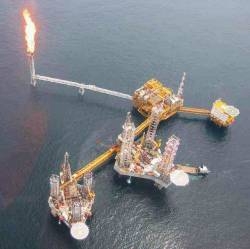
Every year, the oil industry burns off up to 170 billion cubic meters of natural gas released in the oil extraction process, according to a new report commissioned by the World Bank.
The practice, known as gas flaring, not only harms the environment by emitting some 400 million tons of carbon dioxide globally, but is also wasteful of a cleaner energy source, the gas itself, notes Bent Svensson, manager of the Bank’s Global Gas Flaring Reduction partnership. “In Africa alone about 40 billion cubic meters of gas are burned every year, which if put to use could generate half of the electricity needed in that continent,” he says.

When crude oil is brought to the surface from deep inside the earth, gas associated with the extraction frequently surfaces as well. Rather than simply burning it off, the World Bank supports exploiting the resource by either injecting it into the ground for reuse in oil production, converting it to liquid natural gas, transporting it via pipelines, or tapping it to generate electricity on-site. If the estimated 170 billion cubic meters of natural gas burned off in 2006 had been sold on the U.S. market, it would have been worth $40 billion, or 27 percent of U.S. natural gas consumption, the report notes. But in remote areas that lack infrastructure and are far from potential consumers, gas flaring may still be the most economical option.

The study, which examined data collected from 1995 through 2006, is the first of its kind to use satellite images of flaring sites. “In the past, the only way to track gas flaring was through official estimates, but now those days are over,” notes lead author Christopher Elvidge, a scientist with the U.S. National Oceanic and Atmospheric Administration. “These independent figures should help governments and companies alike to get a better sense of how much gas they are actually flaring.” Twenty-two countries have increased gas flaring in the past 12 years, according to the report. Russia and Nigeria appear to be the worst offenders, responsible for roughly one-third and one-sixth of global gas flaring, respectively. Nine countries have had fairly stable gas flaring over the past 12 years, and 16 countries have decreased flaring in that time—among them Argentina, India, Nigeria, Norway, Syria, and the United Arab Emirates.

This story was produced by Eye on Earth, a joint project of the Worldwatch Institute and the blue moon fund. View the complete archive of Eye on Earth stories, or contact Staff Writer Alana Herro at aherro [AT] worldwatch [DOT] org with your questions, comments, and story ideas.

Sunday, September 16, 2007

PRI program on our relationship with animals

Listen! rewilding institute

Christopher Hogwood was not your ordinary household pet. For one thing, he weighed 700 pounds. And he loved to drink beer. Christopher was a very large pig with a heart of gold. In this hour of To the Best of Our Knowledge, the story of how Christopher Hogwood became the best-loved pig in southern New Hampshire. We'll also talk with Dave Foreman - once the most notorious environmental activist in America. He has a new project: re-wilding North America.

SEGMENT 1:

Dave Foreman started as a lobbyist for the Wilderness Society in the 1970s. Then he became a radical and co-founded Earth First! becoming America's most admired and notorious environmentalist. These days he runs a non-profit think tank called The Rewilding Institute. Foreman tells Steve Paulson why he gave up his radical practices and why he now wants to re-introduce wolves, grizzlies and other large carnivores into America's wilderness. Also, we hear poet Mary Oliver recite her poem, "Bear."

SEGMENT 2:

Sy Montgomery tells Jim Fleming about Christopher Hogwood - not the musician, but her beloved pet pig and the subject of her book "The Good Good Pig." Christopher began life as a runty rescued piglet but eventually weighed several hundred pounds and was the town darling.

Also, animal behaviorist Patricia McConnell is the author of "For the Love of a Dog" and the host of the public radio program "Calling All Pets." She visits Anne Strainchamps at home to meet Toby, Anne's ten month old Welsh Corgi. We hear Toby learn how to "Lie Down" and we learn about Tricia's training philosophy. Toby gets lots of good treats and we have a lot of fun.

SEGMENT 3:

Primatologist Barbara J. King is the author of "Evolving God." She tells Steve Paulson about her belief that the rudimentary qualities of religion can be seen in the behavior of the great apes. She says religion began as a set of emotional responses to each other, not a set of beliefs.

Video

"Manufactured Landscapes" SEE THIS BRILLIANT MOVIE! You'll never have the same shopping experience again.