Monday, February 2, 2009

Europe to feel the heat of climate change

From: New Scientist

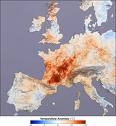
A CENTURY from now, Spain and Italy will be enduring baking, parched summers while residents of central and north-west Europe will be experiencing what we now think of as Mediterranean warmth.

Reindert Haarsma and his team from the Royal Netherlands Meteorological Institute in De Bilt used existing computer models to study changes in weather patterns resulting from the expected global warming. These indicated that summer temperatures in southern Europe would rise by 2 to 3 °C compared with today's, and that lack of rain would dry up the soils.

ADVERTISEMENT

The hot, dry air above these arid soils would then rise and expand, creating a low-pressure zone over the region. Winds circulating anticlockwise around this zone would feed continental air to more northerly areas, raising temperatures there too (Geophysical Research Letters, DOI: 10.1029/2008GL036617).

Article Continues: http://www.newscientist.com/article/mg20126935.400-europe-to-feel-the-heat-of-climate-change.html?DCMP=OTC-rss&nsref=climate-change

ShareThis

Population

Population

by Johathan Porritt
http://www.jonathonporritt.com/pages/2008/11/population_1.html

I thought it might be interesting to share an article done recently for Greenpeace Business.

They have just told me that they can’t use it – too controversial, apparently. If ever an article’s core hypothesis (in this case, that environmental NGOs are both gutless and less than honest in addressing population issues) was borne out by its editorial treatment, then this has to be it.

Which element in the following quotation (taken from a report about climate change issued earlier this year by the Ministry of Defence’s internal think-tank) most powerfully grabs your attention?

"The Earth’s population has grown exponentially in the last century, and rapid climate change of the kind that we have seen before would have more dramatic human consequences, resulting in societal collapse, mega-migration, intensifying competition for much-diminished resources, and widespread conflict."

Unless you are part of that very small minority of environmentalists who put population right at the top of any league table of current crises, that reference to "exponential population growth" will have gone straight in one ear and straight out the other.

There are all sorts of reasons for this: fear of controversy (particularly linked to population's "evil policy twin", namely immigration); "religious sensitivities", in as much as some of the fiercest and most bigoted opponents of proper fertility management are Catholics or Muslims; inexcusable ignorance; an obstinate refusal to think beyond the historical abuses of human rights carried out in the name of "population control" in India or China in the past; economic anxieties that without constant population growth there won’t be enough young people paying their taxes in the future to keep us in the style to which we have become accustomed; and umpteen different shades of political correctness all the way through from “who are we to tell people in the third world how to live their lives?” to “it’s over-consumption in the rich world that’s the problem, not over-population in the poor world”.

Each of those requires proper refutation, but for the purposes of this article, I would like to focus on the "over-consumption versus over-population" debate. This is the argument most favoured by environmentalists who have never really looked into the issue, but are so incensed by the uncaring profligacy of the world’s richest one billion citizens that any other explanation of today's converging crises seems like an irresponsible distraction.

So let's get one thing absolutely clear: I have spent my entire life campaigning against that kind of uncaring profligacy, and no doubt will spend the rest of my life doing exactly the same. There may have been some excuse for the damage we did to the physical environment back in the 1960s and 70s (in that the evidence was often flimsy, and it somehow all seemed to be quite manageable), but today there is no excuse. The evidence is now in – on every count – and what we do today we do with full and shameful knowledge. There is no excuse, and this generation of politicians – in all the major Parties – already stand accused of the most heinous cowardice imaginable.

So I don’t need lecturing about the perils of excessive consumption, or the idiocy of relying on exponential economic growth – fuelled by increased per capita income – to secure a better world! But I’ve never been persuaded that that’s all we have to worry about – as if one mega-reality shaded out every other mega-reality that we are now having to face up to.

And the mega-reality I'm talking about here is carrying capacity: how many people can the Earth’s resources and life-support services sustain on an indefinite basis? The answer to that is obviously determined in part by the level of consumption of each individual human being. But even if, by some currently unimaginable miracle, the richest people in the world today learn to lead what WWF calls "one planet lifestyles", does anyone seriously suppose that this would work for the next 3 billion people aspiring to live in the same way – and the next 3 billion who will be staking a claim on those self-same resources and services before 2050?

It's fascinating to see how many environmentalists have woken up in the last couple of years to the phenomenon of peak oil – the likelihood that we have either already passed or are very close to the "half-way point" in terms of using up existing oil reserves. But I'm not at all sure that the full implications of this have really sunk in. Our near-total dependence on oil makes it very difficult for people to envisage a life without it; activists in today's Transition Towns movement are full of anecdotes of people’s horror as they become acquainted with this reality. Richard Heinberg (author of "The Party’s Over" and a leading activist in the Association for the Study of Peak Oil) likes to rub this in by reminding people that just three spoonfuls of oil provides the equivalent amount of energy as 8 hours of human labour!

Richard’s latest book is called "Peak Everything" – covering not just peak oil, but peak soil, peak wheat, peak rice, peak fisheries, peak precious metals and, perhaps most pressingly of all, peak water.

This is not just a question of more and more people at risk because of declining water resources. A recent report from WWF highlighted the invisible nature of the problem here in the UK. We ourselves are not "running out of water", so there is no direct threat to our current average water consumption of 150 litres per day. But each of us consumes on average thirty times as much "virtual water", which has been used in the production of food and textiles imported into the UK. Big exporting countries like Spain, Egypt, Morocco, Kenya, Israel, Pakistan, South Africa and Uzbekistan are all facing acute water stress – and it’s quite sobering to be reminded that just one green bean from Kenya takes four litres of water to produce. As we work our way through more than 4500 litres of virtual water per person per day, because of these imports, are we, in effect, simply exporting drought?

There are of course all sorts of ways in which we can "fix" some of these problems. Hyper-efficient irrigation systems could reduce water consumption for agriculture by up to 50%. The next generation of solar-powered desalination technologies will bring some comfort to many coastal communities in water-stressed areas. If we had to, albeit at a massive cost, we could totally re-engineer our water and sewerage systems throughout the rich world to deliver exactly the same services for a fraction of current water consumption levels. All this is possible, but unbelievably difficult.

Given all that, one has to point out that it would be a great deal easier to do it for 3 billion people than for 6 billion, let alone 9 billion.

That was exactly the sort of thinking China’s leaders went through 30 years ago: that it might just be possible to sustain a population of around 1 billion on China’s limited land and natural resources, but completely impossible to do the same for 1.5 billion. The "one child family" policy introduced at that time has pegged China’s population at around 1.3 billion; according to the figures the Chinese government uses, it would otherwise have been 1.7 billion. That’s 400 million births averted.

This is where you have to start doing the sums. Per capita emissions of CO2 in China today are around 3.8 tonnes per person. An extra 400 million Chinese citizens legitimately going about their business of improving their economic standard of living, in exactly the same way that citizens of every single one of our rich nations have done over many decades, would today be emitting an additional 1.5 billion tonnes of CO2. When asked which country I believe is doing most about addressing the challenge of climate change, I’m only being partly mischievous when I tell my questioner that it is China.

But logic does not come easily to the hundreds of millions of people who are only just waking up to the threat of accelerating climate change. To be told that the best thing you can do by way of a personal contribution to the problem is to have fewer children (or enable the millions of women all around the world who would just love to have fewer children to do exactly that) comes as a bit of a shock. If, instead of 70 million additional people arriving every year, we had 70 million fewer, then we might still have a chance of arriving at a sustainable future for the whole of humankind. Without that, we are looking at very long odds indeed.

There's a double irony here. Every single one of the multiple socio-economic issues that preoccupy campaigns today would be eased by full-on, government-led interventions to help reduce average fertility – especially in the world’s poorest countries. And we know exactly how to generate that double dividend: massively increase funding for education for girls, for improved reproductive and other health interventions for women, and for ensuring access for women to a choice of reliable and cheap (preferably free) contraceptives. That's what successful family planning looks like.

Yet to listen to critics of family planning, you would still think it’s all about coercion and control. Whilst only too happy to regale you with the shocking statistics about compulsory abortions and sterilisations (let alone very high levels of female infanticide) in China, they know nothing of the success stories in places like Kerala, Thailand, Korea – and even in Iran. With the full support of Islamic leaders in that country, their total fertility rate fell from 6 children per woman in 1974 to 2 children per woman by 2000. And a brilliant education campaign was at the heart of this success story.

The wilful ignorance of environmentalists is one of the reasons why funding for family planning and reproductive healthcare has been falling over the last decade, instead of increasing, despite a rising number of requests for financial support from countries the world over. The other main reason is the vengeful fundamentalism of the George Bush regime, which decreed nearly 8 years ago that no organisation would receive US funding if it so much as acknowledged that abortion is a necessary (though always regrettable) part of any concerted strategy on family planning. Great company for such right-on environmentalists to be keeping.

This is not some abstract lament, detached from the reality of people's lives. In countries like Ethiopia and Kenya, there are tragedies unfolding in front of our eyes right now. In Kenya, the total fertility rate declined from 8 children per woman in 1979 to 4.7 children by 1998. Good news - but then, funding collapsed and average fertility is now on the rise again. If the downward trend had been continued, the population of Kenya in 2050 would have been 44 million. On current trends, it will be more than 80 million.

It's case studies like these (both good and bad) which persuaded the All-Party Parliamentary Group on Population, Development and Reproductive Health to re-engage in this debate in 2007. Its report, ("Return of the Population Growth Factor"), couldn't have been clearer in its overarching conclusion: "The evidence is overwhelming: The Millennium Development Goals are difficult or impossible to achieve with the current levels of population growth in the least developed countries and regions."

So what exactly is going on here? The governments of many of the poorest countries in the world are crying out for financial support for family planning, but are not getting it. The lives of countless millions of women are devastated by their inability to manage their own fertility, and hundreds of thousands die every year because of illegal abortions or complications from unwanted pregnancies. But their voices go largely unheard. On top of all that, every single one of the environmental problems we face today is exacerbated by population growth, and the already massive challenge of achieving an 80% cut in greenhouse gases by 2050 is rendered completely fantastical by the prospective arrival of another 2.5 billion people over the next 40 years.

Yet most environmentalists will still find this article offensive. They will go on banging their utterly inadequate "over-consumption drum", and somehow sleep easy in their beds that they are doing "a good job". I think not.
Thursday, January 22, 2009

When will the water run out?

Climate change, increased industrial demand and wanton wastefulness: is 'peak water' upon us?

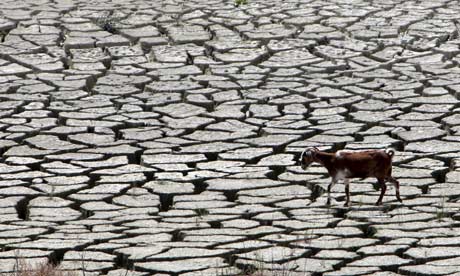
A goat walks along the sun-baked bed of Cyprus's largest reservoir at Kouris

A goat walks along the sun-baked bed of Cyprus's largest reservoir at Kouris. Photograph: Reuters

Peak oil may be the least of our problems, scientists warned today. Growing industrial demand for water in developing countries such as China, rapidly expanding urban populations and the efficiency with which we use water have increased the risk of "peak water" – a resource that most of us presume will be infinite – entering a terminal decline.

Of course, we already knew one of the big eco-bummers of our modern lives is that products from beer to microchips use inordinate amounts of water. Last August, the WWF revealed that each Brit effectively uses 4,645 litres of water a day to produce the food on our tables and the T-shirts on our backs; see our world map for an idea of where Britain's "borrowed water" comes from.

Unsurprisingly, one of the solutions advocated by this new report is a better use of the water we have. To that end, the authors have estimated the water footprint of everyday food and drink, which encouragingly shows that one litre of beer consumes less water (300 litres) than one litre of orange juice (850 litres). One kilogram of coffee is reportedly more thirsty (21,000 litres of water) than one kilogram of hamburger (16,000 litres). Take a look at our image gallery to see the hidden water cost of everything from your daily cuppa to a glass of wine.

According to the report, this is adding up to a global crisis. "We are facing a crisis of running out of sustainably managed water," says Peter Gleick, the author of the sixth edition of the World Water report by California's Pacific Institute. Despite human demand accounting for over 50% of the world's accessible freshwater, the report warns that billions of people still lack access to basic water services. Developing countries, it notes, will suffer worst from peak water because of supply problems exacerbated by flooding, drought and water pollution. Developed countries won't be entirely spared though, as Peter Preston discovered in Spain last year.

The World Water report continues by singling out China as a country in danger of water stress because of its inefficient water use and large projects such as the Three Gorges Dam scheme. "[Chinese] Rivers and lakes are dead and dying, groundwater aquifers are overpumped, uncounted species of aquatic life have been driven to extinction, and direct adverse impacts on both human and ecosystem health are widespread and growing," warns Gleick.

His team also highlights how climate change is adversely affecting water global supplies and its impact on food production.

"The stress on global food production from temperatures alone is going to be huge, and that doesn't take into account water supplies stressed by the higher temperatures," said David Battisti, the lead author of another study published earlier this month.

Gleick's report is keen to stress that the concept of peak water, or more specifically "peak ecological water", isn't completely analogous to peak oil. Unlike oil, some water supplies are infinitely renewable. But even those regions with a water supply that could be exhausted are only likely to suffer peak water locally – whereas peak oil will be a global issue.

Global warming increasing death rate of US trees, scientists warn

Studies find wide range of tree species are dying with serious long-term effects for biodiversity and carbon dioxide release

Global warming prompts increase in tree deaths

A black bear wanders through a meadow dotted with fallen trees on July 8, 2007 in Yellowstone National Park, Wyoming. Photograph: Jeff Hutchens/Getty Images

Trees in the western United States are dying twice as quickly as they did three decades ago and scientists think global warming is to blame.

In their surveys, ecologists found that a wide range of tree species were dying including pines, firs and hemlocks and at a variety of altitudes. The changes can have serious long-term effects including reducing biodiversity and turning western forests into a source of carbon dioxide as they die and decompose. That could lead to a runaway effect that speeds up climate change.

"The trend was pervasive across a wide variety of forest types, across all elevations, in trees of all sizes and among major species," said Phillip van Mantgem of the US Geological Survey (USGS). "At the same time, the rate of new establishment of trees didn't change."

If these trends continued, he said, forests will become sparser and store less carbon. "It introduces the possibility that western forests could be come net sources or carbon dioxide to the atmosphere, further speeding up global warming."

The forest survey, carried out by a team of scientists led by van Mantgem, is published tomorrow in the journal Science. It showed that death rates of trees overall had more than doubled since 1955. In the Pacific north-west and British Columbia, deaths had doubled in 17 years. In California, the death rate took 25 years to double.

The work is the first large-scale study of death rates in forests or temperate regions. Much of the world's population – in North America, Europe, most of China and large portions of Russia – live near temperate forests so what happens in these forests has global importance, according to Jerry Franklin, a professor of forest resources at the University of Washington and a co-author of the study.

The researchers think that warming global temperature is the most likely cause for the dramatic decline. From the 1970s to 2006, the period that includes most of the surveyors' tree data, the average annual temperature of the western US increased by 0.3C-0.4C, and increased even more at the higher elevations that are normally covered in forests.

"While this may not sound like much, it has been enough to reduce winter snowpack, cause earlier snowmelt, and lengthen the summer drought," said van Mantgem. This longer summer drought means less water for trees and it also encourages the growth of insects and diseases that attack the plants. Recent outbreaks of tree-killing bark beetles in the western US have already been linked to warmer temperatures.

Mark Harmon, a forest ecologist at Oregon State University, said another concern from the study is that a climate feedback loop could develop from the increased death rate of trees. As temperatures rise, the smaller forests will not only absorb less CO2 but will emit more greenhouse gases ias the dead material decays. This, in turn, would lead to even higher levels of global warming.

The data for the research was gathered by several generations of scientists counting trees over more than 50 years. It included forests in Oregon, Washington, California, Arizona, Colorado, New Mexico and south-western British Columbia. All were older than 200 years, with many being established more than 500 years ago. Death rates in old forests tend to be more stable since they mostly contain very old trees.

"With many of our long-lived trees that grow very large, each year as they become larger and older, the probability of living the next year increases," said Franklin. "You might imagine that, as a tree gets larger and older, the probability of death would increase but it does not – it decreases for many of our species."

In most forests, it is the youngest trees that are most likely to die. "Often they are shaded by larger, taller trees and so they grow more slowly," said Nathan Stephenson of the USGS. "They are less resilient to changes in the environment and they also don't have as well-developed root systems so, if they run into a drought, they're more likely than a large tree to suffer."

In the latest survey, the research team found that trees of all ages were dying more quickly.

The team also ruled out factors such as overcrowding, forest fragmentation or air pollution. The main air pollutant that harms trees in the western US, for example, is ozone. "In California, where most of our forests are concentrated, ozone is fairly severe," said Stephenson. "Over the time period of the study, there was no trend in ozone and it might even have declined slightly."

Scientists solve enigma of Antarctic 'cooling'

Research 'kills off' climate sceptic argument by showing average temperature across the continent has risen over the last 50 years

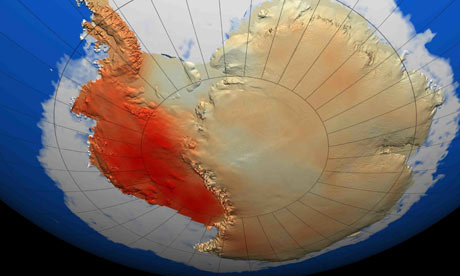
West Antarctic, in red, has warmed far more than the east over the last 50 years

West Antarctica, shown in red, has warmed far more than the east over the last 50 years Photograph: EJ Steig/Nasa

Scientists have solved the enigma of the Antarctic apparently getting cooler, while the rest of the world heats up.

New research shows that while some parts of the frozen continent have been getting slightly colder over the last few decades, the average temperature across the continent has been rising for at least the last 50 years.

In the remote and inaccessible West Antarctic region the new research, based on ground measurements and satellite data, show that the region has warmed rapidly, by 0.17C each decade since 1957. "We had no idea what was happening there," said Professor Eric Steig, at the University of Washington, Seattle, and who led the research published in Nature.

This outweighs the cooling seen in East Antarctica, so that, overall, the continent has warmed by 0.12C each decade over the same period. This matches the warming of the southern hemisphere as a whole and removes the apparent contradiction.

The issue, which had been highlighted by global warming sceptics, was an annoyance, said Steig, despite the science having been reasonably well understood. "But it has now been killed off," he said.

Gareth Marshall, climatologist at British Antarctic Survey, commented: "This work allows us to look at the continent as a whole, which we have not been able to do before with confidence. It fills a big hole in the data in West Antarctica – it is the final piece in the jigsaw."

The rapid warming now revealed in the west concerns some scientists. The new analysis suggests the West Antarctic ice sheet, like that in Greenland, is precariously balanced, said Professor Barry Brook at the University of Adelaide. "Even losing a fraction of both would cause a few metres of sea level rise this century, with disastrous consequences," he said.

It was well known that a small part of Antarctic was warming – the peninsula that protrudes northwards towards South America and is the site of many research stations. But researchers knew that East Antarctica had cooled a little in recent decades and thought that might be the case across the continent's great mountain range in West Antarctica.

Temperature records have been taken on the ground since the first weather stations were built in 1957. But all but two of the 42 are very close to the coast and therefore give no information on the vast interior of the continent. Satellite data, in contrast, can take the temperature of the entire region by measuring the intensity of the infrared radiation reflected from the snow pack and has been available since 1980.

Steig's team found the mathematical relationships between the weather station data and satellite data, tested them, and then used them to go back in time to estimate temperatures across the continent back to 1957. Their statistical model has now been validated by an ice core drilled into the Rutford ice stream in West Antarctica by the British Antarctic Survey, from which temperature records can be measured. That independent work also came up with a warming of 0.17C a decade for the region, and stretched the trend back to at least 1930.

The cooling seen in East Antarctica is caused in part by the ozone hole that opens each year in the atmosphere. The ozone hole causes an increase in westerly winds which, by a complex interaction of wind, sea and ice, results in lower temperatures in the east. Emissions of ozone-destroying gases have now almost been eliminated and the hole is expected to recover by mid-century. When that happens, there will be a rapid catch up of temperatures, says Marshall.

The 2007 report from the UN's Intergovernmental Panel on Climate Change said that the impact of greenhouse gas emissions could be seen on every continent bar Antarctica. The new work, along with another recent study, now clearly shows that the rising temperature of the continent cannot be explained by natural climate variation alone.

Tibet shepherds live on climate frontier

From: The Christian Science Monitor

LANZHOU, CHINA

For Tenzin Dorje, the road home keeps getting longer. Each year the Tibetan shepherd must walk farther to find streams where his sheep can drink.

“I am an old man,” he says, clutching the neck of his cane. Sometimes he trudges six hours a day, twice his old route. He has contemplated learning to ride a motorbike like his grandson, but fears it might be too discomfiting for an 80-year-old man.

The problem is that streams in the province of western China where he lives are drying up, receding into the mountains.


As recent years have brought higher temperatures and altered how snowmelt trickles down from glaciers on the Tibetan-Qinghai plateau, water is becoming scarce.

Mr. Tenzin lives in a small village nestled amid dramatic mountains peaks. Strings of Tibetan prayer flags flap against a still-brilliant blue sky. Yet this apparent purity and timelessness masks another reality: He is living on the frontier of climate change

.

Tenzin’s village is on the slopes of the rugged Qilian mountains in western Gansu province. Glaciers on the mountains are the primary source of water for humans, farms, and industry in his village of Baijiaowan and for others north and south of the range.

The streams distinguish the landscape, including a string of oasis towns along the Old Silk Road, from the abutting Gobi Desert. Today, the desert is expanding.

“The climate is changing,”says Zhang Mingquan, a professor of earth and environmental sciences at Lanzhou University, in the provincial capital. “Snow is the source of the stream water, and now the stream water is less than before.”

Recent years have seen higher temperatures and less precipitation. As a result, mountaintop ice is receding.

The Chinese Academy of Social Sci ences estimates that the glacial area on the Tibetan-Qinghai plateau, the world’s largest ice sheets outside the poles, is shrinking about 7 percent each year.

It might seem that melting glaciers would bring more water in the short term. But that isn’t necessarily the case, says Michael MacCracken of the Climate Institute in Washington.

Article Continues: http://features.csmonitor.com/environment/2009/01/21/tibet-shepherds-live-on-climate-frontier/

Even Antarctica is now feeling the heat of climate change

From: New Scientist

It's official: there is nowhere left to hide from global warming. The notion that Antarctica is the last continent not to be heating up because of climate change is dead, according to a new study.

The results suggest that the southernmost continent is warming roughly as fast as the rest of the planet. They overturn previous suggestions that only the Antarctic peninsula, which stretches points north towards South America, was heating up while the continent's interior cooled.

When the Intergovernmental Panel on Climate Change published its 2007 report, it declared: "it is likely there has been significant anthropogenic warming over the past 50 years averaged over each continent (except Antarctica)".


The exception wasn't made because there was proof that Antarctica was cooling, says Gareth Williams of the British Antarctic Survey, but because there was not sufficient proof that the continent was warming. Since then, data from isolated parts of the seventh continent have confirmed Antarctica is not immune to global warming.

And now, Eric Steig of the University of Washington, Seattle, and colleagues have used satellite data covering the entire continent to show that on average the entire continent warmed by 0.5°C between 1957 and 2006. On average, the planet has warmed 0.6°C in 50 years.

Article Continues: http://www.newscientist.com/article/dn16460-even-antarctica-is-now-feeling-the-heat-of-climate-change.html

Monday, January 5, 2009

It will take more than goodwill and greenwash to save the biosphere

Shell may boast about tackling climate change, but companies tend always to sacrifice good intentions for hard cash

For a while it seemed that Shell had stopped pretending. The advertisements that filled the newspapers in 2006, featuring technicians with perfect teeth and open-necked shirts explaining how they were saving the world, vanished. After being slated by environmentalists for greenwash, after two adverse rulings by the Advertising Standards Authority, Shell appeared to have accepted the inescapable truth that it was an oil company with a minor sideline in alternative energy, and that there was no point in trying to persuade people otherwise.

The interview I conducted with its chief executive, Jeroen van der Veer, broadcast on the Guardian's website today, contains what appears to be an interesting admission. I asked him whether Shell had stopped producing ads extolling its investments in renewable energy. Van der Veer does not express himself clearly at this point, but he seems to admit that his company's previous advertising was not honest.

"If we are very big in oil and gas and we are so far relatively small in alternative energies, if you then every day only make adverts about your alternative energies and not about 90% of your other activities I don't think that - then I say transparency, honesty to the market, that's nonsense." So, I asked, Shell did not intend to return to that kind of advertising? "Probably not," he told me. "I'm very much: keep your feet on the ground, tell them who you are and explain why you are who you are."

But since the interview was filmed, Shell's messianic tendencies appear to have resurfaced. In December the company ran a series of ads in the Guardian suggesting again that it had come to save the world. "Tackling climate change and providing fuel for a growing population seems like an impossible problem, but at Shell we try to think creatively," one boasted. It features a diagram of a human brain, divided into sections labelled "fuel from algae", "fuel from straw", "fuel from woodchips", "hydrogen fuels", "windfarm", "gas to liquids" and "coal gasification". This suggests progress of a kind, in that the company is acknowledging that it sometimes dabbles in fossil fuels, but its core business - oil - and its massive investments in tar sands extraction are missing from the corporate mind. Could Shell be having a senior moment?

The confusion deepens when you watch its latest publicity film. It's called Clearing the Air, and it does just the opposite. It is supposed to tell an inspirational tale of discovery, but the script and the acting are so gobsmackingly bad that it inspires you only to rip your clothes off and run screaming down the street. The lasting impression it leaves is that Shell's staff are chaotic and incompetent. Perhaps the clean-cut corporate clones featured in the ads of 2006 put people off.

Jeroen van der Veer is neither an incompetent nor an automaton. He is charming, friendly and smart. But he refused to answer some of the questions I had prepared.

Reading Shell's reports and publicity material, I kept stumbling on an absence. In 2000, the company boasted that it would be investing $1bn in renewable energy between 2001 and 2005. But since then it appears to have produced no figures for its renewables budget. The company now claims that it is "investing significantly in wind energy", but it doesn't say what "significantly" means. Of the 10 windfarms listed on its website, only one appears to be in the planning or development stage: the others are already in operation. Where is the evidence of new money? When Shell pulled out of Britain's biggest windfarm, the London Array, last year, did this represent the end of its major investments?

I asked Van der Veer a simple question - 15 times. (Only a few of these attempts feature in the edited film.) "What is the value of your annual investments in renewable energy?" He waffled, changed the subject, admitted that he knew the figure, then flatly refused to reveal it. Nor could he give me a convincing explanation of why he wouldn't tell me, claiming only that "those figures are misused and people say it is too small", and it "is not the right message to give to the people". It strikes me that there is only one likely reason for these evasions: that Shell's spending on renewables has fallen sharply from the figure it announced in 2000. It's a fair guess that the current investment would look microscopic by comparison to its spending on the Canadian tar sands, and would make a mockery of its new round of advertising. I challenge Shell - for the 16th time - to prove me wrong.

Nor would Van der Veer give me a straight answer to another straight question: "Is there any investment you would not make on ethical grounds?" I asked this six times. He was unable to furnish me with an example. It's not hard to see why. As well as exploiting the tar sands, which means destroying forest and wetlands, polluting great quantities of water and producing more CO2 than conventional petroleum production, Shell is still flaring gas in Nigeria, at great cost to both local people and the global climate. It has been fiercely criticised for its secret negotiations with the Iraqi government, which led last year to the first major access for a western company to Iraq's gas reserves. It is prospecting for oil in some of the Arctic's most sensitive habitats.

All this makes my question difficult to answer. Aside from the greenwash, it is not easy to spot the practical difference between this civilised, progressive company and the Neanderthals at Exxon.

Like all oil companies, Shell simply follows the opportunities. Shut out of the richest fields by state companies, struggling to extract the dregs from its declining reserves, it has been turning to ever more difficult oil extraction, some of which lies beneath rare and fragile ecosystems. When the price of oil was high, it announced massive investments in the tar sands. Now the price has dropped again, it has cancelled further spending. It has even less of an incentive to invest in renewables. Shell does what the market demands.

I don't blame Shell or Van der Veer for this: they are discharging their duty to their shareholders. I do blame them for creating the impression that the company has a different agenda, and I blame governments for allowing them to drift into whatever fields they find profitable, regardless of the consequences for people or the environment.

On this issue Jeroen van der Veer and I agree. Oil companies, he says, should not seek to determine a country's energy mix: that is for the government to decide.

Saving the biosphere, in other words, cannot be left to goodwill and greenwash: the humanity of pleasant men like Van der Veer will always be swept aside by the imperative to maximise returns. Good people in these circumstances do terrible things. Companies like Shell will pour big money into alternative energy only when more lucrative or immediate opportunities are blocked. Where is the government that is brave enough to block them?

monbiot.com

Vietnam May Revisit Two-Child Population Policy

From: WorldWatch Institute

/lifestyle/article/39010

The government of Vietnam will decide on December 22 whether to penalize parents who have more than two children, reinitiating a coercive population policy it abandoned in 2003.

"We are considering an adjustment to our policy appropriate to the circumstances of the country," Truong Thi Mai, chair of Vietnam's Parliamentary Committee of Social Affairs, confirmed on Saturday. "The Parliament Standing Committee will decide the week after next."

Ms. Mai, a leading figure in the government debate who sits on the influential Standing Committee, was attending a weekend conference of the Asian Forum of Parliamentarians on Population and Development in Hanoi. She declined to provide details of the proposed policy adjustment, but said it was brought about by continuing poverty in rural areas associated with families with more than two children.

Asked whether the policy would violate the principles of family planning voluntarism, an approach that Vietnam government representatives agreed to at the United Nations International Conference on Population and Development in 1994, Ms. Mai responded that the government "has consulted all international laws to which Vietnam is a party" and had discussed the proposed policy change with the United Nations Population Fund. The 1994 agreement lacks the status of international law.

UN sources confirmed that discussion and characterized the initiative as a return of population policy influence by government forces who believe Vietnam's decline in fertility - it fell from 3.8 children per woman in 1989 to less than 2.1 today - is among its greatest social successes. The fertility rate has not risen significantly in recent years, but some Vietnamese officials nonetheless fear that a population "boomlet" may be occurring.

If approved, the new policy would impose fines on parents for any third and higher-order children, the UN sources said. Government officials and parliamentarians are already required to have no more than two children, risking advancement or continued service if they have more.

Initiation of the proposed new policy may also reflect the recent breakup of what had been a ministry devoted to population, maternal health, and child welfare, according to the UN sources. These three functions have since been split into three departments and divided among ministries, weakening the influence of former ministry officials committed to family planning voluntarism.

The Vietnamese two-child population policy had been in effect in the 1990s and until 2003, when - in part due to international pressure against coercive family planning policies - it was replaced with a policy encouraging a "small-family norm" throughout the country.

Reinstatement of the two-child policy would be reminiscent of the longstanding one-child population policy of China, Vietnam's northern neighbor, which requires that most parents have no more than one child or face fines or other penalties. Despite this policy, China's fertility averages around 1.8 children per woman, indicating widespread exceptions to or evasions of the policy.

Vietnam's fertility rate rose slightly around the time its two-child policy was relaxed in 2003, but demographers judge the increase insignificant and doubt it stemmed from relaxation of the policy. The fertility rate has since fallen back to 2.1 or slightly lower, according to UN sources.

Fertility rates that stay consistently at two children per woman allow a population eventually to stop growing in the absence of significant net immigration. Most eastern Asian countries have experienced rapid fertility decline in recent decades, to roughly two children or fewer, due to the increasing popularity of small families and improved access to family planning services in the region.

Robert Engelman is Vice President for Programs at the Worldwatch Institute, an environmental research organization based in Washington, D.C. He is the author of More: Population, Nature, and What Women Want, published in 2008 by Island Press.

Friday, January 2, 2009

More polar bears going hungry

From: New Scientist

/wildlife/article/38980

WARMER temperatures and earlier melting of sea ice are causing polar bears to go hungry. The number of undernourished bears has tripled in a 20-year period.

Seth Cherry of the University of Alberta, Canada, and colleagues monitored the health of polar bears in the ice-covered Beaufort Sea region of the Arctic during April and May in 1985, 1986, 2005 and 2006. They immobilised the bears using tranquilliser darts and measured the ratio of urea to creatinine in their blood. A low ratio means that nitrogenous waste material is being recycled within the body and indicates the animal is fasting - a state which usually only occurs temporarily in males during the spring breeding season.

In 1985 and 1986 the proportion of bears fasting was 9.6 and 10.5 per cent respectively. By 2005 and 2006 this had risen to 21.4 and 29.3 per cent.

Cherry's team believes that the increase in fasting bears is explained by warmer temperatures and earlier spring melts. Polar bears use sea ice as a hunting platform, catching seals by sitting next to their breathing holes and waiting to pounce. Spring is usually a time of feasting for polar bears, filling up before summer when the ice retreats. "It is clear that the changes in the sea ice are affecting the hunting opportunities available to the bears," says co-author Andrew Derocher of the University of Alberta.

What's more, the early melting may also be resulting in a lack of prey. Sea ice is important to seals because they build dens for their pups in the overlying snow, explains Cherry, so their numbers may have dropped.

Article Continues: http://www.newscientist.com/article/mg20126882.700-more-polar-bears-going-hungry.html

Waning wildlife

From: San Francisco Guardian

/wildlife/article/38975

GREEN CITY Changes to ocean and air temperatures, rising sea levels, loss of habitat, scarcity of food, altered precipitation patterns, environmental asynchronicity — these are the concerns of wildlife biologists who are watching the increased effects of climate change on the thousands of plant and animal species that share the earth with people. Overall, global warming threatens a third of existing species, with 50 percent now in general decline due to a variety of human activities.

Bay Area wildlife is already being negatively affected by a warmer world, one that locally manifests in nesting birds roasting to death during heat waves, plummeting fish populations, and starving whales. Those stories were part of "Irreplaceable: Wildlife in a warming world," a recent seminar held at the San Francisco Public Library by the Endangered Species Coalition. Maria Brown, superintendent of Gulf of the Farallones National Marine Sanctuary — one of the most biologically diverse regions in the world, shared a grim account of the Cassin's auklet.


"This little seabird you maybe never heard of may predict the future of climate change in San Francisco," said Brown.

The auklet spends most of its life far out at sea, and flies inland to breed in burrows on remote islands and coastlines. Invasive grasses have choked many of the prime burrowing spots along the coast, so wildlife biologists have installed bird boxes as an alternative. April, the height of the annual nesting season, was an unusually warm month, with thermometers on the Farallones Islands clocking 90-degree temperatures. The bird boxes turned into ovens. "They literally cooked," said Brown of the breeding auklets. "This is a prediction of what's to come."

Article Continues: http://www.sfbg.com/entry.php?entry_id=7769&catid=&volume_id=398&issue_id=412&volume_nu

Can aircraft trails affect climate?

From: Nature News
Published January 1, 2009 09:48 AM

Can aircraft trails affect climate?

/pollution/article/38982

Grounding planes after the 11 September attacks may not have caused unusual temperature effects.

When all commercial air traffic in the United States was grounded after the terrorist attacks of 11 September 2001, scientists got an unexpected opportunity to test ideas about the climate effects of the condensation trails left behind by jets.

A study in 2002 suggested that these contrails could have a significant effect on daily temperature patterns (see 'Air-traffic moratorium opened window on contrails and climate'). But a new analysis now claims that altered US temperature patterns during the three flight-free days can be explained by natural variations in cloud cover, rather than the absence of planes.

Aircraft contrails can spread into cirrus-like clouds high in the atmosphere. Similar to natural clouds, they are thought to have an overall warming effect on the planet. But they can also moderate daily temperature extremes by trapping heat that escapes from the ground and reflecting sunlight. This raises the lowest overnight temperatures and, to a lesser degree, reduces the highs during daylight hours, scientists have suggested.

With air traffic projected to grow by 2—5% per year in the near future — amounting to at least a tripling in traffic by 2050 — the effects of contrails are expected to become an increasingly important factor in climate change. But atmospheric scientists are still unsure about the scale of the contrails' impact.

Theory or fact?

Two studies noted that when planes stopped flying on 11—14 September 2001, the average daily temperature range in the United States rose markedly, exceeding the three-day periods before and after by an average of 1.8 °C. The unusual size of the shift, says David Travis of the University of Wisconsin—Whitewater, who led both of the earlier studies, implied that an absence of contrails gave the temperature range a significant boost. But that idea, he says, was "more like a hypothesis" than a firm conclusion.

Article Continues: http://www.nature.com/news/2008/081231/full/news.2008.1335.html

ShareThis

Video

"Manufactured Landscapes" SEE THIS BRILLIANT MOVIE! You'll never have the same shopping experience again.