Monday, January 5, 2009

It will take more than goodwill and greenwash to save the biosphere

Shell may boast about tackling climate change, but companies tend always to sacrifice good intentions for hard cash

For a while it seemed that Shell had stopped pretending. The advertisements that filled the newspapers in 2006, featuring technicians with perfect teeth and open-necked shirts explaining how they were saving the world, vanished. After being slated by environmentalists for greenwash, after two adverse rulings by the Advertising Standards Authority, Shell appeared to have accepted the inescapable truth that it was an oil company with a minor sideline in alternative energy, and that there was no point in trying to persuade people otherwise.

The interview I conducted with its chief executive, Jeroen van der Veer, broadcast on the Guardian's website today, contains what appears to be an interesting admission. I asked him whether Shell had stopped producing ads extolling its investments in renewable energy. Van der Veer does not express himself clearly at this point, but he seems to admit that his company's previous advertising was not honest.

"If we are very big in oil and gas and we are so far relatively small in alternative energies, if you then every day only make adverts about your alternative energies and not about 90% of your other activities I don't think that - then I say transparency, honesty to the market, that's nonsense." So, I asked, Shell did not intend to return to that kind of advertising? "Probably not," he told me. "I'm very much: keep your feet on the ground, tell them who you are and explain why you are who you are."

But since the interview was filmed, Shell's messianic tendencies appear to have resurfaced. In December the company ran a series of ads in the Guardian suggesting again that it had come to save the world. "Tackling climate change and providing fuel for a growing population seems like an impossible problem, but at Shell we try to think creatively," one boasted. It features a diagram of a human brain, divided into sections labelled "fuel from algae", "fuel from straw", "fuel from woodchips", "hydrogen fuels", "windfarm", "gas to liquids" and "coal gasification". This suggests progress of a kind, in that the company is acknowledging that it sometimes dabbles in fossil fuels, but its core business - oil - and its massive investments in tar sands extraction are missing from the corporate mind. Could Shell be having a senior moment?

The confusion deepens when you watch its latest publicity film. It's called Clearing the Air, and it does just the opposite. It is supposed to tell an inspirational tale of discovery, but the script and the acting are so gobsmackingly bad that it inspires you only to rip your clothes off and run screaming down the street. The lasting impression it leaves is that Shell's staff are chaotic and incompetent. Perhaps the clean-cut corporate clones featured in the ads of 2006 put people off.

Jeroen van der Veer is neither an incompetent nor an automaton. He is charming, friendly and smart. But he refused to answer some of the questions I had prepared.

Reading Shell's reports and publicity material, I kept stumbling on an absence. In 2000, the company boasted that it would be investing $1bn in renewable energy between 2001 and 2005. But since then it appears to have produced no figures for its renewables budget. The company now claims that it is "investing significantly in wind energy", but it doesn't say what "significantly" means. Of the 10 windfarms listed on its website, only one appears to be in the planning or development stage: the others are already in operation. Where is the evidence of new money? When Shell pulled out of Britain's biggest windfarm, the London Array, last year, did this represent the end of its major investments?

I asked Van der Veer a simple question - 15 times. (Only a few of these attempts feature in the edited film.) "What is the value of your annual investments in renewable energy?" He waffled, changed the subject, admitted that he knew the figure, then flatly refused to reveal it. Nor could he give me a convincing explanation of why he wouldn't tell me, claiming only that "those figures are misused and people say it is too small", and it "is not the right message to give to the people". It strikes me that there is only one likely reason for these evasions: that Shell's spending on renewables has fallen sharply from the figure it announced in 2000. It's a fair guess that the current investment would look microscopic by comparison to its spending on the Canadian tar sands, and would make a mockery of its new round of advertising. I challenge Shell - for the 16th time - to prove me wrong.

Nor would Van der Veer give me a straight answer to another straight question: "Is there any investment you would not make on ethical grounds?" I asked this six times. He was unable to furnish me with an example. It's not hard to see why. As well as exploiting the tar sands, which means destroying forest and wetlands, polluting great quantities of water and producing more CO2 than conventional petroleum production, Shell is still flaring gas in Nigeria, at great cost to both local people and the global climate. It has been fiercely criticised for its secret negotiations with the Iraqi government, which led last year to the first major access for a western company to Iraq's gas reserves. It is prospecting for oil in some of the Arctic's most sensitive habitats.

All this makes my question difficult to answer. Aside from the greenwash, it is not easy to spot the practical difference between this civilised, progressive company and the Neanderthals at Exxon.

Like all oil companies, Shell simply follows the opportunities. Shut out of the richest fields by state companies, struggling to extract the dregs from its declining reserves, it has been turning to ever more difficult oil extraction, some of which lies beneath rare and fragile ecosystems. When the price of oil was high, it announced massive investments in the tar sands. Now the price has dropped again, it has cancelled further spending. It has even less of an incentive to invest in renewables. Shell does what the market demands.

I don't blame Shell or Van der Veer for this: they are discharging their duty to their shareholders. I do blame them for creating the impression that the company has a different agenda, and I blame governments for allowing them to drift into whatever fields they find profitable, regardless of the consequences for people or the environment.

On this issue Jeroen van der Veer and I agree. Oil companies, he says, should not seek to determine a country's energy mix: that is for the government to decide.

Saving the biosphere, in other words, cannot be left to goodwill and greenwash: the humanity of pleasant men like Van der Veer will always be swept aside by the imperative to maximise returns. Good people in these circumstances do terrible things. Companies like Shell will pour big money into alternative energy only when more lucrative or immediate opportunities are blocked. Where is the government that is brave enough to block them?

monbiot.com

Vietnam May Revisit Two-Child Population Policy

From: WorldWatch Institute

/lifestyle/article/39010

The government of Vietnam will decide on December 22 whether to penalize parents who have more than two children, reinitiating a coercive population policy it abandoned in 2003.

"We are considering an adjustment to our policy appropriate to the circumstances of the country," Truong Thi Mai, chair of Vietnam's Parliamentary Committee of Social Affairs, confirmed on Saturday. "The Parliament Standing Committee will decide the week after next."

Ms. Mai, a leading figure in the government debate who sits on the influential Standing Committee, was attending a weekend conference of the Asian Forum of Parliamentarians on Population and Development in Hanoi. She declined to provide details of the proposed policy adjustment, but said it was brought about by continuing poverty in rural areas associated with families with more than two children.

Asked whether the policy would violate the principles of family planning voluntarism, an approach that Vietnam government representatives agreed to at the United Nations International Conference on Population and Development in 1994, Ms. Mai responded that the government "has consulted all international laws to which Vietnam is a party" and had discussed the proposed policy change with the United Nations Population Fund. The 1994 agreement lacks the status of international law.

UN sources confirmed that discussion and characterized the initiative as a return of population policy influence by government forces who believe Vietnam's decline in fertility - it fell from 3.8 children per woman in 1989 to less than 2.1 today - is among its greatest social successes. The fertility rate has not risen significantly in recent years, but some Vietnamese officials nonetheless fear that a population "boomlet" may be occurring.

If approved, the new policy would impose fines on parents for any third and higher-order children, the UN sources said. Government officials and parliamentarians are already required to have no more than two children, risking advancement or continued service if they have more.

Initiation of the proposed new policy may also reflect the recent breakup of what had been a ministry devoted to population, maternal health, and child welfare, according to the UN sources. These three functions have since been split into three departments and divided among ministries, weakening the influence of former ministry officials committed to family planning voluntarism.

The Vietnamese two-child population policy had been in effect in the 1990s and until 2003, when - in part due to international pressure against coercive family planning policies - it was replaced with a policy encouraging a "small-family norm" throughout the country.

Reinstatement of the two-child policy would be reminiscent of the longstanding one-child population policy of China, Vietnam's northern neighbor, which requires that most parents have no more than one child or face fines or other penalties. Despite this policy, China's fertility averages around 1.8 children per woman, indicating widespread exceptions to or evasions of the policy.

Vietnam's fertility rate rose slightly around the time its two-child policy was relaxed in 2003, but demographers judge the increase insignificant and doubt it stemmed from relaxation of the policy. The fertility rate has since fallen back to 2.1 or slightly lower, according to UN sources.

Fertility rates that stay consistently at two children per woman allow a population eventually to stop growing in the absence of significant net immigration. Most eastern Asian countries have experienced rapid fertility decline in recent decades, to roughly two children or fewer, due to the increasing popularity of small families and improved access to family planning services in the region.

Robert Engelman is Vice President for Programs at the Worldwatch Institute, an environmental research organization based in Washington, D.C. He is the author of More: Population, Nature, and What Women Want, published in 2008 by Island Press.

Friday, January 2, 2009

More polar bears going hungry

From: New Scientist

/wildlife/article/38980

WARMER temperatures and earlier melting of sea ice are causing polar bears to go hungry. The number of undernourished bears has tripled in a 20-year period.

Seth Cherry of the University of Alberta, Canada, and colleagues monitored the health of polar bears in the ice-covered Beaufort Sea region of the Arctic during April and May in 1985, 1986, 2005 and 2006. They immobilised the bears using tranquilliser darts and measured the ratio of urea to creatinine in their blood. A low ratio means that nitrogenous waste material is being recycled within the body and indicates the animal is fasting - a state which usually only occurs temporarily in males during the spring breeding season.

In 1985 and 1986 the proportion of bears fasting was 9.6 and 10.5 per cent respectively. By 2005 and 2006 this had risen to 21.4 and 29.3 per cent.

Cherry's team believes that the increase in fasting bears is explained by warmer temperatures and earlier spring melts. Polar bears use sea ice as a hunting platform, catching seals by sitting next to their breathing holes and waiting to pounce. Spring is usually a time of feasting for polar bears, filling up before summer when the ice retreats. "It is clear that the changes in the sea ice are affecting the hunting opportunities available to the bears," says co-author Andrew Derocher of the University of Alberta.

What's more, the early melting may also be resulting in a lack of prey. Sea ice is important to seals because they build dens for their pups in the overlying snow, explains Cherry, so their numbers may have dropped.

Article Continues: http://www.newscientist.com/article/mg20126882.700-more-polar-bears-going-hungry.html

Waning wildlife

From: San Francisco Guardian

/wildlife/article/38975

GREEN CITY Changes to ocean and air temperatures, rising sea levels, loss of habitat, scarcity of food, altered precipitation patterns, environmental asynchronicity — these are the concerns of wildlife biologists who are watching the increased effects of climate change on the thousands of plant and animal species that share the earth with people. Overall, global warming threatens a third of existing species, with 50 percent now in general decline due to a variety of human activities.

Bay Area wildlife is already being negatively affected by a warmer world, one that locally manifests in nesting birds roasting to death during heat waves, plummeting fish populations, and starving whales. Those stories were part of "Irreplaceable: Wildlife in a warming world," a recent seminar held at the San Francisco Public Library by the Endangered Species Coalition. Maria Brown, superintendent of Gulf of the Farallones National Marine Sanctuary — one of the most biologically diverse regions in the world, shared a grim account of the Cassin's auklet.


"This little seabird you maybe never heard of may predict the future of climate change in San Francisco," said Brown.

The auklet spends most of its life far out at sea, and flies inland to breed in burrows on remote islands and coastlines. Invasive grasses have choked many of the prime burrowing spots along the coast, so wildlife biologists have installed bird boxes as an alternative. April, the height of the annual nesting season, was an unusually warm month, with thermometers on the Farallones Islands clocking 90-degree temperatures. The bird boxes turned into ovens. "They literally cooked," said Brown of the breeding auklets. "This is a prediction of what's to come."

Article Continues: http://www.sfbg.com/entry.php?entry_id=7769&catid=&volume_id=398&issue_id=412&volume_nu

Can aircraft trails affect climate?

From: Nature News
Published January 1, 2009 09:48 AM

Can aircraft trails affect climate?

/pollution/article/38982

Grounding planes after the 11 September attacks may not have caused unusual temperature effects.

When all commercial air traffic in the United States was grounded after the terrorist attacks of 11 September 2001, scientists got an unexpected opportunity to test ideas about the climate effects of the condensation trails left behind by jets.

A study in 2002 suggested that these contrails could have a significant effect on daily temperature patterns (see 'Air-traffic moratorium opened window on contrails and climate'). But a new analysis now claims that altered US temperature patterns during the three flight-free days can be explained by natural variations in cloud cover, rather than the absence of planes.

Aircraft contrails can spread into cirrus-like clouds high in the atmosphere. Similar to natural clouds, they are thought to have an overall warming effect on the planet. But they can also moderate daily temperature extremes by trapping heat that escapes from the ground and reflecting sunlight. This raises the lowest overnight temperatures and, to a lesser degree, reduces the highs during daylight hours, scientists have suggested.

With air traffic projected to grow by 2—5% per year in the near future — amounting to at least a tripling in traffic by 2050 — the effects of contrails are expected to become an increasingly important factor in climate change. But atmospheric scientists are still unsure about the scale of the contrails' impact.

Theory or fact?

Two studies noted that when planes stopped flying on 11—14 September 2001, the average daily temperature range in the United States rose markedly, exceeding the three-day periods before and after by an average of 1.8 °C. The unusual size of the shift, says David Travis of the University of Wisconsin—Whitewater, who led both of the earlier studies, implied that an absence of contrails gave the temperature range a significant boost. But that idea, he says, was "more like a hypothesis" than a firm conclusion.

Article Continues: http://www.nature.com/news/2008/081231/full/news.2008.1335.html

ShareThis

Third of Britain's mammals 'at risk'

Link

Climate change and habitat loss blamed as eight more species join the seriously endangered list

The hedgehog, water vole and hazel dormouse are among a number of British mammals that face becoming seriously endangered, research published today reveals.

Climate change and habitat loss have led to a dramatic increase in the number of mammals whose future survival is a cause for concern among conservationists, the study commissioned by the People's Trust for Endangered Species concludes. The Bechstein's bat, one of the country's rarest mammals, has shown a marked decline while the number of soprano pipistrelle bats has fallen by 46% in six years.

The report, the seventh annual assessment of the state of land mammals in Britain, says that more effort is needed to help the endangered species, which now number 18 - more than 30% of Britain's mammal species - up from 10 last year. Only two species on the UK Biodiversity Action Plan list, the otter and the lesser horseshoe bat, have increased their numbers.

Professor David Macdonald, conservation biologist in the wildlife conservation unit at Oxford University and co-author of the report, said: "Next year, the focus of biodiversity conservation in England will shift from individual species to a more integrated eco-system approach, incorporating climate change adaptation principles and establishing complementary species and habitat conservation."

Unpredictable and extreme weather conditions, combined with hotter, drier summers and wetter winters, were causing changes in the distribution and behaviour of some species, such as the hazel dormouse, the study finds.

Although modern agricultural practices and the disappearance of hedgerows have had a significant impact on mammals such as the hedgehog, "conflict" between mammal species, particularly involving the invasive American mink, is also posing problems for conservationists, it adds. Mink-free zones on a large scale need to be established to stop the "catastrophic decline" of water voles that has been seen over the last 20 years.

Pine martens, one of the species on the list of conservation concern and extremely rare in England and Wales, are preying on capercaillie in Scotland, one of the fastest-declining gamebirds.

Wild deer, whose distribution has been increasing over the last 30 years, are the major cause of damage to Woodland Sites of Special Scientific Interest and are also destroying vegetation cover for smaller mammals. The damage caused is likely to worsen unless more work is done to fence in deer and manage their populations, the report concludes.

"The interaction between people and nature has positive and negative parts. If people are looking for a single, simple answer then they're going to be frustrated," Macdonald said.

"Conservation is as much about control and management as it is about preservation. Sometimes you've too many and in other places too few, which involves fostering where necessary and controlling elsewhere."

The report also tackles the controversial issue of reintroducing species into the wild where they have become extinct, including the beaver, which will be put back into Scotland next spring for the first time in 400 years. The report said the introduction would bring more benefits than costs to biodiversity. Other species being considered for release are up to 450 Eurasian lynx, which would give Scotland the fourth largest lynx population in Europe. Nida al-Fulaij, development manager for the People's Trust for Endangered Species, said mammals had often been neglected in people's imagination.

"We've been funding more and more mammal conservation work in the UK and are concerned about the number of mammals on the conservation priority list. There's no overall organisation for mammals, in the way that there is the RSPB for birds, and mammal conservation has been very fragmented. Mammals are not as easy to see as birds - many are nocturnal," al-Fulaij said.

"Lots are considered vermin and it's not until numbers drop, as with the hedgehog, that people notice. Sometimes there's a misconception that they're very numerous when in fact numbers are falling. Urban areas, hedgerows and gardens are great habitats and we would encourage people to go out and enjoy them."

Windfarm revolution tangled in red tape

• 262 UK projects await planning permission
• Renewable energy target looks increasingly remote

Britain's wind power industry is facing a double blow of lengthy planning delays and rapidly rising construction costs in a crisis that threatens to sink the government's climate-change goals.

Dozens of projects are being held up by planning inquiries, with the average length of time taken to win permission being 15 to 20 months in England and far longer in Scotland and Northern Ireland, where the bulk of the schemes are being developed.

There are 262 different projects representing seven gigawatts stuck in the planning stages. And the rate of approvals is slowing despite government promises, according to the British Wind Energy Association (BWEA).

It said that the start of a third inquiry into one project in Norfolk that has already been delayed for seven years showed that the government has not cured the problem despite introducing the Planning Act to speed up the process.

Meanwhile Centrica, owner of British Gas and one of the most powerful energy utilities, said a 250-megawatt scheme off the Lincolnshire coast was hanging in the balance because turbine manufacturers and other suppliers had raised their prices so high they were jeopardising the economics of the scheme.

With Britain committed to producing 15% of its energy from renewable sources by 2020 to meet European Union targets, the government would be blown off course unless it intervened more robustly, said the BWEA.

"The government does not want the political problems of undermining local democracy by taking control out of the hands of local councillors," said Charles Anglin, director of communications at the BWEA. "But if it fails to act it is just storing up more difficult problems further down the road when it gives the go-ahead to coal or expensive gas projects instead."

To meet the 15% target, the BWEA estimates that Britain needs more than 30GW of wind capacity. "We think you can get 20GW offshore, which means you need 10-12GW onshore, and yet so far we have only got 2.5GW," Anglin said.

"We are aware that the planning system does need to be quicker and there are other barriers to projects," said a department of energy and climate change spokesman. "That is why we are going to unveil a renewable energy strategy with the next steps to meeting our goals."

The planning problem is highlighted by the battle waged by Ecotricity at Shipdham in Norfolk over a wind farm application submitted in December 2001. The company has won two planning inquiries only to find the final decision challenged in the high court by two local residents claiming potential noise problems.

The Planning Act applies only to schemes in England - and then only those over 50MW. "Eighty to 90% of the schemes in England are under 50MW anyway so the Planning Act does virtually nothing," Anglin said.

Offshore operators are also struggling because of the mounting costs that have already chased Shell and BP off to the US.

The cost of Centrica's 250MW Lincs wind farm off Skegness has increased from £2bn to £3bn a GW. "We are committed to building wind farms," said a company spokesman, "but we have got to get the costs down to an economic level."

Nasa climate expert makes personal appeal to Obama

One of the world's top climate scientists has written a personal new year appeal to Barack and Michelle Obama, warning of the "profound disconnect" between public policy on climate change and the magnitude of the problem.

With less than three weeks to go until Obama's inauguration, Professor James Hansen, who heads Nasa's Goddard Institute for Space Studies, asked the recently appointed White House science adviser Professor John Holdren to pass the missive directly to the president-elect.

In it, he praises Obama's campaign rhetoric about "a planet in peril", but says that how the new president acts in office will be crucial. Hansen lambasts the current international approach of setting targets through "cap and trade" schemes as not up to the task. "This approach is ineffectual and not commensurate with the climate threat. It could waste another decade, locking in disastrous consequences for our planet and humanity," the letter from Hansen and his wife, Anniek, reads.

The letter will make uncomfortable reading for officials in 10 US states whose cap and trade mechanism - the Regional Greenhouse Gas Initiative - got under way yesterday. The scheme is the first mandatory, market-based greenhouse gas reduction programme in the US.

Hansen advocates a three-pronged attack on the climate problem. First, he wants a phasing out of coal-fired power stations - which he calls "factories of death" - that do not incorporate carbon capture. "Nobody realistically expects that the large readily available pools of oil and gas will be left in the ground. Caps will not cause that to happen - caps only slow the rate at which the oil and gas are used. The only solution is to cut off the coal source," the Hansens wrote.

Second, he proposes a "carbon tax and 100% dividend". This is a mechanism for putting a price on carbon without raising money for government coffers. The idea is to tax carbon at source, then redistribute the revenue equally among taxpayers, so that high carbon users are penalised while low carbon users are rewarded.

Finally, he urges a renewed research effort into so-called fourth generation nuclear plants, which can use nuclear waste as fuel.

Hansen argues that the current emphasis on reduction targets combined with carbon trading schemes make it too easy for countries to wriggle out of their commitments. He cites the example of Japan's increasing coal use, which it has offset by buying credits from China through the clean development mechanism - an instrument set up by the Kyoto protocol - yet China's emissions have continued to increase rapidly. China has overtaken the US as the biggest polluter in the world.

Hansen has been one of the most prominent advocates of action to tackle climate change since he first spoke on the issue in the 1980s. His testimony to the Senate featured in Al Gore's film An Inconvenient Truth and he has received numerous honours for his work on the issue, including the WWF's top conservation award.

Professor's wish list

• Moratorium on and phasing out of coal power stations without carbon capture, what Hansen calls the "sine qua non for solving the climate problem". Coal CO2 emissions are the same as those of other fossil fuels combined.

• Raising the price of emissions via a "carbon tax and 100% dividend". This is a tax mechanism to "decarbonise" the economy without a net take from taxpayers. Low carbon users are rewarded while high users are punished.

• Urgent research on "fourth generation" nuclear power with international co-operation. This offers one of the best options for nearly carbon-free power, according to Hansen. It would also help to solve the nuclear waste problem by using that material as fuel.

Slowdown of coral growth extremely worrying, say scientists

Slowdown of coral growth extremely worrying, say scientists

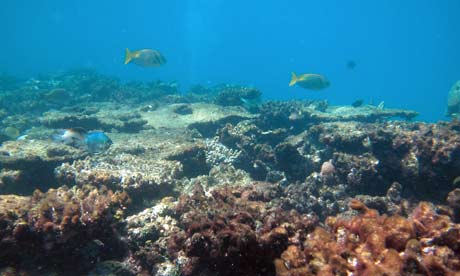
Great Barrier Reef, Australia

Coral growth across the Great Barrier Reef has suffered a "severe and sudden" slowdown since 1990 that is unprecedented in the last four centuries, according to scientists.

The researchers analysed the growth rates of 328 coral colonies on 69 individual reefs that make up the 1,250 mile-long Great Barrier Reef, off north-east Australia. They found that the rate at which the corals were laying down calcium in their skeletons dropped by 14.2% between 1990 and 2005.

Corals around the world are severely threatened by coastal pollution, warming seas and over-exploitation, but the most probable explanation for the drop in the growth rate of the corals' calcium carbonate skeletons is acidification of the water due to rising carbon dioxide levels in the atmosphere. More acid water makes it more difficult for the coral polyps to grab the minerals they need to build their skeletons from the sea water.

"Our data shows that growth and calcification of massive Porites in the GBR [Great Barrier Reef] are already declining and are doing so at a rate unprecedented in coral records reaching back 400 years," wrote Dr Glenn De'ath from the Australian Institute of Marine Science in Townsville, Queensland, and his colleagues in the journal Science. "Verification of the causes of this decline should be made a high priority."

Porites corals can be centuries old and grow into 6m tall mounds. Rather like a tree ring, each year's growth is visible as a band, so by drilling into the corals the scientists could examine the extent of growth in specific years. The team used x-rays and a technique called gamma densitometry to measure annual growth and skeletal density, which then allowed them to calculate the amount of calcification annually. They found that the calcification rate rose 5.4% between 1900 and 1970, but this dropped by 14.2% between 1990 and 2005. The drop was mainly due to a growth slowdown from 1.43cm a year to 1.24cm. The researchers measured the same effect in both nearshore and offshore reefs, suggesting it is not due to pollution from the land.

"This study has provided the first really rigorous snapshot of how calcification might be changing," marine biologist Ove Hoegh-Guldberg of the University of Queensland in Australia told Science. "The results are extremely worrying."

Wednesday, December 10, 2008

Wetter and wilder: the signs of warming everywhere

In the third part of our series on the eve of the Poznan conference, we look at how climate change is already changing ordinary people's lives from Australia to Brazil

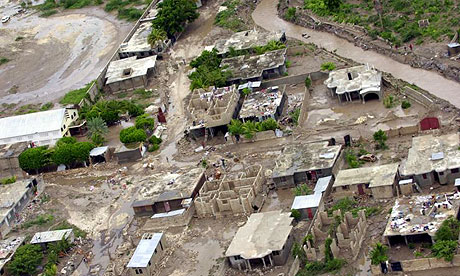
An aerial view of Gonaives, in Haiti, after the passing of tropical storm Hanna

An aerial view of Gonaives, in Haiti, after the passing of tropical storm Hanna. Photograph: Thony Belizaire/AFP/Getty images

Joao da Antonio's eyes are full of tears. If good rains do not come, he says, he will pack his bag, kiss his wife and two children goodbye and join the annual exodus of young men leaving hot, dry rural north-east Brazil for the biofuel fields in the south.

Da Antonio, 19, can earn about £30 a month for 10 hours gruelling work a day cutting sugar cane to make ethanol, and more than a million small farmers like him migrate south for six months of the year because the land can no longer support them. Tens of thousands a year never return, forced to move permanently to Sao Paulo or another of Brazil's cities in search of work.

"Life here is one of suffering," Da Antonio said. "I will do anything to earn some money. None of us want to die, but the lack of water here will kill us. "

Around the world, millions of people like Da Antonio are feeling the force of a changing climate. As UN negotiations towards a global climate deal continue in Poznan, Poland, this week, evidence is emerging of weather patterns in turmoil and the poorest nations disproportionately bearing the brunt of warming.

While rich countries at the talks seek to set up global carbon trading, using financial markets to tackle - and profit from - climate change, poor countries want justice. They are seeking environmental justice: money to adapt their economies to climate changes they did not cause, and technology and resources to allow them to escape poverty while preserving their forests and ecosystems.

The fast and unpredictable shifts in weather are not threats for the future, but happening right now. "The frequency of heatwaves and heavy precipitation is increasing; cyclones are becoming more frequent and intense; more areas are being affected by droughts; and flooding is now more serious," says Sheridan Bartlett, a researcher with the International Institute for Environment and Development in a new study looking at the effects of climate change on children.

"Increasingly unpredictable weather now affects hundreds of millions of farmers, resulting in food and water shortages, more illnesses and water-borne diseases, malnutrition, soil erosion, and disruption to water supplies," she says. Such changes confound the received wisdom of how to live on the land.

North-east Brazil has always known droughts, but they are becoming longer and more frequent, say scientists and farmers. "Climate change is biting. It is much hotter than it used to be and it stays hotter for longer. The rain has become more sporadic. It comes at different times of the year now and farmers cannot tell when to plant," says Lindon Carlos, an agronomist with Brazilian group Acev.

Brazilian scientists have recorded changes in the lifecycles of plants, greater oscillations in temperature and more water shortages, all consistent with the UN Intergovernmental Panel on Climate Change (IPCC) predictions of a devastating 3-4C rise in temperatures within 60 years if climate change is not halted. "All the research points to it becoming drier [in north-east Brazil]. In the last 30 years temperatures have risen by 1C. There is more very heavy rainfall over short periods and more evaporation," says Eneida Cavalcanti, a desertification specialist at the Joaquim Nabuco foundation in Recife.

On the other side of the world, the changing climate is wreaking havoc in a different way on low-lying and populous Bangladesh. There, government meteorologists this year reported a 10% increase in intensity and frequency in major cyclones hitting the country - two of the most powerful cyclones ever recorded have hit the country in the last three years.

"We are getting too much water in the rainy season and too little in the dry season. All this has implications for food security," says Raja Debashish Roy, Bangladesh's environment minister.

"We are learning about climate change," said Anawarul Islam, chair of the Deara district of about 2,500 people in the far south of the county. "This village is experiencing more rainfall and flooding every year. It has led to more homeless people and more conflict. "

"It's far warmer now," says one villager, Selina. "We do not feel cold in the rainy season. We used to need blankets, but now we don't. There is extreme uncertainty of weather. It makes it very hard to farm and we cannot plan. We have to be more reactive. The storms are increasing and the tides now come right up to our houses."

The balmy Caribbean is also being churned up with increasing frequency and ferocity. This year, the region experienced eight hurricanes and five major hurricanes, the second highest ever, and the hurricane season lasted a record five months.

"A warmer climate poses in some cases insurmountable challenges to the region. We face more hurricanes, coral bleaching and flooding," said Neville Trotz, science adviser to the Caribbean community climate change centre.

Across the Atlantic, in Africa, the theme unfolds further: climate change turning already bad situations in poor countries into potential catastrophe, and driving people to absolute poverty. Alexandre Tique, at Mozambique's national meteorological institute, says: "Analysis of the temperature data gathered in our provincial capitals, where we have meteorological stations that have kept continuous data over the years, shows a clear increase in temperature. Extreme events are becoming more frequent. We now see many more tropical cyclones that bring flooding, destruction and loss of lives."

Other African communities are suffering. In the village of Chikani, in Zambia, the farmers last year prepared their fields for planting in November, as they have always done, but the rains were very late for the third year running.

"We waited, but the first drop didn't fall till December 20. After a day, the rains stopped. Three weeks later, it started to rain again. But then it stopped again after a few days. Since then, we have had no rain. We have never known anything like this before," says Julius Njame.

From the plains of Africa, to mountaintop Nepal, where there is no respite from the weather in flux. Villages like Ketbari expect a small flood to wash off the hills every decade or so, now they seem to be annual and getting more serious.

"We always used to have a little rain each month, but now when there is rain it's very different. It's more concentrated and intense. It means that crop yields are going down," says Tekmadur Majsi, whose lands have been progressively washed away by the Trishuli river.

Nepalese villagers observe the minutiae of a changing climate. Some say that forest pigs now farrow earlier, others that some types of rice and cucumber will no longer grow where they used to. The common thread is that the days are hotter, some trees now flower twice a year and the raindrops are getting bigger.

The anecdotal observations of farmers are backed by scientists who are recording in Nepal some of the fastest increases in temperatures and rainfall anywhere in the world. Many lakes in Nepal and neighbouring Bhutan, which collect glacier meltwater, are said by the UN to be growing so rapidly that they could burst their banks.

Melting glaciers are creating anxiety about water supplies across the Earth. In Tajikistan, at current rates of change, thousands of small glaciers will have disappeared completely by 2050, causing more water to flow in spring followed by what is expected to be a disastrous decline of river flow in most rivers. In Peru, temperature increases have led to a 22% reduction in the total area of its glaciers in the last 35 years.

The developing nations on the climate frontline will argue strongly in Poznan that rich countries should pay to help them adapt to climate change. But development groups such as Oxfam and Tearfund say that almost all the money pledged so far has come out of existing aid funds. With a worldwide recession, many analysts expect rich countries to resist paying more.

The UN has established two funds - the Least Developed Countries and Special Climate Change funds - to raise money for the poorest countries to adapt, but the G8 countries have only pledged $6bn (£4bn). All the money is to be diverted from existing aid money.

"Every [official development assistance] dollar that goes to climate adaptation would mean a dollar less for health and education [programmes] in developing countries," said Antonio Hill, a senior policy adviser at Oxfam.

The scale of what is needed for adaptation is immense. Bangladesh says it needs £250m over three years to adapt, Ethiopia £450m, and other countries similar amounts. Development groups estimate that a minimum $50bn a year is needed worldwide.

"The resources currently available for adaptation are grossly inadequate to meet the needs of the least developed countries who bear the brunt of increased climate variability and unpredictability resulting from climate change," said Bangladesh's finance minister, Mirza Azizul Islam.

Back in north-east Brazil, the Pernambuco state environment minister, Aloysio Coasta, says: "In 20 years' time we could be a desert region. In some communities there are no young people left at all. This is an emergency. Food production is going down in many areas."

Joao da Antonio's wife, Luiza, is resigned to becoming a "drought widow". Clearly distressed, she says: "If there is no water, then he must leave."

Rich nations must plan for floods, heat and drought now, warns panel

Two thousand people killed during a summer heatwave; mosquitoes at Heathrow carrying malaria parasites picked up from infected holidaymakers; road-builders switching to a melt-resistant tarmac.

If anyone is in any doubt that climate change is already affecting the UK, this is your answer. "It's not just a question of impacts in the future. We are actually looking at impacts right now," said Chris West, director of the UK Climate Impacts Programme. His job is to advise the government, private and voluntary sectors on how changes to the UK's climate will affect how they operate.

The most severe and immediate impacts of climate change will hit developing countries. But the rich, developed world will also be affected, and adapting to the changes will be extremely expensive.

The Intergovernmental Panel on Climate Change's (IPCC) Fourth Assessment report last year included a detailed breakdown of impacts for regions around the world. Europe must prepare for warmer, wetter winters in the north and hotter, drier summers in the south. That is going to put severe demands on water in southern Europe and will mean more crop failures due to drought. Also, people will suffer directly. The 2003 summer heatwave killed 2,000 people in the UK alone. Winter floods will increase in maritime regions and flash floods will be more common across the continent. Coastal flooding linked to sea-level risk will threaten up to 1.6 million more people each year by 2080.

Like Europe, the US will experience the greatest warming in winter at high latitudes and hotter summers in the south-west, according to the IPCC. Climate modellers expect extremes of hot weather, wildfires, water stress, insect outbreaks and a range of health problems to increase; but there will also be benefits. Crop yields will rise 5-20% during the next few decades as the warming climate opens up more land for cultivation.

But probably the hardest hit of the developed regions will be Australia. In temperate regions, the IPCC climate models predict up to 32 more days in a year over 35°C (95F) by 2020 and up to 84 more by 2050. Water security will become a major concern with prolonged droughts a regular feature, while extreme weather and sea-level rise will cause problems for Australia's predominantly coastal population. Water flow in the Murray-Darling river basin - Australia's largest, which accounts for around 70% of irrigated crops and pastures - is expected to fall by between 10 and 25% by 2050.

Fifth of world's coral reefs dead, say marine scientists

Climate change linked to warmer and more acidic seas pose biggest threat to coral survival, says report

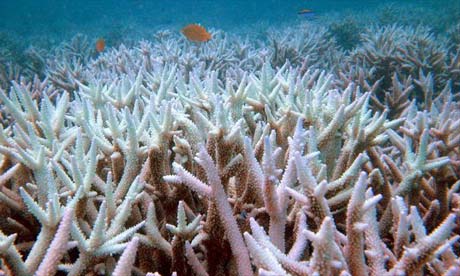
Plight of the coral reefs

Plight of the coral reefs. Photograph: Cathie Page

A fifth of the world's coral reefs have died or been destroyed and the remainder are increasingly vulnerable to the effects of climate change, a new study says.

The Global Coral Reef Monitoring Network says many surviving reefs could be lost over the coming decades as CO2 emissions continue to increase.

"If nothing is done to substantially cut emissions, we could effectively lose coral reefs as we know them, with major coral extinctions," said Clive Wilkinson of the GCRMN.

The report, released today at UN climate talks in Poznan, Poland, said warmer and more acidic seas posed the biggest threat in future. Other threats include overfishing, pollution and invasive species – as well as natural hazards, such as the earthquake that triggered the Indian Ocean tsunami in 2004, which forced reefs from the water.

Corals are crucial to the livelihoods of millions of coastal dwellers around the world. The UN's Millennium Ecosystem Assessment says reefs are worth about $30bn annually to the global economy through tourism, fisheries and coastal protection.

"If nothing changes, we are looking at a doubling of atmospheric CO2 in less than 50 years," said Carl Gustaf Lundin, head of the International Union for Conservation of Nature's global marine programme, which is one of the organisations behind the GCRMN. "As this carbon is absorbed, the oceans will become more acidic, which is seriously damaging a wide range of marine life from corals to plankton communities and from lobsters to seagrasses."

The report found that some 45% of the world's reefs are currently healthy, and that some retain the ability to recover after major bleaching events, such as the one caused by the El NiƱo event in 1998, and to adapt to climate change threats. But, globally, the downward trend of recent years has not been reversed.

David Obura, chair of the IUCN climate change and coral reefs working group, said: "Ten years after the world's biggest coral bleaching event, we know that reefs can recover – given the chance. Unfortunately, impacts on the scale of 1998 will reoccur in the near future, and there's no time to lose if we want to give reefs and people a chance to suffer as little as possible."

Video

"Manufactured Landscapes" SEE THIS BRILLIANT MOVIE! You'll never have the same shopping experience again.