Monday, September 8, 2008

Solar energy can meet all the world's energy demands: expert

From: , The World Business Council for Sustainable Development (WBCSD), More from this Affiliate

/energy/article/38117

The world must speed up the deployment of solar power as it has the potential to meet all the world's energy needs, the chairman of an industry gathering which wrapped up Friday in Spain said.

"The solar energy resource is enormous, and distributed all over the world, in all countries and also oceans," said Daniel Lincot, the chairman of the five-day European Photovoltaic Solar Energy conference held in Valencia.

"There is thus an enormous resource available from photovoltaics, which can be used everywhere, and can in principle cover all the world energy demand from a renewable, safe and clean source," he added.

Lincot, the research director of the Paris-based Institute for Research and Development of Photovoltaic Energy, said solar energy was growing rapidly but still made only a "negligible" contribution to total energy supply.

Last year the world production of photovoltaic models represented a surface of 40 square kilometres (16 square miles) while meeting the electrical consumption of countries like France or Germany would require 5,000 square kilometres, he said.

Under current scenarios, photovoltaic models will represent about 1,000 square kilometres by 2020 accounting for about only 3.0 percent of energy needs in the 27-member European Union, he added.

Over 200 scientists and solar power experts have signed a declaration calling on the accelerated deployment of photovoltaic power which was launched at the conference.

More than 3,500 experts and 715 sector firms took part in the gathering, billed as the largest conference ever organised in the field of photovoltaic conversion of solar energy.

Germany and Spain are the world leaders in solar energy power. Germany has 4,000 megawatts of installed capacity while Spain has 600 megawatts.

This article is reproduced with kind permission of Agence France-Presse (AFP) For more news and articles visit the AFP website.

Friday, September 5, 2008

Asia pollution may boost U.S. temperatures

  • Story Highlights
  • Report says air pollution in Asia may raise summer temperatures in the U.S.
  • Authors: Shorter-term pollutants cause more localized warming than once thought
  • "What they do about their pollution can affect our climate," scientist says
  • Pollution likely to create "hot spots" in the world, one in the central United States

GTON (AP) -- Smog, soot and other particles like the kind often seen hanging over Beijing add to global warming and may raise summer temperatures in the American heartland by three degrees in about 50 years, says a new federal science report released Thursday.

Smog like this seen over Beijing, China, is caused mostly from burning wood and from driving trucks and cars.

Smog like this seen over Beijing, China, is caused mostly from burning wood and from driving trucks and cars.

These overlooked, shorter-term pollutants -- mostly from burning wood and kerosene and from driving trucks and cars -- cause more localized warming than once thought, the authors of the report say.

They contend there should be a greater effort to attack this type of pollution for faster results.

For decades, scientists have concentrated on carbon dioxide, the most damaging greenhouse gas because it lingers in the atmosphere for decades. Past studies have barely paid attention to global warming pollution that stays in the air merely for days.

The new report, written by scientists with NASA and the National Oceanic and Atmospheric Administration, makes a case for tackling the short-term pollutants, while acknowledging that carbon dioxide is still the chief cause of warming.

That concept is also the official policy of the Bush Administration, said assistant secretary of commerce Bill Brennan.

In the United States, this approach would mean cutting car and truck emissions perhaps before restricting coal-burning power plants. In the developing world, especially Asia, it would mean shifting to cleaner energy sources, more like those used in the Western world. Much of this type of pollution in Asia comes from burning kerosene and biofuels, such as wood and animal dung.

In addition to soot, smog and sulfates, other short-lived pollutants are organic carbon, dust and nitrates. While carbon dioxide is invisible, these are pollutants people can see.

Projected increases in some of these pollutants and decreases in others in Asia will eventually add up to about 20 percent of the already-predicted man-made summer warming in America by 2060, the report said.

"What they do about their pollution can affect our climate," said study co-author Hiram "Chip" Levy, a senior scientist at NOAA's fluid dynamics lab in Princeton, New Jersey.

This pollution will likely create three "hot spots" in the world: the central United States, Europe around the Mediterranean Sea, and Kazakhstan, which borders Russia and China. In the United States it's "a big blob in the middle of the country" stretching from the Rocky Mountains to the Appalachians, Levy said.

The same analysis also shows about an inch less of yearly rain in middle America because of Asian emissions by about 2060.

As far as American-produced pollution, smog is the main problem. Reducing diesel emissions and increasing mass transit would prove a more effective and immediate strategy over limiting power plants, said study co-author Drew Shindell, a climate scientist at NASA's Goddard Institute for Space Studies in New York.

The report makes sense, but should also include a strategy for man-made methane, a greenhouse gas which lasts 10 years in the atmosphere, said Michael MacCracken, chief scientist at the Climate Institute in Washington.

Methane mostly comes from landfills, natural gas use, livestock, coal mining and sewage treatment, according to the U.S. Environmental Protection Agency

Wednesday, September 3, 2008

As ocean surface temperatures rise, so do hurricanes' strength

(09-03) 19:14 PDT -- Hurricanes have grown more and more powerful over the past 30 years as ocean surface temperatures - probably aided by global warming - have increased, climate scientists said today.

The trend is worldwide, the researcher said, but the evidence is strongest in the North Atlantic, which takes in the Caribbean and the Gulf of Mexico, where just days ago hurricane Gustav bore down on the Louisiana coast, reviving memories of Katrina.

"The fact that Gustav reached category 4 in the increasingly warm Caribbean is consistent with what we've noted as a trend over the past 30 years," James B. Elsner, leader of a hurricane research team at Florida State University said Wednesday in an e-mail.

The one-two punch of Gustav and of Katrina, the category 5 hurricane that devastated New Orleans just three years ago, he said, "might be a harbinger of things to come in a warmer world as the observed and modeled consequence of climate change."

The study is appearing today in the journal Nature just a day after two other published reports concluded that for the past decade temperatures throughout the Northern Hemisphere have been warmer than at any time in the past 1,300 years.

Surface temperatures both on land and sea have been rising for centuries, and when ocean surfaces heat up they provide energy that can whip the circular winds of normal storms over the ocean into full-scale hurricanes.

Using satellite measurements, Elsner and researchers at the University of Wisconsin studied the peak wind speeds of storms over the world's tropic oceans that later grew to become full-scale hurricanes.

The result, they said, was consistent with the long-held hypothesis that "as the seas warm, the ocean has more energy to convert to tropical winds." More often now than in the past, those winds have speeded up to become hurricanes, Elsner's team has found.

The link between those hurricanes and sea surface temperatures during the past three decades was most clear in the North Atlantic, but it was less significant in other parts of the world, the scientists concluded.

In an earlier review of the links between climate change and hurricane intensity, published in the journal Geophysical Research Letters, Elsner noted that his results "have serious implications for life and property throughout the Caribbean, Mexico and portions of the United States."

The Elsner report follows reports by Peter Webster, Judith Curry and their colleagues at George Tech University who, after studying the increasing intensity of hurricanes and their links to rising sea surface temperatures, concluded in a report published in Science that hurricane intensities worldwide have more than doubled since 1970.

Hurricane intensity is measured on what is called the Saffir-Simpson scale. The weakest are Category 1, in which winds reach from 74 to 95 mph, and the strongest are Category 4, with sustained winds from 131 to 155 mph, and Category 5, such as Katrina, with winds of 156 mph or more.

In the 35 years before 2004, the number of the weakest Category 1 hurricanes that reached Category 4 or 5 rose worldwide from 17 percent to 35 percent, they reported. In an e-mail Wednesday, Curry said that today some 41 percent of all Category 1 hurricanes have increased to Category 4 or 5 in the past five years.

"This increase is associated with the trend of increasing sea surface temperatures associated with global warming, although the link with sea surface temperature is more complex than originally thought," Curry said.

Referring to Hurricane Gustav, Curry cautioned that "you can't attribute the intensity of any single storm to global warming."

E-mail David Perlman at dperlman@sfchronicle.com.

Major ice-shelf loss for Canada

Ice drifts away from the Ward Hunt ice shelf in northern Canada
Ward Hunt is the largest of the remnant ice shelves

The ice shelves in Canada's High Arctic have lost a colossal area this year, scientists report.

The floating tongues of ice attached to Ellesmere Island, which have lasted for thousands of years, have seen almost a quarter of their cover break away.

One of them, the 50 sq km (20 sq miles) Markham shelf, has completely broken off to become floating sea-ice.

Researchers say warm air temperatures and reduced sea-ice conditions in the region have assisted the break-up.

"These substantial calving events underscore the rapidity of changes taking place in the Arctic," said Trent University's Dr Derek Mueller.

"These changes are irreversible under the present climate."

Satellite images of ice loss
Satellite images show the loss of the Markham Ice Shelf over the last year

Scientists reported in July that substantial slabs of ice had calved from Ward Hunt Ice Shelf, the largest of the Ellesmere shelves.

Similar changes have been seen in the other four shelves.

As well as the complete breakaway of the Markham, the Serson shelf lost two sections totalling an estimated 122 sq km (47 sq miles), and the break-up of the Ward Hunt has continued.

Cold remnants

The shelves themselves are merely remnants of a much larger feature that was once bounded to Ellesmere Island and covered almost 10,000 sq km (3,500 sq miles).

Over the past 100 years, this expanse of ice has retreated by 90%, and at the start of this summer season covered just under 1,000 sq km (400 sq miles).

Much of the area was lost during a warm period in the 1930s and 1940s.

Melt water on ice shelf
"Long meltwater lakes" were imaged on the Markham shelf in 2005

Temperatures in the Arctic are now even higher than they were then, and a period of renewed ice shelf break-up has ensued since 2002.

Unlike much of the floating sea-ice which comes and goes, the shelves contain ice that is up to 4,500 years old.

A rapid sea-ice retreat is being experienced across the Arctic again this year, affecting both the ice attached to the coast and floating in the open ocean.

The floating sea-ice, which would normally keep the shelves hemmed in, has shrunk to just under five million sq km, the second lowest extent recorded since the era of satellite measurement began about 30 years ago.

"Reduced sea-ice conditions and unusually high air temperatures have facilitated the ice shelf losses this summer," said Dr Luke Copland from the University of Ottawa.

"And extensive new cracks across remaining parts of the Ward Hunt Ice Shelf mean that it will continue to disintegrate in the coming years."

Loss of ice in the Arctic, and in particular the extensive sea-ice, has global implications. The "white parasol" at the top of the planet reflects energy from the Sun straight back out into space, helping to cool the Earth.

Further loss of Arctic ice will see radiation absorbed by darker seawater and snow-free land, potentially warming the Earth's climate at an even faster rate than current observational data indicates.

Coal plans go up in smoke

Environmentalists in the US have halted a huge new wave of coal-fired power stations. What lessons can Europe learn from them?

One day, historians might speculate that it was the ambition of the companies that sought to profit by building coal-fired power stations that triggered the beginning of the end for humans' most polluting habit.

Four years ago, campaigners in the US raised concerns over plans to build 150 coal-fired power stations nationwide. Today, nearly half those plans have been defeated in the courts or abandoned, while half of the remaining proposals are being actively opposed. Just 14 of the 150 plants are being developed, and environmental lawyers are all still pursuing them.

"The enormity of what they were proposing to do provided a platform to have that whole debate about pollution, including global-warming pollution, " says Bruce Nilles , director of the national coal campaign for the Sierra Club, America's biggest grassroots environment group.

Firmer action

In a few years, the backlash against coal power in America has become the country's biggest-ever environmental campaign, transforming the nation's awareness of climate change and inspiring political leaders to take firmer action after years of doubt and delay. Plants have been defeated in at least 30 of the 50 states, uniting those with already strong environmental records, such as California, with more conservative areas, such as the southern and central states.

The success of the US campaign is also now inspiring a global wave of protests, many in Europe, against similar schemes that plan to build coal-fired generators before carbon capture technology exists. If the European protesters succeed, Nilles believes US legislators will be likely to support presidential candidates' promises to join international efforts to cut emissions. By implication, though, if the protesters fail in Europe, the impact on a US or international deal would be disastrous.

The US anti-coal campaign is being linked to protests against similar plans in Australia, Germany, Italy and the UK, where there are demonstrations at almost every public appearance by E.ON, the company that plans to build Britain's first new first new coal power station for two decades in Kingsnorth, Kent, where protesters set up a protest camp against the new development in August.

US campaigners say they are concerned that if the UK and other European countries go ahead with new coal plants, the momentum to tackle climate change will be lost. " The rest of the world has been leading on this, particularly Europe," says Nilles. "Building new coal makes it increasingly difficult, if not impossible, to meet [emissions] targets, so it's critical the European community countries do not fail."

Coal power returned to the US political agenda when vice-president Dick Cheney's 2001 energy policy lifted key pollution restrictions. It took two years for environmental groups to see what emerged: state by state, project by project, a total of 150 new plants were put forward, almost all of them not to replace old coal but to augment it. Individually, some plants would have emitted more CO2 than some African countries. Together, the plants would have emitted an estimated1bn tonnes of CO2 annually - more than the total emissions cuts by countries that have signed the Kyoto protocol.

That realisation mobilised an incredible national campaign, led by a few national groups including the Sierra Club, the Union of Concerned Scientists and others, but driven by state and local membership of these and many more organisations and employing a wide array of tactics. The first job was to raise public awareness that the cumulative threat was far greater than each local project, says Nilles. "The projects were moving through the public process and nobody was paying any attention."

Using town hall debates, local media and political connections, they stirred up interest and recruited new supporters to the cause, including powerful hunting and fishing interests and religious leaders in the Appalachian mountain states, where opencast coal mining is often affecting the poorest communities. Then the campaign began. State politicians were persuaded to legislate either against emissions, as in the case of California, or in favour of alternatives such as renewables and energy efficiency, in Minnesota. Campaigners targeted banks, telling them that investing in coal might be too risky because of the threat of international emissions caps and high carbon prices, prompting the banks to set tougher conditions on lending.

Then the environmentalists highlighted a little-noticed Federal grant fund that gave billions of dollars for new coal power; following their publicity six planned plants were dropped. Legal challenges successfully blocked more plants on the basis of local pollution in Illinois and Montana. It was also proven that burning coal was not the cheapest method of generating electricity, breaking state rules in Minnesota and Florida.

In 2007 the US Supreme Court ruled that greenhouse gases were a pollutant under the clean air act and so could be regulated. In July this year for the first time a coal plant in Georgia was blocked by a local court using this ruling. Meanwhile, concrete and steel prices have escalated so high that other projects have been dropped on cost grounds.

Extreme weather

It is not only energy policy that has changed: public opinion on climate change has been transformed during this time, thanks in part to extreme weather events across the US, says Nilles.

"The sceptics will say that you can't say one flood is down to global warming. That's right, but we can see an up-tick in extreme and unprecedented weather patterns: wildfires sweeping across California, the drought that stretches [across] the southern tier of states, extreme flooding up in the mid-west, and an up-tick in tornados across the Great Plains."

Public opinion, in turn, has helped persuade at least six states, directly or through emissions limits, to put an effective moratorium on new coal power - California, Washington, Oregon and, perhaps more surprisingly, the conservative southern and midwest states of Florida, Idaho and Kansas. Governors of states that have taken action are also now putting pressure on their peers to stop them building generators that would wipe out their own hard-won emissions reductions. Nilles believes new coal power is now doomed in the US. "My sense is less than 10% [of the 150 plants proposed] will ultimately get built," he says. After this campaign, protesters will turn their attention to existing coal power and the mining industry, he says. "Ultimately, we need to phase out coal entirely .We don't need it and it's very expensive. The US has some of the best [renewable energy] resources in the world."

Growing resistance

In Germany, where 25 plants have been mooted, campaigners are winning local referendums and blocking the proposals. India has also had some resistance to new coal, for example in Chamalapura near the city of Mysore. China is facing a fierce public response to pollution caused by coal and other industrial sites: an environmental official in 2006 estimated there had been 51,000 pollution-related protests the previous year. In Australia, protesters kicked off six planned climate camps around the world this year by chaining themselves to a coal train and blocking access to two plants.
Source: European Climate Foundation

Monday, August 25, 2008

Whaling under fire as Norway catches only 50% of its quota

· Fisherman deny whale meat market has collapsed
· Oil price blamed for restricted hunt

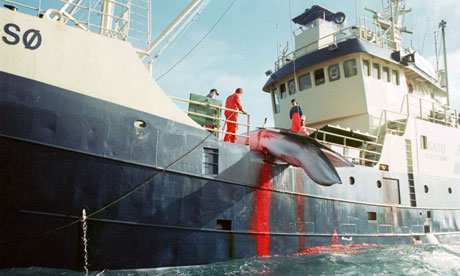
Minke whale

A minke whale is hauled onboard a Norwegian whaling ship in this file photograph from 1999. Photograph: John Cunningham/Getty

Norway will not catch enough whales to meet its quota this year, in what environmentalists are claiming is proof that the nation should abandon the activity completely.

Since the whaling season started on April 1, fishermen have caught around half the number of animals allowed by the authorities – 533 common minke whales out of a quota of 1,052.

The season ends on August 31 and fishermen recognise they will fall short. "I don't think we will do it," said Bjoern-Hugo Bendiksen, chairman of the Norwegian Whalers' Union.

Conservation groups say the catch came short because Norwegians' taste for the mammal has declined. "This shows that people don't want to eat whale meat anymore. The market is not there," said Truls Gulowsen from Greenpeace. "The Norwegian government should stop supporting a dying industry and apply the 1986 international moratorium on whaling."

Fishermen deny that falling demand is behind the low catch. "We were able to meet the quota in the two best areas for whaling, around [the Arctic archipelago of] Svalbard" and along the northern coast of Norway, explained Bendiksen, who caught 23 animals this season.

Instead, Bendiksen claims boats have intentionally avoided the hunting areas that are further away, such as the waters around Jan Mayen, an island 600 miles west of the Norwegian mainland. "Only one boat went there this season. It's a long, dangerous trip and it's very expensive because of the increased fuel costs. So it's not worth the risk," he said.

According to official regulations fishermen have three weeks from the moment they catch a whale to deliver it to a processing plant onshore. But "processing plants don't have enough capacity to deal with the meat," thus limiting how much whalers can catch, claims Bendiksen.

Norway resumed commercial whaling in 1993, despite an international moratorium put in place in 1986 to protect the species from extinction. Only one other nation, Iceland, has followed suit, in 2006. Japan allows whaling for scientific reasons, although a large number of whale steaks are found in fish markets every year.

Norway's whale catches have been declining in recent years. In 2004 fishermen hunted 639 animals from a total quota of 796. Last year they caught just 597, out of a quota of 1,052 – the highest quota allowed since 1993. Around 30 ships were involved in this year's hunting season.

Conservationists have long argued that all forms of whale hunting should be banned because it is cruel and stocks are too low for hunting to be sustainable. But Norway defies the ban because whaling "has high political status, even though it's a marginal industry," according to Gulowsen.

"It's a symbolic issue for the government, a way to show its independence from the international community when it comes to controlling its natural resources," he said.

For many Norwegians, especially for those living in the Arctic north where whaling is considered a normal economic activity, eating whale is as ordinary as eating cod or salmon. Whale steaks are available at supermarkets and are served in restaurants.

Norway hunts only one type of whale, the common minke whale, which is considered as "threatened with extinction" according to Cites, the Convention on International Trade in Endangered Species of Wild Fauna and Flora, which bans its international trade.

The common minke whale is viewed as "near threatened" according to the Red List of the IUCN, the International Union for Conservation of Nature, the second lowest step on its "Red List", its classification of endangered species. In August, the IUCN said common minke whales, along with other big whales, were slowly recovering from the threat of extinction thanks to the 1986 moratorium.

Climate change is not anarchy's football

In seeking to put politics ahead of action, Ewa Jasiewicz is engaging in magical thinking of the most desperate kind

-George Monbiot

If you want a glimpse of how the movement against climate change could crumble faster than a summer snowflake, read Ewa Jasiewicz's article, published yesterday on Comment is free. It is a fine example of the identity politics that plagued direct action movements during the 1990s, and from which the new generation of activists has so far been mercifully free.

Jasiewicz rightly celebrates the leaderless, autonomous model of organising that has made this movement so effective. The two climate camps I have attended – this year and last – were among the most inspiring events I've ever witnessed. I am awed by the people who organised them, who managed to create, under extraordinary pressure, safe, functioning, delightful spaces in which we could debate the issues and plan the actions which thrust Heathrow and Kingsnorth into the public eye. Climate camp is a tribute to the anarchist politics that Jasiewicz supports.

But in seeking to extrapolate from this experience to a wider social plan, she makes two grave errors. The first is to confuse ends and means. She claims to want to stop global warming, but she makes that task 100 times harder by rejecting all state and corporate solutions. It seems to me that what she really wants to do is to create an anarchist utopia, and to use climate change as an excuse to engineer it.

Stopping runaway climate change must take precedence over every other aim. Everyone in this movement knows that there is very little time: the window of opportunity in which we can prevent two degrees of warming is closing fast. We have to use all the resources we can lay hands on, and these must include both governments and corporations. Or perhaps she intends to build the installations required to turn the energy economy around – wind farms, wave machines, solar thermal plants in the Sahara, new grid connections and public transport systems – herself?

Her article is a terrifying example of the ability some people have to put politics first and facts second when confronting the greatest challenge humanity now faces. The facts are as follows. Runaway climate change is bearing down on us fast. We require a massive political and economic response to prevent it. Governments and corporations, whether we like it or not, currently control both money and power. Unless we manage to mobilise them, we stand a snowball's chance in climate hell of stopping the collapse of the biosphere. Jasiewicz would ignore all these inconvenient truths because they conflict with her politics.

"Changing our sources of energy without changing our sources of economic and political power", she asserts, "will not make a difference. Neither coal nor nuclear are the 'solution', we need a revolution." So before we are allowed to begin cutting greenhouse gas emissions, we must first overthrow all governments and corporations and replace them with autonomous communities of happy campers. All this must take place within a couple of months, as there is so little time in which we could prevent two degrees of warming. This is magical thinking of the most desperate kind. If I were an executive of E.ON or Exxon, I would be delighted by this political posturing, as it provides a marvellous distraction from our real aims.

To support her argument, Jasiewicz misrepresents what I said at climate camp. She claims that I "confessed not knowing where to turn next to solve the issues of how to generate the changes necessary to shift our sources of energy, production and consumption". I confessed nothing of the kind. In my book Heat, I spell out what is required to bring about a 90% cut in emissions by 2030. Instead I confessed that I don't know how to solve the problem of capitalism without resorting to totalitarianism.

The issue is that capitalism involves lending money at interest. If you lend at 5%, then one of two things must happen. Either the money supply must increase by 5%, or the velocity of circulation must increase by 5%. In either case, if this growth is not met by a concomitant increase in the supply of goods and services, it becomes inflationary and the system collapses. But a perpetual increase in the supply of goods and services will eventually destroy the biosphere. So how do we stall this process? Even when usurers were put to death and condemned to perpetual damnation, the practice couldn't be stamped out. Only the communist states managed it, through the extreme use of the state control Jasiewicz professes to hate. I don't yet have an answer to this conundrum. Does she?

Yes, let us fight both corporate power and the undemocratic tendencies of the state. Yes, let us try to crack the problem of capitalism and then fight for a different system. But let us not confuse this task with the immediate need to stop two degrees of warming, or allow it to interfere with the carbon cuts that have to begin now.

Jasiewicz's second grave error is to imagine that society could be turned into a giant climate camp. Anarchism is a great means of organising a self-elected community of like-minded people. It is a disastrous means of organising a planet. Most anarchists envisage their system as the means by which the oppressed can free themselves from persecution. But if everyone is to be free from the coercive power of the state, this must apply to the oppressors as well as the oppressed. The richest and most powerful communities on earth – be they geographical communities or communities of interest – will be as unrestrained by external forces as the poorest and weakest. As a friend of mine put it, "when the anarchist utopia arrives, the first thing that will happen is that every Daily Mail reader in the country will pick up a gun and go and kill the nearest hippy".

This is why, though both sides furiously deny it, the outcome of both market fundamentalism and anarchism, if applied universally, is identical. The anarchists' associate with the oppressed, the market fundamentalists with the oppressors. But by eliminating the state, both remove such restraints as prevent the strong from crushing the weak. Ours is not a choice between government and no government. It is a choice between government and the mafia.

Over the past year I have been working with groups of climate protesters who have changed my view of what could be achieved. Most of them are under 30, and they bring to this issue a clear-headedness and pragmatism that I have never encountered in direct action movements before. They are prepared to take extraordinary risks to try to defend the biosphere from the corporations, governments and social trends which threaten to make it uninhabitable. They do so for one reason only: that they love the world and fear for its future. It would be a tragedy if, through the efforts of people like Jasiewicz, they were to be diverted from this urgent task into the identity politics that have wrecked so many movements.

Beauty spots to be devoured by sea

National Trust warns of losing battle to save much-loved coastal landmarks from rising sea levels and erosion

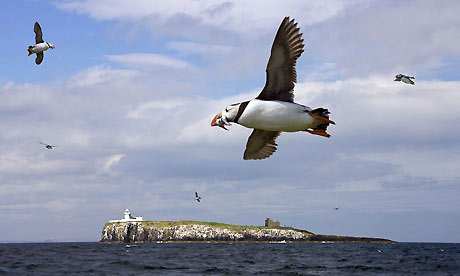
Farne Islands, Northumberland

Farne Islands, Northumberland. Photograph: Steve Allen Travel Photography/Getty Images

Some of Britain's most famous coastal landmarks will be radically changed or even lost because it is no longer possible to hold back rising seas and coastal erosion, according to the National Trust.

The castle of St Michael's Mount off the coast of Cornwall, the white cliffs of Birling Gap in East Sussex, Studland beach in Dorset and the dunes of Formby, near Liverpool, are among the places which could alter dramatically. In one of the most extreme cases to be identified by the trust, the entire 18th-century fishing village of Porthdinllaen on the north-west coast of Wales could be left to crumble into the sea.

The report on the 10 coastal hotspots will be published this week to highlight the problems of climate change which threaten about 70 sites around the coastline owned by the trust.

Phil Dyke, the National Trust's coast and marine adviser, said the decision to stop protecting many coastal areas was driven by the rising cost of damage, because global warming is causing more sea-level rises and more intense storms which exacerbate erosion, and because protection measures often cause damage farther along the coast, for example, depriving nearby beaches of shingle and sand. On one site in Cornwall the trust estimated it would cost £6m to build defences which would only last about 25 years.

The report highlights the difficult decisions which will have to be taken across Britain and around the world as landowners and governments decide how to cope with the impact of climate change on habitats and built infrastructure, particularly after a tradition of pitting engineers against natural change.

'Over the next 100 years the shape of our coastline will change, and our favourite seaside destinations may not look the way they were captured in our holiday snapshots,' said Dyke. 'I think we have a natural affinity with our coast and the sea. But we all need to be aware that our environment is not fixed and that change is inevitable.'

Three years ago a separate report by the National Trust warned that more than half the charity's coastline was under threat and up to 10,000 acres could be lost to the sea in the next century, but the full impact of the problem had not been fully appreciated.

The 10 case studies in the report include three residential areas: at Birling Gap in Sussex one cottage has already been demolished and the remaining four will eventually be lost as the soft chalk cliffs erode by a metre a year; residents on St Michael's Mount, near Penzance, could lose their low-tide causeway permanently and have to move to homes higher above the tide-line; and the 16 houses and inn of Porthdinllaen on the Lleyn peninsula are likely to be lost because more stormy weather will bring more flooding and landslides, says the trust.

Other risk areas identified are the puffin and seal colonies on the Farne Islands off the Northumberland coast; the shingle spit of East Head at the entrance to Chichester Harbour in West Sussex, which will also affect nearby West Wittering beach; Dorset's Studland beach, which is visited by more than one million people a year; the dune system of Formby, near Liverpool; the shingle spit and marshes of Blakeney national nature reserve in Norfolk; the sweeping sands of Rhossili on the Gower peninsula in Wales where a sand-covered medieval village is also being lost to the sea; and Northern Ireland's Portstewart Strand beach and dunes.

In many cases the trust is investing in visitor centres and paths to keep access to the coast, but Dyke said that the trust wanted government to do more to help affected communities, especially property owners.

UN climate talks split over deforestation funds

From: , The World Business Council for Sustainable Development (WBCSD), More from this Affiliate

/ecosystems/article/38007

A 160-nation U.N. climate conference in Ghana split on Friday over ways to pay poor countries to slow deforestation, blamed for producing up to 20 percent of the greenhouse gases caused by human activities.

Options suggested for raising billions of dollars in incentives include markets that would allow trading in the carbon dioxide locked up in trees, higher aid from rich nations and levies on airline tickets or on international shipping.

"It's important that we get to grips with this," Yvo de Boer, head of the U.N. Climate Change Secretariat, told Reuters during the Aug. 21-27 meeting of 1,500 delegates.

"For many developing countries, avoiding deforestation is pretty much the only way they can engage in the climate change regime and reap some benefits," he said of schemes meant to slow logging and burning of forests to clear land for farming.

A U.N. climate conference in Bali last year agreed to explore ways to pay people in the developing world to leave forests standing -- trees soak up carbon dioxide as they grow and release it when they rot or are burned.

The Accra meeting is working on details as part of a plan to agree a sweeping new U.N. climate treaty by the end of 2009 to avert heatwaves, droughts, more powerful storms, risks of more disease and rising sea levels.

"We think this is particularly relevant to Africa. We want this next climate regime to benefit Africa," said Brice Lalonde of France, speaking on behalf of the European Union. France holds the rotating EU presidency.

He said the EU was willing to consider extra aid or to work out new forms of carbon trading. The European parliament voted this year to auction 15 percent of emissions from aviation and use proceeds for measures such as slowing deforestation.

"NEW DAWN"

"We shall perhaps see a new dawn for tropical forests," Lalonde said.

The Pacific island of Tuvalu, threatened by rising seas, said a levy of $20 a tonne on emissions of carbon dioxide from all international aviation and maritime transport would generate revenues of about $24 billion a year.

"A levy of that level is about 0.6 percent of an airfare price," said Ian Fry of Tuvalu. Slowing economic growth in many nations, along with high food and fuel prices, makes it harder to find cash for forest protection.

Friends of the Earth environmental group said there were risks that an inflow of funds would push up the value of forests and lead to a land grab by foreign investors that could threaten the rights of indigenous peoples on the land.

But some developing nations said partnerships with business were inevitable.

"This is about rural communities and indigenous peoples. This is about business. We have got to bring communities and the private sector together," said Kevin Conrad of Papua New Guinea, speaking on behalf of about 20 tropical nations.

De Boer played down worries about "carbon colonialism", saying that measures to protect forests seemed to be in the interests of local people who were dependent on the range of species of animals and plants found in forests.

Submerged Ghana forest may point to timber bonanza

From: Reuters

/ecosystems/article/38006

Logging of a Ghanaian forest submerged 40 years ago by a hydroelectric dam could point to an underwater timber bonanza worth billions of dollars in tropical countries, a senior Ghanaian official said on Monday.

Exploiting submerged rot-resistant hardwoods such as ebony, wawa or odum trees in Lake Volta, the largest man-made lake in Africa, can also slow deforestation on land and curb emissions of greenhouse gases linked to burning of forests.

"Logging will start in October," Robert Bamfo, head of Climate Change at the government's Forestry Commission, told Reuters on the sidelines of a U.N. August 21-27 climate conference in Accra. "This will reduce the pressure on our forests."

"The project aims to harvest 14 million cubic meters (494.4 million cu ft) of timber worth about $4 billion," he said.

Logging will be led by a privately owned Canadian company, CSR Developments, which says it aims to invest $100 million in Ghana. Cutting equipment can be mounted on barges, guided by sonars to grab trees below water.

"There are very similar circumstances in numerous countries around the world including Ivory Coast, Cameroon, Brazil, Surinam, Malaysia and others," Bamfo said of forgotten forests swamped by hydroelectric dams.

"The potential is there -- they are awaiting to see the outcome of the Ghana project," he said.

He told the conference there were estimates that there were "5 million hectares (12.36 million acres) of salvageable submerged timber in the hydroelectric reservoirs in the tropics with the potential to supplement global demand for timber."

"The trees are still strong," Bamfo said, even though they had been under water since construction of the Akosombo Dam in the 1960s. Harvesting would cost more than on land but was still commercial because of the value of the timber.

BOAT COLLISIONS

In some shallower parts of the lake, covering an area of 850,000 hectares (2.1 million acres), thousands of trunks jut several meters out of the water. The lake is 90 meters (300 ft) deep at its deepest with a mean depth of 19 meters.

"Boat collisions with submerged tree stumps cause many fatalities every year," Bamfo said.

In the 1960s, no one saw a need to fell the trees as the lake rose. "Maybe at the time we thought we had enough timber in our forest estates to sustain us. Now, because of the decline, we need to diversify."

Ghana is being deforested at a rate of about 1.9 percent a year.

The U.N. conference is looking at ways to slow deforestation, blamed by U.N. surveys for emitting almost 20 percent of greenhouse gases from human activities. Trees soak up carbon dioxide as they grow and release it when burnt or when they rot.

-- For Reuters latest environment blogs click on: blogs.reuters.com/environment/

(Editing by Tim Pearce)

Environment agency warns government over climate change damage

From: nonewcoal.org.uk

/climate/article/38009

Lord Smith, the new head of the Environment Agency, this week gave a cautionary warning to the government over the folly of continuing with climate damaging super projects like the third runway at Heathrow, and the proposed new coal power station at Kingsnorth in Kent. He also highlighted the threat that climate change induced sea level rises and coastal erosion will have on the UK’s coast line and that tough choices would have to be made over whether to defend threatened communities.

The World Development Movement has also put two and two together; stating that plans for a new coal power plant are completely incompatible with plans to tackle climate change. And that huge areas of Kent’s coastline will be seriously threatened by predicted sea level rises, demonstrating the sad irony of stationing a new carbon belching coal power station in the very same area.

Millions of people all over the world are already suffering as a result of climate change. It is usually the poorest people who are left most vulnerable to increasingly severe weather phenomena such as typhoons and flooding. For coastal communities in the UK, Bangladesh, the Philippines and across the globe, whose homes, jobs and unfortunately lives are threatened, the government must be resolute in its ambition to tackle climate change. It cannot be, or even give the illusion of, being serious about this if it says yes to new runways and new coal power stations.

Monday, August 18, 2008

South Asia monsoon rains kill 147 as thousands rescued

From: Reuters

LUCKNOW, India (Reuters) - Heavy monsoon rains have triggered floods across South Asia in which 147 people have been killed in the past week as the downpours swamped villages and caused landslides, officials said on Monday.

Most of the deaths were due to house collapses triggered by incessant rains in India and Bangladesh. Thousands more have been evacuated across the region after their homes were flooded.

In the northern Indian state of Uttar Pradesh, hundreds of old buildings collapsed, killing 73 people in the past two days, officials said.

"The victims were all very poor people, living in old and dilapidated buildings," said senior government official Balwinder Kumar. "So far we have received reports about the partial or full collapse of as many as 890 houses."

More rain was forecast in the next 48 hours and authorities fear the crisis could worsen.

More than 60 people were killed in flooding in India's southern state of Andhra Pradesh, with tens of thousands more moved to safety in makeshift camps.

In neighboring Bangladesh, at least 14 people were killed, a dozen injured and 10 others feared trapped under the rubble of collapsed houses in landslides in the port city of Chittagong and the coastal town of Cox's Bazar on Monday, officials said.

Every year monsoon rains leave a trail of death and destruction across South Asia, but much of the economy in a largely agricultural region depends on the downpours.

In the Himalayan nation of Nepal, thousands of villagers were moved to safety on Monday after a river in the southeast breached a dam and inundated huge swathes of crop land, police said.

More than 4,000 people from three villages had already been moved to safety in Nepal's Sunsari district after the Koshi river broke an embankment, police official Yadav Khanal said.

"The situation is getting worse and dangerous," Khanal said.

"No one has been killed so far but flood waters have submerged parts of a highway."

Sunsari lies in Nepal's southern plains about 200 km (125 miles) southeast of Kathmandu.

(Additional reporting by Gopal Sharma in Kathmandu, Serajul Islam Quadir and Nazimuddin Shyamol in Chittagong; Writing by Bappa Majumdar; Editing by Paul Tait)

Video

"Manufactured Landscapes" SEE THIS BRILLIANT MOVIE! You'll never have the same shopping experience again.