Monday, August 25, 2008

Beauty spots to be devoured by sea

National Trust warns of losing battle to save much-loved coastal landmarks from rising sea levels and erosion

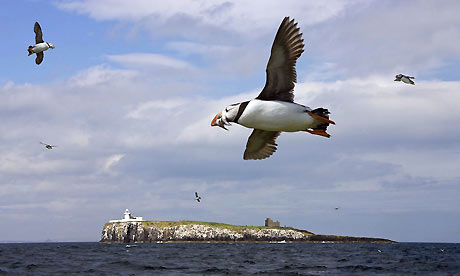
Farne Islands, Northumberland

Farne Islands, Northumberland. Photograph: Steve Allen Travel Photography/Getty Images

Some of Britain's most famous coastal landmarks will be radically changed or even lost because it is no longer possible to hold back rising seas and coastal erosion, according to the National Trust.

The castle of St Michael's Mount off the coast of Cornwall, the white cliffs of Birling Gap in East Sussex, Studland beach in Dorset and the dunes of Formby, near Liverpool, are among the places which could alter dramatically. In one of the most extreme cases to be identified by the trust, the entire 18th-century fishing village of Porthdinllaen on the north-west coast of Wales could be left to crumble into the sea.

The report on the 10 coastal hotspots will be published this week to highlight the problems of climate change which threaten about 70 sites around the coastline owned by the trust.

Phil Dyke, the National Trust's coast and marine adviser, said the decision to stop protecting many coastal areas was driven by the rising cost of damage, because global warming is causing more sea-level rises and more intense storms which exacerbate erosion, and because protection measures often cause damage farther along the coast, for example, depriving nearby beaches of shingle and sand. On one site in Cornwall the trust estimated it would cost £6m to build defences which would only last about 25 years.

The report highlights the difficult decisions which will have to be taken across Britain and around the world as landowners and governments decide how to cope with the impact of climate change on habitats and built infrastructure, particularly after a tradition of pitting engineers against natural change.

'Over the next 100 years the shape of our coastline will change, and our favourite seaside destinations may not look the way they were captured in our holiday snapshots,' said Dyke. 'I think we have a natural affinity with our coast and the sea. But we all need to be aware that our environment is not fixed and that change is inevitable.'

Three years ago a separate report by the National Trust warned that more than half the charity's coastline was under threat and up to 10,000 acres could be lost to the sea in the next century, but the full impact of the problem had not been fully appreciated.

The 10 case studies in the report include three residential areas: at Birling Gap in Sussex one cottage has already been demolished and the remaining four will eventually be lost as the soft chalk cliffs erode by a metre a year; residents on St Michael's Mount, near Penzance, could lose their low-tide causeway permanently and have to move to homes higher above the tide-line; and the 16 houses and inn of Porthdinllaen on the Lleyn peninsula are likely to be lost because more stormy weather will bring more flooding and landslides, says the trust.

Other risk areas identified are the puffin and seal colonies on the Farne Islands off the Northumberland coast; the shingle spit of East Head at the entrance to Chichester Harbour in West Sussex, which will also affect nearby West Wittering beach; Dorset's Studland beach, which is visited by more than one million people a year; the dune system of Formby, near Liverpool; the shingle spit and marshes of Blakeney national nature reserve in Norfolk; the sweeping sands of Rhossili on the Gower peninsula in Wales where a sand-covered medieval village is also being lost to the sea; and Northern Ireland's Portstewart Strand beach and dunes.

In many cases the trust is investing in visitor centres and paths to keep access to the coast, but Dyke said that the trust wanted government to do more to help affected communities, especially property owners.

UN climate talks split over deforestation funds

From: , The World Business Council for Sustainable Development (WBCSD), More from this Affiliate

/ecosystems/article/38007

A 160-nation U.N. climate conference in Ghana split on Friday over ways to pay poor countries to slow deforestation, blamed for producing up to 20 percent of the greenhouse gases caused by human activities.

Options suggested for raising billions of dollars in incentives include markets that would allow trading in the carbon dioxide locked up in trees, higher aid from rich nations and levies on airline tickets or on international shipping.

"It's important that we get to grips with this," Yvo de Boer, head of the U.N. Climate Change Secretariat, told Reuters during the Aug. 21-27 meeting of 1,500 delegates.

"For many developing countries, avoiding deforestation is pretty much the only way they can engage in the climate change regime and reap some benefits," he said of schemes meant to slow logging and burning of forests to clear land for farming.

A U.N. climate conference in Bali last year agreed to explore ways to pay people in the developing world to leave forests standing -- trees soak up carbon dioxide as they grow and release it when they rot or are burned.

The Accra meeting is working on details as part of a plan to agree a sweeping new U.N. climate treaty by the end of 2009 to avert heatwaves, droughts, more powerful storms, risks of more disease and rising sea levels.

"We think this is particularly relevant to Africa. We want this next climate regime to benefit Africa," said Brice Lalonde of France, speaking on behalf of the European Union. France holds the rotating EU presidency.

He said the EU was willing to consider extra aid or to work out new forms of carbon trading. The European parliament voted this year to auction 15 percent of emissions from aviation and use proceeds for measures such as slowing deforestation.

"NEW DAWN"

"We shall perhaps see a new dawn for tropical forests," Lalonde said.

The Pacific island of Tuvalu, threatened by rising seas, said a levy of $20 a tonne on emissions of carbon dioxide from all international aviation and maritime transport would generate revenues of about $24 billion a year.

"A levy of that level is about 0.6 percent of an airfare price," said Ian Fry of Tuvalu. Slowing economic growth in many nations, along with high food and fuel prices, makes it harder to find cash for forest protection.

Friends of the Earth environmental group said there were risks that an inflow of funds would push up the value of forests and lead to a land grab by foreign investors that could threaten the rights of indigenous peoples on the land.

But some developing nations said partnerships with business were inevitable.

"This is about rural communities and indigenous peoples. This is about business. We have got to bring communities and the private sector together," said Kevin Conrad of Papua New Guinea, speaking on behalf of about 20 tropical nations.

De Boer played down worries about "carbon colonialism", saying that measures to protect forests seemed to be in the interests of local people who were dependent on the range of species of animals and plants found in forests.

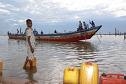
Submerged Ghana forest may point to timber bonanza

From: Reuters

/ecosystems/article/38006

Logging of a Ghanaian forest submerged 40 years ago by a hydroelectric dam could point to an underwater timber bonanza worth billions of dollars in tropical countries, a senior Ghanaian official said on Monday.

Exploiting submerged rot-resistant hardwoods such as ebony, wawa or odum trees in Lake Volta, the largest man-made lake in Africa, can also slow deforestation on land and curb emissions of greenhouse gases linked to burning of forests.

"Logging will start in October," Robert Bamfo, head of Climate Change at the government's Forestry Commission, told Reuters on the sidelines of a U.N. August 21-27 climate conference in Accra. "This will reduce the pressure on our forests."

"The project aims to harvest 14 million cubic meters (494.4 million cu ft) of timber worth about $4 billion," he said.

Logging will be led by a privately owned Canadian company, CSR Developments, which says it aims to invest $100 million in Ghana. Cutting equipment can be mounted on barges, guided by sonars to grab trees below water.

"There are very similar circumstances in numerous countries around the world including Ivory Coast, Cameroon, Brazil, Surinam, Malaysia and others," Bamfo said of forgotten forests swamped by hydroelectric dams.

"The potential is there -- they are awaiting to see the outcome of the Ghana project," he said.

He told the conference there were estimates that there were "5 million hectares (12.36 million acres) of salvageable submerged timber in the hydroelectric reservoirs in the tropics with the potential to supplement global demand for timber."

"The trees are still strong," Bamfo said, even though they had been under water since construction of the Akosombo Dam in the 1960s. Harvesting would cost more than on land but was still commercial because of the value of the timber.

BOAT COLLISIONS

In some shallower parts of the lake, covering an area of 850,000 hectares (2.1 million acres), thousands of trunks jut several meters out of the water. The lake is 90 meters (300 ft) deep at its deepest with a mean depth of 19 meters.

"Boat collisions with submerged tree stumps cause many fatalities every year," Bamfo said.

In the 1960s, no one saw a need to fell the trees as the lake rose. "Maybe at the time we thought we had enough timber in our forest estates to sustain us. Now, because of the decline, we need to diversify."

Ghana is being deforested at a rate of about 1.9 percent a year.

The U.N. conference is looking at ways to slow deforestation, blamed by U.N. surveys for emitting almost 20 percent of greenhouse gases from human activities. Trees soak up carbon dioxide as they grow and release it when burnt or when they rot.

-- For Reuters latest environment blogs click on: blogs.reuters.com/environment/

(Editing by Tim Pearce)

Environment agency warns government over climate change damage

From: nonewcoal.org.uk

/climate/article/38009

Lord Smith, the new head of the Environment Agency, this week gave a cautionary warning to the government over the folly of continuing with climate damaging super projects like the third runway at Heathrow, and the proposed new coal power station at Kingsnorth in Kent. He also highlighted the threat that climate change induced sea level rises and coastal erosion will have on the UK’s coast line and that tough choices would have to be made over whether to defend threatened communities.

The World Development Movement has also put two and two together; stating that plans for a new coal power plant are completely incompatible with plans to tackle climate change. And that huge areas of Kent’s coastline will be seriously threatened by predicted sea level rises, demonstrating the sad irony of stationing a new carbon belching coal power station in the very same area.

Millions of people all over the world are already suffering as a result of climate change. It is usually the poorest people who are left most vulnerable to increasingly severe weather phenomena such as typhoons and flooding. For coastal communities in the UK, Bangladesh, the Philippines and across the globe, whose homes, jobs and unfortunately lives are threatened, the government must be resolute in its ambition to tackle climate change. It cannot be, or even give the illusion of, being serious about this if it says yes to new runways and new coal power stations.

Monday, August 18, 2008

South Asia monsoon rains kill 147 as thousands rescued

From: Reuters

LUCKNOW, India (Reuters) - Heavy monsoon rains have triggered floods across South Asia in which 147 people have been killed in the past week as the downpours swamped villages and caused landslides, officials said on Monday.

Most of the deaths were due to house collapses triggered by incessant rains in India and Bangladesh. Thousands more have been evacuated across the region after their homes were flooded.

In the northern Indian state of Uttar Pradesh, hundreds of old buildings collapsed, killing 73 people in the past two days, officials said.

"The victims were all very poor people, living in old and dilapidated buildings," said senior government official Balwinder Kumar. "So far we have received reports about the partial or full collapse of as many as 890 houses."

More rain was forecast in the next 48 hours and authorities fear the crisis could worsen.

More than 60 people were killed in flooding in India's southern state of Andhra Pradesh, with tens of thousands more moved to safety in makeshift camps.

In neighboring Bangladesh, at least 14 people were killed, a dozen injured and 10 others feared trapped under the rubble of collapsed houses in landslides in the port city of Chittagong and the coastal town of Cox's Bazar on Monday, officials said.

Every year monsoon rains leave a trail of death and destruction across South Asia, but much of the economy in a largely agricultural region depends on the downpours.

In the Himalayan nation of Nepal, thousands of villagers were moved to safety on Monday after a river in the southeast breached a dam and inundated huge swathes of crop land, police said.

More than 4,000 people from three villages had already been moved to safety in Nepal's Sunsari district after the Koshi river broke an embankment, police official Yadav Khanal said.

"The situation is getting worse and dangerous," Khanal said.

"No one has been killed so far but flood waters have submerged parts of a highway."

Sunsari lies in Nepal's southern plains about 200 km (125 miles) southeast of Kathmandu.

(Additional reporting by Gopal Sharma in Kathmandu, Serajul Islam Quadir and Nazimuddin Shyamol in Chittagong; Writing by Bappa Majumdar; Editing by Paul Tait)

In search of world justice

n search of world justice

The burden of climate change solutions can only be equitably shared via an international court

'It is a trite observation that environmental problems, although they closely affect municipal laws, are essentially international; and that the main structure of control can therefore be no other than that of international law." Thus wrote Robert Jennings QC, a former president of the international court of justice, in his foreword to the first edition of Philippe Sands's Principles of International Environmental Law, published in 1995 - years before the potential effects of climate change had transformed public perceptions. Yet even today, after all the millions of words that have been written on the subject of climate change, we seem no closer to establishing that "structure of control". Indeed, Jennings's observation that the problem is mainly to be solved by legal means might now seem not so much trite as unorthodox, bold or even eccentric.

The potential effects of climate change and the urgency of efforts to tackle it have been given a new focus by recent developments, including reports by the Intergovernmental Panel on Climate Change and Nicholas Stern on behalf of the UK government. Although few deny the necessity of finding solutions, even fewer have any to hand. International summit statements only confirm the diplomatic efforts involved in attaining any kind of consensus.

The understandable reluctance of developing countries to sign up to carbon commitments - unless the developed world is prepared to make an equitable contribution - calls for more radical options. Those options must be realised at state, regional and international levels, and they will require political, economic and legal solutions.

In this mix, international legal instruments are crucial. The existing tools lack the necessary jurisdiction, clout and transparency. The time is ripe for a serious consideration of an international court for the environment. Such a court was mooted in Washington in 1999, but sank without trace. Today, however, we cannot afford to drop the ball.

Ideally, such a court would be compulsory and would include a convention on the right to a healthy environment and deliver transparency in access to data and in its proceedings. It would include a scientific body to assess technical issues and a mechanism to avoid "forum shopping" - that is, litigants taking their pick of the most propitious court available.

Of course, regulations and sanctions alone cannot deliver a global solution to problems of climate change, but without such components the incentive for individual countries to address those problems - and to achieve solutions that are politically acceptable within their own jurisdictions - will be much reduced.

As far as the business community is concerned, an international court for the environment would offer a centralised system accessible to a range of actors, an enhanced body of law regarding environmental issues, and consistency in judicial resolution of environmental disputes. Such a court would also bring an increased focus on preventative measures, a set of global standards of care, and the facilitation and enforcement of environmental treaties. In addition, it could persuade the world business community to develop risk-management systems and improve present practices, thereby reducing the likelihood of environmental catastrophe.

Only an impartial adjudicating body is capable of providing the catalyst for a global consensus as to the fairest way to distribute the burdens that accompany solutions to the climate change problem. Whatever difficulties may lie in the path of such solutions, the benefits will be greater.

· Stephen Hockman QC is a former chairman of the Bar Council; a symposium on an international court of the environment is to be held in London in November
clientearth.org
stephenhockmanqc@6pumpcourt.co

Climate change causes birds to lay eggs early

Climate change causes birds to lay eggs early

Conservationists worry that common species of British birds could emerge before suitable food is available

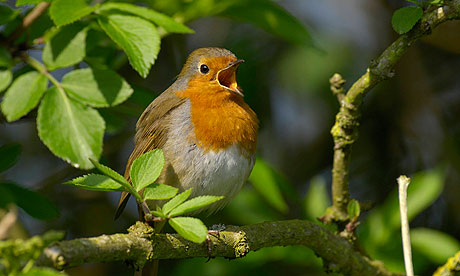
A robin sings

Robins are one of Britain's popular birds hatching their eggs earlier because of climate change. Photograph: Sue Tranter/RSPB

Climate change is making British birds lay their eggs earlier in the year, according to a major survey of how common species are changing their behaviour to cope with warmer temperatures.

Analysis of 30,000 nests shows that birds such as the chaffinch and the robin are laying their eggs about a week earlier than in the 1960s. A similar pattern has been seen for other species, such as blue tits, great tits and swallows.

The survey also found that birds were altering their nesting and migration patterns, and travelling further to find food. The change in egg-laying behaviour has prompted concerns that young birds could emerge in spring before suitable food is available.

Matt Murphy, ornithologist for the Countryside Council for Wales said climate change was affecting the breeding patterns of pied flycatchers living in Welsh oak woodlands.

He said: "They appear to be breeding earlier across a number of sites and the worry is they may eventually breed so early they are out of sync with their major food source of caterpillars."

The annual State of the UK's Birds report was produced by several conservation groups, including the RSPB, Natural England and the Wildfowl and Wetlands Trust. It shows that drier summers are forcing species such as the song thrush to rear fewer chicks. The birds rely on earthworms for food, which are harder to find in drier ground.

Dr Mark Avery, conservation director for the RSPB, said: "This year's report shows that climate change is with us already and from our gardens to our seas, birds are having to respond rapidly to climate change simply to survive. As often before, birds are acting like the canaries in a mine shaft and giving us early warning of dangerous change."

The report found many of the UK's farmland and woodland birds species were continuing to decline, particularly specialists that require a particular habitat, such as the lesser-spotted woodpecker.

In Scotland, there has been a fall in the breeding success of seabirds such as guillemots, puffins and kittiwakes, as warming sea temperatures affect the food chain.

Conservationists are concerned the drop in productivity, as a result of a lack of sandeels, will mean fewer breeding birds and continued decline of key species.

The critically endangered Balearic shearwater, another seabird, has been spotted more often in the UK, as climate change forces it to travel further to find fish.

But the report said there have been large declines in numbers of over-wintering wading birds such as purple sandpipers, ringed plovers and dunlins, which come to the UK's estuaries from northerly and easterly breeding grounds.

It said the birds could be "short stopping" - remaining on the continent as the conditions there become more suitable in the winter.

The report said that a dramatic reduction in duck numbers spending the winter at Lough Neagh in Northern Ireland, suggested some key bodies of water in Europe were no longer freezing over.

Current climate models 'ignoring brown carbon'

From: , Science and Development Network, More from this Affiliate

Current climate models 'ignoring brown carbon'

/pollution/article/37952

[BEIJING] Scientists have found that air pollution from East Asia contains an abundance of 'brown carbon' particles and say that atmospheric models need updating to incorporate their effect.

Current climate models take into account two types of aerosol carbon — organic carbon and black carbon — that arise from the burning of fossil fuels or biomass.

Black carbon strongly warms the atmosphere by absorbing light, while organic carbon absorbs light at a negligible level and has no warming effect.

It has already been claimed black carbon plays a much larger role in global warming than estimates made by the UN Intergovernmental Panel on Climate Change's (see Black carbon climate danger 'underestimated').

But this approximation is too simple, according to Peter Crozier, an associate professor at Arizona State University (ASU) in the United States, whose team published their research in Science last week (8 August).

According to the authors, the method that is currently used to measure the warming effect of different types of particle doesn't take into account the wide variations that can occur between types of carbon from different sources.

They instead used a technique based on a specialised type of electron microscope to directly determine the optical properties of individual carbon particles, and found that samples taken from above the Yellow Sea, east of China, have an abundance of brown carbon particles.

"Brown carbon has light absorbing properties that lie between strongly absorbing black carbon and materials that only scatter light and do not absorb," co-author James Anderson, a research scientist at ASU's Department of Mechanical and Aerospace Engineering, told SciDev.Net.

He adds that brown carbon both cools the Earth's surface and warms the atmosphere, resulting in a complex role in global warming, hence the necessity to incorporate it into climate models.

Hu Guoquan, a senior scientist at the Beijing-based National Climate Centre, welcomes the study, saying it highlights the uncertainties of IPCC models.

"But more studies on the chemical structure and size of brown carbon particles must be done," he told SciDev.Net.

In addition, Hu says, as many carbon aerosols pollutants are emitted by China or India — which have massive combustion of fossil fuels and biomass — judging their accurate warming or cooling effect must be done cautiously and avoid claims without sufficient scientific evidence, as this will contribute to determining the nations' responsibilities in global warming.

Gulf 'dead zone' suffocating fish and livelihood

By Allan Chernoff
CNN Senior Correspondent

GULF OF MEXICO (CNN) -- Fisherman Terry Pizani turns his captain's wheel with a mournful expression on his face. Far below, the fishing grounds off the Louisiana coast where the 63-year-old has made a living for five decades have become an aquatic graveyard known as a "dead zone."

Fisherman Terry Pizani's shrimp catch is not as plentiful because of the Gulf of Mexico's "dead zone."

Fisherman Terry Pizani's shrimp catch is not as plentiful because of the Gulf of Mexico's "dead zone."

"You don't see nothing," he said. "Usually you see bait fish on the water. You don't see no bait fish, nothing. Nothing's there.

"I don't have no kind of testing material to test the water, but I know something's wrong."

Oceanographers who test the Gulf of Mexico waters every month confirm the veteran fisherman is right.

"We're not finding enough oxygen to support life, aquatic life," said scientist Lora Pride aboard the Pelican, the Louisiana Universities Marine Consortium research vessel that studies the Gulf.

CNN traveled aboard the ship August 14-15 as consortium researchers sent sensors to the bottom of the sea, scooped up sediment and collected water samples for analysis at nine testing stations in the Gulf.

As an oxygen meter sank far below the Pelican, Pride pointed to an onboard computer screen displaying the meter's findings in real time.

"This green line is the oxygen right here and at the bottom it's reading less than 2 milligrams per liter," Pride said.

Six of the nine stations revealed such oxygen-deprived, hypoxic water, compared to a normal reading of 6 milligrams per liter.

As Pride and her crew aboard the Pelican monitored the Gulf waters, the journal Science last week published a study that reveals there are more than 400 dead zones around the globe, double the number found by the United Nations two years ago.

One of the major dead zones is in the Gulf of Mexico. It is 8,000 square miles, nearly the size of New Jersey, according to the marine consortium's annual measurement completed in July.

"There's no oxygen in the water for shrimp, crabs, fish to live," said Nancy Rabalais, executive director of the consortium.

Fish and shrimp "can sense that and they start to move out of the area. Otherwise they would die. The animals that still remain in the sediments have to keep breathing. There is not enough oxygen and eventually they will die off," Rabalais said.

Scientists have been studying the Gulf's dead zone for about 20 years, although its existence has been known for decades. So why is oxygen disappearing from fishing waters in the Gulf of Mexico? The answer, scientists say, is found hundreds of miles to the north, up the Mississippi River in corn country.

Farmers in Iowa and across the Midwest use tons of nitrogen and phosphorous to make their cornfields more productive, which allows the farmers to take advantage of high corn prices resulting from growing demand from ethanol factories and developing countries.

Rain always causes some fertilizer to run off farmland, but this summer's historic flooding caused even more runoff into rivers that flow into the Mississippi.

"That's the primary source of the nutrients that go to the Gulf of Mexico," said Rabalais. "And so the size of the low-oxygen zone has increased in proportion to these nutrients reaching the Gulf."

Fertilizer flowing into the Gulf of Mexico triggers an overgrowth of microscopic algae, which eventually die and fall to the bottom.

"When they die, they decompose, and decomposition requires oxygen," said Pride. "So these things will fall to the bottom and as they decompose they consume oxygen."

So much oxygen is taken from the water that slow-moving sea life like clams, small crabs, starfish and snails suffocate.

"We go diving down there quite frequently," said Melissa Baustain, a doctoral candidate at Louisiana State University. "The deeper we go down in the water, it gets kind of scary because there's nothing there. There's no fish, there's no organisms alive, so it's just us," Baustain said.

"It's dark and it's turbid because all that algae that is dying, that's sinking through the water column."

To find lots of shrimp, fishermen like Pizani have to travel to the edge of the dead zone. He calculated that it costs him $450-a-day in diesel fuel to fish.

"You just gotta keep going miles and miles and miles and hopefully you'll run into something," he said. "The fuel costs are so high it's just not feasible to get out there unless you can catch a boatload, really make any money out of it."

So, many boats are idle. Others are staying away from their home port in Grand Isle, Louisiana, a disaster for seafood processor Dean Blanchard, who buys shrimp from fishermen.

"All my boats have to go somewhere else to make a living. It's a shame," Blanchard said.

"This is the prime shrimping ground in the country right here and it shut us down. It just shut us down. It's unreal."

With demand for corn growing, scientists say the dead zone could expand in coming years.

Wednesday, August 13, 2008

Science Weekly: Emergency on Planet Earth

James Randerson and the team ask Prof Bill McGuire if it's already too late to save the planet. Plus, a switch-on date for the LHC. And the woman who cloned her own pit bull terrier

For a man who spends his days pondering the climatic catastrophes and geological disasters that will wipe out large chunks of the human population, this week's guest Prof Bill McGuire of the Benfield UCL Hazard Research Centre is a surprisingly cheery chap. James Randerson and the team discuss his latest book Seven Years to Save the Planet and ask whether it is already too late.

The team also revisits the Large Hadron Collider – the greatest experiment ever built. The LHC switch-on date – 10th September – has finally been announced, but will it live up to the hype. We ask veteran theoretical physicist Prof John Ellis.

Ian Sample, environment correspondent David Adam and BA media fellow Marcus Pearce are also on hand to pick through the week's news, including saving the world's primates, an intriguing chemical find on Mars and the bizarre tale of the woman who cloned her pet pit bull terrier.

Post your comments on the blog or our Facebook Wall. and the LHC at Cern.

Superglue: the climate activist's latest weapon of choice

Sticking it to the man has recently taken on a whole new meaning, as political and environmental activists turn increasingly to the power of superglue (or indeed any non-branded fast-acting cyanoacrylate-based adhesive capable of sticking human flesh to large, immovable objects) to help them make their points.

Last month there was Dan Glass from Plane Stupid, who gamely tried to gum himself to Gordon Brown and then the Downing Street gates, and the rather more successful bonding of six members of the Heathrow Camp for Climate Action to Department of Transport offices to protest against the airport's expansion. Last week, members of the groups Rising Tide and Climate Camp fastened themselves to RBS's oil and gas division building to highlight their investments in polluting technologies, and on Monday a group of superglue-wielding activists targeted mining company BHP Billiton.

Why so? Has the soaring price of commodities on the world markets rendered iron chains and padlocks too pricey? Is throwing yourself beneath a galloping horse simply impractical in the modern era? No. "It's easy to buy and carry," explains a member of Rising Tide, a 51-year-old teacher who took part in their protest. "And you can't walk around with chains if you're a known activist because they can be construed as an offensive weapon. It's harder to construe that with glue." Most importantly, of course, glued-on protestors prolong the activity and make it more headline- and photo-worthy. "It's difficult for people to move you on. The police - in Britain at least - are unlikely to try and rip your hand away and cause injury," says the Rising Tide activist. The boys in blue are, however, apparently becoming wise to the new tactic and have taken to carrying solvents as well as the traditional bolt-cutters to protests to enable them to detach activists without injury.

Superglue deployment is, the activist agrees, a relatively recent phenomenon. "I'd never heard of it until a year ago," she says. "But we feel we have to use it because otherwise a protest can feel a little bit limp. We want to up the ante a bit because the message about climate change is a very, very urgent one that we're trying to get out."

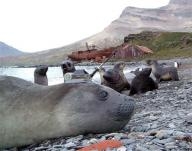
Elephant seals join fight against climate change

From: Reuters

/wildlife/article/37906

SYDNEY (Reuters) - Elephant seals swimming under Antarctic ice and fitted with special sensors are providing scientists with crucial data on ice formation, ocean currents and climate change, a study released on Tuesday said.

The seals swimming under winter sea ice have overcome a "blind-spot" for scientists by allowing them to calculate how fast sea ice forms during winter.


Sea ice reflects sunlight back into space, so less sea ice means more energy is absorbed by the earth, causing more warming.

"They have made it possible for us to observe large areas of the ocean under the sea ice in winter for the first time," said co-author Steve Rintoul from Australia's Commonwealth Scientific and Industrial Research Organization (CSIRO).

Conventional oceanographic monitoring from ships, satellites and drifting buoys, cannot provide observations under sea ice.

"Until now, our ability to represent the high-latitude oceans and sea ice in oceanographic and climate models has suffered as a result," said Rintoul, who also works with the Antarctic Climate and Ecosystems Cooperative Research Centre in Hobart.

The elephant seals have provided scientists with a 30-fold increase in data recorded in parts of the Southern Ocean, said the study by a team of French, Australian, U.S. and British scientists and published in the Proceedings of the National Academy of Sciences.

Between 2004 and 2005, the seals swam up to 65 kilometers (40 miles) a day, supplying scientists with 16,500 ice profiles. The seals dived to a depth of more than 500 meters (1,500 feet) on average and to a maximum depth of nearly 2 km (a mile).

"If we want to understand what's going to happen to climate in the future we need to know what the sea ice is going to do. Will there be more or less and will it form more or less rapidly?" Rintoul told Australian Broadcasting Corp. radio.

The experiment involved 85 seals with sensors attached to their heads.

"They measure temperature and salinity as a function of depth as they dive down and up through the water column," he said.

"From that information we can determine what the ocean currents are doing and so they provide us with a very detailed record of how temperatures and salinity's changed," he added.

The polar regions play an important role in the earth's climate and are changing more rapidly than any other part of the world, with the Southern Ocean warming more rapidly than the global ocean average.

Sea ice not only affects the amount of energy reflected back into space, but also the amount of dense water around the Antarctic which drives ocean currents that transports heat around the globe.

Sea ice also provides a critical habitat for krill, penguins and seals.

(Additional reporting by David Fogarty; Editing by David Fogarty)

Video

"Manufactured Landscapes" SEE THIS BRILLIANT MOVIE! You'll never have the same shopping experience again.