Monday, March 31, 2008

Activists slam changes to green grants

This article appeared in the Guardian on Tuesday April 01 2008 on p28 of the Financial section.

The government announced a shake-up of its controversial grant system for renewable energy technologies yesterday but was sharply criticised by green campaigners who said it does not go far enough.

The Department for Business (BERR) said that the system for allocating grants in the Low Carbon Buildings Programme would be speeded up and more generous grants would be available for technologies such as wind turbines or biomass boilers for public buildings or those owned by charities. Grants available to households would be extended until 2010.

However, a BERR spokeswoman said no extra money would be put into the scheme, which was launched two years ago with total funding of about £80m over three years. The scheme has suffered from a series of problems with applications leading to a huge underspend, enabling the department to relaunch the programme with the original funding. The £12m initially allocated for households still has £10m in the pot while the £50m for public buildings has only seen £9m committed.

Britain installed fewer than 300 solar photovoltaic systems on houses last year while Germany, for example, installed 130,000. Britain remains one of the worst countries in Europe for installing renewable energy, which accounts for less than 2% of its total energy supply.

Energy minister Malcolm Wicks said: "Many people tell me they want to do their bit to help combat climate change but are put off by the hassle involved. These changes remove those barriers."

But campaign groups were furious. Friends of the Earth's low carbon homes campaigner, Ed Matthew, said: "The government's response continues to be woeful. The LCBP should be 10 times bigger, with funds of £1bn, providing at least 50% grants for renewable technologies for every household."

Andrew Cooper of the Renewable Energy Association said he was "shocked". "Making a failing programme fail over a longer period is not a solution. It is no longer the Low Carbon Buildings Programme it is the Slow Carbon Buildings Programme."

Is Lake Mead Disappearing

RELATED ARTICLES

* Las Vegas water source could run dry by 2021
* Interior Secretary Turns Down Request to Reduce Release of Colorado River Water
* Seven Colorado River States Submit Plan for Sharing Water in Drought
* Changing Levels at Arizona Lakes Proves Costly for Park Service

/ecosystems/article/33857

The water supply crisis is not just a third world issue. Nevada’s Lake Mead, the largest man-made lake and reservoir in the U.S., could go dry by 2021, according to a pair of scientists at the Scripp’s Institute of Oceanography in San Diego, California. If human-induced climate change and water usage continues at the present rate, or even slower, there is a 50% chance the lake will go dry in coming years — and sooner, rather than later. The Colorado River’s water is being consumed far beyond a sustainable level.

Regional climate models show California and areas of the Southwest could soon face a devastating water crisis. Reduced winter run-off — due to global warming, changing weather patterns and over-consumption — are draining the area of vital water. If the region enters a serious drought, matters will worsen quickly.

The loss of a resource like Lake Mead would have a tremendous negative impact on the agriculture industry, electrical power production, and local and regional water supplies. With 1.3 million people depending on electricity from the Lake and 8 million people drinking its water, serious conservation programs and restrictions must be put in place.

Agriculture consumes 60% to 80% of water in the area and any restrictions on agricultural water use would have a serious economic downside. Coastal California desalination plants and other measures will have to be explored and the neighboring, Lake Powell, may eventually have to be drained into Lake Mead.


Read more about the crisis here. For tips on saving water, visit American Water & Energy Savers @ americanwater.com

To calculate an estimate of your water footprint, (based on U.S. averages) visit H20conserve.org

Friday, March 28, 2008

AArctic Melting May Lead To Expanded Oil Drilling

from: , Worldwatch Institute, More from this Affiliate

/ecosystems/article/33669

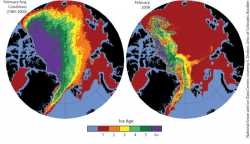
More than half of the Arctic Ocean was covered in year-round ice in the mid-1980s. Today, the ice cap is much smaller. Alarming evidence of this warming trend was released last week when the U.S. National Aeronautics and Space Administration (NASA) released satellite evidence that perennial Arctic ice cover, as of February, rests on less than 30 percent of the ocean.

"The rate of sea-ice loss we're observing is much worse than even the most pessimistic projections led us to believe," says Carroll Muffett, deputy campaigns director with Greenpeace USA. For the first time in recorded history, this past summer the entire Northwest Passage between the Pacific and Atlantic oceans was ice-free, according to scientists.

In the eyes of oil and gas companies, like U.S-based Arctic Oil & Gas Corp., these open waters are potential treasure chests. As the Arctic Ocean resembles less like a gigantic ice sheet and more an ocean of frigid water, energy companies are racing to profit from the melting sea.

Arctic Oil & Gas Corp., an exploration company, has claimed exclusive rights to develop oil resources in the Arctic Ocean. On Tuesday, the group invited major companies from Canada, Norway, and Denmark to explore the Arctic abyss. "It simply doesn't get any bigger than this in the oil patch," CEO Peter Sterling said in a statement.

However, Arctic Oil & Gas Corp. does not yet have official rights to its claim. Development rights in the Arctic Ocean are heavily disputed between the United States, Russia, Canada, and Norway. All four countries are debating how far their continental shelf extends into the ocean and therefore grants them rights to drill. "We're like Lewis and Clark, exploring an area that could significantly increase the area of the U.S.," said David Balton, the U.S. State Department's deputy assistant secretary for oceans and fisheries.

But the potential is still unknown. Modern technology has not accurately assessed the magnitude of oil or gas reserves below the polar caps, Balton said.

In the seas north of Russia and Alaska, expanded oil-and-gas development is already under way. The U.S. Department of Interior last month sold a record-breaking $2.6 billion in development bids throughout the Chukchi Sea, just above the Bering Strait. Additional sales are scheduled for 2010 and 2012.

As companies move into the Arctic to search for energy reserves or to create new shipping lanes, the potential environmental impacts could be huge. Balton acknowledged that shifting ice and coastal erosion makes exploration and development risky. "It's definitely a dangerous area to maneuver. An oil spill would be really hard to clean up," he said.

A report issued by the Interior Department's Minerals Management Service said that in addition to possible damage from lengthy pipelines and onshore facilities construction, "commenters expressed attendant concerns about the inability to clean up an oil spill in broken-ice conditions."

Polar bears, now threatened due to climate change, would face further stress if the Arctic is developed, due to increased contact with humans, Greenpeace's Muffett said.

Some environmentalists argue that the proposal to list the polar bear as threatened on the Endangered Species Act has been delayed to allow the Chukchi drilling plans to continue.


Ben Block is a staff writer at the Worldwatch Institute who covers everything environmental for Eye on Earth. He can be reached at bblock@worldwatch.org.

U.S. West warming faster than rest of world: study

From: Reuters

/ecosystems/article/33723

LOS ANGELES (Reuters) - The U.S. West is heating up at nearly twice the rate of the rest of the world and is likely to face more drought conditions in many of its fast-growing cities, an environmental group said on Thursday.

By analyzing federal government temperature data, the Natural Resources Defense Council concluded that the average temperature in the 11-state Western region from 2003-07 was 1.7 degrees Fahrenheit (0.94 degrees Celsius) higher than the historical average of the 20th century.

The global average increase for the same period was 1.0 degrees Fahrenheit (0.55 degrees Celsius).

In the Colorado River Basin, which supplies water to big and fast-growing cities like Los Angeles, San Diego, Las Vegas and Denver, the average temperature rose 2.2 degrees Fahrenheit (1.21 degrees Celsius), the U.S. group said.


Most of the river's water comes from melting snow in the mountains, and climate scientists predict hotter temperatures will reduce the snowpack and increase evaporation, the NRDC said in a statement.

"Global warming is hitting the West hard," said Theo Spencer of the NRDC. "It is already taking an economic toll on the region's tourism, recreation, skiing, hunting and fishing activities."

Study author Stephen Saunders of the Rocky Mountain Climate Organization said there were signs of the economic impacts throughout the West.

"Since 2000 we have seen $2.7 billion in crop loss claims due to drought. Global warming is harming valuable commercial salmon fisheries, reducing hunting activity and revenues, and threatening shorter and less profitable seasons for ski resorts," he said.

The report is available online at www.nrdc.org/globalWarming/west/contents.asp.

(Reporting by Mary Milliken; Editing by Bernie Woodall)

Tuesday, March 25, 2008

Massive ice shelf on verge of breakup

  • Story Highlights
  • A large chunk of the Wilkins ice shelf in Antarctica broke away last month
  • Only a narrow strip of ice is protecting the shelf from further breakup
  • "I didn't expect to see things happen this quickly," scientist says
  • Ice shelves are floating ice sheets attached to the coast
  • VIDEO

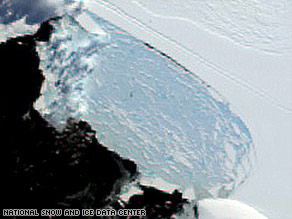
(CNN) -- Some 220 square miles of ice has collapsed in Antarctica and an ice shelf about the size of Connecticut is "hanging by a thread," the British Antarctic Survey said Tuesday, blaming global warming.

art.wilkins.collapse.jpg

Scientists say the size of the threatened shelf is about 5,282 square miles.

"We are in for a lot more events like this," said professor Ted Scambos, a glaciologist at the National Snow and Ice Data Center at the University of Colorado at Boulder.

Scambos alerted the British Antarctic Survey after he noticed part of the Wilkins ice shelf disintegrating on February 28, when he was looking at NASA satellite images.

Late February marks the end of summer at the South Pole and is the time when such events are most likely, he said. Video Watch aerial footage of the area »

"The amazing thing was, we saw it within hours of it beginning, in between the morning and the afternoon pictures of that day," Scambos said of the large chunk that broke away on February 28.

The Wilkins ice shelf lost about 6 percent of its surface a decade ago, the British Antarctic Survey said in a statement on its Web site

Another 220 square miles -- including the chunk that Scambos spotted -- had splintered from the ice shelf as of March 8, the group said.

"As of mid-March, only a narrow strip of shelf ice was protecting several thousand kilometers of potential further breakup," the group said.

Scambos' center put the size of the threatened shelf at about 5,282 square miles, comparable to the state of Connecticut, or about half the area of Scotland. See a map and photos as the collapse progressed »

Once Scambos called the British Antarctic Survey, the group sent an aircraft on a reconnaissance mission to examine the extent of the breakout.

"We flew along the main crack and observed the sheer scale of movement from the breakage," said Jim Elliott, according to the group's Web site.

"Big hefty chunks of ice, the size of small houses, look as though they've been thrown around like rubble -- it's like an explosion," he said.

"Wilkins is the largest ice shelf on the Antarctic Peninsula yet to be threatened," David Vaughan of the British Antarctic Survey said, according to the Web site.

"I didn't expect to see things happen this quickly. The ice shelf is hanging by a thread -- we'll know in the next few days or weeks what its fate will be."

But with Antarctica's summer ending, Scambos said the "unusual show is over for this season."

Ice shelves are floating ice sheets attached to the coast. Because they are already floating, their collapse does not have any effect on sea levels, according to the Cambridge-based British Antarctic Survey.

Scambos said the ice shelf is not currently on the path of the increasingly popular tourist ships that travel from South America to Antarctica. But some plants and animals may have to adapt to the collapse.

"Wildlife will be impacted, but they are pretty adept at dealing with a topsy-turvy world," he said. "The ecosystem is pretty resilient."

Several ice shelves -- Prince Gustav Channel, Larsen Inlet, Larsen A, Larsen B, Wordie, Muller and Jones -- have collapsed in the past three decades, the British Antarctic Survey said.

Larsen B, a 1,254-square-mile ice shelf, comparable in size to the U.S. state of Rhode Island, collapsed in 2002, the group said.

Scientists say the western Antarctic peninsula -- the piece of the continent that stretches toward South America -- has warmed more than any other place on Earth over the past 50 years, rising by 0.9 degrees Fahrenheit each decade.

Scambos said the poles will be the leading edge of what's happening in the rest of the world as global warming continues.

"Even though they seem far away, changes in the polar regions could have an impact on both hemispheres, with sea level rise and changes in climate patterns," he said.

News of the Wilkins ice shelf's impending breakup came less than two weeks after the United Nations Environment Program reported that the world's glaciers are melting away and that they show "record" losses.

"Data from close to 30 reference glaciers in nine mountain ranges indicate that between the years 2004-2005 and 2005-2006 the average rate of melting and thinning more than doubled," the UNEP said March 16.

The most severe glacial shrinking occurred in Europe, with Norway's Breidalblikkbrea glacier, UNEP said. That glacier thinned by about 10 feet in 2006, compared with less than a foot the year before, it said. E-mail to a friend E-mail to a friend

Huge chunk of Antarctic ice sheet collapses

WASHINGTON (AP) -- A chunk of Antarctic ice nine times the size of Manhattan has suddenly collapsed, putting an even larger glacial area at risk.

Satellite images show the runaway disintegration of a 220-square-mile chunk in western Antarctica.

British scientist David Vaughan says it's the result of global warming.

The rest of the Connecticut-sized ice shelf is holding on by a narrow beam of thin ice and scientists worry that it too may collapse. Larger, more dramatic ice collapses occurred in 2002 and 1995. E-mail to a friend E-mail to a friend

Copyright 2008 The

Scientists warn of soot effect on climate

· Coal and wood 'more damaging than thought'
· Black carbon harms environment and health

This article appeared in the Guardian on Monday March 24 2008 on p16 of the UK news section.
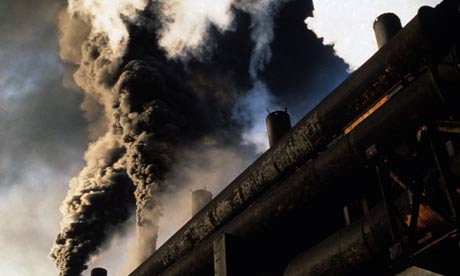
Smoke billowing from a plant in Romania

Smoke billowing from a plant in Copsa Mica, Romania. Photograph: Andrew Holbrooke/Corbis

Soot produced by burning coal, diesel, wood and dung causes significantly more damage to the environment than previously thought, according to research published today. So-called "black carbon" could cause up to 60% of the current warming effect of carbon dioxide, according to the US researchers, making it an important target for efforts to slow global warming.

Around 400,000 people are estimated to die each year due to inhaling soot particles, particularly because of indoor cooking on wood and dung stoves in developing countries. These deaths are mainly among women and children. Professor Greg Carmichael, of the University of Iowa, one of the authors of the study, published in Nature Geoscience, said: "Trying to develop strategies that really go after black carbon is really a very good short-term strategy and a win-win strategy for both climate and air pollution perspectives."

Carmichael and Professor V Ramanathan, at Scripps Institution of Oceanography in San Diego, put together data from satellites, aircraft and surface instruments on the warming effect from black carbon. They conclude that its effect in the atmosphere is around 0.9 watts per square metre, considerably higher than the estimate of between 0.2 and 0.4 watts in last year's report from the Intergovernmental Panel on Climate Change.

Most particulates in the atmosphere reduce the warming effect from greenhouse gases by bouncing radiation back into space - so-called global dimming. But black carbon has the opposite effect and Ramanathan and Carmichael argue that its contribution to global warming has been underestimated.

"The aerosols in aggregate are either acting to, you could say, cool the atmosphere or mask the effect of CO2," said Carmichael, "[Black carbon] is the only component of this aerosol mix that in and of itself is a heating element."

Previous estimates had not taken into account the fact that it has a larger impact at high altitude in the atmosphere and that it interacts with other particulates in the atmosphere. Scientists do not fully understand these interactions, but observations suggest that they result in more warming. The researchers said that programmes to replace wood-burning stoves with clean technology such as solar energy in developing countries such as India should be pursued to reduce the number of deaths caused by inhaling the smoke.

The authors stressed that these measures were not a magic bullet. "It is important to emphasise that black carbon reduction can only help delay and not prevent unprecedented climate changes due to CO2 emissions," they wrote.

Australian wine industry feels heat from climate change

From: Reuters

/agriculture/article/33486

By Victoria Thieberger

MELBOURNE (Reuters) - Australian grape growers reckon they are the canary in the coalmine of global warming, as a long drought forces winemakers to rethink the styles of wine they can produce and the regions they can grow in.

The three largest grape-growing regions in Australia, the driest inhabited continent on earth, all depend on irrigation to survive. The high cost of water has made life tough for growers.

Some say they probably won't survive this year's harvest, because of the cost of keeping vines alive. Water prices surged above A$1,000 a megaliter last year from around A$300.

"On the back of three very ordinary years, this year is probably the worst that could have occurred with the drought and the high costs of water," said Michael de Palma, a mid-sized grower in Redcliffe near Mildura in the Murray Valley, one of the country's three big wine regions.

"In this depressed situation, growers have only two choices, stick it out as long as they can or to cut their losses and get out," said de Palma, who is part-way through a weather-influenced early harvest on his 40-hectare vineyard.

Recent rains have bypassed the country's parched inland wine regions, and have fallen half-way through the harvest in eastern Australia, too late to help the berries and instead causing a mildew-like disease.

De Palma, the chairman of Murray Valley Winegrowers, said he would wait to see the results of his harvest before deciding whether to sell up or hold on to his vineyard, which mainly supplies Foster's Group, Australia's largest wine company.

He estimated around 40 percent of grape growers in the Murray Valley who had access to water trading couldn't afford to buy water last year, while most of the others had to borrow to do so, going deeper into debt.

Industry groups estimate up to 1,000 winegrowers out of around 7,000 may be forced to leave the industry this year because their vineyards are no longer financially viable.

"There's a Darwinian economics going on at the moment, and the outcome remains to be seen," said Paul Henry, general manager of market development at Australian Wine and Brandy Corp.

"One might say we're guilty of the charge of being slow to change thus far, but the experience of this harvest will change the outlook for Australian producers."

In some regions, such as the Murray Valley, wine grape yields are down 30-40 percent.

Australia's harvest is forecast to be down on average years, which may cut into exports in the A$6 billion industry.

Wine exports total some A$3 billion. Australia is the number one supplier of imported wine in the United Kingdom with a market share of 23 percent and it is second in the United States.

The smaller 2008 vintage, made worse by a record-breaking heatwave which withered grapes on the vines, is expected to push up prices and spell the end of cheap bulk wine after a three-year glut that produced a rash of no-name brands called "cleanskins."

WARMER AND DRIER

Scientists say Australia's vast inland winegrowing districts face the greatest degrees of warming.

These are the Riverland on the Murray River in South Australia, the Murray Valley, and the Riverina on the Murrumbidgee River in New South Wales.

And it is the grape-growers in these semi-arid areas that already face the greatest hardship, with calls to rural financial counseling services soaring in recent months.

"We believe there are 800 to 1,000 growers predominantly in Murray Valley and the Riverland in South Australia who are going to have to make a decision this year about whether they stay or go," said Wine Grape Growers chief Mark McKenzie.

A landmark study by the Commonwealth Scientific and Industrial Research Organization (CSIRO) found these areas would warm by 2.5 degrees Celsius by 2030.

Last year was one of the warmest on record for southern Australia, where all of the nation's winegrowing regions lie, as well as one of the driest.

And that is enough to change harvesting times as berries ripen earlier, which can also affect their quality.

"Climate change is the biggest issue we face. Relatively small changes in temperature and precipitation do have reasonably large impacts in terms of wine style," said Winemakers' Federation Chief Executive Stephen Strachan.

"Wine is a bit of a bellwether in terms of some of the very immediate impacts you see from climate change."

According to the CSIRO, grape quality could fall by 23 percent by 2030 because of the climate changes, and suitable land for viticulture could be cut by 10 percent.

By 2050, some 44 percent of current grape-growing areas would be affected, the study found.

The solution may be for cooler climate areas, such as the bayside Mornington Peninsula south-east of Melbourne and the Yarra Valley to the east, to expand the varieties they grow.

The southern island state of Tasmania is also attracting attention as a region that could dramatically boost its grape cultivation, with its mild weather closer to that of New Zealand than the parched mainland.

Indeed, wine-growers in neighboring New Zealand are upbeat about a future that includes climate change, because higher temperatures are expected to make cold areas of New Zealand more temperate and better suited to grape growing.

CHANGING TASTES

Warmer temperatures and less rainfall will also mean changes in the grape varieties the traditional growing areas produce.

"Styles in existing regions will change," said Strachan of the Winemakers' Federation.

"Most regions can produce most grape varieties, but whether they can produce them to quality levels that the market expects is the big question."

While Australia's signature shiraz fares quite well in a hot climate, cabernet, pinot noir and merlot among the reds and chardonnay, sauvignon blanc and riesling among the whites may have a tougher time.

"Merlot is relatively intolerant of water stress, and it doesn't cope well with periods of very high temperatures," said Snow Barlow, a winemaker and the chairman of the agriculture school at Melbourne University, who co-authored the CSIRO study.

Experts say Australian growers need to experiment with tougher varieties from Spain and Sicily. Tempranillo from Spain is one of Australia's fastest-growing varieties, while along the Murray river, the Corsican grape Vermentino is being planted.

"Wine companies build up brands. Whether we can convince the world to take to Australian Sicilian varieties in same way they take to Australian shiraz, that's quite a big commercial question," said Barlow.

Barlow, who owns the boutique Baddaginnie Run vineyard nestled in the foothills of the Strathbogie Ranges in Victoria state, said climate change shaped his decisions on what varieties to plant when he started his vineyard 10 years ago.

Even so, merlot has proved problematic and he did not produce a merlot last year because of poor quality. His $20 merlot has won awards in better years.

Over time, different root stocks that are able to provide good fruit with lower water requirements will become more common.

But it can take months or years to import new varieties through Australia's strict quarantine system, and three to four years to establish new rootstock for commercial production.

For grape growers already deep in debt, that is simply too long to wait.

(Editing by Megan Goldin)

($1=A$1.11)

Arkansas towns endure floods as White River swells

from CNN.com

  • Story Highlights
  • NEW: Man points to U.S. flag hanging in water, says it's 10-15 feet off ground
  • NEW: White River has risen 7 feet in last four days, weather service says
  • Sheriff in Des Arc says of flooding, "I'd never seen it come up so fast"
  • 35 counties in Arkansas declared disaster areas

DES ARC, Arkansas (AP) -- Forecasters issued flash-flood warnings for parts of Arkansas' prairie as the state's largest water surge in a quarter-century continued its way downstream.

art.flooding.tues2.ap.jpg

Adrianna Lopez, 5, carries animal feed Monday, as her cousin, Oscar Lopez, helps clean up after flooding.

Click to view previous image
1 of 2
Click to view next image

Swollen by last week's storms that devastated large parts of the Midwest, the fast-rising White River had risen about 7 feet in four days and was expected to crest Tuesday at 33.5 feet, the National Weather Service estimated.

Water poured into Bayou Des Arc, an area just north of the town of 1,900, damaging scattered homes and cabins.

"It's the worst," Trey Newby, 17, said as he piloted a small boat with an outboard motor through the brown water in an RV park along Bayou Des Arc. He and a friend pointed to a pole and a U.S. flag hanging partially in the water.

"That's probably 10, 15 feet off the ground right there," Newby said.

Prairie County Sheriff Gary Burnett, a lifelong resident of the area, about 60 miles east of Little Rock, said he had never seen the river flood so quickly.

"It came up just so fast," said Burnett, 37. "I'd never seen it come up so fast."

No flood-related injuries were reported, Burnett said.

Downtown Des Arc is on a rise and was not in immediate danger. Video Watch how boats have became popular modes of transportation »

Just south of town and beyond a levee, Rick Thompson, 38, stood looking at his flooded mobile home. He said he had no flood insurance and had yet to go inside.

"I'm going to come back with my boat and get my pictures and Bibles and things like that out of there and pray on the rest of it," Thompson said.

Last week's torrential rain in the Midwest also caused flooding in parts of Ohio, Indiana and southern Illinois, and in wide areas of Missouri. At least 17 deaths have been linked to the weather and thousands of people evacuated, most of them in Missouri.

David Maxwell, the Arkansas emergency management director, said state and federal emergency workers would visit flood-damaged areas of the state Tuesday. Arkansas Gov. Mike Beebe has declared 35 counties disaster areas.

Although wide areas of Missouri were especially hard-hit, the city of Cape Girardeau, which had record flooding in 1993, narrowly escaped serious problems this time. The Mississippi River crested there early Monday at 41.04 feet, a foot shy of the level that signals serious flooding, the weather service said.

Flood gates protecting the city's business district were closed Monday and will stay closed until the river drops to below 36 feet. There was some minor flooding Monday in Cape Girardeau's northeast section.

River towns south of the point where the Ohio and Mississippi rivers meet at Cairo, Illinois, could see flooding in the next few days.

The Mississippi River is expected to crest Thursday at 42 feet at New Madrid, Missouri, an hour south of Cape Girardeau, and at 41 feet Friday in Caruthersville, Missouri, enough to cause moderate flooding in both areas, meteorologists said.

Rain is forecast in the region Wednesday and could produce localized flooding. "There'll be a lot of runoff in creeks and smaller tributaries again, but there's not much of a place to drain into with the rivers running so high," said Mary Lamm, a weather service hydrologist in Paducah, Kentucky.

Friday, March 21, 2008

New horizon: what we can expect as nature changes

· Forecast identifies threats and opportunities
· Rising demands putting pressure on habitats

This article appeared in the Guardian on Thursday March 20 2008 on p23 of the UK news section.

Artificial life forms, robots that mimic natural processes, and even people who spend all day in front of the computer and rarely experience the real outdoors, may all fundamentally affect the quality of nature in Britain over the next 45 years.

According to 35 environmental scientists, drawn from the government as well as colleges and charities, a host of new threats and opportunities for UK biodiversity is gathering pace as technologies develop, social habits alter and the possibility of large-scale responses to phenomena like climate change grows.

The scientists have drawn up a list of 25 factors, including the rising demand for food and biofuels, thought to be having an immediate effect. These, say the scientists, are already putting worse pressure on the habitats of birds and mammals.

Others factors, such as sea-level rise, extra fire risk and extreme weather events, are looming with climate change.

But many more challenges, identified in the "horizon-scanning" report, come from what now appears science fiction. Environmental manipulation could be a quick-fix way to mitigate climate change, scientists say. Putting trillions of lenses in orbit to deflect the sun's energy, building giant mirrors in space, fertilising oceans with iron filings and laying reflective covers on deserts, have all been suggested, says the paper in the British Ecological Society's Journal of Applied Ecology.

The paper's authors do not try to judge the ideas or even predict any follow-up. However, they say the public reaction to GM food, in particular, has taught them to look ahead to what society is likely to consider important.

Bill Sutherland, lead author and chair in conservation biology at Cambridge University, said studies were needed in emerging areas. "We need to have the science ready before policies are made and products are on the market ... the necessary science was not done before the introduction of biofuels. In terms of the environmental consequences and societal concerns, we should have thought of all these things before."

High on the list of new technologies that may profoundly affect nature are revolutionary nanotechnology processes involving minute particles. These also have biological properties and the scientists think it will be a huge challenge to predict their impact.

One potentially positive development could be large-scale restoration of habitats to encourage wildlife seen as iconic. In a Dutch experiment, a 13,800-acre reserve was created with populations of animals that were common in medieval times. The paper says comparable schemes are likely to occur in places such as East Anglia and the Scottish Highlands where creatures such as the lynx might be introduced.

The paper's authors are concerned about new pathogens, from overseas or developed through biotechnology.

"A series of fungal pathogens have devastated north American forests. One has recently appeared in the UK and could have similar impacts on native woodlands," says the paper. "New pathogens [affecting] people and livestock are likely to become established in the UK in future as climate change allows them to survive. But this could increase the use of insecticides. If, for instance, malaria established itself in Britain because of climate change, widespread drainage of wetlands and ponds could be recommended."

Other human factors are also acknowledged. Were bird flu or rabies to get established in British wildlife, the authors say, public attitudes to biodiversity might alter profoundly.

"This could lead to reduced political and financial support for conservation, and higher rates of killing wildlife." Equally, while the internet informs, there is a danger that sedentary lives will erode engagement with nature and care for the environment. "Young people spend about half the time outdoors compared to 20 years ago. This leads to a fall in knowledge of biodiversity."

Key issues

· Politics: policies may be unable to keep pace with the environmental changes of the future

· Extreme weather: local wildlife extinctions are likely

· More food demand: habitat loss and intensification of farming

· New genetically modified pathogens: likely reduction of
critical species

· Sea level rise: some new habitats, but great damage from salt

· River flow: climate change will greatly alter river ecology

· More biofuels: possibly more pesticides, loss of habitat

· Increased fire risk: some new habitats, but big potential impact

· Invasions: alien species can move in from abroad

· Nanotechnologies: can help with pollution cleanup but could be toxic

· Artificial lifeforms and bio-robots: possibly invasive

· Renewable energy: new safe havens, but also damage possible

· Internet: no substitute for people experiencing nature for themselves

Reichstag to run solely on renewable power

· Wind, water and solar sources to fuel building
· German parliament to be the world's greenest

This article appeared in the Guardian on Friday March 21 2008 on p29 of the International section.

The German Reichstag is expected to become the greenest parliament building in the world, thanks to a decision to rely solely on renewable energy.

From late summer the building is due to swap to green power sources such as water, wind and solar energy, replacing the conventional power that it has largely relied upon until now.

Its extensive refurbishment in the late 1990s, including the glass cupola designed by the British architect Sir Norman Foster, had already won it plaudits. Ecologists praised the building's energy efficiency, which has led to a 94% cut in its carbon emissions.

Its roof makes passive use of solar power and natural light and its thick, well-insulated 19th-century walls help retain warmth in winter and reduce the need for air conditioning in summer.

At the moment biofuel generators in the basement produce 40% of the building's energy, for lighting, heating, the flow of air conditioning and water, while the rest comes mainly from coal and nuclear supplies.

But in future the Reichstag, which has been the home of Germany's parliament for nine years, will go a step further, entirely abandoning conventional sources in favour of renewables, which will be provided by an outside supplier.

A parliamentary subcommittee agreed last week to seek bids from renewable energy producers to replace that conventional power use, and expects to choose a supplier by late summer.

Currently, it costs approximately €3m (£2.3m) a year to provide the energy that keeps the building's lights on, air conditioning flowing and water running.

Parliamentarians hope that the switch to clean energy will boost Germany's reputation as one of the greenest countries in the world and help the renewable energy sector. Germany has one of the most globally successful and innovative clean energy industries. Boosted by a subsidy system, around 13% of its electricity comes from renewable power - mostly wind - a figure that is set to rise to 27% over the next 12 years.

The greening of the Reichstag fits in with a growing trend in zero-emission homes in Germany, with some homes so energy-efficient that they even produce power. The owners are allowed to sell their surplus back to the grid for generous returns.

Melting glaciers will shrink grain harvests in China and India.

From: Lester Brown, Earth Policy Institute

/top_stories/spotlight/33355

The world is now facing a climate-driven shrinkage of river-based irrigation water supplies. Mountain glaciers in the Himalayas and on the Tibet-Qinghai Plateau are melting and could soon deprive the major rivers of India and China of the ice melt needed to sustain them during the dry season. In the Ganges, the Yellow, and the Yangtze river basins, where irrigated agriculture depends heavily on rivers, this loss of dry-season flow will shrink harvests.

The world has never faced such a predictably massive threat to food production as that posed by the melting mountain glaciers of Asia. China and India are the world’s leading producers of both wheat and rice—humanity’s food staples. China’s wheat harvest is nearly double that of the United States, which ranks third after India. With rice, these two countries are far and away the leading producers, together accounting for over half of the world harvest.

The Intergovernmental Panel on Climate Change reports that Himalayan glaciers are receding rapidly and that many could melt entirely by 2035. If the giant Gangotri Glacier that supplies 70 percent of the Ganges flow during the dry season disappears, the Ganges could become a seasonal river, flowing during the rainy season but not during the summer dry season when irrigation water needs are greatest.

Yao Tandong, a leading Chinese glaciologist, reports that the glaciers on the Tibet-Qinghai Plateau in western China are now melting at an accelerating rate. He believes that two thirds of these glaciers could be gone by 2060, greatly reducing the dry-season flow of the Yellow and Yangtze rivers. Like the Ganges, the Yellow River, which flows through the arid northern part of China, could become seasonal. If this melting of glaciers continues, Yao says, “[it] will eventually lead to an ecological catastrophe.”

Even as India and China face these future disruptions in river flows, overpumping is depleting the underground water resources that both countries also use for irrigation. For example, water tables are falling everywhere under the North China Plain, the country’s principal grain-producing region. When an aquifer is depleted, the rate of pumping is necessarily reduced to the rate of recharge. In India, water tables are falling and wells are going dry in almost every state.

On top of this already grim shrinkage of underground water resources, losing the river water used for irrigation could lead to politically unmanageable food shortages. The Ganges River, for example, which is the largest source of surface water irrigation in India, is a leading source of water for the 407 million people living in the Gangetic Basin.

In China, both the Yellow and Yangtze rivers depend heavily on ice melt for their dry-season flow. The Yellow River basin is home to 147 million people whose fate is closely tied to the river because of low rainfall in the basin. The Yangtze is China’s leading source of surface irrigation water, helping to produce half or more of China’s 130-million-ton rice harvest. It also meets many of the other water needs of the watershed’s 368 million people. (See data at www.earthpolicy.org.)

The population in either the Yangtze or Gangetic river basin is larger than that of any country other than China or India. And the ongoing shrinkage of underground water supplies and the prospective shrinkage of river water supplies are occurring against a startling demographic backdrop: by 2050 India is projected to add 490 million people and China 80 million.

In a world where grain prices have recently climbed to record highs, with no relief in sight, any disruption of the wheat or rice harvests due to water shortages in these two leading grain producers will greatly affect not only people living there but consumers everywhere. In both of these countries, food prices will likely rise and grain consumption per person can be expected to fall. In India, where just over 40 percent of all children under five years of age are underweight and undernourished, hunger will intensify and child mortality will likely climb.

For China, a country already struggling to contain food price inflation, there may well be spreading social unrest as food supplies tighten. Food security in China is a highly sensitive issue. Anyone in China who is 50 years of age or older is a survivor of the Great Famine of 1959—61, when, according to official figures, 30 million Chinese starved to death. This is also why Beijing has worked so hard in recent decades to try and maintain grain self-sufficiency.

As food shortages unfold, China will try to hold down domestic food prices by using its massive dollar holdings to import grain, most of it from the United States, the world’s leading grain exporter. Even now, China, which a decade or so ago was essentially self-sufficient in soybeans, is importing 70 percent of its supply, helping drive world soybean prices to an all-time high. As irrigation water supplies shrink, Chinese consumers will be competing with Americans for the U.S. grain harvest. India, too, may try to import large quantities of grain, although it may lack the economic resources to do so, especially if grain prices keep climbing. Many Indians will be forced to tighten their belts further, including those who have no notches left.

The glaciologists have given us a clear sense of how fast glaciers are shrinking. The challenge now is to translate their findings into national energy policies designed to save the glaciers. At issue is not just the future of mountain glaciers, but the future of world grain harvests.

The alternative to this civilization-threatening scenario is to abandon business-as-usual energy policies and move to cut carbon emissions 80 percent—not by 2050 as many political leaders suggest, because that will be too late, but by 2020, as outlined in Plan B 3.0: Mobilizing to Save Civilization. The first step is to ban new coal-fired power plants, a move that is fast gaining momentum in the United States.

Ironically, the two countries that are planning to build most of the new coal-fired power plants, China and India, are precisely the ones whose food security is most massively threatened by the carbon emitted from burning coal. It is now in their interest to try and save their mountain glaciers by shifting energy investment from coal-fired power plants into energy efficiency and into wind farms, solar thermal power plants, and geothermal power plants. China, for example, can double its current electrical generating capacity from wind alone.

We know from studying earlier civilizations that declined and collapsed that it was often shrinking harvests that were responsible. For the Sumerians, it was rising salt concentrations in the soil that lowered wheat and barley yields and brought down this remarkable early civilization. For the Mayans, it was soil erosion following deforestation that undermined their agriculture and set the stage for their demise. For our twenty-first century civilization, it is rising atmospheric carbon dioxide (CO2) concentrations and the associated rise in temperature that threatens future harvests.

At issue is whether we can mobilize to lower atmospheric CO2 concentrations before higher temperatures melt the mountain glaciers that feed the major rivers of Asia and elsewhere, and before shrinking harvests lead to an unraveling of our civilization. The good news is that we have the energy efficiency and renewable energy technologies to dramatically reduce CO2 concentrations if we choose to do so.

Data and additional resources at www.earthpolicy.org

Source: http://www.earthpolicy.org/Updates/2008/Update71.htm

Video

"Manufactured Landscapes" SEE THIS BRILLIANT MOVIE! You'll never have the same shopping experience again.