Friday, March 21, 2008

China’s SUV Culture: Flaunting Fat Wallets While Choking on Dirty Air

From: , Worldwatch Institute, More from this Affiliate

/pollution/article/33349

As sport utility vehicles (SUVs) become increasingly unpopular in Europe and the United States, the gas-guzzling wagons are capturing the attention of an expanding class of Chinese consumers: the new rich. The rapid increase in SUV sales in China is the result of a strong push by international automakers to capitalize on the huge Chinese market, using captivating ads to stimulate an individualistic SUV culture. This trend, if left unchecked, will likely only compound the already serious air-quality problems in a country beleaguered by mounting urban air pollution.

China's auto industry has expanded at double-digit annual growth rates in recent years, thanks in part to cheap fuel prices that remain under tight government control. Against this background, SUVs fared particularly well in 2007. According to the China Association of Automobile Manufacturers, more than 370,000 of the vehicles were sold in China last year, a 58 percent increase over 2006. The bulk of the sales concentrated on mid- and high-end models, which are expected to dominate the market in 2008.

Imports of luxury SUVs in 2007 hit record levels, with popular brands ranging from BMW and Porsche to Lexus, Cadillac, and Volvo. All major international automakers are accelerating their entry into China's burgeoning SUV market, with General Motors, Kia, and Buick also planning to introduce models in the country in the near term.

SUV buyers comprise a relatively small group of China's new rich, who represent the top of the nation's income pyramid. While personal cars are still beyond the reach of the average Chinese citizen, for the country's most affluent, luxury SUVs are becoming their second or third vehicle. Price and cost are not a limitation, and what buyers look for in the chunky and sturdy vehicles is the image the SUVs convey, which caters to their aspirations for novelty and individualism.

Ads featuring the tough and agile vehicles maneuvering over rough terrain-long common in the Western media-are now instilling in Chinese customers the message of an SUV culture generated in the West. By appealing to the suppressed side of human nature, the ads convey to buyers a sense of freedom and individualism, bringing "wildness" to urban centers while enabling dominance on the road.

China's SUV buyers gain self-satisfaction from sitting high behind the wheel in a roomy compartment, distinct from the rest of society in wealth, status, and perceived taste. Yet these drivers are neglecting the common ground they share with other urban dwellers: foul air. Chinese cities already suffer from serious industrial air pollution from coal burning, and auto emissions have become a major pollution source in recent years.

According to a recent Worldwatch Institute report, only 1 percent of the 577 million urban Chinese breathe air that meets the European Union's air-quality standards. An unpublished World Bank study in 2007 concluded that poor air quality is causing between 350,000 and 400,000 premature deaths in China each year. SUVs, known for their high emissions relative to standard vehicles, are contributing a disproportional share of that pollution and greenhouse gas emissions.

In an era when all people are threatened by a warming planet, concerned citizens around the world are making greener choices. Even in the United States, where the SUV culture first emerged, green consumption has become a national trend. Ironically, China's new SUV owners, who thrive on emulating Western lifestyles and the latest fashions, seem to have missed the fact that the gas-guzzling vehicles are no longer "in."

Yingling Liu is manager of the China Program at the Worldwatch Institute, a Washington-D.C. based environmental research organization.

The Reality of Renewables

From: , The World Business Council for Sustainable Development (WBCSD), More from this Affiliate

/pollution/article/33352

In the 1970s they were called “new and renewable energies” a grouping that allowed energy planners to lump nuclear energy (relatively new) in with hydro, solar, wind and biomass. A WBCSD Learning by Sharing session at our October meeting in Brussels focused on new and renewable energies in Europe and some of the barriers to realizing the high official hopes for them there.

The very name renewable has great appeal, as it promises unlimited sources of relatively clean energy daily, such as sunlight or a breeze. But today, when we need them to greatly reduce greenhouse gas (GHG) emissions, they are not ready because they were never able to overcome the marketplace muscle of cheap coal and oil. This market strength makes targets for renewable energy use, such as the 20% mandatory target set by the European Union, either overly ambitious or overly naïve. Participants in the Brussels session heard that the share of traditional renewables, especially hydro, in the overall mix of energy sources has declined and is lower than it was 30 years ago. Hydro will still be in first position among all renewables in 2050, approaching 50% of total renewables production.

Biomass accounts for 10-11% of all primary energy, but this is mostly the cooking fires of the developing world, with their devastating effects on health through indoor air pollution.

Wind is the largest second-generation technology available today, with 25% growth in 2006 and a global market value of 8 billion Euros and costing 4-8 Euro cents per kWh for onshore production. Key issues surrounding it are wind variability and forecasting. Solar is the next largest second generation technology It has huge potential, but at 12-20 Euro cents per kWh it also has huge costs. Installed capacity is increasing 40% per year, while costs are decreasing by 18-20% for every doubling of installed capacity. Solar is more effective in areas with lots of sun, and it requires state-of-the-art batteries to store the electricity. It is good for off-grid solutions, but as more people move into cities, there are fewer in the countryside who need such solutions.

In order to make the picture a bit rosier for renewables, some European companies are calling for harmonized government certificates for CO2 emissions, rather than the 30-some different support systems currently in place. For example, the UK’s Renewables Obligation Certificate (ROC) is issued to an accredited generator for eligible renewable electricity generated within the UK and supplied to customers within the country by a licensed electricity provider. It places an obligation on UK electricity suppliers to source an increasing proportion of their electricity from renewable sources.

Harmonizing these certificate programs throughout Europe would put governments and business in a win-win situation, lowering emissions and growing the marketplace for renewables. Business would also like to see the removal of national feed-in tariff systems (a regulated rate paid by the utility to a private electricity producer) that arguably stymie innovation in that the regulators pick the technology and set the price.

A common market would be more efficient, making the transport and sharing of resources (such as biomass) easier. It would create a European arena for innovation where technology is crucial and can benefit from active research, common development policies and public support.

However, the relatively low historic price of fossil fuels has slowed innovation in renewables, and participants felt that the price of oil would have to stay well over US$ 60 per barrel to encourage companies and governments to embrace renewables.

Politicians who want to see more use of renewables will have to subsidize more. The average price of electricity will need to go up in order meet the EU’s 2020 target, an increase that would have to be covered by subsidies, carbon taxes and green certificates.

Nuclear energy works well in many parts of the world but has enjoyed high government subsidies and legal protection. Nuclear is currently a lot cheaper than renewables, at 4 Euro cents per kWh as opposed to 6 on average for renewables, because of those subsidies.

The discussion concluded that getting anywhere close to Europe’s goals will require a clever patchwork of solutions to overcome present technological, economic and policy barriers.

Wednesday, March 19, 2008

Arctic pollution's surprising history

From: University of Utah

/ecosystems/article/33207

Study: Early explorers saw particulate haze in late 1800s

Scientists know that air pollution particles from mid-latitude cities migrate to the Arctic and form an ugly haze, but a new University of Utah study finds surprising evidence that polar explorers saw the same phenomenon as early as 1870.

“The reaction from some colleagues — when we first mentioned that people had seen haze in the late 1800s — was that it was crazy,” says Tim Garrett, assistant professor of meteorology and senior author of the study. “Who would have thought the Arctic could be so polluted back then? Our instinctive reaction is to believe the world was a cleaner place 130 years ago.”

The study will be published soon in the March 2008 issue of the Bulletin of the American Meteorological Society.

By searching through historic records written by early Arctic explorers, Garrett and his collaborator Lisa Verzella, former undergraduate student at the University of Utah, were able to find evidence of an aerosol “dry haze” that settled onto the ice to form a layer of grayish dust containing metallic particles. The haze and dust were likely the byproducts of smelting and coal combustion generated during the Industrial Revolution.

“We searched through open literature, including a report in the second issue of the journal Science in 1883 by the famous Swedish geologist Adolf Erik Nordenskiold, who was the first to describe the haze,” says Garrett. “We also looked through books describing Arctic expeditions that had to be translated from Norwegian and French.”

The historic accounts show that more than 130 years ago, the Industrial Revolution was “already darkening the snow and skies of the far North,” Garrett says.

History of Arctic Pollution

Garrett and Verzella say the first report of Arctic haze pollution usually is credited to a U.S. Air Force meteorologist J. Murray Mitchell, who in 1957 described “the high incidence of haze at flight altitudes” during weather reconnaissance missions from Alaska over the Arctic Ocean during the late 1940s and 1950s.

Mitchell was credited in the 1970s by Glenn Shaw from the University of Alaska, Fairbanks, and his collaborators Kenneth Rahn and Randolf Borys, from the University of Rhode Island, who were the first to discover the haze contained high levels of heavy metals, including vanadium, suggestive of heavy oil combustion.

In a later study, Rahn and Shaw said: “Arctic haze is the end product of massive transport of air pollution from various mid-latitude sources to the northern polar regions, on a scale that could never have been imagined, even by the most pessimistic observer.”

Since humans had been generating aerosol pollution long before 1950 — namely, since sometime after the advent of the Industrial Revolution in the late 1700s — it made sense to Garrett that pollution generated from earlier times also might have made it to northern latitudes from Europe, Asia and North America.

“I thought that pollution had to be observed in the Arctic prior to 1950, so I decided to find out if that was true,” says Garrett. So he hired Verzella to search historic records to determine if there was written evidence of early Arctic pollution.

Verzella found a number of published reports from the late 1800s to early 1900s that mention a whitish haze in the sky, or a gray or black dust on the ice. But Nordenskiold “was the first to explicitly draw attention to the haze phenomenon” during his 1883 expedition to Greenland, the researchers concluded.

Even during an earlier expedition in 1870, Nordenskiold observed “a fine dust, gray in color, and, when wet, black or dark brown, is distributed over the inland ice in a layer which I should estimate at from 0.1 to 1 millimeter.”

He found that the dust contained “metallic iron, which could be drawn out by the magnet, and which, under the blowpipe, gave a reaction of cobalt and nickel.” He believed it to be a “cosmic dust” possibly from meteors. However, the concentration of metallic iron, nickel and cobalt made it much more likely that the origin was industrial pollution generated at mid-latitudes.

Last year, other researchers found that the dust is present in ice core samples. “Recent Greenland ice cores show a rapid rise in anthropogenic soot and sulfate that began in the late 1800s, but with peak sulfate levels in the 1970s, and peak soot between 1906 and 1910,” Garrett and Verzella say in their study. A higher composition of sulfate suggests oil combustion, while higher soot suggests coal combustion, consistent with the main sources of pollution generated in the 20th versus 19th centuries.

Early Arctic Warming

In a 2006 study, Garrett concluded that particulate pollution from mid-latitudes aggravates global warming in the Arctic. Did it do the same back in the 1800s?

“It is reasonable that the effect of particulate pollution on Arctic climate may have been greater 130 years ago than it is now, because during the Industrial Revolution, technologies were dirtier than they are now,” says Garrett. “Of course, today carbon dioxide emissions are greater and have accumulated over the last century, so the warming effect due to carbon dioxide is much greater today than 100 years ago.”

In fact, after fossil-fuel combustion became more efficient in the mid-1900s, the levels of particulate pollution in the Arctic dropped dramatically from levels earlier in the century. However, Garrett believes that we might be seeing another increase due to higher emissions from developing industrial countries such as China.

Tiny Mexican porpoise near extinct from fish nets

/wildlife/article/33170

By Tomas Sarmiento

SAN FELIPE, Mexico (Reuters) - The vaquita, a tiny stubby-nosed porpoise found only in Mexico's Sea of Cortez, is on the brink of extinction as more die each year in fishing nets than are being born, biologists say.

A drop in vaquita numbers to as few as 150 from around 600 at the start of the decade could see the famously shy animal go the same way as the Chinese river dolphin, which was declared all but extinct in 2006.

"The urgency now is to prevent the vaquita becoming extinct," Omar Vidal, the WWF conservation group's director in Mexico, told Reuters in San Felipe, a fishing town in the upper Gulf of California, or Sea of Cortez, where the vaquitas live.

"The latest studies suggest that we have perhaps one or two years for that," said Vidal, one of a team that has been battling to preserve the species for over 10 years.

The world's smallest porpoise, growing to a maximum of 5 feet long and gray in color, vaquitas are so timid that they are hardly ever sighted.

They shun the showy acrobatics of other porpoises, and when they come up for air they poke their odd-looking faces, with their black-circled eyes and beak, above the surface for just a second or two before diving quietly back below.

Identified only 50 years ago when some skulls were found, vaquitas are tracked using underwater microphones to pick up the high frequency clicks they use to communicate.

TANGLED IN FISHING NETS

The drop in numbers suggests they are getting tangled in fishing nets at a faster rate than they can reproduce.

Female vaquitas only produce young once every two years and the genetic pool is now too small for effective breeding.

Meanwhile mesh gillnets used to catch sea bass, mackerel, shrimp and sharks also trap and drown air-breathing vaquitas, whose name is Spanish for "little cow."

The government is trying to persuade some fishermen to ditch their nets and start conservation-based tourism businesses, like boat trips to see marine life.

But one person in four in the area lives off fishing and few want to give up a trade where a small fishing boat can haul in 441 pounds (200 kg) of blue shrimp, worth thousands of dollars to the export market, in a single day.

"We've been fishermen all our lives. It's what we do," said Tomas Ceballos, 51, talking over the top of a government official trying to promote a scheme of financial incentives to start tourism projects.

Conservationists are also trying to get fishermen to switch to new nets that are less likely to trap vaquita.

Jose Campoy, head of a marine reserve set up in 1993 to protect endangered species in the area, said one vaquita death a year in nets was too many for the struggling species.

Environment Minister Juan Elvira Quesada said the government would spend $10 million this year on protecting the vaquita. "Every day that goes by is a lost day," he said.

(Writing by Catherine Bremer, editing by Sandra Maler)

U.S. to let states kill sea lions to save salmon

/wildlife/article/33180

By Teresa Carson

PORTLAND, Oregon (Reuters) - Washington and Oregon can start killing sea lions that feed on migrating salmon to help preserve dwindling U.S. Pacific Northwest salmon populations, a federal agency said on Tuesday.

The National Marine Fisheries Service granted permission to the states to target as many as 85 sea lions a year near the Bonneville Dam on the Columbia River. Oregon's Department of Fish and Wildlife said removal will start after April 1.

Salmon-gobbling pinnipeds have been a problem in West Coast waters for over a decade and at Bonneville Dam for about five years. About 100 California sea lions make the 150-mile (240-km) trip upriver to feast on spawning salmon channeling into the dam's fish ladders, according to Oregon.

Authorities have tried to deter the sea lions by installing physical barriers and driving them off with rubber bullets, firecrackers and other noise-makers with little success.

Only sea lions seen gobbling salmon during between January 1 and May 31 can be killed, according to the order. Before sea lions are killed, they must be trapped and held for 48 hours while fisheries managers try to find them a home at a zoo or aquarium.

There is a provision, however, that allows sea lions to be shot in the water if the animals are not easily captured. The decision raised the ire of one animal protection group.

"This is a waste of money, time and lives and diverts attention from the real problems the fish face," Sharon Young, marine issues field director for The Humane Society of the United States said. The HSUS supports "non-lethal harassment" of sea lions at Bonneville Dam.

The decision comes just in time for the peak of the spring salmon run in April and May. Washington, Oregon and Idaho were required to ask permission because the sea lions are protected under the Marine Mammal Protection Act.

A male sea lion, which can reach 1,000 pounds (454 kg), consumes about 30 pounds (13.6 kg) or five to seven fish a day. The National Marine Fisheries Service estimates that the sea lions ate nearly 4,000 salmon last year, which accounted for about 5 percent of the spring salmon run.

About one-third of the salmon eaten are endangered, according to the National Oceanic and Atmospheric Administration.

State and federal governments have spent billions trying to protect the once abundant fish and fishery managers have also proposed a virtual shutdown of salmon fishing this year in California and Oregon coastal waters.

(Editing by Daisuke Wakabayashi and Eric Walsh)

Investors warm to water as shortages mount

From: Reuters

/business/article/33190

By Gerard Wynn

LONDON (Reuters) - As liquidity is drained from credit and money markets and pours into oil and gold, another asset class that could offer long-term returns to the discerning investor is water.

Water shortages are on the rise -- stemming from soaring demand, growing populations, rising living standards and changing diets. A lack of supply is compounded by pollution and climate change.

Investors are mobilizing funds to buy the assets that control water and improve supplies, especially in developing countries such as China where urban populations are booming, further tightening supply.

"Many of these cities have tripled in size in the last 10 years so there's just an unaddressed need, there's an enormous opportunity for investment," said Kimberly Tara, chief executive of commodities investor FourWinds Capital Management.

FourWinds will this year start raising global funds initially of up to 3 billion euros ($4.68 billion) to invest in water, Tara said.

Water shortage is already a serious problem in many regions of the world, as underlined in a December report from Zurich-based Sustainable Asset Management (SAM), which manages about 8.5 billion Swiss francs in assets.

These include southern Spain, the Maghreb, the Middle East, Central Asia, Pakistan, southern India and northern China. In the Americas, the U.S. mid-west, Mexico and the Andes are the worst-hit areas. Eastern Australia is also badly affected.

China is a particularly strong example. It has a fifth of the world's population but just 7 percent of the water.

Most of the length of the country's five main rivers is unsafe for direct human contact, and the country will have to build 1,000 wastewater treatment plants between 2006 and 2010 to meet national pollution targets, Citigroup analysts say.

But not everyone will benefit. While some Chinese cities are now investment hotspots, rural areas are being by-passed, underscoring a trend of under-funding in poorer regions and countries most vulnerable to shortages.

Large equipment suppliers for sourcing water and treating waste will not operate in parts of the developing world, said Merrill Lynch analyst Robert Miller-Bakewell.

"They're pretty selective about where they go. That means a lot of this need will not necessarily be addressed in the near-term," he said.

"The technologies exist. You and I and the World Bank and everyone else can identify the need. The big problem all along is about who's going to pay for it all."

Parts of Africa are especially dry -- both of clean water and cash -- at a time when prices are rising for the steel and concrete raw materials for treatment plants.

A combination of unsafe water and poor sanitation kills about 1.8 million children annually, a Merrill report estimates.

TREATMENT, NOT WATER

The FourWinds Capital Management investment approach is to go after projects in water treatment and desalination and companies which make meters, pipes and pumps.

Little money stands to be made from owning and charging customers for water itself, because governments subsidize this to ensure the vital asset is most under-priced when in greatest need.

"It's very intuitive -- you (the government) must have the water, and so you'll pay anything to anyone who will get that water to you, but the water itself you have to control. So the price of the water is not the place to invest," said Tara.

"We've been researching water for about two and a half years now, looking at different ways to invest," she added.

A warming world is expected to play havoc with the world's rainfall patterns -- with less rain in heavier bursts -- and is likely to melt mountain glaciers on which hundreds of millions of people in Asia and South America depend.

Some governments fret that the attention paid to fighting the causes of climate change, especially greenhouse gas emissions, has been at the expense of coping with the damage it is already wreaking, or that is around the corner.

A collapse of the Indian summer monsoon from as early as next year is one of the world's most immediate, serious climate risks according to research posted by Britain's University of East Anglia last month.

Drought is perhaps the most immediate of climate change threats, but even without global warming the aspirations of new middle-classes in Asia are a challenge.

An average European uses 150-400 liters of water daily for their personal requirements, the SAM report said. Consumption in the United States is almost twice as high but in China, the figure is only 90 liters per day on average, while in many developing countries it is below the 50 liters a day "critical threshold" set by the Food and Agriculture Organization (FAO).

CLEANTECH

Where there are customers who can afford them, new technologies may offer a profitable solution to excessive water extraction, for example by agriculture which is the biggest user by sector, mainly for irrigation.

The production of one kg of beef requires 16,000 liters of water, according to www.waterfootprint.org, a Web site run by the Dutch University of Twente and the UNESCO-IHE Institute for Water Education. That compares with 1,500 liters for a kg of grain.

Like FourWinds Capital, agriculture firm Monsanto has been swotting up on climate change, said its head of technology strategy and development David Fischhoff.

Along with other agriculture companies such as AGCO Corp, Monsanto's share price has risen recently on the back of spiraling grain prices and resulting higher farmer incomes, partly caused by droughts in Australia and south-east Europe.

Over the past 12 months it has tasked its top 20 experts to digest how the latest climate science will affect the company.

"Drought is our leading example of a problem to solve," Fischhoff said.

The recent discovery of new genes and other scientific advances have aided the first deliberate biotech targeting of drought-tolerance with new crops now in the pipeline, he said.

"The most advanced of these is now a drought-tolerant corn product ... commercializable within several years. We expect this to be the first generation of an ongoing stream."

Monsanto is currently trading at nearly 39 times its forecast earnings for the year to August 2008: almost double the valuation for an emblem of growth in another sector, Google, according to data from Reuters Estimates.

In industry, another major water user, innovation in water-recycling is exciting former dotcom entrepreneurs, in a trend mirroring Silicon Valley's recent enthusiasm for alternative energy to curb greenhouse gas emissions.

British-based entrepreneur Daniel Ishag made money as founder of e-Spotting, which prospered from selling Web search links to advertisers: he now sees an opportunity to clean up on waste water.

The key contribution of his new company Bluewater Bio, he says, is to keep alive and grow bacteria which munch their way through the waste that comes out of factories, homes and landfill sites, saving on chemicals and micro-organisms.

He compared the state of water-processing technology to driving an antique car: "There are better pumps and pipes but the process is the same. It's about continued access to water, and not a lot of money is going into technology to do that."

-- For Reuters latest environment blogs click on:

http://blogs.reuters.com/environment/

(Reporting by Gerard Wynn; Editing by Sara Ledwith)

Asia's Odd-ball Antelope Faces Migration Crisis

From: Wildlife Conservation Society

/wildlife/article/33209

The study, which appears in a recent issue of The Open Conservation Biology Journal, tracked saiga with GPS collars in Mongolia and discovered a "migration bottleneck" -- a narrow corridor of habitat that connects two populations. The authors say that the corridor, which spans just three miles wide, is threatened by herders with livestock, along with increased traffic from trucks and motorcycles.

"Like other species of the steppes and deserts, saiga have avoided extinction by being able to migrate long distances as their habitat changed over time," said Dr. Joel Berger, a Wildlife Conservation Society conservationist, and professor at the University of Montana. "Given the uncertainty of how global climate change might affect specific regions, and how and where species might persist, prudent conservation strategies must take into account the movements of highly mobile species like saiga."

According to Berger, the Mongolian government, which participated in the study, has already expressed interest in protecting the bottleneck.

Saiga once occurred in Alaska and Yukon but vanished in North America after the last ice age. Today, they exist only in isolated pockets in Uzbekistan, Turkmenistan, Kalmykia, Kazakhstan, and Mongolia. Their numbers have plummeted by 95 percent, from an estimated one million animals 20 years ago, largely due to poaching for horns used in traditional Chinese medicines and competition with livestock.

Standing just under two feet at the shoulder and weighing about 50 pounds, the most striking feature of the saiga is its large nose, or proboscis. The function of this unusual nose is not clear, but it may serve to warm or filter air during Mongolia's frigid winters and notorious dust storms.

Icy start, but 2008 may be in top 10 warmest years

/climate/article/33213

By Alister Doyle, Environment Correspondent

OSLO (Reuters) - After the coldest start to a year in more than a decade, spring will bring relief to the northern hemisphere from Thursday.

Bucking the trend of global warming, the start of 2008 saw icy weather around the world from China to Greece. But despite its chilly start, 2008 is expected to end up among the top 10 warmest years since records began in the 1860s.

This winter, ski resorts from the United States to Scandinavia have deep snow. Last year, after a string of mild winters, some feared climate change might put them out of business.

In many countries crops and plants are back on a more "normal" schedule. Cherry trees in Washington are on target to blossom during a March 29-April 13 festival that has sometimes mistimed the peak blooms.

"So far 2008, for the globe, has been quite cold, only just above the 1961-90 average," said Phil Jones, head of the Climatic Research Unit at the University of East Anglia which supplies global temperature data to the United Nations.

"This is just January and February, so two coolish months comparable to what happened in 1994 and 1996," he told Reuters.

The northern spring formally begins on March 20 this year.

And an underlying warming trend, blamed by the U.N. Climate Panel on human use of fossil fuels, is likely to reassert itself after the end of a La Nina cooling of the Pacific in the coming months. There were similar conditions in 1998 and 2005, the hottest so far, Jones said.

SNOW AND SANDSTORMS

China suffered its worst snowstorms in a century in January and February. At least 80 people died and the government estimated costs at more than 150 billion yuan ($21 billion), including animal deaths and crop losses.

Sandstorms hit Beijing on Tuesday and residents rushed to hide from the dust mixed with petals from the city's magnolia trees.

During the northern winter, snows also fell in unusual places such as Greece, Iraq and Florida. Experts say climate change will bring more swings as part of a warming that will bring more droughts, floods, heatwaves and rising seas.

U.S. ski resorts reported above average snowfall.

"We're 90 percent sure we will extend the season for at least a couple of weeks toward the end of April," said Jeff Hanle, a spokesman for the Aspen Skiing Co. in Colorado. The mountain town has had 400 inches of snow, the normal amount for the whole season, which still has a month to go.

Skiers "have got big smiles on their faces," he said.

"It's been a good season all around," said Tom Horrocks, spokesman of the Killington Ski Resort in Vermont. He said meteorologists said more consistent snows were typical for a La Nina season in the northeast.

But not all places have been chilly -- Jones said western and northern Europe were the warmest parts of the northern hemisphere in the first two months of 2008.

NASA satellite data this week showed the thickest and oldest ice around the North Pole has been disappearing.

Finland had its warmest winter on record. High-speed ferries between Helsinki and Tallinn in Estonia, normally halted for months by winter ice on the Baltic Sea, started earlier than ever in mid-March.

In Norway, many ski resorts have deep snow even though the winter has been the third warmest on record -- scientists say a spinoff of climate change may be more precipitation.

"Turnover is 16 percent over the best season of 2004," said Andreas Roedven, head of Norway's Alpine Ski Area Association.

Electricity prices in the Nordic region halved this month to 27.5 euros ($43.48) per megawatt hour from late 2007 highs because hydropower reservoirs were full and warm temperatures curbed heating demand.

Senior officials from about 190 nations will meet in Bankok from March 31-April 4 to start work on a new long-term treaty to combat climate change to succeed the U.N.'s Kyoto Protocol.

(For Reuters latest environment blogs click on:

http://blogs.reuters.com/environment/)

(Additional reporting by Deborah Zabarenko in Washington, Emily Chasan in New York, Jim Bai in Beijing, Tarmo Virki in Helsinki, Jeremy Lovell in London, Wojciech Moskwa in Oslo; Editing by Janet Lawrence)

Sunday, March 16, 2008

Britain dismisses Japan climate change plan

From: Reuters
Published on ENN.com

/pollution/article/32874

By Chisa Fujioka

MAKUHARI, Japan (Reuters) - Japan wants major emitters to fight climate change by targeting efficiency of industries, a trade ministry official said on Friday, but Britain dismissed it as the wrong approach.

Japan is hosting a three-day meeting of 20 of the world's top greenhouse gas polluters and believes sectoral curbs on major polluting industries such as cement makers and power generators can rein in growing carbon dioxide emissions.

Japan, the world's fifth-largest greenhouse gas emitter, argues nations should share energy efficiency indicators to figure out how much they can cut climate-warming emissions blamed for rising seas, more intense storms and melting glaciers.

"We think it is an approach which all major emitters will be able to take part in," said Toru Ishida, director-general at the Ministry of Economy, Trade and Industry's Bureau for Industrial Science and Technology Policy and Environment.

"It is not putting a sector cap. It's adding up potential volume from each sector," he said in an interview with Reuters.

Full details of Japan's plan have yet to be announced, but introducing energy-saving technologies on a sectoral basis would be in its favor since many of its industries are already relatively energy efficient.

China, India and other developing nations have less cash to upgrade their industries and say rich nations should help them pay for cleaner technology.

"That's not the overall approach that Britain favors," British Energy Minister Malcolm Wicks said in an interview in Tokyo on Friday as environment and energy officials from the G20 countries began talks.

"You can't mess around with this. There needs to be clear international targets and they need to be translated into targets for nation states," he added.

ACCOUNTABLE

He said governments needed to be held accountable for hitting targets. This would be difficult under a sectoral approach.

"We've got to monitor these things. If you have a sectoral approach it's not quite clear how you'd monitor it," Wicks said. "Would they be mandatory or voluntary? I don't think, to be blunt, that fits the bill really."

Washington says it will accept binding emissions commitments if all other major emitters back individual goals as well. The Bush administration refuses to commit unilaterally to emissions goals for 2020 or 2050 as some other nations are demanding.

But President George W. Bush also wants all major emitters to agree curbs on emissions by the end of 2008, without saying what level of reductions it would accept.

The G20, ranging from top polluters the United States and China to Indonesia, Brazil and South Africa, emit about 80 percent of mankind's greenhouse gases and the group is under pressure to find ways to curb growing emissions.

They are among nearly 190 nations that agreed in Bali in December to launch two years of talks on creating a global pact to replace the Kyoto Protocol from 2013. Kyoto only commits rich nations to curb emissions. Developing nations are excluded.

Former British prime minister Tony Blair, who addresses the G20 gathering on Saturday, backs a plan for the world to halve greenhouse gases by 2050, he told the Guardian newspaper in an interview published on Friday.

"This is extremely urgent. A 50 percent cut by 2050 has to be a central component of this," Blair said.

"We have to try this year to get that agreed, because the moment you do agree that then you have something for everyone to focus upon. We need a true and proper global deal and that needs to include America and China."

Environmentalists on Friday also called on rich nations to come up with billions in new money to help poor countries fight global warming and not just repackage development aid.

Doubts about Japanese, British and U.S.-backed funds aimed at transferring clean technology to poorer nations or to help them adapt to climate change were "not creating a very good mood going into the G20," Jennifer Morgan of environmental institute E3G told an NGO briefing on the sidelines of the

G20.

-- For Reuters latest environment blogs click on:

http://blogs.reuters.com/environment/

(Additional reporting by Risa Maeda and Isabel Reynolds in Tokyo, David Fogarty in Makuhari and Peter Graff in London; Writing by David Fogarty; Editing by Jeremy Laurence)

Brown could be the new green for Ireland

From: Reuters
Published on ENN.com

Climate change could turn Ireland's green to brown

/ecosystems/article/33023

By Deborah Zabarenko, Environment Correspondent

WASHINGTON (Reuters) - The wearin' of the brown? Forty shades of beige? Climate change could turn Ireland's legendary emerald landscape a dusty tan, with profound effects on its society and culture, a new study released in time for St. Patrick's Day reported.

Entitled "Changing Shades of Green," the report by the Irish American Climate Project twins science gleaned from the U.N. Intergovernmental Panel on Climate Change and the musings of a poet, a fiddler, a fisherman, a farmer and others with deep connections to Ireland.

"The lush greens could turn to brown and the soft rains that people talk about as a blessing -- 'May the rains fall soft upon your field' -- those soft rains could turn harsh," said Kevin Sweeney, an environmental consultant who directs the climate project.

"It really is changing the look and feel of Ireland," Sweeney said in a telephone interview.

The report is available online at http://irishclimate.org.

While he acknowledged the impact of climate change on Ireland is less than that elsewhere, notably in Africa, Sweeney emphasized the difference this global change could make on a place that millions of people picture as lush and green.

FEWER POTATOES, MORE BOG BURSTS

Among other findings, the report said:

-- Potatoes, the quintessential staple of Irish agriculture, might cease to be a commercial crop under the stress of prolonged summer droughts;

-- Dried grasses in summer and autumn would change hillsides from green to brown;

-- Pastures could be saturated until late spring, making it impossible for livestock to graze; instead, farmers would plant row crops to grow animal feed, a change in the look of Ireland;

-- Reduced summer rains would hurt inland fisheries for salmon and sea trout;

-- Bog bursts, caused when summer heat lifts peat bogs off the bedrock on hillsides and sends the bogs sliding down the slope, would be more frequent.

But the most evident change could be the difference in rainfall.

"The nickname Emerald Isle is a legacy of Ireland's steady rainfall," the report said. "By mid-century, winters could see an increase of more than 12 percent and summers could see a decrease of more than 12 percent. Seasonal storm intensity changes will increase the impact of these changes."

The southeast may have elements of a Mediterranean climate, according to the report.

"If it's pouring rain, I'll say, 'We're in the climate of the music,"' Irish fiddler Martin Hayes said in the report. " ... That softness of the rain, it's there."

Discussing the climate changes possible in Ireland, Hayes said, "I feel frightened and worried. I feel despair. It goes into every aspect of my life."

Ireland is especially good as a focus because some 80 million people around the world can claim Irish heritage, compared to the 5 million or so who actually live in Ireland. Of these, Sweeney said, most associate Ireland with green pastures, rolling hills and rain. And that image could change.

"This is not Africa, where ... the rain may dry up and millions of people might have to move," Sweeney said.

"People can raise their children, they can make a living, they can find sustenance in Ireland, but it will look and feel and be different. And that's the subtlety we want to explain here. We don't want to project that this is catastrophe. What it is, is it's heartbreaking."

Ozone case shows Bush meddling in science: watchdogs

From: Reuters
published on ENN.com
/pollution/article/32995

By Deborah Zabarenko, Environment Correspondent

WASHINGTON (Reuters) - President George W. Bush's decision to intervene in setting air pollution standards is part of a longstanding administration pattern of meddling in environmental science, watchdog groups said on Friday.

In cases this week dealing with polar bears, ozone smog and environmental research, groups that monitor these decisions faulted the Bush administration for slighting science in favor of politics.

Bush overruled officials of the Environmental Protection Agency to weaken U.S. standards for smog-forming ozone meant to protect parks, crops and wildlife. On Wednesday, the agency tightened a different ozone standard aimed at protecting human health, but not as much as its own scientists unanimously recommended.

Asked why the president intervened, White House spokesman Tony Fratto said: "What we were trying to do on the smog decision was try to have a decision that was consistent with our interpretation of the statute. This was not a weakening of regulations or standards governing ozone, but it was an effort to make those standards consistent."

Environmental and scientific groups disagreed, saying the decision benefits coal-fired power plants and other industries that emit ground-level ozone. In addition to harming plants, ozone smog endangers human health, especially the young, the elderly and those with respiratory problems.

"This is a pattern unfortunately that extends across the Environmental Protection Agency, across pretty much every science based agency in the federal government," said Tim Donaghy of the Union of Concerned Scientists.

'AN EPIDEMIC OF INTERFERENCE'

"In the last several years, there has been an epidemic of interference in the work of scientists," Donaghy said by telephone. "And often this happens because interfering in the science is an easy way in winning the battle over the policy."

The Clean Air Act, which includes the ozone standards, forbids consideration of any other factor but science in making this kind of decision. But in announcing the new standards on Wednesday, EPA chief Stephen Johnson suggested the act should be changed to include economic factors.

The ozone decision showed that "real science appears to have been tainted by political science," said Frank O'Donnell, president of Clean Air Watch.

Mark Wenzler of the National Parks Conservation Association concurred. "The scientists carefully explained what needed to be done to protect plants and wildlife and the administration completely ignored the science and decided it would protect industry from having to do anything in addition to what they're doing," he said.

On another front, the EPA drew criticism for closing some of its 26 research libraries to save money.

The Government Accountability Office, the investigative arm of Congress, said the changes "could have impaired the continued delivery of library materials and services to its staff and the public."

In practice, the library move meant scientists who can't get to EPA libraries have to go online, where only about 10 percent of the agency's collections are available.

On Monday, environmental groups sued the Interior Department for failing to meet a court deadline to decide whether polar bears are threatened by climate change under the Endangered Species Act.

The EPA said its lawyers were still considering the case. (Editing by Doina Chiacu)

Glaciers melt 'at fastest rate in past 5,000 years'

This article appeared in the Observer on Sunday March 16 2008 on p1 of the News section. It was last updated at 09:11 on March 16 2008.
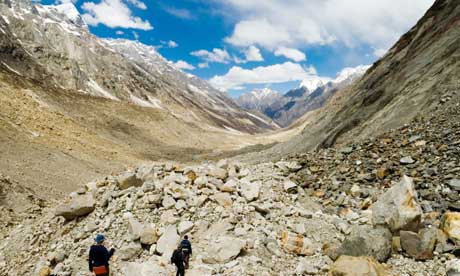
Trekkers crossing Gangotri glacier in Indian Haimalayas

Trekkers crossing Gangotri glacier in Indian Haimalayas. Photograph: Alamy

The world's glaciers are melting faster than at any time since records began, threatening catastrophe for hundreds of millions of people and their eco-systems.

The details are revealed in the latest report from the World Glacier Monitoring Service and will add to growing alarm about the rise in sea levels and increased instances of flooding, avalanches and drought.

Based on historical records and other evidence, the rate at which the glaciers are melting is also thought to be faster that at any time in the past 5,000 years, said Professor Wilfried Haeberli, director of the monitoring service. 'There's no absolute proof, but nevertheless the evidence is strong: this is really extraordinary.'

Experts have been monitoring 30 glaciers around the world for nearly three decades and the most recent figures, for 2006, show the biggest ever 'net loss' of ice. Achim Steiner, head of the UN Environment Programme (UNEP), told The Observer that melting glaciers were now the 'loudest and clearest' warning signal of global warming.

The problem could lead to failing infrastructure, mass migration and even conflict. 'We're talking about something that happens in your and my lifespan. We're not talking about something hypothetical, we're talking about something dramatic in its consequences,' he said

Lester Brown, of the influential US-based Earth Policy Institute, said the problem would have global ramifications, as farmers in China and India struggled to irrigate their crops.

'This is the biggest predictable effect on food security in history as far as I know,' said Brown.

Based on the Intergovernmental Panel on Climate Change's mid-range prediction that global temperatures will rise 2C above their long-term average, UNEP last year warned of further dramatic declines in glaciers by the end of the century.

The revelation that the world's glaciers are in retreat came as Tony Blair began a series of high-level environmental meetings in Japan, China and India as the leader of a new international team charged with securing a global deal on climate change. In a speech yesterday in Chiba, Japan, Blair said that the world now faced catastrophe.

'We have reached the critical moment of decision on climate change,' he said. 'Failure to act now would be deeply and unforgivably irresponsible. The scale of what is needed is so great that the purpose of any global action is not to ameliorate or to make better our carbon dependence; it is to transform the nature of economies and societies in terms of carbon consumption and emissions.

'If the average person in the US is, say, to emit per capita, one-tenth of what they do today and those in the UK or Japan one-fifth, we're not talking of adjustment, we're talking about a revolution.'

The key to that revolution was a vastly increased use of nuclear power across the world, he added.

Blair is also scheduled to meet Yasuo Fukuda, Japan's Prime Minister, and members of the Indian and Chinese governments.

Video

"Manufactured Landscapes" SEE THIS BRILLIANT MOVIE! You'll never have the same shopping experience again.