Sunday, November 25, 2007

Skiers, snowboarders forced to start Sierra ski season with man-made snow

Ah, summer in the mountains: Bone-dry sequoias scraping the clear blue sky, bare-dirt trails winding beneath them, birds twittering in the sunny calm. Tourists in shirt sleeves.

But wait - what's that the calendar says?

It's the end of November?

And it's what? Ski season?

Even a way-cool boarding dude could be forgiven for making the mistake. With temperatures high and snowfall nonexistent of late, you had to hunt pretty hard in the Sierra Nevada this weekend to find enough white stuff to carry a leaf, let alone a snowboard or ski.

Yes, a smattering of ski resorts including Northstar and Sugar Bowl were open on what is traditionally the longed-for Thanksgiving kickoff of the season. Practically all, though, just offered ice skating, low-level tubing or beginner slopes near the bottom of a hill. Thrill runs were short in supply.

But hold on. There was at least one sort-of Valhalla to be found for those who searched the hardest - and it was known as the awesome land of Boreal. OK, so it's really just Boreal Ridge ski resort.

But tell that to guys like Kyle Velo.

He drove up from San Jose Saturday morning after hearing that Boreal's snow-making machines had conjured up three actual snow runs. And the minute his eyes lit on that wide-open plain of 14-inch-deep ivory between boundless stretches of bare dirt and trees he dashed up the hill with his snowboard, goggles and underwear.

Yes, underwear.

On a dare, Velo, 22, snowboarded in nothing but his boxer shorts, this being the first real weekend of the season and all things being fresh and possible. In a rad sort of way. "All right, so as soon as I started, they threw me off the mountain and made me put on some shorts," he said, panting from a bumpy run down the jumping hills. "But this is the most awesome place ever!"

Velo rakishly hooked a thumb into the waistband of his blue basketball shorts, which, slid halfway down his hips, displayed hefty swaths of skin around his obviously torn boxers.

"I dared him, told him I'd pay his lift ticket if he went on in his underwear," giggled his friend Christina Valentine as another pal rubbed a snowball all over Velo's bare chest just to watch him shiver in the 45-degree chill. "Didn't think he'd do it."

So wasn't it too cold skiing in your near-altogether? Velo was asked by nearly everyone he met. And didn't it hurt when you fell down with no padding?

"Nope," he said with a disjointed grin. "I'm drunk. Jagermeister cures all."

Among the hundreds of others hitting Boreal's very short and hard-packed, but truly snowy, runs Saturday were the usual gaggle of avid boarders, a man in a gorilla suit and moms and dads towing tots behind them on skis. Depending on how many kids were in tow, the short length of the slopes was a bit of a blessing, several said.

"I've got two kids up there right now on snowboards, and with the runs like this I can keep a good eye on them," said Chris Chong of San Francisco. "They can't go too far like this."

There was also at least one filmmaker braving the not-so-scary drifts.

At least that's what 5-year-old Mimi Nguyen of San Jose said she was, despite no evidence of a camera anywhere.

Mimi stood with her equally young cousin in line at the kiddie-tubing carousel - which is like a pony ride with slowly revolving poles, only with inner tubes instead of ponies attached to the tethers - and squinted seriously at the lucky kids going round and round in the tubes.

"I'm making a movie, and I'm in the snow, and I'm the hero," she said as her aunt Noel Nguyen cocked her head to assess the creative young mind in action. "It's a really serious movie."

So where was her camera? Mimi was asked. Face as solemn as a nun, she made a circle with her fingers and peered through it - filming, as it were.

Well, then, who will she save in this movie? Mimi was asked. She rotated her finger camera until it lit on her cousin, and her face lit up.

"I'm saving her!" she piped.

A couple of snowballs and laughing fits later, Mimi lay giggling in one of the carousel inner tubes, going round and round, filmmaking forgotten. Until the next snowball, that is.

Farther up the Sierra Nevada, the Heavenly and Squaw Valley ski fields also opened low runs this weekend, as did Royal Gorge and Kirkwood. Most slopes are expected to be open by Christmas.

"It's a pretty awesomely nice day to get going even if there's not much snow," said Jennie Bartlett, Sugar Bowl spokeswoman. "And just wait - by early December this mountain will be covered."

-- Check out the Snow Report page with weather updates, resort profiles and features stories: sfgate.com/sports/skiing/

E-mail Kevin Fagan at kfagan@sfchronicle.com.

Saturday, November 24, 2007

Polar Bears Threatened By Hunter's Choice of Males

From: University of Alberta

/wildlife/article/25757

ScienceDaily (Nov. 23, 2007) — Policies that encourage hunters to go after male polar bears in order to conserve females, could make it harder for the animals to find mates. University of Alberta researchers determined there is a critical threshold in the male-to-female ratio. Below it, their model predicts a sudden and rapid collapse in fertilization rates.

Harvesting regulations vary around the world, notes PhD student Péter Molnár of the Department of Biological Sciences, the study’s lead author. For example, Canada uses a quota system, permitting some hunting to a predetermined limit, while Norway bans any hunting of polar bears.

Current Canadian management polices encourage hunters to go after male bears in order to conserve females while maximizing the number of bears that may be harvested. But harvesting based on sex selection has reduced the number of males compared to females in polar bear populations across the Canadian Arctic, Molnár says.

Molnár’s work was supervised by Professor Andrew Derocher, a noted polar bear expert, and Professor Mark Lewis, who holds the Canada Research Chair in Mathematical Biology. The study was conducted in collaboration with Dr. Mitchell Taylor from the Government of Nunavut.

The U of A team warns that under certain conditions, this practice of sex-selective harvesting could lead to trouble when it comes to polar bears finding a mate - based on a biological mathematical model they developed, and data from the polar bear population at Lancaster Sound off Cornwallis Island (northwest of Baffin Island) in the High Arctic.

The mathematical model has given the researchers the ability to predict how many male bears are needed in an area compared to the number of female bears that are around, to maintain successful mating.

They determined that there is a critical threshold in the male-to-female ratio. If the sex ratio drops below this threshold, the model predicts a sudden and rapid collapse in fertilization rates. This threshold depends on whether the area has a high-density or low-density bear population.

Each bear population must be evaluated separately, since results will be different depending on the population characteristics of the area. But the U of A scientists can say that in regions with fewer bears travelling a larger area (low-density population), there actually needs to be more males than breeding females to maintain high fertilization rates.

Given this important population threshold, the authors concluded that polar bear populations should be closely monitored and carefully harvested, as severe negative effects could arise either from overharvesting male bears or from population decline.

These findings appeared November 21 in the online edition of the Proceedings of the Royal Society.

Firefighters make progress against blaze near Malibu

MALIBU, California (CNN) -- A "dangerous and dynamic" wildfire in Southern California that left six firefighters hurt and destroyed dozens of homes grew to 4,650 acres Saturday night, officials said.

art.fire.hose.ap.jpg

A firefighter battles flames at a home in Malibu, California, on Saturday.

But firefighters have been able to contain 25 percent of the blaze, according to the Los Angeles County Fire Department.

They got a slight break when dry Santa Ana winds clocked at 57 mph (92 kph) earlier in the day decreased to about 20 mph, CNN meteorologist Jacqui Jeras said.

But the winds, blowing from the west, were unpredictable.

"Until the fire is knocked down, we can't be sure what the next development will be," Los Angeles County Supervisor Zev Yaroslavsky said at a news conference earlier.

About 10,000 people fled their homes in the Malibu area ahead of the flames, which began around 3:30 a.m. PT (6:30 a.m. ET). Check out where the fire is located »

The fire has also knocked down power lines, said Los Angeles County Fire Chief Michael Freeman. About 1,700 firefighters were battling the blaze, aided by 23 aircraft. Video Watch efforts to fight the fire from the air »

Gov. Arnold Schwarzenegger pledged to make available help that was offered during the devastating fires in the region a few weeks ago.

"The state of emergency I declared last month has been reactivated, so no time is wasted in providing any needed resources to fight these fires or help those Californians who have been impacted," he said in a statement.

An enormous number of resources were being devoted to the fight, said Malibu Mayor Jeff Jennings. Video Watch the mayor call the fire a 'disaster' »

"I'm standing on my deck of my house here, and I can see four helicopters ... all attacking the fire at once. So they are going after it in a hurry, there's no doubt about that," he said.

It's "certainly not as bad as it could have been," said Jennings, who urged residents to "listen to the radio, stay alert, stay vigilant."

The fire destroyed 51 homes and damaged 27 by Saturday evening. The flames also damaged a mobile home and eight vehicles. Video Watch houses engulfed in flames »

"Whenever these fires are pushed by ... winds, it's a like a blow torch with a hair dryer behind it," said Inspector Sam Padilla of the Los Angeles County Fire Department.

The fire started on a dirt road next to a paved highway in the Corral Canyon area, Freeman said.

Officials said that it's unclear how the wildfire started, and that arson investigators were on the scene. Photo See more photos of the flames »

Mandatory evacuations were ordered in the area bordered by Corral Canyon on the east, Trancas Canyon on the west, Mulholland to the north and the Pacific Coast Highway on the south, although some were lifted later Saturday.

The Red Cross set up a shelter at Agoura Hills High School. Evacuated residents farther south were instructed to go to Channel Islands High School in Ventura County. Video Watch how evacuees are dealing with the fire »

A resident who was not told to evacuate did so anyway, and he told CNN he thought his home had been destroyed.

Sia Hodjatie said the smell of smoke awoke him about 3:45 a.m. He and his family packed their pets into their car and started leaving the house an hour later.

"When we were leaving, the fire was in our back door," Hodjatie said. "My older son ... said, 'Dad, if we would have left 30 or 40 seconds more, we would have been baked here.' And we saw the fire coming toward the house, and heavy smoke, and very, very uncomfortable situation."

Thick smoke billowed into the air and could be seen several miles from the flames, witnesses said. The fire is producing a "tremendous" amount of smoke, Pepperdine University official Jerry Derloshon told CNN.

Looking westward, where the fire was several miles away, he said, "There's so much smoke, it almost defies understanding."

Pepperdine students were being asked to relocate to a central location on campus as a precaution, he said.

Maurice Luque, a spokesman for the San Diego Fire Department, said their firefighters were ready in case the fire spreads there. The city is about 130 miles southeast of Malibu.

"We're very, very concerned. We're on high alert. Our fire crews have been told to be ready to come in off duty. They all have their equipment with them, so they can report anywhere they're needed."

"We're hoping and praying that the winds do not materialize down here, that we have no fires, and there's no need for additional resources down here if something breaks. It's a very tense, nervous situation," Luque said.

It was the second time in just over a month that fires ravaged the region. Last month's fires charred more than 508,000 acres in several counties, destroying about 1,600 homes, causing 14 deaths and forcing 1 million people from their homes.

Commonwealth divided on climate change

From: Reuters

/climate/article/25759

By Barry Moody

KAMPALA (Reuters) - Commonwealth leaders worked on Saturday to overcome differences on climate change, which poses a mortal danger to some of its members, with the result of Australia's election shifting the balance at the meeting.

On the second day of their three-day summit in Kampala, members of the 53-member club of mostly former British colonies were working on a final declaration which they hope will influence a major environment meeting in Bali next month.

Most Commonwealth countries, led by Britain, want a tough statement that sets binding targets for greenhouse gas emissions.

Canada says it does not want to scupper such a declaration but insists it would be meaningless if it did not include big emitters in the developing as well as developed world.

The victory of the opposition Labor party in Australia's election on Saturday appeared to have shifted the balance at the meeting towards a strong declaration with binding targets.

Labor leader Kevin Rudd party has promised to radically change climate policy, ratify the Kyoto protocol and push for an ambitious target of a 60 percent cut in emissions by 2050.

Before the election, Australia's refusal to ratify Kyoto had angered Pacific island nations, including Commonwealth members, who could be submerged by rising sea levels.

A senior Canadian official in Kampala said Ottawa would refuse to sign a final declaration that was "weaker" than agreements by the recent summits of the G8 group of industrial nations and the Asia-Pacific grouping APEC.

Both summits were criticized by environmentalists for agreeing only on vague and "aspirational" targets.

"Canada is holding firm for a declaration that is as strong as the APEC declaration ... that all countries, notably major emitters, must contribute to reducing greenhouse gas emissions," the official said.

This was a reference to China and India -- a Commonwealth member -- which were exempted from targets set under Kyoto.

Kamalesh Sharma, elected as the new Commonwealth Secretary-General on Saturday, said he expected the leaders to agree a strong statement on climate.

"This particular CHOGM will certainly be recognized as having come out with an indicative road map and a declaration," he said.

Sharma, the Indian High Commissioner in London, will succeed New Zealand's Don McKinnon on April 1.

(Additional reporting by Tim Cocks and Jeremy Clarke; Editing by Charles Dick)

Prime minister John Howard loses seat - Ill equipped to handle Ausralia's climate change crisis

Staff and agencies
Guardian Unlimited, UK


Prime minister John Howard today admitted defeat in Australia's general election, and looks set to lose his parliamentary seat.

Labor Party leader Kevin Rudd swept to power, ending an 11-year conservative era and promising major changes to policies on global warming and his country's role in the Iraq war.

The win marked a humiliating end to the career of Howard, who became Australia's second-longest serving leader - and who had appeared almost unassailable as little as a year ago.

In a nationally televised concession speech, Howard announced he had phoned Rudd to congratulate him on "a very emphatic victory".

"I accept full responsibility for the Liberal Party campaign, and I therefore accept full responsibility for the coalition's defeat in this election campaign," Howard said.

Howard was also in danger of becoming only the second sitting prime minister in 106 years of federal government to lose his seat in parliament.

Official figures from the Australian Electoral Commission showed Labor well ahead with more than 60% of the ballots counted. An Australian Broadcasting Corp analysis showed that Labor would get at least 81 places in the 150-seat lower house of parliament - a clear majority.

ABC radio reported that Howard aides said the prime minister had phoned Rudd to concede defeat. Rudd is expected to formally claim victory later today.

The change in government from Howard's centre-right Liberal-National Party coalition to the centre-left Labor Party also marks a generational shift for Australia.

Rudd, a 50-year-old former diplomat who speaks fluent Chinese, urged voters to support him because Howard was out of touch with modern Australia and ill-equipped to deal with new-age issues such as climate change.

Howard campaigned on his economic management, arguing that his government was mostly responsible for 17 years of unbroken growth, fueled by China's and India's hunger for Australia's coal and other minerals, and that Rudd could not be trusted to maintain prosperous times.

Rudd said he would withdraw Australia's 550 combat troops from Iraq, leaving twice that number in mostly security roles. Howard had said all the troops will stay as long as needed.

However, a new government is unlikely to mean a major change in Australia's foreign relations, including with the United States - its most important security partner - or with Asia, which is increasingly important for the economy.

But one of the biggest changes will be in Australia's approach to climate change. Rudd has nominated the issue as his top priority, and promises to immediately sign the Kyoto Protocol on greenhouse gas emissions.

When he does so, the United States will stand alone as the only industrialised country not to have signed the pact.

Labor has been out of power for more than a decade, and few in Rudd's team - including him - has any government experience at federal level. His team includes a former rock star - Midnight Oil singer Peter Garrett - and a swag of former union officials.

But analysts say his foreign policy credentials are impeccable, and that he has shown discipline and political skill since his election as Labor leader 11 months ago.

Rudd's election as Labor leader marked the start of Howard's decline in opinion polls, from which he never recovered.

Howard's four straight election victories since 1996 made him one of Australia's most successful politicians. He refused to stand down before this election - even after being urged to do by some party colleagues. However, Howard earlier this year announced plans to retire within about two years if he won the election.

Friday, November 23, 2007

U.N.: Greenhouse Gases Hit High in 2006

Two of the most important Greenhouse gases in the Earth's atmosphere reached a record high in 2006, and measurements show that one — carbon dioxide — is playing an increasingly important role in global warming, the U.N. weather agency said Friday.

The global average concentrations of carbon dioxide, or CO2, and nitrous oxide, or N2O, in the atmosphere were higher than ever in measurements coordinated by the World Meteorological Organization, said Geir Braathen, a climate specialist at the Geneva-based agency.

Methane, the third of the three important greenhouse gases, remained stable between 2005 and 2006, he said.

Braathen said measurements show that CO2 is contributing more to global warming than previously.

CO2 contributed 87 percent to the warming effect over the last decade, but in the last five years alone, its contribution was 91 percent, Braathen said. "This shows that CO2 is gaining importance as a greenhouse gas," Braathen said.

The concentration of carbon dioxide in the atmosphere rose by about half a percent last year to reach 381.2 parts per million, according to the agency. Nitrous oxide totaled 320.1 parts per billion, which is a quarter percent higher than in 2005.

Braathen said it appears the upward trend will continue at least for a few years.

The World Meteorological Organization's annual Greenhouse Gas Bulletin provides widely accepted worldwide data on the amount of heat-trapping greenhouse gases in the atmosphere.

Studies have shown that human-produced carbon dioxide emissions heat the Earth's surface and cause greater water evaporation. That leads to more water vapor in the air, which contributes to higher air temperatures. CO2, methane and N2O are the most common greenhouse gases after water vapor, according to the meteorological organization.

They are produced by natural sources, such as wetlands, and by human activities such as fertilizer use or fuel combustion.

There is 36.1 percent more carbon dioxide in the atmosphere than there was in the late 18th century, primarily because of combustion of fossil fuels, the World Meteorological Organization bulletin said.

A report presented by a U.N. expert panel said last week that average temperatures have risen 1.3 degrees Fahrenheit in the last 100 years, and that 11 of the last 12 years have been among the warmest since 1850. Global Warming also led to a sea level increase by an average seven-hundredths of an inch per year since 1961, according to the U.N. Intergovernmental Panel on Climate Change.

The panel's report, which said human activity is largely responsible for global warming, noted that the concentration of carbon dioxide in the atmosphere is far higher than the natural range over the last 650,000 years.

The World Meteorological Organization also concluded that "Greenhouse gases are major drivers of global warming and climate change."

The World Meteorological Organization said it based its findings on readings from 44 countries.

The U.N. Intergovernmental Panel on Climate Change forecast that by 2020, 75 million to 250 million people in Africa will suffer water shortages, residents of Asia's large cities will be at great risk of river and coastal flooding, Europeans can expect extensive species loss, and North Americans will experience longer and hotter heat waves and greater competition for water.

History shows climate changes led to war

From: Reuters

/sci-tech/article/25646

HONG KONG (Reuters) - Global warming is one of the most significant threats facing humankind, researchers warned, as they unveiled a study showing how climate changes in the past led to famine, wars and population declines.

The world's growing population may be unable to adequately adapt to ecological changes brought about by the expected rise in global temperatures, scientists in China, Hong Kong, the United States and Britain wrote in the journal Proceedings of the National Academy of Sciences.

"The warmer temperatures are probably good for a while, but beyond some level plants will be stressed," said Peter Brecke, associate professor in the Georgia Institute of Technology's Sam Nunn School of International Affairs.

"With more droughts and a rapidly growing population, it is going to get harder and harder to provide food for everyone and thus we should not be surprised to see more instances of starvation and probably more cases of hungry people clashing over scarce food and water."

Trawling through history and working out correlative patterns, the team found that temperature declines were followed by wars, famines and population reductions.

The researchers examined the time period between 1400 and 1900, or the Little Ice Age, which recorded the lowest average global temperatures around 1450, 1650 and 1820, each separated by slight warming intervals.

"When such ecological situations occur, people tend to move to another place. Such mass movement leads to war, like in the 13th century, when the Mongolians suffered a drought and they invaded China," David Zhang, geography professor at the University of Hong Kong, said in an interview on Thursday.

"Or the Manchurians who moved into central China in 17th century because conditions in the northeast were terrible during the cooling period," he said.

"Epidemics may not be directly linked to temperature (change), but it is a consequence of migration, which creates chances for disease to spread."

HALF THE WORLD AT RISK

Although the study cited only periods of temperature decline to social disruptions, the researchers said the same prediction could be made of global warming.

A report last week said climate change will put half the world's countries at risk of conflict or serious political instability.

International Alert, a London-based conflict resolution group, identified 46 countries -- home to 2.7 billion people -- where it said the effects of climate change would create a high risk of violent conflict. It identified another 56 states where there was a risk of political instability.

"I would expect to see some pretty serious conflicts that are clearly linked to climate change on the international scene by 2020," International Alert secretary general Dan Smith told Reuters in a telephone interview.

Near the top of the list are west and central Africa, with clashes already reported in northern Ghana between herders and farmers as agricultural patterns change.

Bangladesh could also see dangerous changes, while the visible decline in levels of the River Ganges in India, on which 400 million people depend, could spark new tensions there.

Water shortages would make solving tensions in the already volatile Middle East even harder, Smith said, while currently peaceful Latin American states could be destabilized by unrest following changes in the melting of glaciers affecting rivers.

Unless communities and governments begin discussing the issues in advance, he said, there is a risk climate shift could be the spark that relights wars such as those in Liberia and Sierra Leone in west Africa or the Caucasus on Russia's borders. Current economic growth in developing states could also be hit.

(Reporting by Tan Ee Lyn; Editing by Bill Tarrant)

The world's first climate change election.

The Australian prime minister, John Howard, has poured scorn on the idea of global warming. But now the trees are dying, the crops are failing and the rivers are drying up. As the country prepares to go to the polls, Julian Glover reports on the world's first climate change election.
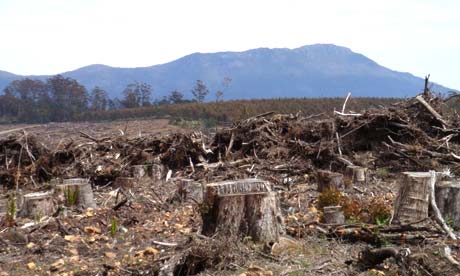
The loggers are moving in on the Tamar valley

The loggers are moving in on the Tamar valley. Photograph: Julian Glover

On an early summer's morning in northern Tasmania, the Tamar valley looks like an Australian slice of Tuscany. There are groves of walnut trees beside white-barked eucalyptus, a lavender farm, apricot orchards and small fields of olives. Vineyards run down to the river and fat black cattle graze the pasture. Yachts are anchored in the winding reaches of the tidal river. The Tamar seems a model of sustainable development - green and welcoming.

Except that the Australian government has just approved the building of one of the world's largest pulp mills in the middle of this scene. A 200-hectare (500-acre) polluting giant by the side of the Tamar river, the factory would accelerate - some say double - the already rapid pace of logging in the mountainous and verdant island state. Turned into woodchip and then exported as chlorine-bleached pulp, much of what remains of Tasmania's native forests may end up as cheap paper for the hungry markets of Asia.

This is not the first time that the island has found itself caught up in environmental conflict. The logging industry has long been a source of controversy as well as local jobs. The successful 1970s campaign to stop a dam being built on the wild Franklin river led to the birth of the world's first Green party. The Bell Bay pulp mill is now part of a much wider public debate over Australia's environmental future that is now shaping the country's politics.

Australia goes to the polls tomorrow in what is arguably a milestone in 21st-century history: the world's first climate-change election. It comes after a five-year drought that has seen some of the country's greatest rivers dry up and crops fail. A land that has grown rich over two centuries on the back of what seemed like unlimited space and resources - and which is booming through the shipping of coal and iron ore to fuel the furnace of China's economy - is confronting a far less comfortable reality of water shortages, failing crops and environmental collapse. But the logic of the new debate is emerging faster than the old politics can catch up. As the 21st-century wind changes, political faces are caught in 20th-century grimaces. There is a disconnect between national arguments and Saturday's election choices.

The story begins with Australia's conservative prime minister, the Liberal leader John Howard, the man who the polls say will be defeated tomorrow night - though Australians know there is a chance that the great survivor could pull off one last victory. His downfall, if it comes, will be symbolic for reasons that run well beyond climate change. An icon of global conservatism, he is the last of the Iraq warriors to seek re-election, after Tony Blair and George Bush. He stood alongside the United States in refusing to sign the 1997 Kyoto agreement. Howard poured scorn on the existence of climate change, though he has now been forced to change his mind. Australians can see for themselves that he was wrong.

"Salt is coming up out of the ground, trees are dying," says Geoffrey Cousins, a well-known Sydney businessman and former adviser to Howard who has now turned his efforts to stopping the pulp mill. "It is quite clear to anyone living in Sydney that rainfall patterns have changed, the pattern of storms is different. There has been a big shift in thinking and the mill became a concrete, readily understandable example of all of this, something we could actually do something about."

Facing Howard is the man who expects to become Australia's prime minister tomorrow night, the Labor party's leader, Kevin Rudd. A clever, bespectacled former bureaucrat from the tropical state of Queensland, he recently used his fluent Mandarin to chat to the Chinese premier Hu Jintao in front of the anglophile Howard - a humiliation that symbolised the way national priorities are shifting to Asia.

Yet Rudd has fought a highly restricted, personalised campaign, aping Howard more than opposing him on most issues. Friends - including Britain's former cabinet minister Alan Milburn - have turned Rudd into a brand: Kevin07. It is very reminiscent of New Labour. Rudd has fought on a handful of issues targeted at working families in suburban seats, especially the changes to employment law that were pushed through by Howard. Such caution has disappointed some supporters. Controversially, Rudd has also backed the construction of the Tasmanian mill - shaken by a Labor defeat in 2004, when the party promised to save the island's native forests in the last week of the campaign, only to be savaged on polling day.

But Rudd has been much bolder on climate change, making it a defining point of difference. He has promised to sign the Kyoto protocol as his first act of government - and the fact that the decade-old agreement is still a live issue in Australia is a sign of how far debate is behind Europe. For a car-addicted nation that was last week named as the world's biggest per-capita emitter of greenhouse gasses - Australians produce 27% more tonnes of carbon dioxide per head than Americans - it would be a significant moment.

"There is no doubt that over the past few years the impact of the drought has been to make voters personally experience what they see as a changing climate," says Lynton Crosby, the pollster and campaign strategist who helped Howard to win four elections in a row and directed the Conservative party campaign in Britain in 2005. "For the first time in 25 years in this country, the environment is an important voting issue." Crosby is no new-generation eco-rebel. That he can see the way the wind is blowing speaks volumes.

By the banks of the Tamar river in Tasmania, winegrower Peter Whish-Wilson has built up the Three Wishes vineyard and is also in no doubt that the climate is changing in politics as well as the skies. "We have had storms come through that we have never seen before," he says. "In the last five years we have broken every single temperature record - highest temperature, lowest, highest rain. Climate change is tangible; we can see it in the country. Farmers are coping with the worst droughts on record.

"The country is learning the hard way. It has always been seen as the lucky country, with a lot of land and resources, but you can't live in a lot of Australia now."

For him, the pulp mill is part of the choice facing Australia: between exploiting its natural resources or managing them. On the road that runs past his farm, huge logging trucks already pass every few minutes, loaded with wood cut from the hills. The scene confronting visitors to the forests is almost apocalyptic. Trees are bulldozed or blown apart with explosives and the ground cleared by fires, started by napalm dropped from helicopters. Any native wildlife that survives is culled by sodium fluoroacetate poison, allowing regimented new saplings to grow - monoculture on an industrial scale.

This, and the sense that the island is in thrall to the power of the giant timber business Gunns, is one reason Howard's Liberal party fears it will lose two key marginal seats in Tasmania tomorrow, on the back of Green party votes redistributed to Labor under Australia's preferential system.

Gunns, the company that wants to build the plant, argues that it will be "the world's greenest pulp mill". Opponents dispute that: they say that its chlorine processes are outdated and will pump dioxins into the fishing grounds of the Bass Strait. They also question the economics: the A$1.7bn (£720m) plant will require state funding and huge bank loans.

The logging company argues that "opponents of the development have resorted to misinformation, scaremongering and false claims". It has not been shy of taking on Tasmania's green movement, and in 2004 launched a multimillion-dollar claim for damages against a group of environmentalists. It is true that, as Gunns say, part of the Tamar valley is already industrialised. There is a metals plant at one end, and a woodchip mill, which will feed the pulp plant. But the planned site is untouched. "If it can happen here, it can happen anywhere. People have got to come to grips with the fact there has got to be a balance," says Whish-Wilson.

The journey from Tasmania to Sydney's eastern suburbs involves a dramatic switch of cultures. In the richest part of the country's largest city, Saabs and Range Rovers crowd narrow streets of Victorian terraced houses and huge glass and stone millionaires' palaces tumble down to the harbourside. There are boutiques and designer coffee bars, the haunt of Australia's pinot grigio classes, as well as Bondi beach and Australia's biggest gay community.

This is the Wentworth constituency of Malcolm Turnbull, the millionaire lawyer who took on the British establishment in the Spycatcher trial and went on to campaign, unsuccessfully, for a republic in a referendum opposed by most Liberals. By saving the monarchy, he said, Howard was "the prime minister who broke Australia's heart". At least until tomorrow, Turnbull is also the environment minister and one of the most striking players in Australian politics - a man of ability and undisguised ambition.

He could hope to replace Howard as Liberal party leader. Instead, Turnbull's political career may be cut short. As environment minister, Turnbull himself led the way in announcing a ban on the sale of tungsten light bulbs, a world first. But his seat ... solidly conservative for more than a century - is at risk after a backlash from voters who oppose the Tasmanian pulp mill. Lampposts across the constituency sport Green party slogans. The Greens expect a record vote in this election, but their vote is not concentrated enough to win seats in parliament. The irony is that if Turnbull is defeated, Labor, which also supports the mill, will win.

The scale of Green activism in Wentworth is one sign of a changing country. Another is the background of the man picked by Labor to fight the Sydney seat that sits next to Turnbull's. Elected as a Labor MP in 2004, and now - like Turnbull - his party's environment spokesman, Peter Garrett is the closest Australia gets to Bono. As the lead singer of Midnight Oil, a rock group that formed the soundtrack to rebellion for a generation of Australians, Garrett used his music to campaign for Aboriginal rights and environmental change.

Now he is accused of being a sell-out in a suit, kept out of the limelight during the election campaign by a party worried that he might frighten voters. In the ferocious TV attack ads allowed by Australian electoral law, he has been repeatedly described by the Howard campaign as one of Labor's "fanatics, extremists and learners" - after a supposed slip when he admitted that Labor's green policies appeared cautious but that "once we get in, we'll just change it all".

Garrett and Turnbull might deny it, but the two Sydney MPs have much in common. Both want to push further on the environment than their parties allow. Both probably privately wish the Tasmanian pulp mill plan would disappear. And both are tall poppies in a political culture that punishes individuality.

Westminster is a model of freethinking compared with Australia's House of Representatives and elected Senate. Rebellion against the party whip is not just frowned upon but banned: any MP who tries it risks expulsion. The result is a form of processed politics that encourages caution and blandness. David Cameron's attempt to modernise the Tories produces puzzled looks from Australian Liberals, still a party of white men sweating slightly in heavy suits and loud striped ties.

Howard himself will soon leave office whether he wins or loses - and he may lose in the most dramatic form possible, since his marginal Sydney seat of Bennelong will swing to Labor if the polls are right. Even if he survives, he faces a fate familiar to Tony Blair. Having long fended off the prime ministerial ambitions of his treasurer Peter Costello, he has been forced by a cabinet revolt to promise to stand down after the election. But Costello is an unconvincing performer with the droopy looks of a fall guy in a New York cop show and a political agenda almost as antique as Howard's.

According to Crosby, "the government is campaigning on the risk associated with change to an inexperienced team". It is a tactic Gordon Brown will surely use in Britain next time - and it might work. But it has allowed the Rudd campaign to set the terms of the debate. The Howard government has proposed an aggressive plan to intervene in Aboriginal affairs. Though it was much-discussed before the campaign, Labor has not challenged its fundamentals. Nor has Australia's presence in Iraq, or the future of the monarchy, caught national attention.

Politicians blame Australia's media culture for the decline in debate, but the fault lies with parties too. They have reduced campaigning to the mechanistic manipulation of numbers - seeking to catch the attention of the sort of disengaged and easily scared wavering voters who do not turn out in Britain but must do so by law in Australia or risk a $20 fine. That leads to turnout of more than 90%, but also crude tactics such as Howard's scare stories over asylum seekers in past elections, and a Liberal leaflet discovered this week that claimed to be from a Muslim group backing suicide bombers and thanking Labor from its support. Howard distanced himself from it quickly.

Labor has also indulged in attention-grabbing: Rudd exposed himself to an interview in which he was asked whether he would win a bar fight against Howard, and who he "might turn gay for". "My wife," he replied - which led the host to ask, not unreasonably, if she was therefore a man.

That demeaning of debate is common to many modern democracies: caught on camera seemingly eating his own earwax, Rudd faced mockery. The British tabloids would surely do the same to Cameron or Brown. Underneath all this there is a serious election trying to escape: it's about a society that is more prosperous than ever, but uncomfortable about the effect of prosperity on the way people live and on the planet's ecosystem.

"The Howard government has degenerated and is purely obsessed with its own re-election," says Lindsay Tanner, the Labor MP for inner-city Melbourne, a seat where the Green party is also strong. He is hopeful that the necessary superficialities of a campaign will not prevent the election of a government that can respond to environmental and social change. "We have been disciplined and focused and kept political attention on critical issues, with climate change and Workchoices employment legislation as the most obvious priorities," he says.

Back in Tasmania, Gunns claim that its timber industry will be part of this sustainable future. If elected, Labor will have to decide if it agrees. It will not have much time to think. Logging of new sections of native forest is set to start on Monday. Work on the pulp mill will begin within weeks.

Thursday, November 22, 2007

Spain hydroelectric reserves cut in half

From: Reuters

/energy/article/25608

MADRID (Reuters) - Water levels in Spain's hydroelectric reservoirs dropped to under half capacity in the week to Monday night, official data showed, as Spain's dry autumn continued to worry power companies and farmers.

Hydroelectric reservoir levels fell to 49.4 percent from 50.3 percent of capacity a week earlier. As little as four months ago, Spain's hydro reservoirs were more than 80 percent full.

In contrast to normally-rising levels in the autumn, Spain's hydro-reserves have fallen consistently this season and volumes are now nearing multi-year lows hit in 2005/06.

However there was better news from Tuesday as heavy rains fell across much of Andalucia and Galicia and as wide-spread showers forecast for at least the next three days.

Tuesday's level compares to 69.5 percent in the same week in 2006 and a 10-year average of 63.8 percent for the 47th week of the year, the Environment Ministry said.

That means there are 7,594 gigawatt hours (GWh) of electricity available, 184 less than the previous week, and 73.9 percent of capacity available a year ago.

In the last week, power companies have generated 317.9 GWh of hydroelectric power, taking the total so far this year to 24,392 GWh, which is still 27.8 percent more than in the same period last year.

In a good year, some 12 percent of Spain's electricity comes from hydropower, but in dry years like 2005 and 2006, this falls to about 8 percent.

Spain's biggest utility, Iberdrola produced 22.6 percent of its power in Spain from hydro-electricity in the first nine months of the year -- more than any other source.

Drinking water reservoir levels slipped to 38.0 percent from 38.2 percent last week, 39.6 percent in the same week last year and an average 48.3 percent in week 47 over the last 10 years.

(Reporting by Ben Harding; Editing by Chris Johnson)

Water runs dry in rural Tennessee town

From: Reuters
Pu
/ecosystems/article/25603

By Matthew Bigg

ORME, Tennessee (Reuters) - A small town tucked away in the mountains of southern Tennessee is getting by on just a few hours of water a day because its spring has run dry in the drought sweeping the Southeast.

The worst drought to hit the region in decades prompted Georgia to impose water-use restrictions including a ban on outdoor residential watering.

It has also sparked a political battle between Georgia, Alabama and Florida over how to share water from north Georgia's Lake Lanier, which serves cities such as Atlanta as well as industries and a nuclear power plant

But rural Orme with its population of just 140 people has become a symbol of the drought because few other places appear to have been so directly hit.

Each evening, residents wait for Mayor Tony Reames to make the short drive from his home where he keeps chickens up to a water tower on a wooded hill above the town to open a valve.

When the water is flowing families can fill buckets and water jars, do laundry, take showers and wash dishes before the faucets run dry and they wait for the next evening.

Resident Julie Hoover described Orme as a "hideaway" and a "piece of heaven" because it was safe and everyone knew each other but she said the water shortage had created serious problems.

"People don't like change and they don't like losing their water," said Hoover, who started filling up buckets with water draining from an air-conditioner to get water to flush toilets when the spring ran dry in August.

Hoover and her sisters have also taken to cooking one big family meal for all their children to save water, something she said had proved a blessing.

HELP AT HAND

Sporadic water supply is the norm for much of the world's population but for Orme, near the border of Alabama and Georgia, help is at hand. Local businesses and churches donate bottled water, bringing it to the town's one-room fire house for residents to collect.

Orme received a $377,590 grant from the Department of Agriculture plus a further grant of $229,000 to build a water pipe from Bridgeport, Alabama, to the town's water tower, Reames said.

Workmen laying down sections of the bright blue pipe beneath the side of a road leading to the town move closer each day.

A century ago, Orme was a bustling coal mining town with a railroad running down the main street but when the coal industry left, the town declined. Many residents are now elderly and average per capita income is around $15,000, according to government figures.

Reames, 48, said he had spent his whole life in the town, which has two small churches, no school, no shops and no cell phone service.

In the past, a creek and a waterfall fed the town but the creek dried up years ago and the waterfall slowed to a trickle in August, exposing a fissure in the rock that leads down to a big network of caves, residents said.

"Back then you could ride ponies and horses up on the mountains and you didn't need to go half a mile and you would find a stream," Reames said, adding: "A person don't know what they have got till it's gone."

Orme votes mainly Democratic, but the town's water problems had made the 2008 presidential election and other national issues seem less important, according to Reames.

"This (drought) ain't nothing more than a disaster. I ain't saying he (President George W. Bush) shouldn't be giving money to other countries but he has a problem right here."

(Editing by Eddie Evans)

Wednesday, November 21, 2007

Billions of jellyfish wipe out N. Irish salmon farm

CNN
  • Jellyfish came in 10-square-mile, 35-foot deep pack
  • Company boats couldn't make way through jellyfish to rescue salmon
  • Mauve stinger jellyfish normally found in Mediterranean

DUBLIN, Ireland (AP) -- The only salmon farm in Northern Ireland has lost its entire population of more than 100,000 fish, worth $2 million, to a spectacular jellyfish attack, its owners said Wednesday.

art.salmon.afp.gi.jpg

Farm-raised salmon swim in a pen off Norway.

The Northern Salmon Co. Ltd. said billions of jellyfish -- in a dense pack of about 10 square miles and 35 feet deep -- overwhelmed the fish last week in two net pens about a mile off the coast of the Glens of Antrim, north of Belfast.

Managing director John Russell said the company's dozen workers tried to rescue the salmon, but their three boats struggled for hours to push their way through the mass of jellyfish. All the fish were dead or dying from stings and stress by the time the boats reached the pens, he said.

Russell, who previously worked at Scottish salmon farms and took the Northern Ireland job just three days before the attack, said he had never seen anything like it in 30 years in the business.

"It was unprecedented, absolutely amazing. The sea was red with these jellyfish and there was nothing we could do about it, absolutely nothing," he said.

The species of jellyfish responsible, Pelagia nocticula -- popularly known as the mauve stinger -- is noted for its purplish night-time glow and its propensity for terrorizing bathers in the warmer Mediterranean Sea. Until the past decade, the mauve stinger has rarely been spotted so far north in British or Irish waters, and scientists cite this as evidence of global warming.

Russell said the company, which bills its salmon as organic and exports to France, Belgium, Germany and the United States, faces likely closure unless it receives emergency aid from the British government.

"It's a disaster," he said.

Tuesday, November 20, 2007

Solar power on the rise in Africa

Solar power on the rise
The East African, Kenya

By Ayoki Onyango

Installation of solar panels in homes is on the rise following the recent rise in oil prices, which has led to an increase in the cost of electricity.

Jua Moto Systems marketing manager, Mr Prakash Wanzah (left), explains to former Mombasa Mayor, Mr Hamisi Mwidani, how one of their latest solar energy products works. Picture by Ayoki Anyango

Not only is electricity expensive due to a fuel surcharge, but there have also been numerous and unexplained power disconnections, particularly in Nairobi. This has caused a surge in demand for fuel-powered generators, and a growing interest in solar energy.

Mr Prakash Wanzah, the marketing manager of Jua Moto Systems, who sell solar energy systems, says: "The uptake is very high, but there is lack of sensitisation, complete solution providers and service to the rural areas".

Another vendor, Mr Pavin Chukla of Solar Africa, is even more upbeat. "Demand is too much. We used to sell ten pieces of various sizes of solar panels per day. Today we are selling 30 pieces every day," he says.

Products on offer range from solar power packs, solar home light systems, solar concentrating cookers, solar parabolic cookers, wind generators, solar lanterns, solar electric water pumping system, evacuate tube collector, solar water heating system, flat plate water heating systems and solar street lights among others.

According to Mr Leornard Makuli of Solar World East Africa, installation of a solar heating and lighting system for a three-bedroom house in Nairobi costs an estimated Sh230,000 inclusive of Value Added Tax.

This includes two solar panels at Sh51,000 each, two solar batteries at Sh19,500 each, a 20amps charge controller at Sh8,500, electrical connections at Sh18,000, a 1000 watts inverter at Sh4,450, five energy savers at Sh450 each, solar connecting accessories at Sh4,500 and an installation charge of Sh8,500.

Says Chukla of Solar Africa: " the installation of a solar system can cut Kenya Power and Lighting Company bills from say Sh2,000 monthly to about Sh1,300 per month. What you get is more power for less money".

Wanzah says solar power packs are electricity-generating systems that make use of benign solar power to generate electricity cleanly, quietly and without causing any damage to the surrounding environment.

"Such systems are ideal for locations where the main electricity grid is unreliable or inaccessible or the access is prohibitively expensive," he says.

The salient features are clean, silent, eco-friendly sources of power and advanced controls for remote operation and monitoring. "There is little maintenance required as there are no moving parts," say Wanzah.

Further, solar energy offers a stable grid quality output without power fluctuations. "It is easy to install with no recurring fuel costs," he says.

Wanzah says the solar homelight system is a small electricity generating kit that makes use of the benign, clean and non-polluting energy from the sun. It powers appliances like lights, small television sets, fans and radios, adding that the solar homelight system consists of solar modules, deep cycle battery, compact fluorescent lamps and wires and hardware required to set the system up.

The solar home light systems, notes Wanzah, serve as an invaluable source of power in remote places off the national grid. These include communication outposts, forest reserves, campsites, and rural communities among others. It can also be used as a stand –by source during power outages.

The vendors say the rural areas need to be sensitised on the availability of solar energy systems. "When it is sunny like this, you can use solar energy for two to three days without switching on the mains. We need to see more demonstrations and advertising in rural areas," says Chukla.

Jua Moto now intends to introduce solar concentrating cookers and concentrating parabolic cookers. "The solar concentrating cooker is many times more useful that conventional box type solar cookers. The system can thus be used to cook a wide variety of foods, including chapatis, and other traditional preparations that require roasting, frying or baking," insists Wanzah.

The solar concentrating cooker can be easily installed, and can cater to the cooking requirements of 80 to 100 persons in a rural or urban environment. "Solar cookers are easy to install, easy to use and deliver years of trouble free service," says Jua Moto Systems Managing Director, Mr Jayesh Dave.

Solar cookers were introduced to two refugee camps, Kakuma, and Dadaab with relative success. Women were taught how to use the cookers, which are made out of cardboard and foil, and given a portion of food to cook so they did not have to use their own.

According to Mr Daniel Kammen, in the July 1995 issue of Scientific American, the average Kenyan spends about 40 per cent of earned income on fuel, 74 per cent of which is used for cooking. Using solar cookers has the potential to save each family 60 per cent of its fuel wood. Not to mention the benefits of decreased deforestation, which include rebuilding carbon, sinks, providing habitat for animals, and beautifying villages. The United Nations estimates that solar cooking will reduce the felling of trees around villages by 40 per cent.

The solar cookers are not as fast as traditional fires, but they are cleaner and require fewer raw materials. Another disadvantage is that they do not work as well on rainy or cloudy days. However, they do free up a substantial amount of time for women. It is estimated that women spend about five hours every day searching for fuel wood. With solar cookers, that time could be used to care for children or improve.

A solar lantern is a portable source and handy source of light ideal for use both indoors and outdoors. The solar lantern consists of a solar module, sealed maintenance free battery, charge controller, inverter and a compact fluorescent lamp.

The solar lantern uses solar energy to charge a battery inside the lantern. "The high efficiency inverter in the solar lantern uses battery power to operate a 5W or 7W compact fluorescent lamp for between two to six hours," says Wanzah.

Solar Water Pumping Systems are ideal water pumping solution when access to power is not readily available.

Then there are water heaters. Evacuated tube solar water heaters are a product, which is and reliable solution to conserve energy. Evacuated tube solar water heater use the abundant energy of the sun to heat water to temperatures as high as 85C and result in quantum savings in electricity or fuel oil. The abundantly available, free energy from the sun, can be tapped anywhere the evacuated tube collector water heating systems, says Wanzah adding that the systems can be easily installed and integrated with existing water heating systems such as a geysers in houses, steam boilers in industries, or pressurized systems in hotels.

"What is more, the water heating system pays back your investment in two to three years. With an estimated life span of 25 years, this represents excellent value for money," reveals Wanzah. Hot water is available round the clock, with significant energy savings. It is non polluting and environmentally friendly, with an operating life of 25 to 30 years.

Neighbourhood organisations and companies can also explore solar powered outdoor lighting systems, solar streetlights and solar garden lights. The lights can be used in locations where the supply of electricity is erratic or unobtainable.

Solar Streetlights are available in a wide range and can also be custom designed to meet particular service or aesthetic requirement.

Efforts have been made to decrease Kenya’s dependence on hydropower, mainly building diesel based or geothermal based power plants. In July of 1981, Kenya became the first country in Africa to install a geothermal unit. The unit is in Olkaria, near Lake Naivash, which is about 80 km northwest of Nairobi. Fuel oil is also being used to power generators to feed the national grid.

However, solar power has not been as thoroughly explored as hydroelectric and geothermal power in Kenya, but the country stands to benefit from its use because of its equatorial location.

There is a small but growing market for PV systems. Currently, PV cells are restricted to affluent society.

Still, the use of wind and solar energy has remained low, just like in the rest of Africa.

Whereas Egypt and South Africa are slightly advanced than the rest of Africa, they have also failed in providing complete turnkey solutions

"The significance of the carbon credit has not been fully exposed to the developed world. The Government should provide income tax relief to users of renewable energy products," says Prakash.

Video

"Manufactured Landscapes" SEE THIS BRILLIANT MOVIE! You'll never have the same shopping experience again.