Tuesday, November 20, 2007

MIT sees acceleration in US greenhouse emissions

From: Massachusetts Institute of Technology

/pollution/article/25505

CAMBRIDGE, Mass.--U.S. greenhouse gas emissions could grow more quickly in the next 50 years than in the previous half-century, and technological change may cause increased emissions rather than control them, according to a new study by an MIT economist and his colleague.

What's more, technology itself cannot be relied on as the most efficient tool for reducing carbon dioxide (CO2) emissions or solving the global energy crisis, said Professor Emeritus Richard Eckaus of the MIT Department of Economics and his co-author, Ian Sue Wing, of Boston University.

Their paper, "The Implications of the Historical Decline in U.S. Energy Intensity for Long-Run CO2 Emission Projections," was published in the November issue of Energy Policy. In it, the pair portray the changing interplay among technology, energy use and CO2 emissions based on a simulation of the U.S. economy.

"We found that, in spite of increasing energy prices, technological change has not been responsible for much reduction in energy use, and that it may have had the reverse effect," said Eckaus, who with Sue Wing is also affiliated with the Joint Program on the Science and Policy of Climate Change at MIT.

The researchers studied the periods 1958 to 1996 and 1980 to 1996 and projected from 2000 to 2050. Based on their findings from the past 50 years, and adjusting for a more realistic expectation for technological changes, they found that the rates of growth for energy use and emissions may accelerate from the historical rates of 2.2 percent and 1.6 percent, respectively.

"The rates of growth could be higher by a half percent or more, which becomes significant when compounded over 50 years," Eckaus says.

Eckaus acknowledged it has become counter-intuitive to question technology's potential to solve the energy problem. But U.S. steelmaking illustrates how fossil fuel consumption can increase along with technological change: Steelmakers' furnaces are now electrical, reducing coal use at the plant. But coal generates some of the electricity that powers the factory furnace, resulting in more CO2 emissions.

"The net savings in this case comes from the use of scrap steel instead of iron ore, not from new furnace technology," Eckaus said.

"There is no 'a priori' reason to think technology has the potential for reducing energy use while meeting the tests of economics. It's politically unappetizing in the U.S., but in Europe, gas costs six dollars a gallon. Make energy more expensive: People will use less of it," Eckaus said.

A former consultant to the World Bank, Eckaus has been an adviser on economic policy to Egypt, India, Mexico and Portugal, among other countries; he advocates policies to control both energy use and CO2 emissions.

Autumn rain down 90 percent in China rice belt

From: Reuters

/ecosystems/article/25470

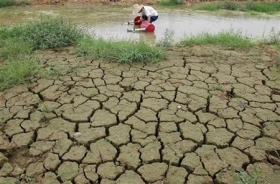
BEIJING (Reuters) - Large areas of south China are suffering from serious drought, with water levels on two major rivers in rice-growing provinces dropping to historic lows, state media said on Tuesday.

Rainfall since the beginning of October had dropped by 90 percent in Jiangxi and 86 percent in neighboring Hunan, the country's largest rice-growing province, from average figures, Xinhua news agency said.

Rice is a staple for most Chinese and a crop which needs a constant supply of water

The Gan and Xiang rivers running through the two provinces had seen their lowest water levels in history, Xinhua said. The shallow water has caused a jam of barges in some sections of the Gan.

Authorities had rushed to ensure drinking water supplies in big cities along the rivers and irrigation of fields by diverting water from reservoirs and installing pumps, Xinhua said.

Water levels on China's longest river, the Yangtze, and on the Pearl River in the southern province of Guangdong had also dropped, Xinhua said.

Drought and floods are perennial problems in China where meteorologists have complained about the increased extreme weather, partly blaming it on climate change.

More than 1,100 Chinese were killed during summer floods this year.

But some parts of the south were hit by weeks of scorching heat and drought in the summer, when as much as a third of farmland was damaged and millions of people were short of drinking water.

It was not immediately clear how much damage had been caused to the rice crop.

The China National Grain and Oils Information Centre early this month estimated rice production this year would rise by 2 percent to 186.5 million tons.

(Reporting by Guo Shipeng and Niu Shuping, editing by Nick Macfie)

Brittish PM outlines climate action plan

Gordon Brown
Mr Brown said there were hard choices ahead

Prime Minister Gordon Brown has said there will be a "green hotline" to advise people on what they can do to cut their impact on the environment.

Mr Brown, who said the UK's emission target of a 60% cut by 2050 could be increased to 80%, said he would also seek the end of one-use plastic bags.

He committed Britain to meeting EU targets on boosting renewable energy.

There would be "hard choices and tough decisions" but he said a new low carbon economy could bring thousands of jobs.

The new Green Homes Service - a telephone line, website and advice centres - aims to provide a single point of contact for people who want a "home energy audit".

Home energy

It will also give advice on saving water, reducing waste and other ways to be more environmentally friendly.

Mr Brown said that in 50 of Britain's poorest areas homes would be offered energy efficiency deals, and for those selling or buying energy wasting homes it would offer discounted help.

While the richest countries have caused climate change it is the poorest who are already suffering its effects
Gordon Brown

He said it represented "the biggest improvement in home energy efficiency in our history", with a third of households offered help over the next three years to reduce their emissions.

In his wide-ranging speech, the prime minister said climate change had been the product of many generations, but "overcoming it must be the great project of this generation".

Emissions cap

Mr Brown said: "I believe it will require no less than a fourth technological revolution. In the past the steam engine, the internal combustion engine, the microprocessor transformed not just technology but the way our society has been organised and the way people live.

"Now we're about to embark on a comparable technological transformation to low carbon energy and energy efficiency and this represents an immense challenge to Britain, but it is also an opportunity."

Chimneys billowing smoke
High targets have been set for Britain's cut in emissions

Mr Brown said he wanted Britain to become a "world leader" in building a low carbon economy, which could lead to thousands of new British businesses, hundreds of thousands of new jobs and a "vast export market".

And the prime minister also said he wanted to work with countries like the US and Japan to establish a new "funding framework", to help developing countries adjust to low carbon growth, adapt to climate change and tackle deforestation.

"While the richest countries have caused climate change it is the poorest who are already suffering its effects," Mr Brown said.

Renewable targets

Britain was "absolutely committed to meeting our share" of the EU's 2020 renewable energy target, he said.

It could mean the UK will have to produce between 40 and 50% of its electricity from renewable sources by 2020 - the current figure is about 5%.

BBC environment analyst Roger Harrabin said this would be "staggering", but he said that the government was seeking to negotiate down the EU target.

Until Gordon Brown learns that tough action is needed to back up his warm words, he cannot be the change the country needs
Peter Ainsworth
Conservative Party

Mr Brown said the Climate Change Bill put a "statutory cap" on Britain's carbon emissions - with five year "carbon budgets" to give certainty for businesses and investors.

And he said he wanted the post-2012 agreement, to be discussed at a climate change summit in Bali in December, to include "binding emissions caps" for all developed countries.

The Climate Change Bill would ensure Britain met its target of a 60% reduction in emissions by 2050.

Plastic bags

But he said new evidence suggested developed countries may have to reduce emissions by up to 80% - and he would ask the committee on climate change "to advise us, as it begins to consider the first three five-year budgets, on whether our own domestic target should be tightened up to 80%".

Mr Brown also said the government would convene a forum of supermarkets, the British Retail Consortium and others to look at how to reduce plastic bags to cut landfill waste.

"I am convinced that we can eliminate single-use disposable bags altogether, in favour of long-lasting and more sustainable alternatives," he said.

The government blithely talks of the opportunities created by green industries yet refuses to promote fledgling initiatives properly
Chris Huhne
Liberal Democrats

Shadow environment secretary Peter Ainsworth said Mr Brown's record on the environment consisted of "missing targets, then scrapping them, then cutting the budgets that deal with them".

"Just this weekend, we learnt of a further £300m of crippling cuts to key environmental services.

"Until Gordon Brown learns that tough action is needed to back up his warm words, he cannot be the change the country needs," he said.

Global deal

Liberal Democrat environment spokesman Chris Huhne said he wanted to see whether Mr Brown was prepared to meet promises on renewable energy without counting nuclear power.

And he added: "The government blithely talks of the opportunities created by green industries yet refuses to promote fledgling initiatives properly.

"Boasts of a new green home service seem shallow when recent cuts to the New Millennium Grants will dissuade many homeowners from installing energy saving measures in their homes."

United Nations Secretary General Ban Ki-moon has challenged governments to act on the findings of a major new report on climate change, saying real and affordable ways to deal with the problem existed.

The Intergovernmental Panel on Climate Change says climate change is "unequivocal" and may bring "abrupt and irreversible" impacts.

Climate change will be discussed at a forthcoming summit of Commonwealth leaders, just ahead of a UN meeting in Indonesia where a new global deal on emissions will be considered.

UN scientists urge carbon tax to fight global warming

· Temperatures may rise 6C by 2100, says panel
· Report marks effort to find post-Kyoto consensus

Graphic: How the earth will heat up by 2099 (pdf)

All sources of carbon pollution - from flights to inefficient light bulbs - must become more expensive if the world is to tackle global warming, an influential panel of scientists and government officials will say today.

Putting a price on harmful emissions from goods and services would require a fundamental shift in the world's economy, but "could realise significant mitigation potential in all sectors" according to a report from the UN's Intergovernmental Panel on Climate Change (IPCC).

The report will be launched today in Valencia by Ban Ki-moon, the UN secretary general, and marks the start of an international effort to agree a worldwide treaty to regulate greenhouse gas output.

The IPCC, which won this year's Nobel peace prize jointly with Al Gore, will confirm it is 90% sure that recent global warming is down to human activity, and warn that the impact of future temperature rise will be severe. It will say action to cut emissions is needed in the coming decades to stop global temperatures rising by as much as 6C by 2100, and that most of the technology needed already exists. Even deep cuts in carbon production would have only a marginal effect on economic growth, the IPCC will say.

Today's report comes two weeks before a UN meeting on climate in Bali, when countries will try to map out the timescale and structure of an agreement to replace the Kyoto protocol, the existing treaty which regulates greenhouse gases, when it expires in 2012. Analysts say the post-Kyoto deal needs to be finalised by 2009 for it to start in time.

Today's report combines and summarises three other papers from the IPCC earlier this year, which discussed the science of global warming, its likely impact, and possible ways to tackle the problem. Scientists and officials were still working yesterday on the final wording of the document. "This report is the blueprint for Bali and every country wants their own position represented. They know ... they can't ignore what it says," said one source close to the process.

The IPCC does not recommend specific policies, but a draft summary obtained by the Guardian highlights the introduction of an "effective carbon price signal". It says a carbon price of between $20-$80 (£10-£40) per tonne by 2030 should be enough to limit the expected temperature rise. How such a worldwide price could be introduced will be one focus of the Bali talks. Europe favours cap-and-trade systems, which place a mandatory limit on pollution from countries, companies and even individuals, who must buy the right to pollute more.

Despite reports that the US delegation was unhappy with the report, one of the senior authors told the Guardian yesterday there had been few serious disagreements. The draft report also restores the phrase "dangerous anthropogenic interference with the climate system" which was removed from the key summary chapters of the IPCC reports earlier this year after US protests.

Main points

A draft of today's synthesis report from the UN Intergovernmental Panel on Climate Change presents the challenge in five key areas.

Observed changes Warming of the system is visible in increases in air and sea temperatures, melting snow and ice, and rising sea levels. All regions are getting hotter. The extent of Arctic sea ice is shrinking by 2.7% a decade. More areas are affected by drought.

Causes of change Human greenhouse gas emissions grew by 70% from 1970 to 2004. Carbon dioxide output rose by 80%. Carbon dioxide in the atmosphere is highest for 650,000 years.

Projected change Greenhouse gas emissions are projected to almost double by 2030. Depending on emissions, temperatures to 2100 could increase by 1.1C to 6.4C. With no policies to curb pollution, the most likely increase is 4C. Sea levels could rise 0.18m to 0.59m by 2100. Heatwaves and hurricane strength will increase. Hundreds of millions more will suffer water shortages, up to 30% of species will risk extinction and food production will be hit.

Adaptation and mitigation options There are lots of cost-effective ways to mitigate greenhouse gas emissions using existing technology. An effective carbon price signal from governments could bring significant emission cuts across all sectors.

Monday, November 19, 2007

Bangladesh cyclone death toll passes 3,000

In pictures: Bangladesh assesses cyclone damage

Randeep Ramesh, South Asia correspondent, Owen Bowcott, Haroon Siddique and agencies
Monday November 19, 2007
Guardian Unlimited
Aid poured into Bangladesh today as the death toll from Cyclone Sidr spiralled above 3,000, with fears that thousands more bodies have yet to be found.

The government rapidly deployed naval and military helicopters as rescue workers made their way to outlying areas where entire villages are believed to have been flattened.

Sorties were being flown to the devastated areas, dropping food, drinking water and medicine for the survivors, but they were limited as to where they could land.

The official death toll reached 3,113 today, with 3,322 injured and 1,063 missing, according to Lieutenant Colonel Main Ullah Chowdhury.

However, a government "early warning programme" had saved a vast number of lives, the UN resident coordinator, Renata Dessallien, said. About 1.5 million people on the coast were able to flee to shelters.

Unicef said the cyclone had affected 3.2 million people.

"We are trying to reach all the affected areas on the vast coastline as soon as possible, when we will know how many people exactly have died in the devastation," one government official said.

The UN said it was making available $7m (£3.4m) from its central emergency fund, and the World Food Programme (WFP) was rushing in aid. Britain announced a £2.5m relief package last night, and Washington said two ships would deliver 35 tonnes of non-food aid. The Dhaka foreign ministry said King Saud of Saudi Arabia had announced a $100m grant for the victims and Riyadh would airlift 300 tonnes of food and relief materials.

International aid organisations promised initial packages of $25m in total during a meeting with Bangladesh agencies today, said Emamul Haque, from the Dhaka office of the WFP, which is coordinating international relief efforts.

During his Sunday blessing from the Vatican, Pope Benedict XVI called for "every possible effort to help our brothers who have been so sorely tested".

Cyclone Sidr, which produced winds of 150mph, demolished houses, crops, trees and shrimp farms. Disaster officials put the number of homes destroyed at more than 750,000. Although the main port, Chittagong, was back in operation yesterday, many ships were still missing.

Suman Sengupta, the director of Save the Children in Bangladesh, said he feared the final death toll could be as high as 10,000 to 15,000.

His assessment was based on the widespread extent of disruption caused by floods that have cut off many areas of the country, creating isolated islands.

"A lot of fishermen are not yet accounted for," a London-based spokeswoman for the charity added. "At this stage we simply don't know how many people have been killed. We expect that when communications improve and these isolated areas are contacted, the death toll will rise. It's such a vast area where the roads have been destroyed."

The Bangladesh Red Crescent agreed that thousands more may have died. "Based on our experience in the past, and reports from the scene, the death toll may be as high as 10,000," its chairman, Muhammad Abdur Rob, told Reuters.

"We have seen more bodies floating in the sea," a fisherman, Zakir Hossain, from the south-west of the country, told the Associated Press after reaching shore with two decomposing bodies he and other fishermen had picked up.

In many areas mass graves have been created and grieving families have been begging for clothes to wrap around the bodies for burial.

Aid agencies also warned that floods in the summer had ruined one harvest and the havoc wreaked by the cyclone would compound the country's food situation. It is estimated that at least half the coastal crop was destroyed in a matter of hours.

Another fear was that many areas would be cut off for days. Oxfam said its teams took one and a half days to reach towns that were normally just five hours' drive from the capital, Dhaka.

Heather Blackwell, the head of Oxfam in Bangladesh, said: "There are many villages in remote areas, including on sandbank islands, that are yet to be reached. It could take weeks before we know how bad this cyclone was."

Impoverished, low-lying Bangladesh is battered by cyclones and floods every year. In 1991, more than 130,000 people died in a storm of similar size and strength.

Japan urged to recall whaling fleet

Japan urged to recall whaling fleet


· Humpbacks hunted for first time since 1963
· 'Scientific' hunting claims disputed
· Campaigners accuse fleet of underhand tactics


Justin McCurry in Tokyo
Monday November 19, 2007
Guardian Unlimited


A humpback whale
A humpback whale takes a dive. Photograph: Ormuzd Alves/AP


New Zealand and Australia today called for a Japanese whaling fleet to return to port a day after it set off for the southern ocean whale sanctuary vowing to slaughter more than 1,000 whales.

Among the targets of the hunt, which is being carried out in the name of scientific research, are 50 protected humpbacks.

The demand follows international protest at the fleet's departure yesterday. Britain is one of several other countries to have condemned the expedition, which will see humpbacks killed for the first time since they became a protected species more than 40 years ago.

Helen Clark, the New Zealand prime minister, said the fleet should have stayed at home, and condemned the expedition as commercial whaling in the guise of scientific research.

In a TV interview, Clark said she hoped there would be no repeat of last year's clashes between the whalers and protesters, and indicated that New Zealand was not in a position to assist the Japanese fleet. "It is very difficult for us, as the nearest country with any sort of search and rescue capacity, to offer any help," she said.

"Of course, we don't like the Japanese whaling fleet being down there at all. It would just be better if the Japanese stayed home and didn't come down under the guise, the deception, the claim, that it is scientific whaling when they want to take 1,000 whales."

Under the 1986 International Whaling Commission's ban on commercial whaling, Japan is allowed to hunt whales for scientific research.

Japan says such research is vital to understanding the size of whale populations, the age and reproductive status of the creatures and the effects of environmental damage, but critics denounce it as commercial whaling in disguise. Most of the meat from the scientific hunts is sold to markets and restaurants, and the profits are used to fund future expeditions.

Japan has killed almost 10,500 whales, mainly minkes and Brydes, since the commercial ban was introduced. This year, the fleet expects to catch 835 minke whales and 50 endangered fin whales in its biggest scientific expedition yet. But most international anger is directed at plans to kill humpback whales for the first time since the species was protected in 1963.

Having dwindled to just 1,200 in the 1960s, the humpback population now stands at between 30,000 and 40,000, according to the American Cetacean Society. The species is listed as vulnerable by the World Conservation Union.

Known for their size, complex songs and athleticism, humpbacks are a favourite among the estimated 1.5 million whale-watchers, who watch them make their way along the Australian coast every year.

Alex Dower, the Australian foreign minister, said he was "deeply disappointed" with Japan's decision to go ahead with the hunt.

"The government again appeals to Japan to reconsider its position on this inhumane practice, which is also opposed by the majority of nations," he said.

Robert McClelland, foreign affairs spokesman for the opposition Labour party, suggested the Australian military could be dispatched to track the whalers if, as the polls indicate, Labour takes power in elections this weekend.

"We really need to rattle a cage here," he said. "It's unacceptable that it's not only going on but getting worse."

Britain is also considering making a "high-level diplomatic protest" to Japan, according to the Department for Environment, Food and Rural Affairs.

Anti-whaling campaigners today accused the fleet of using underhand tactics after the vessels, led by the factory ship the Nisshin Maru, left port following a send-off from a brass band and flag-waving supporters.

Greenpeace said it had yet to locate the whaling vessels, which had sailed into international waters under cover of darkness after switching off their automated identification system, preventing other vessels from learning their location.

"They are operating by stealth, and we see that as a demonstration that that they don't want to be seen for what they are," Dave Walsh, a Greenpeace spokesman, told the Guardian from aboard the group's ship the Esperanza. "But we're confident we'll find them."

Walsh said the group would attempt to frustrate the whalers by positioning themselves between the whales and whalers and creating "walls" of water to bock the harpoonists' view of their prey.

"But we are also stepping up our campaign in Japan, because change will start there, not in the southern ocean," he added.

Greenpeace is understood to be seeking legal advice after Japanese officials repeatedly denounced it and other campaigners as terrorists.

In a speech at the weekend, the hunt's leader, Hajime Ishikawa, said: "They are violent environmental terrorists. Their violence is unforgivable ... We must fight against their hypocrisy and lies."

Last year's expedition was marred by clashes on the high seas between the whalers and the Sea Shepherd Conservation Society, which favours direct action.

The hunt was abandoned in February after the Nisshin Maru caught fire, killing a crewman. The current expedition is expected to end in April.

Sunday, November 18, 2007

Destination of 'recycled' electronics may surprise you

CNN
SAN FRANCISCO, California (AP)
-- Most Americans think they're helping the earth when they recycle their old computers, televisions and cell phones. But chances are they're contributing to a global trade in electronic trash that endangers workers and pollutes the environment overseas.
art.electronics.ap.jpg

Discarded electronics pile up at a recycling event Thursday in Bloomington, Minnesota.

While there are no precise figures, activists estimate that 50 to 80 percent of the 300,000 to 400,000 tons of electronics collected for recycling in the U.S. each year ends up overseas. Workers in countries such as China, India and Nigeria then use hammers, gas burners and their bare hands to extract metals, glass and other recyclables, exposing themselves and the environment to a cocktail of toxic chemicals.

"It is being recycled, but it's being recycled in the most horrific way you can imagine," said Jim Puckett of the Basel Action Network, the Seattle-based environmental group that tipped off Hong Kong authorities. "We're preserving our own environment, but contaminating the rest of the world."

The gear most likely to be shipped abroad is collected at free recycling drives, often held each April around Earth Day, recycling industry officials say. The sponsors -- chiefly companies, schools, cities and counties -- often hire the cheapest firms and do not ask enough questions about what becomes of the discarded equipment, the officials say.

Many so-called recyclers simply sell the working units and components, then give or sell the remaining scrap to export brokers.

"There are a lot of people getting away with exporting e-waste," said John Bekiaris, chief executive of San Francisco-based HMR USA Inc., which collects and disposes of unwanted IT equipment from Bay Area businesses. "Anyone who's disposing of their computer equipment really needs to do a thorough inspection of the vendors they use."

Don't Miss

The problem could get worse. Most of the 2 million tons of old electronics discarded annually by Americans goes to U.S. landfills, according to U.S. Environmental Protection Agency data. But a growing number of states are banning such waste from landfills, which could drive more waste into the recycling stream and fuel exports, activists say.

Many brokers claim they are simply exporting used equipment for reuse in poor countries. That's what happened in September, when customs officials in Hong Kong were tipped off by environmentalists and intercepted two freight containers. They cracked the containers open and found hundreds of old computer monitors and televisions discarded by Americans thousands of miles away.

China bans the import of electronic waste, so the containers were sent back to the U.S.

The company that shipped out the containers was Fortune Sky USA, a Cordova, Tennessee-based subsidiary of a Chinese company. General manager Vincent Yu said his company thought it was buying and shipping used computers, not old monitors and televisions, and is trying to get its money back.

Fortune Sky exports used computers and components to China, Malaysia, Vietnam and other Asian countries.

"There's a huge market over there for secondhand computers that we don't use anymore," Yu said. "I don't think it's going to cause any pollution. If the equipment can still be used, then that's good for everybody."

Discarded electronics

  • Most of the 2 million tons of annual discarded U.S. electronics ends up in landfills, says EPA.
  • 50 to 80 percent of the 300,000 to 400,000 tons of U.S. electronics annually gathered for recycling ends up overseas, activists estimate.
  • Hong Kong returned 85 shipping containers of electronic junk, including 20 from the United States.
  • Eight states have passed laws requiring manufacturers to take back and recycle their old electronics.
  • U.S. bars export of monitors and televisions with cathode-ray tubes without permission from the importing country, but federal authorities don't have the resources to check most containers.
  • Yu refused to say where he bought the material, but Basel Action Network tracked it to a San Antonio, Texas, company that collects computers, printers and other electronics from schools and businesses.

    Activists complain that most exporters don't test units to make sure they work before sending them overseas.

    "Reuse is the new excuse. It's the new passport to export," said Puckett of Basel Action Network. "Other countries are facing this glut of exported used equipment under the pretext that it's all going to be reused."

    At the other end at customs, the goods don't always get checked either.

    "It is impossible to stop and check every single container imported into Hong Kong," said Kenneth Chan of Hong Kong's Environmental Protection Department. "Smugglers may also deliberately declare their ... waste as goods."

    In the first nine months of this year, Hong Kong authorities returned 85 containers of electronic junk, including 20 from the U.S.

    Exporting most electronic waste isn't illegal in the United States. The U.S. does bar the export of monitors and televisions with cathode-ray tubes without permission from the importing country, but federal authorities don't have the resources to check most containers.

    The EPA recognizes the problem but doesn't believe that stopping exports is the solution, said Matt Hale, who heads the agency's office of solid waste. Since most electronics are manufactured abroad, it makes sense to recycle them abroad, Hale said.

    "What we need to do is work internationally to upgrade the standards (for recycling) wherever it takes place," he said.

    The EPA is working with environmental groups, recyclers and electronics manufacturers to develop a system to certify companies that recycle electronics responsibly. But so far the various players have not agreed on standards and enforcement.

    Many activists believe the answer lies in requiring electronics makers to take back and recycle their own products. Such laws would encourage manufacturers to make products that are easier to recycle and contain fewer dangerous chemicals, they say.

    Eight states, including five this year, have passed such laws, and companies such as Apple, Dell, Hewlett-Packard and Sony now take back their products at no charge. Some require consumers to mail in their old gear, while others have drop-off centers. HP says it also now designs its equipment with fewer toxic materials and has made it easier to recycle

    Australians named as world's worst polluters

    Australians named as world's worst polluters

    · Countries ranked by power station output
    · Americans in second place and Britons come ninth

    Australians are the world's worst individual greenhouse gas polluters if emissions are calculated from the output of the country's power stations, according to new analysis.

    Each Australian produces nearly 11 tonnes of CO2 power sector emissions, the United States follows on nine tonnes per person, while Britain is ranked ninth at 3.5 tonnes and China - heavily criticised by the international community for its rapid development of coal-fired power stations - produces only two tonnes a year per person. Indians emit about half a tonne of CO2 per person.

    The data was compiled by the Centre for Global Development, a Washington-based thinktank. It found that the US had nearly one in six of the world's power stations, and emitted nearly 25% of the world's total CO2 emissions.

    The analysis is embarrassing for the Australian government, which is fighting a general election on November 24. Climate change has been high on the election agenda after the conservative prime minister, John Howard, behind in the polls, consistently refused to sign the Kyoto climate pact. He has argued it would harm Australia's economy, which relies for most of its power on old coal-fired stations.

    One surprise in the data, said the report, was that the world's biggest emitters of CO2 in absolute terms are no longer in the rich world but in rapidly emerging economies with enormous coal-fired plants. Five of the world's most polluting companies are in China and three in the US.

    "High US emissions are partly the result of high living standards but they also reflect differences in government policy. Europeans with comparable living standards emit less than half the power sector CO2 of the average American," said Nancy Birdsall, one of the report's authors.

    Power stations are the most concentrated source of greenhouse gases. The report found that the world's worst is Taichung in the Taiwanese city of Lung-Ching, which emits 41.3m tonnes of CO2 per year. By comparison, the Drax power station in Selby, North Yorkshire, which was named as the biggest UK polluter producing 23.7m tonnes of CO2, is a relative minnow, the world's 23rd worst.

    The US produces 2.79bn tonnes a year and China slightly less with 2.7bn. They are followed by Russia with 661m tonnes; India 583m tonnes; Japan 400m tonnes; Germany 356m tonnes; Australia 226m tonnes; South Africa 222m tonnes; the UK with 212m tonnes and South Korea with 185m tonnes.

    We behave as if there is no penalty for our luxurious consumption

    We behave as if there is no penalty for our luxurious consumption

    Climate scientists are warned to avoid words like 'disaster' - they lead to apathy and fatalism

    In 1784, Robert Burns described a disturbing local phenomenon in a letter to a friend. A band of religious fanatics were roaming the countryside of south west Scotland, led by a woman who gave people the spirit of the Holy Ghost by breathing on them "which she does with postures & practices that are scandalously indecent." Their tenets, Burns wrote, were "a strange jumble of enthusiastic jargon" and their behaviour offensive enough to have them run out of several towns. Men and women "lodge and lye all together" and believed they could commit no moral sin. All in all, it was to Burns "one of the many instances of the folly in leaving the guidance of sound reason, & common sense in matters of religion."

    These were the Buchanites, an obscure branch of Scottish theological history that died with its last adherent in the 1840s. Their leader, Elspeth 'Lucky' Buchan, had abandoned husband and children to become a religious voluptuary who imagined herself to be "the Woman Clothed with the Sun" in the prophecies of Revelations. As the end of the world was nigh, there was no point in celibacy or marriage and children. Infanticide and unusual degrees of sexual liberty were rumoured. Then, after more than three years of prophecy and rough sleeping, the Buchanites threw away what valuables they possessed (watches, rings, shoes) and obeyed Mrs Buchan's instruction to climb Templand Hill in Dumfries-shire. There, in July, 1786, they built a platform and stood singing and wailing on it to await their transfer to heaven.

    A storm blew up. The platform collapsed. The disconsolate Buchanites tramped downhill through the mud. There was amusement from the watching crowd. Lucky Buchan never recovered from the ignominy and died five years later, when her remaining followers buried her in feathers so she would be in good condition for her resurrection, which was expected to be soon.

    Consider the Buchanites on the hill that day in the summer of 1786, looking up to what they hoped would be the face of God. What was the proportion of carbon dioxide in the atmosphere up there beyond the clouds? Probably not much more than 280 parts per million (ppm), the figure we now judge to be its pre-industrial level, which in the records of climatology ended in 1750. But even in 1786 it was changing, thanks primarily to one of Buchan's fellow Scots. James Watt's improved steam engines were already draining mines of water and blowing iron furnaces and soon their rotary motion would be powering textile, corn and paper mills, breweries and distilleries. As Buchan roamed around Scotland she might see a pillar of smoke from a lonely coal pit, not realizing (as nobody else did for the next two hundred years) that its carbon particles contained a different prescription for the world's end to that in Revelations.

    According to the Intergovernmental Panel on Climate Change (IPCC), the level of carbon dioxide in the atmosphere was 379ppm in 2005 and rising at just under 2ppm annually. Add methane and nitrous oxide, and the current total of greenhouse gases expressed as carbon dioxide equivalents, stands at 459ppm. The European Union's ambition is to halt growth at 550ppm of carbon dioxide, and greenhouse gases in total at 666ppm. Even if this target proves achievable, it offers no hope that the world will stay much the same. "Dangerous" climate change is reckoned to be a rise in the global average temperature of more than 2C; the Stern Report says that a rise of 3C is more likely than not when greenhouse gases reach 650ppm.

    The latest IPPC predictions are no more cheerful. No matter what we do to stabilize emissions in future, "anthropogenic warming and sea level rise would continue for centuries due to the time scales associated with climate processes and feedbacks." We can mitigate future consequences by cutting the growth in emissions and adapt to them by building sea walls, but about some things we can do nothing. During the rest of this century, coral will continue to bleach and species to die, there will be more droughts and wildfires, glaciers will melt, the Arctic will shed much more ice, coast will crumble. Sub-Saharan Africa, the big Asian deltas, low-lying islands: these are not places you would want to be. If the Greenland ice sheet disappears entirely - which at present rates of shrinkage is likely - then seas already swollen thermally could rise by another seven metres and the world would assume the shape of the inter-glacial epoch 125,000 years ago.

    We should be frightened. Perhaps we are. But fear finds odd expression. The popularity of Cormac McCarthy's doomsday novel, The Road, may be a symptom of fear as entertainment, the make-believe of the story strengthened in our heads by the knowledge that, yes, it may well end like this. Elsewhere, there is what Leo Hickman warned against in the Guardian this week: "eco-fatigue". He quoted Professor Mike Hulme, formerly director of the Tyndall Centre for Climate Change Research, who told scientists and the media to steer clear of hyperbole - words such as "disaster", "apocalypse", "catastrophe" - when they were describing climate change predictions because it led to apathy and fatalism. Also, and never to be underestimated in a society that always demands new fashions, there is gathering irritation with the consumers of "green lifestyle choices" and their apparent belief that by driving to farmers' markets to buy organic carrots they have done their bit.

    Mainly, we do nothing. No, worse than that, we behave as though there is no tomorrow, no penalty attached to our luxurious consumption, as thought the world's resources were infinite. London shops may ban free carrier bags, but the bar at Claridge's has introduced a specialism in bottled water: thirty expensive brands of it, with Berg from melted icebergs in Newfoundland selling at £30 a litre. What are we, the well off, prepared to renounce? Bottled water, air travel, cars, wage rises, profits, house price increases, central heating? The answer seems to be none of these things. In the last century the king of renunciation, the great advocate of restricting want, was MK Gandhi, who is the kind of figure that the struggle against climate change badly needs (unlike Al Gore, he practised what he preached). But it should be noticed that his followers tended to adopt the easier of his injunctions: chucking western clothes on to a bonfire was one thing, cleaning one's own latrine another.

    I suppose we are in that state called denial, though that word suggests a refusal to acknowledge what Hulme wants us to stop calling a looming catastrophe. But a catastrophe is what it is, and our behaviour may be a reaction to that knowledge rather an avoidance of it; we may, in fact, be full and overflowing with acknowledgment. Future historians, should they exist, will surely look back on our time and see in its manic excesses the evidence of a society gathering its rosebuds while it may. At a conference on climate change last year I heard someone say that the fear of global warming was like the fear of death: always there but impossible to dwell on.

    Lucky Buchan and her followers were very certain of heaven. That is their distance from the rest of us, then and now. In other ways, however, so many of us are Buchanites. We sense an inevitable apocalypse, live accordingly, and hope that our grandchildren have a high hill to live on, somewhere relatively wet and unpeopled like Scotland, and have learned to use a gun.

    U.N. panel releases comprehensive research on global warming

    If the nations of the world continue to pump tons of carbon dioxide into the atmosphere from smokestacks and tailpipes, the world will suffer catastrophic droughts and heat waves and rising seas that could kill millions of people, according to the most exhaustive work ever done on planetary climate change.

    The arid and semi-arid lands, including the western United States, would be hit by runaway wildfires, have less drinking water from shrinking snowpacks, and face unpredictable ocean conditions that would upset the feeding cycles of krill, fish and other sea life.

    But if the United States and China, the two top greenhouse gas producers, work with other countries to improve energy efficiency and invest in alternative technologies, the worst effects of global warming could be forestalled on Earth, according to a Nobel Peace Prize-winning U.N. science panel that released its final report Saturday.

    The Intergovernmental Panel on Climate Change, a group of 2,000 scientists from 140 countries, has over the past several months been releasing volumes of its work on global warming. The report released Saturday is the synthesis of that work, a six-year endeavor to measure most of what is known about global warming and its effects on human health, the oceans, wildlife and how the world might adapt, among other topics. The first of the five-year assessments came out in 1990 and was used as the basis for the U.N. Framework Convention on Climate Change.

    The summary report released Saturday is geared toward policymakers who will meet in Bali, Indonesia, next month to begin forging a treaty to replace the Kyoto Protocol, which expires in 2012.

    Since 1970, global greenhouse gas emissions have grown by 70 percent, and are causing global warming, according to the report.

    Maintaining today's rate of emissions from power plants, factories, vehicles and other sources could raise global temperatures 10 degrees by the end of the century. That would mean the extinction of more than half of the world's plant and animal species, creation of super-intensive hurricanes and melting of glaciers, according to the panel.

    To limit the increase in global temperatures to 4 degrees - which would limit sea level rise to between 15 and 55 inches over the century - the world needs to cut emissions by 50 to 85 percent by 2050, the panel said. That reduction is close to what California law requires.

    Over the past century, global temperatures rose 1 to 2 degrees, and the global average for sea level rise was 6 inches.

    Some of the effects of global warming, such as melting land and sea ice, intense hurricanes and an increase in wildfires, are happening now and can occur with greater intensity as temperatures rise even a few degrees, the scientists said.

    That should send a strong, clear message to policymakers around the globe, said climatologist Stephen Schneider, co-director of Stanford University's Center for Environmental Sciences and Policy. He was returning to the Bay Area on Saturday from the five-day panel sessions in Spain.

    "The warming of the 20th century is unequivocal," Schneider said.

    "The warming in the last 40 to 50 years is very likely due to human activities, mostly from our smokestacks and tailpipe waste and deforestation activities, which have increased carbon dioxide by 35 percent" since the Industrial Revolution, he said. "Although some risks are already unavoidable, there is still time to reduce the likelihood of really catastrophic impacts like melting ice sheets and massive species extinction."

    Possible solutions include enlisting private industry to develop alternative technologies that are less emitting, according to the report. Government officials also could use tax incentives and subsidies, levy a tax on companies or people who emit greenhouse gases, or develop market-based systems in which people pay extra for the right to emit more greenhouse gases than otherwise allowed, the summary report said.

    Despite the exhaustive work by the U.N. panel, much is still not known, the scientists said.

    For example, it is not clear whether the planet is more likely to be 2 to 3 degrees or 10 degrees warmer by the end of the century. Other unknowns are the amount of sea level rise and how precipitation will be affected in different parts of the world.

    The Carnegie Institution at Stanford University compared cities' annual average temperatures to get a feel for what a temperature increase would mean: Tucson is an average 10 degrees hotter than San Francisco, and Santa Barbara is, on average, 2.2 degrees warmer than San Francisco.

    Because a significant portion of carbon dioxide from industrial emissions will remain in the atmosphere for decades to centuries, "it's going to get warmer," said Jonathan Overpeck, professor of geosciences and director of the University of Arizona's Institute for the Study of Planet Earth. Overpeck was the coordinating lead author for a section of the U.N. report.

    "We're going to continue to see sea levels go up, to see a continued dwindling of mountain snowpack in the spring when we need it most, and a drying out of the semi-arid West. Water resources are likely to become more limited," Overpeck said.

    The summary emphasizes the uncertainty over sea level rise, he said.

    "It's clear that scientists couldn't define the upper end of sea level rise by the end of the century. The ice sheets in Greenland and Antarctica are changing very rapidly in ways we still don't understand," Overpeck said.

    Scientists expect a better estimate within the next five years. "An increasing number of scientists are saying we could have a meter or more by the end of the century" if the melting of glaciers in Greenland and other areas is considered, he said.

    Kevin Trenberth, head of the climate analysis section at the National Center for Atmospheric Research in Boulder and a coordinating lead author for part of the summary report, said the scientists also look for improvements in the way that they can predict ocean conditions or precipitation.

    Refining and improving predictions is crucial, he said, in helping policymakers make decisions regarding fisheries, forests, water and agriculture.

    Trenberth wasn't optimistic that policymakers would take the cautionary advice of the scientists and make deep cuts in emissions.

    The United States leads in per capita emissions but has not actively participated in scientific assessments to pull together all that is known about global warming. In some cases, the U.S. government has at times sought to block such science, Trenberth said.

    "The U.S. needs to play a substantial leadership role in Bali, and I just don't see that happening with this administration. If they do, I think other countries will be more inclined to follow. China and India are not going to lead in this," Trenberth said.

    "The U.S. has the responsibility to lead but has not been doing so in recent years, in my view."

    Online resources

    Read the report:

    www.ipcc.ch

    Key findings

    Some important findings from

    the U.N. Intergovernmental Panel on Climate Change:

    -- Global warming is unequivocal. Temperatures have risen 1.3 degrees in the last 100 years. Eleven of the past 12 years are among the warmest since 1850. Sea levels have gone up by an average 0.07 of an inch per year since 1961.

    -- About 20 to 30 percent of all plant and animal species face the risk of extinction if temperatures increase by 2.7 degrees . If the thermometer rises by 6.3 degrees, between 40 and 70 percent of species could disappear.

    -- Human activity is largely responsible for warming. Global emissions of greenhouse gases grew 70 percent from 1970 to 2004. The concentration of carbon dioxide in the atmosphere is much higher than the natural range over the past 650,000 years.

    -- Climate change will affect poor countries most, but will be felt everywhere. By 2020, 75 million to 250 million people in Africa will suffer water shortages, residents of Asia's large cities will be at great risk of river and coastal flooding, Europeans can expect extensive species loss, and North Americans will experience longer and hotter heat waves and greater competition for water.

    Source: Associated Press

    Oil leaders' private debate televised by mistake

    Tim Webb in Riyadh
    The Observer

    'Kill the cable, kill the cable,' shouted the security guard as he burst through the double doors into the media room at the Intercontinental Hotel in Riyadh, followed by Saudi police. It was too late.

    A private meeting of Opec leaders, gathered this weekend in Riyadh for the cartel's third meeting in its 47-year history, had just been broadcast to the world's media for more than half an hour after a technician had mistakenly plugged the TV feed into the wrong socket. The facade of unity that the cartel so carefully cultivates to a world spooked by soaring oil prices was shattered.

    Sometimes, such innocent mistakes can have far-reaching economic and political consequences. Commodity and currency traders said this weekend that oil prices would surge again tomorrow - possibly breaking the $101 per barrel record set in the late 1970s - while the already battered dollar would fall further on the back of the unintentional broadcast.

    On Friday night, during what the participants thought were private talks, Venezuela's oil minister Venezuela Rafael Ramirez and his Iranian counterpart Gholamhossein Nozari, argued that pricing - and selling - oil using the crippled dollar was damaging the cartel.

    They said Opec should formally express its concern about the weakness of the dollar when the cartel makes its official declaration at the close of the summit today. But the Saudis, the world's largest oil producers and de facto head of Opec, vetoed the proposal. Saud al-Faisal, the Saudi foreign minister, warned that even the mere mention to journalists of the fact that leaders were discussing the weak dollar would cause the US currency to plummet.

    Unfortunately his words and those of everyone at the meeting were being broadcast via a live television feed to a group of astonished reporters. 'I couldn't believe it,' said one who was there. 'When I realised they didn't know they were being broadcast live, I frantically started taking notes.'

    Opec only realised that the leaders' row was being broadcast to the world when the Reuters news agency put out a report of the argument.

    The weakness of the dollar is one reason why oil prices are so high, as cartel members seek to compensate for their lower earnings. This means a further drop in the dollar is likely to be accompanied by a rise in oil prices.

    Friday, November 16, 2007

    Coal Creates Legacy for China’s Past, Future

    From: Julia Tier, Worldwatch Institute

    /pollution/article/25126

    Acid rain and air pollution, mainly from the burning of coal, have contributed to the degradation of more than 80 percent of China’s 33 designated World Heritage sites, according to the Associated Press. Across the nation, particulates from smokestacks have stained historic structures and statues black, including the 17-meter Leshan Giant Buddha, a sandstone landmark that has stood in Sichuan Province since the 7th century.

    But China’s rising energy demand isn’t just leaving its mark on the country’s heritage. Every 30 seconds, an infant with birth defects is born in China, according to Jiang Fan, deputy head of the country’s National Population and Family Planning Commission. The rate of birth defects nationwide has soared 40 percent in the past five years, from 105 defects per 10,000 births in 2001 to nearly 146 in 2006. The problem now affects nearly 1 in 10 Chinese families, the Commission stated in a recent report.

    Birth defect rates are highest in the northern province of Shanxi, an area that is also home to some of China’s richest coal resources. “The incidence of birth defects is related to environmental pollution,” An Huanxiao, director of Shanxi’s provincial family planning agency, told Xinhua News. “The survey’s statistics show that birth defects in Shanxi’s eight large coal-mining regions are far above the national average.”

    Currently, as much as 70 percent of China’s primary energy comes from coal, compared with less than 25 percent in the United States and Japan, according to the Worldwatch Institute, which just released a new report, Powering China’s Development: The Role of Renewable Energy. Coal is used to satisfy a wide range of domestic energy needs, including electric power and heating, and is the source of 80 percent of China’s electricity, the report notes. Coal also provides energy security to the nation, which has many decades of reserves, and is less expensive than other energy sources, write authors Eric Martinot and Li Junfeng.

    At the same time, China is pursuing a wide range of new energy options, including energy efficiency measures and the use of renewable resources like wind and solar power. China is likely to meet and even exceed targets to obtain 15 percent of its energy and 20 percent of its electricity from renewables by 2020, Worldwatch reports.

    Video

    "Manufactured Landscapes" SEE THIS BRILLIANT MOVIE! You'll never have the same shopping experience again.