Tuesday, October 16, 2007

California Seabird Decline on the Rise

From: the Center for Biological Diversity

Endangered Species Act Protection Sought for California's Ashy Storm-petrel, A Declining Seabird

SAN FRANCISCO, Calif. — The Center for Biological Diversity filed a scientific petition with the U.S. Fish and Wildlife Service October 15 to protect the ashy storm-petrel under the federal Endangered Species Act.

The ashy storm-petrel (Oceanodroma homochroa) is a small, smoke-gray seabird that nests and forages almost exclusively on the offshore islands and waters of California near San Francisco, Los Angeles, and San Diego. These waters are heavily impacted by development, including offshore energy terminals, shipping traffic, commercial fishing, and pollution, as well as by global warming. Faced with these multiple threats, the seabird has experienced sharp population declines in recent decades. The largest colony of ashy storm-petrels decreased by over 42 percent in 20 years, prompting the World Conservation Union and BirdLife International to list the species as endangered.

"The ashy storm-petrel is a barometer of the health of California's coastal waters," said Shaye Wolf, a biologist with the Center for Biological Diversity who has studied the ashy storm-petrel as well as the effects of ocean climate change on California's seabirds. "The declines we've observed in its numbers and breeding success are indicative of troubling changes we're seeing throughout the ocean off the West Coast."

The marine ecosystem off the California coast is changing due to global warming, resulting in warmer, less productive waters with less food available for seabirds like the ashy storm-petrel. Also, ocean acidification caused by the ocean's absorption of excess carbon dioxide may lead to declines in the storm-petrel's prey. Sea-level rise from global warming threatens to drown important breeding habitat for the bird in sea caves and on offshore rocks.

Our fossil-fuel demand is also spurring the proliferation of proposed offshore liquefied natural gas terminals off California's coast, which not only increase pollution but also add artificial lighting at night. "Artificial light attracts nocturnally active seabirds like the ashy storm-petrel like moths to a flame, and the effects can be devastating," said Wolf. Instead of going about their natural foraging and breeding activities, storm-petrels will continuously circle or collide with lighted structures at night, leading to exhaustion, injury, and even death.

The storm-petrel faces a variety of other threats at sea and on its island breeding colonies, including (1) the threat of oil spills near breeding and foraging hotspots that could decimate the population in one fell swoop; (2) ingestion of floating plastic pieces that can lead to starvation of adults and the chicks that are fed these plastics; (3) lower breeding success caused by eggshell thinning from persistent pollutants like DDT and PCBs that continue to affect southern California seabirds; and (4) depredation by introduced predators such as rats on the bird's island breeding sites.

"Protecting the ashy storm-petrel under the Endangered Species Act will not only provide critical protections to this unique seabird," noted Wolf, "but also enhance the health of California's coastal ecosystem as a whole."

The Amazon burns for biofuels


The restraint of the last few years is brought to an end by rising demand for crops the land could bear

Tom Phillips in Alta Floresta
The Guardian, UK


Burning rainforest in Para state, Brazil
Burning rainforest in Para state. Government satellites recorded more than 16,000 fires across Brazil in August, the overwhelming majority in the Amazon. Photograph: Daniel Beltra/Greenpeace


Veteran Amazon pilots such as Fernando Galvao Bezerra are hard men to shock. During 20 years in aviation Mr Bezerra, 45, has ferried prostitutes and wildcat miners to remote, lawless goldmines. He has taxied wealthy loggers between ranches, lost countless colleagues to malaria and once survived when his plane plummeted out of the sky.

But as his 10-seater Cessna banked over a vast expanse of burning rainforest in the state of Mato Grosso, the pilot, who now works for the environmental group Greenpeace, was virtually speechless. "Holy shit," he blurted over the plane's PA system, as the plane swung sharply to the right towards an image of destruction which owed more to a scene from Apocalypse Now than the Amazon rainforest. "Just look at the size of what this guy is burning."

It is burning season in Brazil, and across the Amazon region, where illegal loggers, cattle ranchers and a growing number of soy producers continue their advance into their world's largest tropical forest, similar scenes are taking place. In August government satellites registered 16,592 fires across Brazil, the overwhelming majority in the Amazon.

For environmentalists the fires are one of the first indications that deforestation is once again on the rise. Over the last two years fears for the future of the Amazon have been tempered by news of a reduction in deforestation. In August the Brazilian government heralded a 30% drop in rainforest destruction - the result, it said, of a government deforestation plan launched in March 2004. The plan outlined the creation of conservation units and 19 anti-deforestation units in deforestation hotspots such as Novo Progresso and Apui.

Great achievement

Marina Silva, Brazil's environment minister, claimed the drop was a clear indication that the Action Plan for Amazon Deforestation Prevention and Control was working. "It is a great achievement for Brazilian society," she said.

Many, however, believe the good news is about to run out.

Already there are signs that rainforest destruction is gathering speed. Deforestation in the states of Mato Grosso and Para is reportedly rising, with chainsaws and forest fires levelling thousands of hectares of pristine forest. Figures released last week by Brazil's space agency, INPE, show that between May and July of this year there was a 200% rise in deforestation in Mato Grosso.

Further north, in the Amazon state of Para, local ranchers and environmental activists claim a similar process is under way. Flying over the south-western corner of Para the tell-tale signs that logging continues at a staggering rate are everywhere: in the illegal dirt tracks that trail through the forest and the trucks that are dotted along them; in the charred trees that litter the landscape; and most strikingly in the newly deforested areas, which have turned the landscape into a messy patchwork of dark green and dull brown.

"It [the level of deforestation] is definitely going to rise," said Agamenon da Silva Menezes, the president of the Rural Workers Union in the Amazon town of Novo Progresso and one of the region's most powerful farmers.

"Lula [president of Brazil) says what he says because it is beneficial for him. But this year they have chopped down much more. What I am supposed to say to the guys [to stop them?]" added Mr Menezes.

Mr Menezes compared the illegal actions of the loggers to the American invasion of Iraq. If George Bush could attack a country out of financial interest, why could the loggers not do the same to the rainforest, he wondered.

"If you were stood next to your house and there was a mahogany tree next to you which would be worth R$5,000 (£1,360) if you chopped it down and your son was there crying out with hunger what would you do?"

Activists claim that the spike in deforestation is a sign that the government's action plan has been largely ineffective. They argue that the recent reductions owe more to external economic factors such as the market price of soy and beef.

With ranchers now looking to cash in on rising prices, Marcelo Marquesini, a former inspector for Ibama (Brazilian ministry of the environment's enforcement agency) who now works for Greenpeace, says the outlook for the rainforest is bleak. "Brazilian society has to celebrate the reduction of deforestation over these three years. It genuinely did fall," said Mr Marquesini, whose organisation will next month launch a report criticising the government's failure to control this notoriously lawless region.

But, he added, "everything now leads us to believe that deforestation is going to rise again".

On the frontline of the government's battle against deforestation are men such as Decio Luiz Motta, a fresh-faced 38-year-old environmental inspector from Rio de Janeiro who heads a six-man taskforce in the dusty frontier town of Novo Progresso. Sitting at a rickety wooden table in the unit's improvised HQ, Mr Motta said progress was being made, pointing to the apprehension of 13 lorries carrying illegal wood the previous day. "Just our being here reduces what is happening," he said.

"The infrastructure we have is much better, you have people who know how to use satellite imagery, GPS. It used to be much more about following your nose. The monitoring teams would see smoke coming from a certain area and head there to check it out. Now we are much better equipped for this work."

Yet the challenges facing such inspectors are clear. Mr Motta's team has just three cars to police a huge and remote area of rainforest, for example.

The collusion of local residents with the loggers also made tackling deforestation more difficult. Mr Motta claimed that after a recent seizure of illegal wood in the nearby town of Castelo dos Sonhos the local petrol stations began to boycott the government inspectors, putting their vehicles temporarily out of action.

The region's loggers meanwhile are adamant that as long as the government gives them no economically viable alternative to logging, the deforestation will continue. "It is a farce," said Mr Menezes. "How are you going to take an area that has been mine for 20 years and tell me it is a conservation unit all of a sudden?"

Zero deforestation

He described the idea that a policy of "zero deforestation" could be introduced as "the biggest load of rubbish I have ever heard". Mr Menezes asked: "Where is he [President Lula] going to get 30,000 soldiers from to police the insides of this whole forest?"

Three thousand feet over the burning forest Paulo Adario, the Amazon director of Greenpeace, let out a sigh of resignation. "It's like a scene from a world war," he said gazing down at the forest, which now more resembled the aftermath of a napalm bombing.

"It is forbidden to sell cocaine, it's illegal to deal marijuana and it's illegal to molest little children," Mr Adario added with mix of frustration and irony. "And, as you can see, it is also illegal to destroy the Amazon rainforest."


Monday, October 15, 2007

Riches in energy harvesting, farmers told

The Age, Melbourne, Australia

Farmers could be almost $3 billion a year richer if they invested in clean energy measures such as wind and carbon farming, according to a report by the nation's top science agency.

The Agriculture Alliance on Climate Change (AACC) commissioned the CSIRO to examine opportunities to provide fuel, as well as greenhouse-friendly food, to the national economy.

Farmers could earn up to $1.3 billion a year, including wind royalties of up to $263 million, by harvesting clean, renewable energy and farming carbon, the CSIRO report found.

The total potential revenue, including biodiversity stewardship payments, was up to $2.94 billion.

Following the CSIRO report, the AACC made several key recommendations, including setting a clean renewable energy target of 25 per cent by 2020.

"The interests of rural businesses and landholders are likely to be best served by scenarios with more ambitious mid-term emissions reduction targets, along with higher carbon prices and policies that support renewable energy deployment in the near-term," the AACC said.

"It is likely that a range of clean energy technologies will be able to meet projected demand for peak and base load power to 2050 and beyond."

Last month, the Federal Government pledged 30,000 gigawatt hours of energy each year would come from low emissions sources by 2020 - about 15 per cent of national energy consumption.

Labor has backed a 60 per cent cut from 2000 levels by 2050.

The AACC called for boosting biodiversity conservation on private land from six to 14 per cent nationally.

"Environmental stewardship payments have the potential to address climate-related pressures on both landholders and ecosystems," it said.

"Implementing an ambitious, voluntary stewardship scheme could more than double the area of actively conserved native vegetation through total outlays of $740 million to $1,360 million per year, some of which might be funded through the carbon value of the native vegetation protected."

The AACC also recommended creating environmentally sound offsets in the rural sector, as part of a national emissions trading scheme (ETS).

"Policy makers should engage the agriculture sector in the design of an emissions trading scheme so that ... agriculture has a say in how and when agriculture is included as an active participant in an ETS and complementary policies so that the sector is rewarded for early action," it said.

Both the government and Labor have embraced a national emissions trading scheme.

Members of the AACC include the Australian Conservation Foundation, WA Farmers Federation and The Climate Institute.

The CSIRO - Commonwealth Scientific and Industrial Research Organisation - is Australia's national science agency

Biofueling water problems

From: Environmental Science and Technology

Source: pubs.acs.org

Iowa farmer Steve Rash has just begun to harvest this year's corn. He planted half corn and half soybeans, just as he has for 30 years. And that makes Rash different. All around him, midwestern farmers are cashing in on golden ears. In fact, the U.S. Department of Agriculture (USDA) recently forecast (PDF: 886KB) the largest corn crop ever this year—13.3 billion bushels—to meet the nation's demand for ethanol-based fuel.

That has scientists and environmental advocates worried about the toll that expanding biofuel crops, such as corn, will have on land and water. Farmers planted an extra 14 million acres of corn this year—equal to an area more than half the size of Indiana. And more growth is coming: the U.S. ethanol sector will need 2.6 billion bushels per year (yr) by 2010—nearly 50% more than in 2005, according to USDA. The rush to farm more corn is a result of President Bush's call to produce 35 billion gallons (gal) of renewable and alternative fuel by 2017, or about 15% of all U.S. liquid transportation fuel.

Now, the National Academies' National Research Council (NRC), the top science review board in the U.S., has released a new report that fuels the concerns of environmentalists. The study, Water Implications of Biofuels Production in the United States, warns that if the U.S. continues to expand corn-based ethanol production without new environmental protection policies, "the increase in harm to water quality could be considerable." The results: more soil erosion, more pesticides and herbicides in waterways, more low-oxygen "dead zones" from fertilizer runoff, and more local shortages in water for drinking and irrigation.

For now, Rash is waiting to see whether corn ethanol will keep its front-runner status or will be replaced by other green fuels. "I'm not anti-ethanol, I'm just really cautious about the boom," he says, citing concerns about both the economic and environmental sustainability of corn ethanol. For one thing, he notes, traditional corn–soy rotation replenishes soil nutrients that could be stripped away by corn in the long run.

The environmental impacts of biofuel sources, such as corn and soy, have not been adequately factored into policy decisions that encourage biofuel production, according to the NRC report. "We wanted to look at the full life cycle of biofuel production and its impact," says Dara Entekhabi, a report coauthor and hydrologist at the Massachusetts Institute of Technology. Those impacts, he says, could include increases in water, fertilizer, and pesticide use; downstream effects on rivers and estuaries; increased soil erosion; and depletion of aquifers. "These are aspects that have not been carefully considered in assessing whether biofuels are the way to go in the U.S.," he adds.

The NRC Water Science and Technology Board initiated the report after board members brainstormed "the most immediate and high-priority water problems today," says Entekhabi, a board member. Six experts from various disciplines of science, engineering, and agricultural economics, chaired by ES&T's editor in chief, Jerald Schnoor of the University of Iowa, wrote the report after holding a workshop with 130 scientists and stakeholders. The board convened the workshop to speed up the report-writing process, in hopes of providing timely guidance for the U.S. farm and energy bills making their ways through Congress, Schnoor says.

Biofuels could be made "greener" than they are now, experts say. "We already know how to grow corn with less nutrient runoff," adds Nathanael Greene, a senior researcher at the environmental group Natural Resources Defense Council. The key, he says, is making policy choices that set goals not only for more gallons of biofuels but also for reducing water-quality impacts, whether from corn or other biofuel feedstocks. "We have to pursue biofuels because of the climate change imperative," he says. "But we don't want to trade off water pollution, and we don't have to."

Bigger dead zones?

One of the top water-quality concerns about biofuel crops, especially corn, is fertilizer use, the NRC writes. "Corn is such a leaky crop," says environmental scientist Don Scavia of the University of Michigan, referring to the large amounts of nitrogen from fertilizer that runs off cornfields. For one thing, he notes, corn farmers often use drain tiles, a kind of belowground "plumbing", to promote drainage. This drainage also helps flush fertilizer nitrogen from soil into ditches and nearby waters. Plus, corn requires more fertilizer per hectare than other biofuel feedstocks such as grasses, although the report notes that this amount is coming down because of recent advances in biotechnology.

In general, planting more corn should increase the amount of nitrogen that enters groundwater and streams, says Eugene Turner, an oceanographer at Louisiana State University. Others who study hypoxia, the low-oxygen condition resulting from excess nutrients, agree. But this effect is not entirely straightforward, notes Mark David, who is a biogeochemist at the University of Illinois and sits on a U.S. EPA panel studying hypoxia in the Gulf of Mexico. "Every year it's dependent on whether it rains or not," he says. Warmer, wetter conditions flush more nitrogen into waterways. Future climate change adds another layer of uncertainty, according to the NRC report, because major U.S. agricultural regions are projected to become warmer and wetter, but the climate also could be more variable.

The timing of fertilizer application is important, too. Farmers often apply fertilizer in the fall rather than the spring, because fall is drier (so equipment is less likely to compact the soil), less busy, and often brings lower fertilizer prices. Unfortunately, fall application also can give fertilizer more time to leak from soil before the growing season. Overall, increasing corn production by 18 million acres—foreseeable soon given this year's 14 million acre increase—could result in a 33% increase in annual nitrogen loss from soil, according to the latest draft (PDF: 3.1 MB) of the EPA panel's hypoxia report.

The corn boom is so recent, occurring mostly in the past year, that David says "no one can tell for sure yet" whether corn expansion has added to the dead zone in the Gulf of Mexico, which this year was the third-largest on record. But many scientists suspect a link. "The amount of nitrogen in the water in Iowa was at record levels this year," says Matt Rota, water program director for the Gulf Restoration Network, an advocacy group. These levels are so closely tied to hypoxia that Turner says "you almost have to prove it's not the case" that the corn boom contributed to this year's large dead zone.

Scavia, who designs models of nutrients' effect on the dead zone, helped to develop EPA's hypoxia plan in the 1990s. That plan has failed to meet its goal of reducing the size of the dead zone. "Conservation and environmental aspects of the action plan were trampled on the way to $3- and $4-a-bushel corn," he writes in a new commentary for the research organization Resources for the Future.

Scavia and others note that federal soil conservation programs, as well as EPA's hypoxia plan, focus on voluntary best management practices for farmers to reduce environmental impacts, rather than stricter performance standards. In part, this is because it's difficult to monitor runoff from individual farms to demonstrate compliance with standards. Scavia argues that this monitoring is possible if programs require states to conduct watershed-scale monitoring and representative sampling.

Chemicals and water

Fertilizer isn't the only potential problem. According to the NRC report, more pesticides are applied per hectare of corn than with other biofuel plants, such as soy or mixed-species perennial grasses. The report also notes that atrazine, a common herbicide used on corn, can wash into streams.

But an emphasis on atrazine would be misplaced, explains Robert Gilliom, director of the U.S. Geological Survey's National Water-Quality Assessment program. When USDA released enormous corn acreage projections this spring, Gilliom's team rushed to project increases in atrazine. But looking at the best available pesticide use data from industry, the team was surprised. Atrazine use remained level through 2006, but "glyphosate use has gone up dramatically," he says. One reason, according to Gilliom, is that corn farmers are switching from atrazine to glyphosate, sold under the trade name RoundUp, and are planting "RoundUp Ready" corn engineered to survive the herbicide while weeds die.

Glyphosate use has shot up from about 1–2 million pounds (lb) applied to corn and soy in the early to mid-1990s to 13 million lb in 2005. Gilliom says his team would like to keep a closer eye on glyphosate entering into streams, but "it's kind of a budget buster." Because it costs about $300 to analyze one water sample for glyphosate, the group has little data on where it ends up.

Underlying these issues is another problem—soil erosion, which accounts for up to half of the 1.5 billion metric tons of sediment dumped into U.S. waterways each year, carrying nutrients and farm chemicals. The USDA Conservation Reserve Program pays farmers to keep 34 million acres—much of it highly erodible—out of use. But land is in high demand to grow more corn, and USDA is expected to decide this fall whether to allow farmers to cancel contracts early, pulling up to 2.5 million acres out of the program to ease shortages. In addition, corn is considered poor for soil conservation, because it lacks the spreading roots that help perennial grasses hold soil. Tilling adds to that problem by loosening soil, but farmers argue that tilling is needed for seeds to germinate, or sprout, well.

Water use is another concern as corn expands into dry regions, like Texas, that require heavy irrigation. NRC predicts these impacts will be localized but potentially severe in some places. Ethanol production facilities can be water hogs, the report notes, using 3–5 gal of water for every gallon of fuel produced. This means an ethanol facility making 100 million gal/yr uses about 400 million gal of water—equivalent to water use by a small town of 10,000 people.

Again, farming practices could influence how strongly biofuel production exacerbates water supply shortages. For example, Márta Birkás, an agronomist at Szent István University (Hungary), recently presented a study at a farming conference in Budapest that shows that using corn stalks as cogeneration fuel to run biofuel facilities is worsening a drought in Hungary by removing cover and soil organic matter that would hold moisture in soil.

Right ways and wrong ways

The future of biofuels may not lie with corn, and the NRC report suggests that policies should promote the development of cellulosic biofuels from grasses or wood waste. Perennial prairie grasses, like switchgrass, hold great promise if done right, asserts Richard Cruse, an agronomist at Iowa State University and the director of the Iowa Water Center. These plants produce less erosion, because they root well and aren't tilled, and they need no or little fertilizer, he says. But if cropped in monoculture, he cautions, even they could have pest problems that require chemical inputs.

However, USDA's latest report on cellulosic ethanol sends a message to farmers that there is little hope for a boom on the horizon. Granting that cellulosic fuel holds "some longer-term promise," the report maintains that "much research is needed to make it commercially economical." And even that target is a drop in the bucket compared with the 140 billion gal of gasoline that Americans burn every year and the 6 billion gal of ethanol already produced every year from corn.

The NRC report suggests policies that could spur cellulosic development, or at least reduce harmful impacts from corn. For one thing, the farm subsidy system has to change, says report coauthor and Purdue University agricultural economist Otto Doering. "What's been driving the boom expansion has been the 53 cent subsidy for ethanol, and cheap corn," he says. Now, the subsidy is critical to allow ethanol producers to turn a profit, because the price of corn is going up with rising demand, and the price of ethanol is dropping as a supply glut overwhelms the specialized trucks, trains, and barges available to distribute it.

The report suggests a variable subsidy for ethanol, a tactic that has been taken up by Sen. Richard Lugar (R-IN). A sliding scale based on profitability would reduce taxpayer burden and discourage overexpansion funded on subsidies. Plus, the subsidy could be tied to performance standards that require environmental stewardship. Although the plan doesn't have strong support in Congress yet, the EU's European Council is working to define biofuel sustainability requirements, such as CO2 savings, as part of its plan to increase biofuels to 10% of transportation use by 2020. Furthermore, Doering says, "There's an elephant standing in the corner of the room that no one's willing to tackle, and that's the potential for conservation—using less fuel in the first place." —ERIKA ENGELHAUP

Sunday, October 14, 2007

Five Asian nations to study flood, climate risks

From: Alister Doyle, Environment Correspondent

OSLO (Reuters) - A new U.N. course will help five Asian nations cope with a predicted worsening of floods due to climate change that may threaten cities from Beijing to Hanoi, the U.N. University said on Sunday.

Experts from China, the Philippines, Vietnam, Nepal and Sri Lanka would take part from November in a three-month course run by the U.N. University in Thailand to help map risks of downpours, rivers breaking their banks and rising sea levels.

If successful, the course could be expanded to other regions.

"Catastrophic floods may become much more common," Srikantha Herath, senior academic officer at the U.N. University in Tokyo, told Reuters. "Asia suffers most from floods of all the regions and we want to prepare for what may happen."

The courses, gathering two-four experts from each nation, would identify risks of floods, potential economic damage, and help work out everything from better designs for dykes to better weather forecasts and flood warnings.

Flooding linked to monsoon rains killed more than 3,000 people and affected more than 100 million people in south Asia this year with damage to property estimated in the billions of dollars, the U.N. University said.

Many cities such as Beijing could be flooded under certain storm conditions, it said. Global warming, mainly blamed on human burning of fossil fuels that releases greenhouse gases, is likely to be making matters worse.

The course would examine examples such as a 1991 storm in the Philippines that dumped 50 cm (20 inches) of rain in six hours on Ormoc City, the Philippines, killing 5,000 people.

The 2004 Indian Ocean tsunami, caused by an earthquake, highlighted other flood risks unrelated to climate change.

"The time to assess the risk to people and property, especially in large urban centres, and to act on that information is now," said Janos Bogardi, the vice rector of the U.N. University which groups academics around the world.

The courses might also be of interest in rich nations, especially after Hurricane Katrina battered New Orleans in the United States in 2005.

Studies by the U.N.'s climate panel, awarded the 2007 Nobel Peace Prize with former U.S. Vice President Al Gore on Friday, project more floods, more powerful storms and a rise in sea levels of up to 59 cms (two feet) this century.

Among ideas are that cities should have systems that would, for instance, channel flood waters that topped dykes into low-lying parks or other areas where it would do least damage, Herath said.

And a small ramp or a couple of steps up from street level around stairs down to metro stations could help protect subways.

Green New Zealand to get Greener

From: , Green Energy News

Al Gore and the UN Intergovernmental Panel on Climate Change were headline news Friday, October 12, 2007 for winning, and sharing, the Nobel Peace Prize. But for energy, greenhouse gases and climate change equally significant news came from about as far away from Nobel headquarters in Norway as you can get: New Zealand.

There, in a new energy strategy set by the government, the construction of new fossil fueled powerplants would be banned for a decade.

Though not binding (yet) by law, the New Zealand Energy Strategy is one that lawmakers will follow in the coming months.

Prime Minister Helen Clark said, “The New Zealand Energy Strategy puts our country on an ambitious but achievable pathway towards greater sustainability, and a secure energy future."

"It's important that New Zealand plays its part in tackling climate change. We need to reduce our greenhouse gas emissions from energy use. This strategy, and its companion document, the New Zealand Energy Efficiency and Conservation Strategy, help us do that."

Aside from halting conventional power plant construction, the Strategy sets a bold target of 90 percent of electricity from renewable sources by 2025, from less than 70 percent now. (Of course 70 percent is quite high compared with most nations.)

Together the plans go beyond power plants. New rules would ensure that by 2015 new and used imported cars would be 25 percent more fuel efficient than those imported now. More diesels are expected to be sold there.

Beyond 2015 the target for transport is halving emissions per capita by 2040. The use of renewable energy from biofuels will increase, and New Zealand aims to be a world leader in electrically powered vehicles, according to Energy Minister David Parker

The government would also focus on better cycling and walking facilities as well as more emphasis on public transportation. The goal would be to find ways to reduce car use with a target of cutting single occupant journeys by 10 percent.

On the home front there would be a focus on energy efficiency and conservation. Upgraded insulation and energy efficiency improvements in 180,000 homes, such as the use of more efficient appliances, are part of the plan.

Links:

New Zealand Energy Strategy
http://www.med.govt.nz/templates/ContentTopicSummary____19431.aspx

New Zealand Energy Efficiency and Conservation Strategy
http://www.eeca.govt.nz/about/national-strategy/nzeecs-index.html

Saturday, October 13, 2007

Row erupts over risk to polar bears

One of the most controversial voices in the global warming debate believes too much emphasis is put on extinction fears for ecology's poster animals

The global warming sceptic Bjorn Lomborg, has sparked fresh debate about the dangers of increasing temperatures with new claims that polar bears are not on the brink of collapse and are more threatened by hunting than by climate change.

In a new book called Cool It, Lomborg says many of the predicted effects of climate change - from melting icecaps to drought and flood - are 'vastly exaggerated and emotional claims that are simply not founded in data'.

Based on this 'hype', international leaders are spending too much time and money trying to cut carbon dioxide and the other greenhouse gas emissions blamed for global warming, rather than spending cash on policies that would help humans and the environment more effectively - such as stopping the hunting of polar bears, he argues.

'This does not mean that global warming will not happen, or that it will not predominantly have negative impacts,' writes Lomborg. 'But it is important to get the facts right: exaggeration will not help us select the right priorities.'

His book comes at a highly charged time for the climate change debate. Last week a British High Court judge, Mr Justice Barton, ruled that Al Gore's Oscar-winning film An Inconvenient Truth was guilty of 'alarmism and exaggeration' in making several claims about the impacts of climate change, including the plight of polar bears.

Claims in the film that the animals were drowning because they were being forced to swim greater distances due to disappearing ice were unfounded, the judge said. There was only evidence that four polar bears had drowned and that was due to storms.

The judge did go on to say there was good support for the four main hypotheses of Gore's film: that climate change is mainly caused by human-created emissions, that global temperatures are rising and are likely to continue to rise, that unchecked climate change will cause serious damage, and that governments and individuals could reduce its impact. On Friday, Gore was awarded the Nobel Peace Prize for his environmental work.

Lomborg's analysis has in turn been attacked by international polar bear experts saying that he has used out-of-date statistics to make his case and play down the plight of the world's biggest carnivores.

Lomborg made his name with an earlier book The Skeptical Environmentalist, which claimed fears about man-made climate change were overstated, and followed this up with Global Crises, Global Solutions, in which economists assessed the best ways of spending $50bn to improve people's lives, and put tackling global warming low on the list. Environment groups were outraged, but Time magazine listed him in the 100 most influential people in the world.

In his latest book Lomborg turns to the impacts of climate change, and says the story of the polar bears 'encapsulates the problems with many of the other scares - once you take a look at the supporting data the narrative falls apart'.

He claims that in this case many fears about polar bears being driven to extinction as global warming melts the ice floes they depend on to hunt and wean their cubs can be traced back to research published in 2001 by the Polar Bear Specialist Group of the World Conservation Union, the IUCN. It looked at 20 populations of polar bears in the Arctic, a total of about 25,000 bears.

That report, says Lomborg, found only two bear populations that were in decline, and two were showing an increase in numbers. It said the declining populations were in areas where temperatures were getting colder, and the flourishing populations in areas where temperatures were rising.

Other research referred to in the book shows that since the Sixties global polar bear numbers have increased from 5,000, says Lomborg.

More specifically, he challenges frequently repeated claims that the population of polar bears on the western coast of Canada's Hudson Bay fell from 1,200 in 1987 to 950 in 2004. The research actually goes back to 1981, when there were only 500 bears in that area, since when, he says, numbers have 'soared'. And, based on these figures, Lomborg calculates that legal hunting of 49 bears a year accounts for most of the recent decline in Hudson Bay, rather than climate change.

Finally, Lomborg says even though it is 'likely disappearing ice will make it harder for polar bears to continue their traditional foraging patterns', many can turn to the lifestyles of brown bears, 'from which they are evolved'.

'They [polar bears] may eventually decline, though dramatic declines seem unlikely,' he concludes.

He tries to explode other 'myths' too: it is too soon to say that Greenland's ice is melting fast and the threats of catastrophic sea level rise, extreme weather, drought and flooding have all been over-hyped, he says.

Last night Lomborg was accused of the same misuse of statistics which he levels at other scientists, environmental groups and the media.

Dr Andrew Derocher, chairman of the IUCN Polar Bear Specialist Group, said Lomborg's book was based on outdated statistics because the group had published an updated report in 2006, which showed that of 19 populations five were declining, five were stable and two were increasing; and for the remaining six there was not enough data to judge.

Derocher said data from before the Eighties was considered 'very questionable', that hunting was considered a 'minor concern in some populations', and that the decision by the IUCN to classify polar bears as 'vulnerable' was based on the unanimous advice of his committee of 20 members from the five 'polar bear nations' in the Arctic, including the only previous dissenter, a scientist quoted by Lomborg in his book.

Derocher, a professor in biological sciences at the University of Alberta in Canada, also criticised the idea that polar bears can adapt to the sort of life lived by the brown bear because they need to eat vast numbers of seals, which are also threatened by the changing ice. 'The changes of sea ice are evident to local people living in the north,' he said. 'Over the last 25 years that I've worked in the Arctic the changes are astounding. Polar bears are adaptable, but there are limits to this.'

Derocher said the author had not tried to contact him: 'Lomborg choosing not to ask for accurate information or using outdated information reflects a lack of scholarship.'

Speaking to The Observer, Lomborg said he concentrated on the 2001 report because it was so influential in promoting polar bears as an icon of climate change, but added: 'I would have liked to have known there was a new one.'

However, he said the latest research did not detract from his key argument: that the best way to protect polar bears was not to reduce greenhouse gas emissions but to cut or ban hunting. This is recently estimated to account for between 300 and 1,000 deaths annually. 'Shouldn't we stop shooting at least 300 polar bears a year before we spend trillions of dollars trying to save one polar bear a year through the Kyoto protocol?' he said.

Lomborg argues that international efforts to reduce greenhouse gases are too slow and expensive to solve the problems that climate change will bring. Instead money should be spent protecting threatened communities, tackling other threats, and investing in zero-carbon technology to reduce long-term emissions, he said.

'We constantly believe the only answer to any question is cut carbon emissions; very often it's one of the least efficient solutions,' he told The Observer

This is less controversial. But for many scientists it is not a question of either reducing greenhouse gases or adapting to climate change, but doing both, said Asher Minns of the UK's Tyndall Centre for Climate Change Research at the University of East Anglia. 'The idea of adaptation to climate change is very old and there's as much work around adaptation as there is around mitigating greenhouse gases and coming up with low carbon technologies.'

· 'Cool It: The Skeptical Environmentalist's Guide to Global Warming' is published by Cyan-Marshall Cavendish, £19.99

: Fuel and coal industry behind court attack on Gore film

Fuel and mining magnate backed UK challenge to An Inconvenient Truth

Jamie Doward, home affairs editor
The Observer, UK


The school governor who challenged the screening of Al Gore's climate change documentary in secondary schools was funded by a Scottish quarrying magnate who established a controversial lobbying group to attack environmentalists' claims about global warming.

Stewart Dimmock's high-profile fight to ban the film being shown in schools was depicted as a David and Goliath battle, with the Kent school governor taking on the state by arguing that the government was 'brainwashing' pupils.

A High Court ruling last week that the Oscar-winning documentary would have to be screened with guidance notes to balance its claims was welcomed by climate-change sceptics.

The Observer has established that Dimmock's case was supported by a powerful network of business interests with close links to the fuel and mining lobbies. He was also supported by a Conservative councillor in Hampshire, Derek Tipp.

Dimmock credited the little-known New Party with supporting him in the test case but did not elaborate on its involvement. The obscure Scotland-based party calls itself 'centre right' and campaigns for lower taxes and expanding nuclear power.

Records filed at the Electoral Commission show the New Party has received nearly all of its money - almost £1m between 2004 and 2006 - from Cloburn Quarry Limited, based in Lanarkshire.

The company's owner and chairman of the New Party, Robert Durward, is a long-time critic of environmentalists. With Mark Adams, a former private secretary to Tony Blair, he set up the Scientific Alliance, a not-for-profit body comprising scientists and non-scientists, which aims to challenge many of the claims about global warming.

The alliance issued a press release welcoming last week's court ruling and helped publicise Dimmock's case on its website. It also advised Channel 4 on the Great Global Warming Swindle, a controversial documentary screened earlier this year that attempted to challenge claims made about climate change.

In 2004 the alliance co-authored a report with the George C Marshall Institute, a US body funded by Exxon Mobil, that attacked climate change claims. 'Climate change science has fallen victim to heated political and media rhetoric ... the result is extensive misunderstanding,' the report's authors said.

Martin Livermore, director of the alliance, confirmed Durward continued to support its work. 'He provides funds with other members,' Livermore said.

In the Nineties, Durward established the British Aggregates Association to campaign against a tax on sand, gravel and rock extracted from quarries. Durward does not talk to the media and calls to the association requesting an interview were not returned last week. However, he has written letters to newspapers setting out his personal philosophy. One letter claimed: 'It is time for Tony Blair to try the "fourth way", declare martial law and let the army sort out our schools, hospitals and roads.'

He later clarified his comments saying he was merely pointing out that the army had done a 'fantastic job' in dealing with the foot and mouth crisis. He has also asked whether there has been a 'witch-hunt against drunk drivers'.

Dimmock also received support from a new organisation, Straightteaching.com, which calls for politics to be left out of the classroom. The organisation, which established an online payment system for people to make contributions to Dimmock's campaign, was set up by Tipp and several others. Its website was registered last month to an anonymous Arizona-based internet company.

Tipp, who is described on the website as having been a science teacher in the Seventies and Eighties, declines to talk about who else is backing it. 'There are other people involved but I don't think they want to be revealed,' he said.

He said he thought his organisation could bring more cases against the government. 'There are a lot of people who feel the climate change debate is being hyped up,' Tipp said. 'To try to scare people into believing the end is nigh is not helpful. We've been contacted by other teachers who raised concerns. There's a lot of interest, especially from people in the US.'

Amazon tribe hits back at green 'colonialism'

It's one of the most fashionable ideas to save the planet from global warming: buying up tropical rainforest to save it from destruction. Gordon Brown has even appointed the millionaire founder of one such charity, Johan Eliasch, as his special adviser on deforestation.

But like all big ideas it is controversial, and this week a leading Amazonian campaigner will visit Britain to protest that this latest trend is linked to a health and social crisis among indigenous people, including sickness, depression, suicide, obesity and drug addiction.

Davi Kopenawa, a shaman of the Yanomami tribe, will help launch a report that, says Survival International, the charity behind it, claims separation from the land is directly linked to the 'physical and mental breakdown' of indigenous communities, whose lifestyle and culture is already under threat from mining, logging and resettlement away from traditional lands.

In a statement issued through the group, Kopenawa said: 'You napepe (whites) talk about what you call development and tell us to become the same as you. But we know that this brings only disease and death. Now you want to buy pieces of rainforest, or to plant biofuels. These are useless. The forest cannot be bought; it is our life and we have always protected it. Without the forest, there is only sickness.'

Survival International, which announced Kopenawa's visit, said that destruction of the rainforest had been blamed for the release of 18-25 per cent of human carbon dioxide emissions, the biggest greenhouse gas blamed for climate change.

Charities such as Cool Earth, the organisation set up by Eliasch and former Labour minister Frank Field, could buy a tiny fraction of the rainforest, but their popularity 'diverts attention' from the more urgent need to return rainforest to indigenous people, claims Stephen Corry, Survival International's director.

'It's like a bucket of water in the North Sea: the amount of land that's being bought by outsiders is infinitesimally small, and if you look at [the land bought by Cool Earth] there's 15,000 times more land protected because it's under indigenous control in the Amazon,' said Corry. 'We're not saying it's imperialistic, we're not even saying there's anything wrong with it: what's wrong is the claims being put forward in its name, that this is a permanent solution.'

Matthew Owen, Cool Earth's director, defended the charity against claims that the benefits of buying rainforest were exaggerated. Cool Earth only bought land which had rights for logging and was on the 'frontier' of the risk of destruction, said Owen. The charity, which charges donors £70 an acre, has bought 32,000 acres in Brazil and Ecuador. An estimated 50 million acres of rainforest - an area the size of Britain - is cut down annually.

Cool Earth and other charities have previously been accused of 'green colonialism' - a criticism they tried to counter by giving the freehold of land to local organisations, along with funds and training to protect it, and encouraging local people to carry on traditional trades such as rubber tapping and gathering fruits and nuts. 'We give it to them with no strings attached except it's kept standing,' added Owen.

The Survival International report, 'Progress can Kill', says land ownership has the biggest impact on health of indigenous tribes because people separated from their land are prone to imported western diseases, suffer mental illnesses and high rates of suicide, said Corry.

Friday, October 12, 2007

World Bank studies rising seas in Guyana

From: Lesley Wroughton

WASHINGTON (Reuters) - The World Bank and Global Environmental Facility have approved $3.8 million in grant funding to protect low-lying coastal areas in Guyana threatened by rising sea levels, an official said on Friday.

This is the first project of its kind to be approved under the Global Environmental Facility's Special Climate Change Fund. It will look at ways to improve coastal drainage in the small South American country.

Gerald Meier, a consultant with the World Bank's hazard risk management group, said the project was responding to the catastrophic flooding in Guyana in 2005, which affected most of the inhabited northern coast of the country where up to 90 percent of the population lives.

He said the Conservancy Adaptation Project would collect technical data about the land and the rising seas that would help the government to make informed decisions on reducing Guyana's vulnerability to flooding.

"The idea is to try and take the results of what we do on this and then parlay that onto additional investments on the part of other donors," Meier said in an interview.

The project will identify at least 10 key drainage systems and support construction work designed to increase drainage of the so-called East Demerara Water Conservancy system to the Demerara River by 35 percent.

Meier said sea levels around Guyana have risen about 1.7 feet since the 1950s, according to a tide gauge.

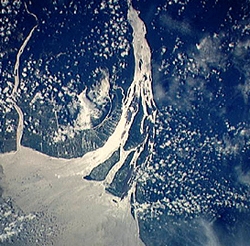
While the rising seas could be blamed on the effects of global climate warming, Meier said it could also be due to Guyana's location in northern South America that is affected by sediment deposits from the Amazon. The country, with a population estimated at about 769,000, is bordered by the Atlantic Ocean on the north, with Suriname as its neighbor to the east and Venezuela to the west. Guyana's southern border touches Brazil.

"We see a relative change in sea level with regard to their drainage window, but what's causing it, we're not in a position to say," he said, adding, "However, given global predictions, we'd be foolish to ignore (climate change) and so as part of the project in our design parameters, we're artificially anticipating that there will be a sea-level rise."

Using a computer model and an aircraft-guided remote sensing system, World Bank experts will be able to collect topographic data of how much of the land is sloping into the sea around Guyana. It will also establish how surface water could be drained and will look at how future development will impact drainage.

"The coastal topography of Guyana is very gently sloping and if someone just builds a mound around their house, that can have an impact on somebody else downstream," Meier added.

Caroline Anstey, the bank's country director for the Caribbean, said reducing Guyana's vulnerability to floods was critical for its economic stability.

"The consequences of climate change in Caribbean nations like Guyana will impose a heavy burden on the economies of the region, in particular on the poor," she added.

Camel racing comes to Sydney

Barbara McMahon in Sydney
The Guardian, UK


Camels galloped around a racetrack in Sydney yesterday, taking the place of horses, which have been banned because of an outbreak of equine flu.

Crowds cheered on the animals at the city's Harold Park Paceway. but could only put unofficial bets on the outcome of the six races, as camel racing is not recognised by Australia's leading betting organisation, TAB.

The novelty event was staged to recoup some of the losses suffered by the horse-racing industry after Australia's first outbreak of equine flu in August halted racing across the country. Hundreds of people in the industry have been laid off. Racing has restarted in three states under strict controls, but Sydney's lucrative spring racing carnival was abandoned five weeks ago.

Equine flu is not infectious to humans but has a debilitating effect on horses and in rare cases can be fatal. Horses are being vaccinated against the disease.

The camel meet attracted hundreds of racegoers, and racecourse staff said they spent heavily in function rooms and bars. More camel race meetings are expected to be held. "There's been lots of raucous laughter. Everyone's had a good time," said a spokesman. "It's lifted everyone's spirits."

Camel racing is usually held in the outback and the animals racing in Sydney were transported from Queensland, where they normally perform for tourists. Camels were introduced to Australia in the early 1800s to help workers building railway and telegraph lines and were later released into the wild. There are now upwards of 600,000 in Australia.

Worldwatch Perspective: Can Biofuels Make or Break Iowa’s Future?

From: , Worldwatch Institute

A report profiling the impact of the current biofuels boom in the U.S. state of Iowa and painting a more sustainable path forward for the biofuels industry was released Tuesday in the state capital, Des Moines. The report, Destination Iowa: Getting to a Sustainable Biofuels Future, is a joint project of the Worldwatch Institute and the Sierra Club. It examines the implications of biofuel development for Iowa’s economy and environment as well as for climate change.

Iowa is currently the undisputed leader in U.S. biofuels production, with nearly one-third of the nation’s ethanol capacity. The state is home to 28 ethanol refineries with a combined capacity of 1.9 billion gallons per year, and to 13 biodiesel refineries with a combined capacity of nearly 260 million gallons a year. Nineteen additional corn-based ethanol refineries are under construction that would enable Iowa to produce another 1.4 billion gallons annually, bringing it to a future ethanol capacity of 2.3 billion gallons.

Biofuels, particularly corn-based ethanol, have been embraced by many in Iowa as a way to provide economic development while reaching energy security and climate goals. Yet the industry is not living up to its potential. Iowa’s corn ethanol boom has made some farmers better off but is causing a host of other problems, such as increased water pollution and soil erosion and the loss of conservation reserve lands. It is also pricing some farmers out of the market. Ethanol refineries have brought jobs to small towns—though fewer than expected—and some residents are wondering what will happen once the corn frenzy dies down and the market demands more advanced biofuels and different feedstocks.

Biofuels production has complex implications, not just for the economy but also for agriculture, health, and rural development, as well as for air and water quality, biodiversity, and climate change. The lessons from Iowa and from biofuel programs around the world show that it is important to promote “smarter,” rather than just “more,” biofuels development.

Biofuels do have enormous potential. If developed in a sustainable manner, they can improve the environment, promote social justice, and provide a carbon-neutral energy source. Yet they represent only part of the solution to our energy needs. Capturing gains from energy efficiency, improving transport systems, and developing a diverse array of renewable energy sources are other important keys to mitigating climate change and assuring a sustainable energy supply.

The positive potential of biofuels will not be realized unless there is a framework that rewards sustainable production and punishes production that imposes external costs on society and the environment. Without such precautions, biofuels could do as much harm as good. One only has to look to the oil palm takeover in Southeast Asia or the continued clearing of Amazon forests for soy and sugarcane plantations to see the devastation that can arise from poorly considered biofuels production.

Iowa—and the United States overall—needs policies that support more sustainable biofuels. But having the right policies in place is just one step. Another is building awareness of why some biofuels measure up better than others. Blind faith in a concept does little good, because the devil is in the details—in this case, the details of production from the field to the tank.

For example, consumers might think twice about buying ethanol produced in a coal-fired refinery, since these facilities release double the greenhouse gases on average that refineries powered by natural gas do. Consumers may also wish to avoid ethanol derived from corn grown on fragile soils because of the impact this can have on water quality and wildlife habitat, or because of the associated carbon losses and nitrate oxide emissions from cultivating that soil.

Consumers—and producers—might instead choose to invest in the cellulosic ethanol fuels and advanced biodiesel fuels that are now nearing commercialization. These so-called “second-generation” biofuel technologies are much more efficient and sustainable, from an energy and climate perspective, than corn ethanol or soy biodiesel. Moreover, the cellulosic crops—which include certain grasses and woody crops—may be far more effective at promoting rural development in the United States than the current corn-dominated biofuels industry, because more processing will have to be done locally to make their use economical.

The best solution would be to develop a sustainability rating for biofuels—something like a consumer labeling system that rates a fuel based on its life-cycle impacts. Policymakers in the European Union are already working on such a system, which may provide a useful model for the United States. Meanwhile, as the report on Iowa notes, Iowans—and Americans—can demand policies that support sustainable agricultural and fuel refining practices and promote second-generation biofuel technologies.

Raya Widenoja, a research associate at the Worldwatch Institute, is the lead author of Destination Iowa: Getting to a Sustainable Biofuels Future.

This story was produced by Eye on Earth, a joint project of the Worldwatch Institute and the blue moon fund. View the complete archive of Eye on Earth stories, or contact Staff Writer Alana Herro at aherro [AT] worldwatch [DOT] org with your questions, comments, and story ideas.

Video

"Manufactured Landscapes" SEE THIS BRILLIANT MOVIE! You'll never have the same shopping experience again.