Monday, September 24, 2007

Australian Drought aid tops $1 billion

The Age, Melbourne, Australia
The Federal Government today announced a $714 million package to help farmers hit by the worst drought in living memory.

The package comes on top of $430 million in exceptional circumstances funding announced by Prime Minister John Howard on September 17.

Assistant Water Minister John Cobb told a drought summit in Parkes in Central Western NSW the package would include direct grants to irrigators and more exceptional circumstances funding.

Exit grants of up to $150,000 will be available to farmers to leave their properties and there will be an increase in the number of mental health counsellors from the package.

Mr Cobb said there would be an increase to the off-farm assets limit for access to the exceptional circumstances interest rate subsidy from $473,000 to $750,000.

The change means farmers living in exceptional circumstances declared areas will be able to hold more off-farm assets before being cut off from drought funding.

The everlasting floods of Africa

The East African Standard, Kenya

By Otsieno Namwaya

More than 20,000 people have been displaced, at least five killed, homes submerged, property destroyed, schools shut and some areas completely cut off in the aftermath of Budalang’i floods.

And now authorities are warning that the situation could get worse.

Budalang’i DO, Mr Kennedy Maunde Nyamboga, says water levels increase everyday and flooding is expected to continue for at least four months.

Residents of Budalang’i stand on an island created after the floods swept away dykes along River Nzoia. The dykes are a result of raised soil put in sacks many years ago, and have been easily swept away when the floods hit.

A website set up by a Budalang’i parliamentary aspirant, Mr Ababu Namwamba, to appeal for humanitarian aid for victims also warns of the possibility of the situation getting worse and estimates that the displaced could be well over 40,000.

Having been displaced thrice in less than one year, Budalang’i residents are now spoiling for confrontation with the authorities, against whom they level claims of corruption in the distribution of humanitarian aid and management of funds allocated for construction and repair of the dykes.

The chairman of the dyke management committee, Mr James Opiyo, a retired water superintendent, says so much money has been released for the repair of the dykes, but there is little to show for it.

Locals now want investigations launched into how the money was used since the dykes break every time the water level rises.

Speaking to The Standard from Budalang’i, some residents said it was due to poor workmanship that the frequency of floods from River Nzoia, which empties into the nearby Lake Victoria, has increased from an initial once every ten years to thrice a year.

The current floods started in August and are expected to last four months as the rains in Mount Elgon and Cherengany Hills continue.

The DO says the Government has released more than 210 tonnes of food, which he hopes will last the four months.

"People are receiving food aid as required," said Nyamboga.

Funds misappropriated

This is the third time the floods have hit the area since last November. The second time the floods came was in April, forcing residents to stay in the makeshift structures for more than a month.

Residents say the money released by Government since 1997 is adequate for the construction of new concrete dykes but no sustainable repairs on the current dykes that were constructed in the 1960s and 1970s have been carried out.

The current dykes are raised ground, mainly with soil from riverbed, and are said to have cost less than the amount the Government has spent on their repairs since 1997.

The colonial government constructed the 16.7km long dyke on the southern side in 1961 and the 16.8km long northern dyke in 1977.

Government sources said both dykes cost less than Sh1 million in 1961 and 1977 respectively.

However, the Government has since 1977 released Sh123 million for repairs that were either shoddily done or never done, thus necessitating the current breakages at various points of the dykes.

"This dyke is old. The Government needs to put up a new and stronger one. The new dyke should not be made of soil," says Ms Hellen Nabalayo, the vice chairperson of the dyke management committee, a body formed by residents and whose officials also sit on various other Government planning committees.

The Special Programmes minister, Mr John Munyes, last month said the World Bank had released Sh6 billion for the constructions of dykes in Nyanza and Western provinces while the Government had set aside an additional Sh3 billion for the same.

Speaking on condition of anonymity, an engineer in the Ministry of Roads said a concrete dyke of one metre thick, four metres high for 35km could cost between Sh840 million and one billion.

This, said the engineer, would last over 50 years without floods destroying it.

The dykes are managed by the Ministry of Water and Irrigation.

The ministry’s Busia District resident engineer has not been seen in Budalang’i due to bad blood with the locals, say provincial administration officials.

"I know the residents are hostile to the engineer, but I’m only a few months old here and have no idea what happened," said Nyamboga.

Opiyo, however, said residents resolved not to allow the engineer to work on the dykes further.

"We want an expatriate engineer. Maybe he will do a better job on the dyke. And this time we want to know how the money being released for dykes is used," he said, adding that they had forwarded a request for an inquiry into the past expenditures to the Government.

Budalang’i locals are also taking issue with the way Government officials, particularly chiefs, distribute food aid.

While the DO said food rations were given to the families on a weekly basis, some families said they only received food aid on August 15, when they fled the floods.

Mrs Clementina Anyango, a grandmother of three and whose food granary was swept away by the floods, said they had since been summoned by chiefs several times to go for food rations.

"But every time we go there, they say it is late and food is being taken to the St Annes store for storage.

""That would be the last we hear of that food," she said.

Humanitarian agencies concur with the residents, saying there has been lack of transparency in the food distribution process.

"Food has been brought here at least six times, but nobody knows how much of it has come, when it comes and who receives it.

"They don’t even have a list of the people they give food," said Susan Atieno, the ActionAid programme co-ordinator for Busia.

She says Government appointed Kenya Red Cross to distribute food to the flood victims, but her oganisation’s officials have not been given the food.

Brown urges US to accept carbon limits

Climate change protest

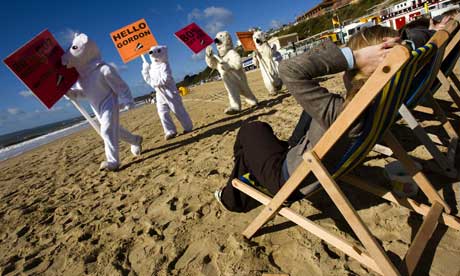
Climate change protesters on the beach at Bournemouth. Photograph: Stop Climate Chaos

Gordon Brown has insisted that global climate change can be limited to 2C and called on the US to accept binding targets to limit its carbon pollution.

In a letter to Stop Climate Chaos, a coalition of green groups, the prime minister said "all developed countries" needed to commit to reduce emissions to tackle the problem.

"Climate change poses the most urgent challenge to humankind - a challenge that threatens not only the environment, but international peace, security, prosperity and development," he wrote.

The letter was the first significant statement on climate change from Mr Brown since he became prime minister.

It came ahead of a key week of talks on developing a new international treaty, to succeed the Kyoto Protocol in 2012, to limit greenhouse gas emissions.

The UN will today hold a special high-level session on the issue in New York, attended by more than 70 heads of state.

The talks are intended to secure political commitment and build momentum for the UN climate change conference, taking place in Bali in December, where negotiations for the new international treaty will start.

Hilary Benn, the UK's environment, food and rural affairs secretary, is expected to attend.

"Bali must advance a negotiating agenda to combat climate change on all fronts, including adaptation, mitigation, clean technologies, deforestation and resource mobilization," the UN secretary general, Ban Ki-moon, said.

Prior to today's meeting, the conservation group WWF called on the UN to negotiate within the UN framework convention on climate change to achieve an "ambitious comprehensive climate agreement", which sets clear targets to reduce emissions, by no later than 2009.

"For world leaders to come together under the UN umbrella and to commit to deeper cuts in emissions is a watershed moment," Hans Verolme, the director of the WWF's global climate change programme, said.

Friends of the Earth urged the US and the rest of the world to focus on the UN process prior to a two-day meeting of the major emitting countries, taking place in Washington later this week.

The Washington meeting provoked controversy when the US president, George Bush, announced it earlier this year.

Critics claimed it was a diversionary tactic, and said the US was trying to sideline the separate UN process. The US insisted its efforts would help the UN agree the outline to a new treaty at Bali.

Privately, British officials say they are not yet convinced by the US, which remains opposed to binding targets and new international carbon trading markets.

Britain and Europe believe such measures are needed to draw developing nations such as China and India into a new deal.

"The EU has already agreed to reduce its greenhouse gas emissions by 30% by 2020…we want other developed nations to follow suit," Mr Brown said.

Ashok Sinha, director of I Count, the campaign of the Stop Climate Chaos coalition, welcomed the Prime Minister's aim to achieve a climate change agreement that will limit global warming to 2C.

But he called on Mr Brown to raise the target in the government's forthcoming climate change bill from a 60% reduction in CO2 emissions by 2050 to at least 80%, and to include aviation and shipping.

This is necessary in order to "meet the UK's moral obligation to play its fair share in the international effort to keep global warming under 2C," said Dr Sinha.

Tornadoes leave trail of destruction across Britain

By Emily Dugan

The Independent, UK

Tornadoes wreaked havoc across the country yesterday, with as many as 11 separate twisters destroying homes and uprooting trees.

The worst-hit areas included Nuneaton in Warwickshire, where more than 30 homes were damaged, and Farnborough in Hampshire, where at least 20 houses were affected. But the trail of destruction did not end there; tornadoes also ripped through Luton, Northampton and Eye in Cambridgeshire. In Breasdon, Derbyshire, part of a factory roof was torn off by the wind.

According to the Tornado and Storm Research Organisation (Torro), the violent weather was caused by the meeting of two extreme winds, one warm and one cold. The organisation said that up to 11 tornadoes occurred when a squall line ripped through the Midlands and southern parts of the country early in the morning, with gusts of up to 80mph.

Terry Parrott, from Farnborough, saw the twister approaching his house. " At about 7.30, I was getting ready to get in the shower and I heard this tremendous rushing noise – the winds were just getting stronger and stronger, " he said.

"I looked out of my bedroom window and saw this huge whirling thing come through between the two houses and it lifted the garage roofs up.

"It just picked everythingup, even stuff that was nailed down. It was incredible, then after 90 seconds it was gone, it was all over".

Hayley Stroud, 27, also from Farnborough said the noise from the twister was so loud that her son was screaming in fear. "It was like something out of The Wizard of Oz", she said.

John Hammond, a meteorologist at the Met Office, said: "It's certainly been an eventful morning, with some very disturbed weather. The conditions were in place for tornadoes, as a band of warm air in the east met with cooler air in the west".

John Edwards, director of community and environment for Rushmoor council, said the residents of Farnborough were "petrified" as high winds tore through their streets, uprooting a bus shelter and overturning a caravan. Mr Edwards said it was fortunate the tornado hit so early in the morning, as a few minutes later there would have been children on the streets making their way to school.

In Nuneaton, witnesses spoke of a terrific noise as roof tiles and chimneys went flying under the tornado's path. Yvette Mawson, 40, described how her children's trampoline had flown across the garden. "I could hear bangs, glass smashing and car alarms going off ... it was unbelievable".

Terence Meaden, of Torro, said there were likely to have been more tornadoes than reported and that such weather patterns were "uncommon". On average, he said, there were about 70 tornadoes a year in Britain.

UK extremes

* Birmingham tornado

Some 120 people had to be evacuated on 28 July 2005, when a twister ripped through the south of the city, injuring 19 people.

* Kensal Rise tornado

The strongest tornado to affect London in more than half a century hit Kensal Rise on 7 December last year, with winds reaching speeds as high as 130 miles an hour.

* Manchester earthquakes

In August the city had six separate earthquakes in a month.

* Scorching spring

This April was the hottest in Britain since records began almost two centuries ago.

* Summer floods

Substantial parts of England were submerged and the skies remained an almost unrelenting shade of grey this summer – the wettest since records began.

People, Bears, Record Clashes In Western US

From: Laura Zuckerman, Reuters

SALMON, Idaho (Reuters) - Black bears in search of food are wreaking havoc across the western United States, with wildlife managers reporting a record number of conflicts with people and a rise in the number of bears killed to protect the public.

"It's nuts out there," said Kevin Hurley, wildlife management coordinator with Wyoming Game and Fish.

American black bears, which are exclusive to North America, dwell in forests from Mexico to Canada. Weighing from 150 to 500 pounds (68 kg to 227 kg), adult bears can have a range of up to 250 square miles.

They begin hunting for high-calorie foods immediately after emerging from hibernation in spring and forage for up to 20 hours a day until they enter dens in fall.

Late freezes, drought and tree infestations in the Rocky Mountain West have diminished the sources of natural food from bugs to berries the bears eat. Now they are hunting for food in all the wrong places, from backcountry campgrounds to suburban kitchens.

In recent days, bear sightings have locked down schools in Idaho, Montana and Wyoming and emptied neighborhoods as officials sought to capture or kill them.

BEARS JUST BEING BEARS

In Colorado, bears have burst through the front doors of homes, sauntered into stores and broken into cars. Officials say the number of bears killed by state wildlife officers this year has topped a record 43 killed between January and August in 2002.

"It's a difficult day here when we decide we have to put down a bear; it's the last thing we want to have to do," said Colorado Division of Wildlife's Tyler Baskfield.

Wildlife officers in northwest Wyoming, where luxury housing is crowding into prime bear habitat, are fielding 100 calls a week about bears feasting in fruit trees and snoozing on front lawns. Game wardens have killed twice as many bears this season -- conservatively estimated at 15 -- as they kill in an average year.

In Montana, hungry bears have plowed through dumpsters and grabbed garbage from garages, a pattern Montana Fish, Wildlife and Parks Captain Sam Sheppard says is unusual for its scope, duration and intensity.

Wildlife officers across Western states have renewed campaigns to stem bear conflicts by retraining humans.

In Jackson Hole, Wyoming, where a bear recently lumbered through the open door of a daycare center, officials have plastered neighborhoods with signs urging residents to harvest fruit, remove birdfeeders and "bear-proof" their garbage.

"Bears are just being bears," said Mark Bruscino, bear management program supervisor with Wyoming Game and Fish, noting that people living near bear country have a social obligation to take steps to discourage the animals from foraging in populated areas.

Schwarzenegger, UN Chief, Call For Fast Action On Climate

From: Reuters

UNITED NATIONS (Reuters) - U.N. Secretary-General Ban Ki-moon and California Gov. Arnold Schwarzenegger had the same message on Monday at a special session on climate change, urging quick action to stem emissions that heat the planet.

"Today let the world know that you are ready to shoulder this responsibility and that you will address this challenge head on," Ban told some 80 world leaders at the session's opening.

"The time has come to stop looking back at the Kyoto Protocol," Schwarzenegger said. "It is time to stop looking back in blame or suspicion ... The rich nations and the poor nations have different responsibilities, but one responsibility we all have is action."

Ban wants the one-day gathering to send a "strong political message" about the urgency of the problem of curbing the greenhouse gas emissions that contribute to climate change.

It is the first of three U.S. events on climate change this week that are likely to focus attention on whether Washington can make good on its pledge to take a leading role in curbing such emissions.

But it is not a negotiating session. That will come in December in Bali, Indonesia, where climate experts will try to craft a successor to the emissions-limiting Kyoto Protocol, which expires in 2012.

Al Gore, the former presidential candidate and star of the Oscar-winning global warming documentary, "An Inconvenient Truth," is also to address the U.N. meeting.

But President George W. Bush, who defeated Gore, will not speak at this gathering, but he will dine with Ban after it ends.

Bush has rejected the Kyoto Protocol, an international agreement that requires 36 industrial nations to cut greenhouse emissions by at least 5 percent from 1990 levels by 2012.

He contends the accord unfairly burdens rich countries while exempting developing countries like China and India and that it will cost U.S. jobs.

Developing countries have said it is unfair to ask them to curb their emissions as their economies grow while industrialized nations have been polluting for decades.

Bush does plan to speak at a two-day Washington meeting at the State Department on Thursday and Friday, a gathering of "major economies" -- the world's biggest global warming contributors -- on energy security and climate change.

A third conference, the nongovernmental Clinton Global Initiative, will convene in New York from Wednesday through Friday to discuss climate change with participants from business, academia, entertainment and environmental organizations.

(Additional reporting by Jeff Mason)

Mon Sep 24, 2007 12:55pm EDT

By Deborah Zabarenko, Environment Correspondent

UNITED NATIONS (Reuters) - U.N. Secretary-General Ban Ki-moon and California Gov. Arnold Schwarzenegger had the same message on Monday at a special session on climate change, urging quick action to stem emissions that heat the planet.

"Today let the world know that you are ready to shoulder this responsibility and that you will address this challenge head on," Ban told some 80 world leaders at the session's opening.

"The time has come to stop looking back at the Kyoto Protocol," Schwarzenegger said. "It is time to stop looking back in blame or suspicion ... The rich nations and the poor nations have different responsibilities, but one responsibility we all have is action."

Ban wants the one-day gathering to send a "strong political message" about the urgency of the problem of curbing the greenhouse gas emissions that contribute to climate change.

It is the first of three U.S. events on climate change this week that are likely to focus attention on whether Washington can make good on its pledge to take a leading role in curbing such emissions.

But it is not a negotiating session. That will come in December in Bali, Indonesia, where climate experts will try to craft a successor to the emissions-limiting Kyoto Protocol, which expires in 2012.

Al Gore, the former presidential candidate and star of the Oscar-winning global warming documentary, "An Inconvenient Truth," is also to address the U.N. meeting.

But President George W. Bush, who defeated Gore, will not speak at this gathering, but he will dine with Ban after it ends.

Bush has rejected the Kyoto Protocol, an international agreement that requires 36 industrial nations to cut greenhouse emissions by at least 5 percent from 1990 levels by 2012.

He contends the accord unfairly burdens rich countries while exempting developing countries like China and India and that it will cost U.S. jobs.

Developing countries have said it is unfair to ask them to curb their emissions as their economies grow while industrialized nations have been polluting for decades.

Bush does plan to speak at a two-day Washington meeting at the State Department on Thursday and Friday, a gathering of "major economies" -- the world's biggest global warming contributors -- on energy security and climate change.

A third conference, the nongovernmental Clinton Global Initiative, will convene in New York from Wednesday through Friday to discuss climate change with participants from business, academia, entertainment and environmental organizations.

Sunday, September 23, 2007

Heathrow Climate Camp

The climate camp at Heathrow is materially different from protests that have taken place in Britain before.

By George Monbiot. Published in the Guardian 21st August 2007

There are plenty of people at the Heathrow climate camp who say they are campaigning on behalf of their children. But when Alf Pereira spoke on Sunday outside the church in Harmondsworth, we knew he meant it. His daughter died of bronchial problems, caused, he believes, by pollution from the airport. She was buried in the graveyard behind us. He fears that if a third runway is built, the developers will disinter her.

Until this week, Mr Pereira’s voice was drowned by the roar of jet engines. The people of the villages around the airport have been campaigning for years against the threat of expansion, but no one in power has listened. Both the government and the airports operator BAA appear determined to evict the living and raise the dead.

Heathrow is already the busiest international airport on earth. The new runway and the terminal and approach roads it needs would demolish around 1200 homes(1). One primary school will be flattened; six others will be permanently blighted by noise. Separated from the rest of Heathrow, this would, in effect, be a second airport.

The government hopes to have the new airport built “as soon as practicable”(2) on the grounds that it will “generate the largest direct net economic benefits of any new runway”(3). The Times reveals that BAA has been allowed to influence the tests which will determine whether or not the runway would breach the legal limits for pollution and noise. The government has also given the company the results of its air pollution studies, while withholding them from the public(4).

It seems pretty obvious that this scheme could go ahead only if the government is prepared to rip up both its agreements with the public and the EU’s pollution laws. When Heathrow’s fifth terminal was approved, a planning condition capped the number of flights using the airport at 480,000 a year. The new runway would raise them to 720,000(5). BAA also wants to end the “alternation agreement” which regulates flights at Heathrow’s existing runways: planes leaving the airport currently switch directions at 3pm in order to give the people of West London a break from the noise. If the policy changes, the airport could take a further 72,000 flights a year(6).

The government has promised that the area of land subject to noise levels which the World Health Organisation defines as causing “serious annoyance” (57 decibels or more) will not increase. But its own forecasts suggest the new runway will expand this zone by at least 12%(7). This is almost certainly an underestimate, which is perhaps why it has refused to publish maps of the flight paths to and from a third runway. A consortium of local authorities has drawn up its own maps. They show a massive northern expansion of the noise zone, sweeping over much of London and the counties to the west of Heathrow(8).

The airlines say that they will make their planes quieter in order to meet the government’s promise. But they also say they will make them more efficient to reduce emissions of carbon dioxide, and the method favoured by some of them is to swap the current engine design for “open rotor” turbines, which are much noisier(9). They can’t have it both ways.

Already the planes and their associated traffic have been breaching the EU’s limits for nitrogen dioxide pollution, which suggests that current airport activities are unlawful (remember that when you hear ministers fulminating about our illegal protest)(10). Now we are expected to believe that air pollutants can be reduced to below the legal limits while the number of flights almost doubles. It looks as if our civil servants will be busy with what they call “statisitical interpretations of the target”(11). The rest of us call it lying.

Camping in the fields north of the airport this week, I found that I fell asleep promptly at 11, when the flights mostly cease, and woke - despite my wax ear plugs - promptly at 6, when they resume. My throat swelled and my eyes itched, and I am sure that my headache was not just the result of a few too many bottles of Pitfield’s Eco Warrior. Even if we were to put climate change to one side, who can honestly claim that new runways, for all their economic benefits, improve the quality of our lives? A pall of skull-scraping misery hangs over the catchment of every major airport. But the business plan cannot be faulted: the more hellish our lives become, the more we seek to escape from them.

Of course we cannot put climate change to one side. In a previous article I showed that, depending on whether you believe the government’s figures or those produced by academic researchers, by 2050 the greenhouse gases produced by the UK’s air passengers will equate to between 91% and 258% of the carbon dioxide the government says the whole economy should be producing(12). Its airport expansion plans, in conjunction with those of other nations, will cause runaway climate change even if we were to spend the rest of our lives shivering in the dark. So much for the economic benefits of new runways.

The people seeking to prevent this expansion know that when the government supports a development, explaining your objections at its public inquiries is about as much use as shaking your fist at the sky. An elaborate theatre of consultation and democracy is designed only to hide the fact that the decision has already been made.

So what else do the critics of direct action expect us to do? How else do they suggest we drag this issue out of the shadows and thrust it to the front of the public mind?

We did not get everything right. The media strategy was hopeless: sympathetic journalists were excluded; unsympathetic journalists went undercover and stayed in the camp for as long as they wanted. But in other respects it was better organised, more democratic and more disciplined that any I have seen before. It drew on the protests of the 1990s but introduced two new elements: much better logistics and a model of popular democracy imported from Latin America. All the facilities that 1500 people would need - including running water, sanitation, hot food twice a day, banks of computers and walkie-talkies, stage lighting, sound systems, even a cinema - were set up in a few hours on unfamiliar ground, in the teeth of police blockades. A system of affinity groups and neighbourhoods, feeding their decisions upwards to general meetings, permitted a genuine participatory democracy of the kind you will never encounter in British public life. The actions themselves were disciplined and remained non-violent even when the police got heavy. I left the camp on Sunday evening convinced that a new political movement has been born.

We haven’t prevented runaway climate change by camping beside Heathrow and surrounding the offices of BAA, nor did we expect to do so. But we have made it harder for Alf Pereira and the other unheard people to be swept aside, and harder for the government to forget that its plan for perpetual growth in corporate utopia is also a plan for the destruction of life on earth.


Biofuels: A Lethal Solution

We need a five-year freeze on biofuels, before they wreck the planet.By George Monbiot. Published in the Guardian 27th March 2007.

It used to be a matter of good intentions gone awry. Now it is plain fraud. The governments using biofuel to tackle global warming know that it causes more harm than good. But they plough on regardless.

In theory, fuels made from plants can reduce the amount of carbon dioxide emitted by cars and trucks. Plants absorb carbon as they grow - it is released again when the fuel is burnt. By encouraging oil companies to switch from fossil plants to living ones, governments on both sides of the Atlantic claim to be “decarbonising” our transport networks.

In the budget last week, Gordon Brown announced that he would extend the tax rebate for biofuels until 2010. From next year all suppliers in the UK will have to ensure that 2.5% of the fuel they sell is made from plants - if not, they must pay a penalty of 15p a litre. The obligation rises to 5% in 2010(1). By 2050, the government hopes that 33% of our fuel will come from crops(2). Last month George Bush announced that he would quintuple the US target for biofuels(3): by 2017 they should be supplying 24% of the nation’s transport fuel(4).

So what’s wrong with these programmes? Only that they are a formula for environmental and humanitarian disaster. In 2004 this column warned that biofuels would set up a competition for food between cars and people. The people would necessarily lose: those who can afford to drive are, by definition, richer than those who are in danger of starvation. It would also lead to the destruction of rainforests and other important habitats(5). I received more abuse than I’ve had for any other column, except when I attacked the 9/11 conspiracists. I was told my claims were ridiculous, laughable, impossible. Well in one respect I was wrong. I thought these effects wouldn’t materialise for many years. They are happening already.

Since the beginning of last year, the price of maize has doubled(6). The price of wheat has also reached a 10-year high, while global stockpiles of both grains have reached 25-year lows(7). Already there have been food riots in Mexico and reports that the poor are feeling the strain all over the world. The US department of agriculture warns that “if we have a drought or a very poor harvest, we could see the sort of volatility we saw in the 1970s, and if it does not happen this year, we are also forecasting lower stockpiles next year.”(8) According to the UN Food and Agriculture Organisation, the main reason is the demand for ethanol: the alcohol used for motor fuel, which can be made from both maize and wheat(9).

Farmers will respond to better prices by planting more, but it is not clear that they can overtake the booming demand for biofuel. Even if they do, they will catch up only by ploughing virgin habitat.

Already we know that biofuel is worse for the planet than petroleum. The UN has just published a report suggesting that 98% of the natural rainforest in Indonesia will be degraded or gone by 2022(10). Just five years ago, the same agencies predicted that this wouldn’t happen until 2032. But they reckoned without the planting of palm oil to turn into biodiesel for the European market. This is now the main cause of deforestation there and it is likely soon to become responsible for the extinction of the orang utan in the wild. But it gets worse. As the forests are burnt, both the trees and the peat they sit on are turned into carbon dioxide. A report by the Dutch consultancy Delft Hydraulics shows that every tonne of palm oil results in up to 33 tonnes of carbon dioxide emissions, or ten times as much as petroleum produces(11). I feel I need to say that again. Biodiesel from palm oil causes up to TEN TIMES as much climate change as ordinary diesel.

There are similar impacts all over the world. Sugarcane producers are moving into rare scrubland habitats (the cerrado) in Brazil and soya farmers are ripping up the Amazon rainforests. As President Bush has just signed a biofuel agreement with President Lula, it’s likely to become a lot worse. Indigenous people in South America, Asia and Africa are starting to complain about incursions onto their land by fuel planters. A petition launched by a group called biofuelwatch, begging western governments to stop, has been signed by campaigners from 250 groups(12).

The British government is well aware that there’s a problem. On his blog last year the environment secretary David Miliband noted that palm oil plantations “are destroying 0.7% of the Malaysian rain forest each year, reducing a vital natural resource (and in the process, destroying the natural habitat of the orang-utan). It is all connected.”(13) Unlike government policy.

The reason governments are so enthusiastic about biofuels is that they don’t upset drivers. They appear to reduce the amount of carbon from our cars, without requiring new taxes. It’s an illusion sustained by the fact that only the emissions produced at home count towards our national total. The forest clearance in Malaysia doesn’t increase our official impact by a gram.

In February the European Commission was faced with a straight choice between fuel efficiency and biofuels. It had intended to tell car companies that the average carbon emission from new cars in 2012 would be 120 grams per kilometre. After heavy lobbying by Angela Merkel on behalf of her car manufacturers, it caved in and raised the limit to 130 grams. It announced that it would make up the shortfall by increasing the contribution from biofuel(14).

The British government says it “will require transport fuel suppliers to report on the carbon saving and sustainability of the biofuels they supply.”(15) But it will not require them to do anything. It can’t: its consultants have already shown that if it tries to impose wider environmental standards on biofuels, it will fall foul of world trade rules(16). And even “sustainable” biofuels merely occupy the space that other crops now fill, displacing them into new habitats. It promises that one day there will be a “second generation” of biofuels, made from straw or grass or wood. But there are still major technical obstacles(17). By the time the new fuels are ready, the damage will have been done.

We need a moratorium on all targets and incentives for biofuels, until a second generation of fuels can be produced for less than it costs to make fuel from palm oil or sugarcane. Even then, the targets should be set low and increased only cautiously. I suggest a five-year freeze.

This would require a huge campaign, tougher than the one which helped to win a five-year freeze on growing genetically modified crops in the UK. That was important - GM crops give big companies unprecedented control over the foodchain. But most of their effects are indirect, while the devastation caused by biofuel is immediate and already visible.

This is why it will be harder to stop: encouraged by government policy, vast investments are now being made by farmers and chemical companies. Stopping them requires one heck of a battle. But it has to be fought.

You can join the campaign at www.biofuelwatch.org.uk.

www.monbiot.com


Extreme weather creates fire risk for UK's beauty spots

Some of Britain's most outstanding areas of natural beauty are at risk from the sort of fires that devastated Greece this summer, according to new analysis looking at the threats posed by global warming.

Firefighters report that the number of heath, forest and grass fires in the UK has risen by more than 60 per cent in 20 years as long, hot summers have created tinder-dry conditions. Conversely, when summers are not arid, a huge increase in the threat of flooding has been another major concern for firefighters. Figures show the average land temperature has risen by 1C since the 19th century, raising concerns over extreme fluctuations in weather.

Now the Fire Brigades Union says that, with its members being asked to tackle outdoor blazes and flooding, their ability to deal with burning buildings is diminished, which could put lives at risk. 'Tackling these sorts of fires or flooding is becoming a huge part of our job,' said the union's Sean Cahill. 'The rise in the threat posed by global warming is unprecedented and it's out of our control. We believe these threats posed by extreme weather are going to increase.'

According to an FBU analysis of government figures, between 1986 and 1993 there were on average 37,371 grassland and heathland blazes a year in Britain. But in the 11 years from 1994 to 2005 the average rose to 60,332 a year.

Last year the number of outdoor fires soared by 37 per cent to 88,400, and in 1995 and 2003 it peaked at more than 100,000. The FBU warns the government is ignoring the problem at its peril. 'People think tackling the new threats associated with climate change is just an aside to our job,' Cahill said. 'But it's becoming a core part.'

The increasing fire threat is having a profound effect on some of Britain's most famous beauty spots. Rural areas in Devon, Cornwall and the north have been plagued by grass fires during recent dry summers.

In 2006 a series of blazes ripped across Ilkley Moor in Yorkshire's Bronte country, which is also home to important prehistoric rock carvings. As a result, regional tourism temporarily shut down. Experts say that it will be 20 years before the region fully recovers and that it will cost millions of pounds to put right.

Despite the rising fire and flood threats, firefighters claim that little has so far been done. A Local Government Association document looking ahead to the future of firefighting in 2017 makes no mention of climate change. And the government is reluctant to increase funding when the number of property and vehicle fires is falling.

But a Department for Communities and Local Government document highlights the threat from forest fires, which ravaged Greece this summer, killing 65. Because of climate change, it states, ' it is definitely important to investigate the possibility that forest fires could grow to become a significant problem'.

Bush Seeks Global Warming Process

From: Associated Press

WASHINGTON- Bush administration officials set out Friday to convince the world it can cool the Earth with voluntary "processes," more cooperation and fewer barriers to trade among the U.S., China and other major polluters, contrary to the U.N.'s mandatory approach to global warming.

In a preview of their separate climate talks next week, U.S. and U.N. officials downplayed the broad gap between how they would cut carbon dioxide and other heat-trapping greenhouse gases. All sides say their focus is on what will succeed the Kyoto Protocol, negotiated a decade ago and due to expire in 2012.

"Is this competing? And the answer is absolutely not," said Harlan Watson, the chief U.S. climate negotiator.

On Monday, U.N. Secretary General Ban Ki-moon plans a meeting in New York to build momentum for a large U.N. meeting in December in Indonesia where negotiators will try to create a post-Kyoto accord. Three days later, President Bush has called for a two-day climate gathering in Washington with major industrial nations, the United Nations and a few developing countries, including China and India.

"Tackling global climate change requires all major economies - developed and developing - to work together. And it requires each to make a contribution consistent with its national circumstances," Dan Price, a deputy national security adviser to President Bush, told reporters. "Not every country can afford to invest large sums to develop or acquire technologies. But every country can eliminate tariffs and other barriers to trade in clean energy goods and services."

But where the U.N. seeks agreement by 2009 or 2010 for another round of mandatory emissions cuts, the Bush administration wants a strictly voluntary agreement among nations by the end of 2008, in the waning days of Bush's presidency - and only hopes to take incremental steps without establishing firm goals or the requirements to meet them.

"We're not going to solve all these issues, obviously. What we want to do is to set up processes, we want to set up work teams," Watson said.

The Kyoto Protocol mandates emissions cuts through 2012 to a collective 5 percent below 1990 levels only from the industrialized nations that ratified it, but has produced mixed results at best. President Bush rejected it as too costly for the U.S. economy, and unfair because it excluded China, India and other developing economies.

Bush now wants to let countries each set "national midterm goals" for 2020 and 2030, with no binding commitments internationally, according to Watson's PowerPoint presentation at the Brookings Institution forum.

"One size won't fit all: national/regional strategies are most realistic," the document says. "Each would establish its own targets, goals and programs that are legally binding domestically."

But the danger U.N. officials warn against - besides actual climate warming - is a gap in the emerging multibillion-dollar trade in carbon "credits" that has grown from the Kyoto treaty. For nations that signed on and businesses within them, any reductions that go further than needed can be sold to others who might need them.

Earlier this year, the U.N. Intergovernmental Panel on Climate Change, an authoritative group of world climate scientists, forecast that all regions of the world will change from climate warming and a third of the Earth's species would vanish if global temperatures continue to rise and reach 3.6 degrees above the average temperature in the 1980s-90s.

"Decisive action in the next decade can still avoid some of the most catastrophic scenarios the IPCC has forecast," said Yvo de Boer, the U.N.'s top climate official.

"A strong climate change framework needs to be in place by 2009 or 2010 in order to insure that there is no gap between the end of the Kyoto Protocol's first commitment period and the entry into force of a new regime. And that is important for a number of reasons, including to give confidence to the carbon markets that policies will continue to move forward," he said. "That is the agenda which we cannot achieve without the help and consensus of the United States and other countries from around the world."

Copyright 2007 The Associated Press. All rights reserved. This material may not be published, broadcast, rewritten or redistributed.

Better than Kyoto: for the first time ever, rich and poor nations – even the US – agree to pollution cuts

By Geoffrey Lean, Environment Editor

Rich and poor nations yesterday agreed, for the first time, to make big cuts in pollution in order to fight global warming. And the Bush administration, which has consistently sought to sabotage international action to combat climate change, helped to lead the way.

Governments and environmentalists are hoping this weekend that the apparently incredible breakthrough will set the stage for a new onslaught on the heating-up of the planet.

On Tuesday, the new UN Secretary-General, Ban Ki-moon, is hosting a meeting of 70 government heads to try to kick-start an international treaty to replace the Kyoto Protocol when its present provisions expire in 2012. On Thursday and Friday President George Bush will hold his own international meeting on the issue.

Yesterday's little-expected breakthrough, which was foreshadowed in last week's Independent on Sunday, is expected to do more than the Kyoto agreement to slow down global warming. It came after negotiations – under the auspices of the United Nations Environment Programme (Unep) – on strengthening another treaty, the Montreal Protocol on the ozone layer, first agreed exactly 20 years ago.

Negotiators from 190 countries agreed to accelerate the banning of hydrochlorofluorocarbons (HCFCs), used in refrigeration and air-conditioning. These damage the Earth's ozone layer, which shields the planet from the sun's harmful ultra-violet rays. But HCFCs are even more dangerous as greenhouse gases, up to 1,700 times more powerful than carbon dioxide in warming up the planet.

Under the protocol's existing provisions, the HCFCs were due to be phased out by 2030 in rich countries, and by 2040 in poor ones, but at last week's meeting negotiators accepted a proposal – put forward by the Bush administration – to bring both deadlines forward by a decade.

Although the measure will help to heal the ozone layer faster, its main intention is to combat global warming.

The accelerated phase-out is estimated to be the equivalent of cutting carbon-dioxide emissions by up to 25 billion tonnes over the coming decades. This compares with the two million tonnes a year due to be saved by the Kyoto Protocol between 2008 and 2012 if, as seems unlikely, its targets are met.

It also involves both rich and poor countries agreeing targets to cut emissions, something that has not yet happened under any other climate-change agreement – and is one of the main bones of contention over Kyoto. China, which produces most HCFCs, has had to make particular sacrifices.

The breakthrough is a triumph for Achim Steiner, Unep's executive director, who did much to bring it about. He said yesterday: "Historic is an often over-used word, but not in the case of this agreement. Governments had a golden opportunity to deal with the twin challenges of climate change and protecting the ozone layer – and governments took it."

Even before yesterday's breakthrough, the Montreal Protocol was seen as the most effective environmental treaty. Agreed shortly after the discovery of the ozone hole above Antarctica, it has already phased out almost all of the chemicals primarily responsible – the chlorofluorocarbons or CFCs once used in aerosol sprays and refrigeration.

This is expected to prevent 6.3 million deaths from skin cancer in the United States alone. But the biggest benefit has been an unintended one, in combating global warming, since the CFCs are also powerful greenhouse gases.

Scientists in the Netherlands and in the US concluded earlier this year that, by the end of this decade, the Montreal treaty will have done more than five times more to counteract climate change than Kyoto.

Professor Mario Molina, one of the first scientists to discover the threat to the ozone layer, says this has delayed warming by 12 years, and may have kept the world from "passing the 'tipping point' for abrupt and irreversible climate change".

Yesterday's agreement on HCFCs, which replaced CFCs, will do even more – but governments and environmentalists caution that it will be no substitute for tough action over the next two years to cut emissions of carbon dioxide, primarily from the burning of oil, gas and coal. This remains the main cause of climate change, but Mr Bush is still resisting growing pressure for action both in the US and from overseas.

David Doniger, of the Natural Resources Defense Council, said yesterday that "the Bush administration deserves credit for working with other countries to push for faster cuts in HCFCs". But he added: "This is the tail. Cutting carbon dioxide emissions is the dog."

Further reading: 'Action on Ozone', published by the United Nations Environment Programme (Unep)

EU clashes with U.S. over airline emissions trade

From: Reuters

BRUSSELS – The European Union will press ahead with plans to include aviation in its emissions trading system despite United States' efforts through a U.N. body to discourage it, a spokeswoman for the EU executive said on Friday.

Airline emissions are at the top of the agenda of a tri-annual meeting of the International Civil Aviation Organization (ICAO) in Montreal, which began earlier this week.

The United States, which opposes EU plans to include foreign airlines in its emissions trading scheme, is pushing ICAO to let individual nations decide the best way to manage greenhouse gas emissions from their airlines, a U.S. working paper says.

It asks the group to “endorse guidance material for emissions trading that is on that basis of mutual consent” and to say “the only acceptable manner for managing emissions from international aviation is on the basis of mutual agreement.”

But the European Commission, which authored the legislation that would include flights coming into and out of the 27-nation bloc from 2012 in the EU scheme, said it will go forward with its proposal, which it says is in line with international law.

“The mutual consent approach for us is not an option,” said Barbara Helfferich, spokeswoman for Environment Commissioner Stavros Dimas.She said ICAO conclusions in 2001 and 2004, which supported establishing a global emissions trading scheme for aviation, had helped spur the EU to get a system started.

“ICAO seems to be wavering on their previous conclusions, which we believe would undermine their own credibility,” she said.Environmentalists say the airline industry must contribute more to reducing the gases blamed for global warming.

“After a shameful decade of inaction and obstruction ICAO must now give its full support to emissions trading and other measures to combat rapidly growing aviation emissions,” said Joao Vieira of Brussels-based Transport & Environment (T&E) in a statement earlier this week.

“The EU must be prepared to go it alone should ICAO give anything less than full backing to the emissions trading plan.”T&E said ICAO's guidance on emissions would not be legally binding, but the EU has committed itself in the past to act within the ICAO framework.

Industry positions are mixed. The Association of European Airlines, which represents big carriers such as British Airwaysand Lufthansa, supports the EU scheme but would prefer a global one, a spokeswoman said.

Global airlines group IATA, which stresses that airlines account for only 2 percent of world carbon dioxide (CO2) emissions, has called for a voluntary but global scheme.The EU trading system, which began in 2005 for energy intensive businesses such as power companies and oil refineries, sets limits on the amount of CO2 factories may emit.

Companies that overshoot their targets must buy permits in the market or pay a fine, while those that come in below their limits can sell the extra allowances.

Video

"Manufactured Landscapes" SEE THIS BRILLIANT MOVIE! You'll never have the same shopping experience again.