Sunday, September 9, 2007

EU Warns Carmakers: Fail CO2 Target, Get Fined

From: From: Reuters

BERLIN (Reuters) - European Environment Commissioner Stavros Dimas warned in a newspaper interview on Sunday that carmakers will face sanctions if they fail to meet new rules on reducing emissions.

Dimas told Bild am Sonntag newspaper before the international car show (IAA) in Frankfurt that carmakers will be punished if they fail to meet targets and dismissed complaints from carmakers that the targets are unrealistic.

"We're fully aware that European manufacturers have very different types of cars in their fleets," he said. "That's why we'll have rules that will enable us to reach our climate goals in a way that the car industry can live with.

"But the law must be obeyed," Dimas added. "In the event that a company does not obey the requirements, there will be corresponding sanctions."

The Commission plans to introduce legislation next year to have them cut emissions from new cars to an average 130 grams per kilometer by 2012. That would contribute to an overall aim of 120 g/km by 2012 compared to current levels of 163 g/km.

Car makers have criticized the move as unfair and unrealistic, and called on the executive body of the European Union to push the deadline back to 2015 to give them more time to prepare.

"As the public debate has become more intense, we've suddenly seen what can be achieved," Dimas said. "Just about every carmaker is now bringing out low emission vehicles on the market -- and that is true for every segment."

German carmakers have long resisted pressure and legislation to make less polluting cars. They have been slow to cut cars' carbon dioxide (CO2) emissions and improve fuel efficiency.

© Reuters 2007. All rights reserved.

Does APEC merely add to global warming?

From: Bill Tarrant -Associated Press

SYDNEY (Reuters) - As Asia-Pacific leaders jetted home on Sunday with yet another APEC souvenir to stuff into their "funny shirt" closet, folks back home may well ask: "So what did you get out of that meeting besides the outback raincoat?".

Host Australia shelled out A$300 million ($250 million) to accommodate the 21 leaders of the Asia-Pacific Economic Cooperation forum in Sydney, whose disgruntled residents were subjected to the biggest security operation in the country's history.

But leaders did come bearing gifts for Prime Minister John Howard, who is widely expected to call an election this week -- a $45 billion gas export deal with China, uranium sales to Russia, top-secret military technology from the United States.

Much to the chagrin of green groups, non-environmentalist Howard burnished his legacy with a "Sydney Declaration", signing up APEC members to an "aspirational target" for cutting greenhouse gases. It's voluntary and non-binding, so no worries for APEC, which includes some of the world's biggest polluters.

Green groups immediately dismissed the "Sydney distraction" as so much hot air adding to the warming of the globe.

DECISION-MAKING BODY

Critics say APEC has lost its focus on economics and trade by meandering into the fields of security and now the environment.

But some analysts say that may be the price of its success.

"APEC is more important now than ever, and though its role in some realms remains modest -- security is the most glaring example -- in other areas it is emerging as the global decision-making body," the security analysis Web site Stratfor.com said.

"APEC's growing power is most clearly on display when it tackles issues such as climate change and consumer product safety."

So, when the APEC leaders, whose countries account for more than half of global trade, came out on Sunday with a strong endorsement of compromises on farm subsidies and industrial tariffs that negotiators are working on in Geneva, it must have been music to World Trade Organization chief Pascal Lamy's ears.

For the past two decades, APEC has been quietly crafting some of the most important rules for global commerce. At the Sydney meeting it completed three more chapters for a model free trade agreement that can be rolled out anywhere along the Pacific rim.

APEC also offers an unparalleled public relations platform to push pet projects and causes -- and to network like crazy.

U.S. President George W. Bush, who stopped off in Iraq on his way to Sydney, took every opportunity to defend the unpopular war. And to bolster the election fortunes of Howard, one of the most steadfast supporters of the war.

"They refer to the Prime Minister around here as a battler," Bush said this week. "I know why: he's courageous, he's wise, he's determined."

Russian President Vladimir Putin stopped off in Jakarta on the way to APEC to seal a $1 billion arms deal with Indonesia by way of advertising that Russia is back in the geopolitical game in Asia, after taking a long sabbatical from the Cold War.

"The main outcome of the summit is that Russia has significantly upgraded its status in the grouping and in the region," a senior diplomat in the Russian delegation said.

But China's Hu Jintao kept a relatively low profile, belying predictions that Beijing is big-footing APEC, founded in Canberra in 1989 with backing from the United States to push an Asia-Pacific free trade agenda.

Hu issued the usual stern warnings about Taiwan's leanings toward independence.

But mostly he seemed keen to reassure his Asia-Pacific neighbors that Beijing, grappling with a series of product recalls ranging from toys to toothpaste, took product safety "very seriously".


China's foreign ministry spokesman said Beijing did not have any larger ambitions in APEC.


"On this issue, China definitely does not seek any kind of an important role, or to gain some kind of a leadership position," spokesman Liu Jianchao said in Sydney.


Howard had enthused that APEC would make Australia "the centre of the universe in our region", but a comedy troupe stunt during APEC might have been the most-watched story overseas.

Posing as the Canadian delegation, members of ABC TV's The Chaser show drove a "motorcade" through two checkpoints to within meters of Bush's hotel -- one of them made up to look like Osama bin Laden, and the designation "Insecurity" written on their convention passes. Police arrested 11 of them.

(Additional reporting by John Ruwitch and Oleg Shchedrov)

Saturday, September 8, 2007

Typhoon kills two, heads north in Japan

Saturday, Sept. 8, 2007

Kyodo News, Japan Times, Japan

Typhoon No. 9 left two people dead, at least one person missing and more than 70 injured after hitting Tokyo early Friday and sweeping northward through the Kanto and Tohoku regions.

News photo
Rescue workers wade through the swollen Tama River searching shacks for homeless people after Typhoon No. 9 blew through Tokyo early Friday, causing extensive floods. AP PHOTO

Although the typhoon, named Fitow, lost some of its force after engulfing Tokyo, the Meteorological Agency warned the public to be on guard for strong winds and heavy rain along its path before its expected landing in Hokkaido on Saturday morning.

Fitow also disrupted mass transportation in the capital and cut power to thousands in the surrounding areas, which were hit by flooding and strong winds.

In Karuizawa, Nagano Prefecture, Tsuneo Yanagisawa, 76, died after being hit by a tree around 11 p.m. Thursday while clearing other trees felled by the typhoon, police said.

In Ono, Fukui Prefecture, a construction worker died and another was injured after being caught by a landslide at a dam construction site, firefighters said.

Many rivers in Tokyo and its surrounding vicinities swelled to near flood levels.

On the Tama River on the Tokyo-Kanagawa border, 29 people, mainly homeless who live along the banks, were rescued Friday after being stranded by the rising waters.

However, a 52-year-old company worker was reported missing in Kawasaki after leaving home Thursday night, police said.

He reportedly told his wife he was going to take a look at the swollen river, and police suspect he fell in and got washed away.

There also were unconfirmed reports that three people were swept away by the Tama River.

News photo
A bridge over the Sakawa River in Matsuda, Kanagawa Prefecture, is shown after collapsing Friday morning after its base was weakened by flood waters. KYODO PHOTO

Authorities temporarily urged some 20,000 households in Kanagawa Prefecture to evacuate due to flooding fears.

Similar evacuation advisories were issued Friday in areas including Tokyo's Setagaya Ward, and Gunma and Yamagata prefectures.

In Tokyo Bay off Yokohama, two cargo ships collided after dragging their anchors around 2 a.m. Friday, the Japan Coast Guard said. But none of 36 crew members on the 15,888-ton, Bahamas-registered African Oryx or the 1,995-ton, China-registered Tian Dao was hurt.

At 8 p.m. Friday, the typhoon, about 90 km southwest of Hakodate, Hokkaido, was moving north at 35 kph, whipping up winds up to 126 kph near its center with an atmospheric pressure of 990 hectopascals, according to the agency.

More than 100,000 households in eight prefectures have suffered blackouts since Thursday morning, with nearly 30,000 lacking power Friday morning, Tokyo Electric Power Co. and Tohoku Electric Power Co. said.

At least 76 people were injured in the regions hit by the typhoon, according to a Kyodo survey.

East Japan Railway Co. and other railways suspended many morning commuter runs, including express and subway trains in the metropolitan area, delaying some 1.2 million people.

Some bullet trains on the Tokaido, Nagano, Tohoku-Akita and Yamagata Shinkansen lines were also suspended.

But Joetsu Shinkansen and Narita Express trains between the metropolitan area and Narita airport in Chiba Prefecture were running on schedule, JR East said.

Eight international flights and one domestic flight were canceled Friday morning due to strong winds, according to Narita International Airport Corp. officials.

Elsewhere, more than 240 domestic flights, mainly those arriving at and leaving Tokyo's Haneda airport and Miyagi Prefecture's Sendai airport, were scrubbed Friday.

Winds of 160.9 kph were clocked Friday at Cape Irozaki in Shizuoka Prefecture, while the wind speed reached 137.9 kph in Choshi, Chiba Prefecture, the agency said.

In the 24-hour period to Saturday evening, up to 200 mm of rain has been forecast along the Pacific coast of the Tohoku region and Hokkaido, and up to 150 mm in areas on the Sea of Japan and Okhotsk sides of Hokkaido, the agency said.

Floods leave North Koreans hungry

From: Stephanie Nebehay -Reuters

GENEVA (Reuters) - North Korea, where floods have seriously damaged nearly one sixth of arable land, will continue to need international food aid in the long term, the United Nations said on Friday.

The U.N.'s World Food Program, reporting on its assessment of food security in the reclusive country after last month's devastating floods, is to provide emergency food rations to 215,000 people in six provinces for the next three months.

The floods killed hundreds and left hundreds of thousands homeless, with the hardest hit areas located in four provinces which are home to 76 percent of total arable land, it said.

"North Korean farmers and communities will require continuing international assistance to dig out from the damage caused by these floods, to recover livestock and to replant fields," WFP spokeswoman Christiane Berthiaume said.

The foreign aid would need to be "long term", she added.

The country does not produce enough food to feed its population of 23 million, even with a good harvest. Aid agencies have said they expect the food shortage to be severe this year.

Relations between the secretive communist state and the West are thawing after a long stand-off over Pyongyang's nuclear program. U.S. President George W. Bush, who once branded North Korea part of an "axis of evil", said on Friday that Washington would consider a peace treaty with North Korea.

North Korea's Agriculture Ministry had told the WFP that 16 percent of arable land -- mainly used for growing rice, maize and soybeans -- had been seriously damaged, Berthiaume said.

"WFP fears a negative impact on the public distribution system in the country where everyone receives food rations," she said.

WFP had enjoyed "unprecedented government permission" to visit some 33 flood-stricken districts during its food security evaluation conducted from August 17-26, she added.

WFP's program to feed 215,000 people, estimated to cost $5-6 million, is part of a wider U.N. appeal for $14.1 million, launched in late August.

Elisabeth Byrs, spokeswoman of the U.N. Office for the Coordination of Humanitarian Affairs (OCHA), said the appeal was 50 percent financed. "We are very satisfied for now. It is a good start," she said.

The U.N. Children's Fund (UNICEF) said it feared outbreaks of water-borne diseases such as diarrhea in North Korea following the floods.

UNICEF is distributing oral rehydration salts and water purification tablets, but its priority is to help repair broken water distribution systems as quickly as possible, she said.

North Korea's appeal for aid was its first call in 12 years, since flooding in the 1990s led to a famine that some estimate killed as many as 2 million people.

Most polar bears could be lost by 2050: report

From: Deborah Zabarenko -Reuters

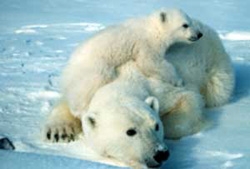
WASHINGTON (Reuters) - Two-thirds of the world's polar bear population could be gone by midcentury if predictions of melting sea ice hold true, the U.S. Geological Survey reported on Friday.

The fate of polar bears could be even bleaker than that estimate, because sea ice in the Arctic might be vanishing faster than the available computer models predict, the geological survey said in a report aimed at determining whether the big white bear should be listed as a threatened species.

"There is a definite link between changes in the sea ice and the welfare of polar bears," said Steve Amstrup, who led the research team. Arctic sea ice is already at an all-time low this year and is expected to retreat farther this month, according to the U.S. National Snow and Ice Data Center.

That means that polar bears -- some 16,000 of them -- will disappear by 2050 from parts of the Arctic where sea ice is melting most rapidly, along the north coasts of Alaska and Russia, researchers said in a telephone briefing.

Other polar bear populations could survive beyond that date but many of those could be gone by 2100, Amstrup said. By century's end, the only polar bears left might live in the Canadian Arctic islands and along the west coast of Greenland.

"Projected changes in future sea ice conditions, if realized, will result in loss of approximately two-thirds of the world's current polar bear population by the mid 21st century," the report's executive summary said.

"Because the observed trajectory of Arctic sea ice decline appears to be underestimated by currently available models, this assessment of future polar bear status may be conservative."

ARE POLAR BEARS 'THREATENED'?

In January, the U.S. Fish and Wildlife Service proposed listing the polar bear as a threatened species under the Endangered Species Act, noting polar bears depended on sea ice as a platform to hunt seals, their main prey.

The research released on Friday was sent to the Fish and Wildlife Service. A decision on the bears' status is expected in January.

Without enough sea ice, polar bears would be forced onto land, but they are inefficient hunters once they get out of the water and ice, the researchers said. The bears' disappearance would probably take place as young cubs failed to survive to adulthood and females were unable to reproduce successfully.

The first polar bears probably first appeared about 40,000 to 50,000 years ago, and the species has not lived through a period as warm as the one predicted by the U.N. Intergovernmental Panel on Climate Change, the scientists said.

In a series of reports this year, the U.N. climate panel said with 90 percent probability that global climate change was occurring and that human activities contributed to it. The emission of greenhouse gases -- including carbon dioxide from petroleum-fueled vehicles and coal-fired power plants -- is the prime human cause of this warming trend, the panel said.Global warming was an important topic of discussions of the Asia Pacific Economic Cooperation forum this week in Australia and will be the subject of a special U.N. meeting later this month.

Friday, September 7, 2007

Should we stop flying in organic food?

Should the Soil Association withdraw the 'organic' label from produce flown in from abroad? As the public debate hots up, critics insist a ban would threaten the livelihoods of farmers in developing nations. Others are more worried about the environmental impact ..

Guardian, UK

No

Claire Melamed, head of trade and corporate policy at charity Action Aid

A ban would have serious consequences for the developing world. It is important to keep the greenhouse gas emissions produced by organic air freight in perspective. The trade of fruit and vegetables from Africa to the UK accounts for only 0.1% of all the UK's emissions. Therefore, banning organic green beans from Kenya or mange tout from Zambia, say, is not going to make much difference to the UK's overall carbon footprint. However, there are many poor people in Africa who depend on that trade, so, for them, banning organic air freight means fewer children in schools, no investment in small businesses, less development of the economy and more poverty.

Of course, it is in the interest of the whole world to live in a greener way. No one denies that we should all be thinking about the effects on the planet of the emissions caused by aviation, but we shouldn't be looking to the poorest people in the world to save us from climate change. Every country is going to have to make some sacrifices for the environment and I think it is much fairer to ask everyone in the UK to give up one of their cars than it is to ask families in Africa to give up their entire year's income. It isn't acceptable for us to keep driving to the supermarket in our gas-guzzling 4 x 4s but stop people from developing countries from selling us their products because it has had to be flown into the UK. It shouldn't be the poor who suffer while we carry on in our own little world.

I don't think there is a single magic bullet to increase development in poorer countries but trade is undeniably a force for good - if it is the right sort of trade. In some countries exports are a very important part of the solution, and we can't deny that fact. At the moment, developing countries earn twice as much trading with UK supermarkets as the UK gives them in debt relief, so it is incredibly significant for their economies.

We all need to be thinking about ways to reduce poverty without damaging the environment. The organic movement should be a part of that, but rather than saying where the axe should fall now, we should be looking at how we can help organic farmers in Africa achieve this aim. A start would be giving them access to technology and investment so they can produce crops that have a longer shelf life and can be shipped to us, rather than air-freighted. We have to give them the tools to be able to reduce their environmental impact, rather than just cutting them out of the market.

Yes

Jon Stewart, campaigner for pressure group Airport Watch

There are major problems with the air-freighting of organic produce, which we need to address. The contribution of aviation to global warming is the most alarming. The figure that is often quoted is that it accounts for 2% of emissions worldwide. That figure seems quite low, but because it is a worldwide average and people in poor countries hardly fly, it essentially means the developed world's aviation emissions are proportionately very high.

Farmers in the developing world may have a sense of security from exporting fresh produce, but it is a false security because the poorest will feel the effects of climate change most immediately and most acutely. That's why richer countries need to take action first.

Another problem is the noise pollution caused by air freight and the impact it has on local communities in the UK. A lot of freight comes in on rather old, noisy planes, which often arrive at night. For example, East Midlands airport has more than 160 flights flying over rural Leicestershire every night and the people are being driven crazy by it. This may seem a small problem compared with what people in the developing world are facing, but don't forget they suffer from it too, only at the other end.

Also, air-freighting will soon become economically unsustainable as the demand for oil starts to outstrip supply. This will cause fuel prices, including the price of aviation kerosene, to rise rapidly. Farmers in Kenya who are growing organically are becoming almost entirely reliant on air freight to sell their goods. In the short term, that will bring some development benefits but it is a high-risk strategy. I would argue that it is unwise to become so dependent on a form of transport that won't be able to continue in the future the way it is now. Instead of being tied to this unsustainable form of trade, it would be more sensible to develop local trade, industry and agriculture.

It is a very difficult decision for ethical consumers to stop buying organic fresh produce that has been air-freighted to the UK because they naturally want to support farmers in the developing world. But they are also environmentally conscious. Therefore, I'm not advocating a ban on organic air freight overnight. But I do believe there has got to be a planned programme over the next 10 to 20 years where developing economies become less dependent on air freight and create more local opportunities. A selective ban with some exemptions introduced over a number of years seems the most equitable way forward.

· If you would like to comment on the Soil association's air freight consultation, visit soilassociation.org/airfreight. Read Peter Melchett on why the issue is dividing the Soil Association at blogs.guardian.co.uk/ethicalliving

· Post questions and answers to Ask Leo The Guardian, 119 Farringdon Road, London EC1 3ER Fax: 020-7713 4366. Email:ethical.living@guardian.co.uk Please include your address and telephone number.

Is population control pure fantasy?

Stop procreating, or the baby gets it

Leo Hickman

We all like to try and do our bit. Take public transport when we can. Wash clothes at 30C. Recycle. Have a shower rather than a bath. Shop locally.

The Chinese authorities say they have been doing their bit, too, and should be recognised for doing so. (It must get to you in the end being accused - for right or wrong - of being Climate Enemy Number One.) This week at UN climate talks in Vienna, Su Wei, a senior foreign ministry official, said that China's one-child policy, initiated in the late 1970s, had led to 300 million fewer people being on the planet today. This is equivalent, he said, to the population of the United States and in 2005 alone meant China - based on the average global per capita emissions of 4.2 tonnes - averted 1.3 billion tones of carbon dioxide from entering the atmosphere.

OK, there are still 1.3 billion people in China, but he has a point. Population control is the subject that dares not speak its name among environmentalists, even though most would agree that there are far too many people on the planet for us to ever collectively achieve a sustainable future. There are all sorts of reasons for this - ideology and theology among them - but the principal reason is the basic question of how on earth would such a policy ever be implemented outside of a totalitarian, one-party state such as China? Mandatory sterilisation? Financial incentives? Improved education and healthcare?

Many campaigners say that development always acts to lower a country's birth rate. So while many developed countries now say they are facing a population decline due to ever-lower birth rates, most people in developing countries still cling to the idea that having children is the nearest thing to a pension policy.

Groups such as the Optimum Population Trust believe that the world's population needs to be at least halved in order to be sustainable. Meanwhile, the UN predicts that by 2050 the global population will have peaked at about 9 billion from its current 6 billion before slowly declining after this point. Something has got to give, says the Optimum Population Trust, and we must start to address this issue fast. But how?

"No one is in favour of governments dictating family size but we need to act quickly to prevent it," said Professor John Guillebaud, author of a report published by the trust earlier this year. The report recommends that the UK initiates a "stop at two" campaign. It also wants motherhood to be deglamorised: "New guidelines should be introduced for the portrayal of fertility issues by the media, aimed at countering the glamorisation of sex and stressing the responsibilities and frequent 'sheer drudgery' of motherhood. Storylines could demonstrate how teenage motherhood blights educational and earning prospects." (I suspect the trust won't be happy by the runaway success of the film Knocked Up this summer, then. One assumes Logan's Run to be more its kind of film.)

Beyond the UK, it says cultural and religious barriers to contraception must be lifted. But is this just pure fantasy? Is the world's population really going to be persuaded to halve itself in number by the end of the century? Or will some Biblical-style event do the culling on our behalf, as the Optimum Population Trust suggests could happen if numbers continue to inexorably rise?

Whenever people say that there are too many people on the planet, for me at least, there always follows a deafening silence of solutions that are really likely to work. But then again I - a father of three and therefore not really one qualified to talk on such matters - don't have any bright ideas, either. So, what would you do?

New Research Identifies How One Storm Can Affect Another

From: University of Leeds

University of Leeds - Weather forecasting and climate modelling for the notoriously unpredictable Sahel region of Africa could be made easier in the future, thanks to new research results coming from the African Monsoon Multidisciplinary Analysis study.

A paper published in Geophysical Research Letters describes how the AMMA scientists gathered new atmospheric data by using satellite imagery to plot flight paths over areas where storms had produced very wet soils. Dropsondes (weather reconnaissance devices) were launched from a research aircraft above these wet areas to record data such as humidity, wind strength and temperature. The findings allowed the scientists to compare the atmospheric conditions above wet soils with those above adjacent dry soils.

The data showed that temperatures fell by up to 3°C in the air just above the wet soils and also confirmed theoretical studies that predict soil moisture can affect winds. The temperature contrasts between very wet soils and nearby dry soils can have a dramatic effect on weather conditions. Air over wet soils can build up considerable humidity, while the warm air over dry soils rises. When the wet and dry conditions combine, storms are likely to build.

Lead author Chris Taylor from Centre for Ecology and Hydrology said, “Even small patches of moist soils, just ten kilometres across, were found to influence wind patterns. This provides a mechanism where storms can develop in a region because it rained there several days previously.”

The results of the study will help climate modellers who have traditionally struggled to accurately represent climate in the region.

Dr Doug Parker from the University of Leeds said, “If we can get it right for West Africa, other parts of the world will automatically benefit.”

Issued by the Natural Environment Research Council

APEC draft climate statement seen a compromise

From: Jalil Hamid -Reuters

SYDNEY (Reuters) - Asia-Pacific officials agreed on Friday to a draft climate statement which reaffirms a U.N. treaty on fighting global warming, while urging non-binding "aspirational targets" for greenhouse gas reductions, a delegate said.

But the climate statement, which has emerged after tough negotiations following a split between developing and developed members of the Asia Pacific Economic Cooperation (APEC) forum, remains to be agreed to by the 21 Asia-Pacific leaders.

"Its a compromise statement," an Asian delegate at the APEC Sydney forum told Reuters, adding it reaffirms the U.N. Framework Convention on Climate Change and backs "aspirational targets," proposed by Australia.

"Clearly the countries got what they wanted in the draft."

Host Australian Prime Minister John Howard placed climate change at the top of the APEC agenda, seeking a post-Kyoto Protocol consensus to be called the "Sydney Declaration."

Green groups have said the APEC leaders' summit would be a failure if it did not agree to binding greenhouse gas reduction targets, but Howard has said no binding targets will be set.

Howard has pushed for "aspirational targets" and for each nation to set their own climate change goals.

Developing economies -- including China -- are strongly opposed to any wording that commits them to binding targets and some say they would prefer climate change goals be handled at a U.N. meeting later this month.

Howard's friend and strong ally President George W. Bush has said in Sydney he is prepared to support a strong leaders' statement on climate change and urged China, a developing nation and a major polluter, so do the same.

Both Australia and the United States say Kyoto, which sets binding greenhouse reduction targets, is flawed because it does not include major polluters China and India.

Both Howard and Bush have said at APEC that China and India must be included in any climate change

The draft climate statement will go up to APEC leaders when they begin their two day summit on Saturday.

Australian Foreign Minister Alexander Downer said that negotiations on the APEC climate statement were "very difficult."

"If we can get a good declaration out of this, that will be a very great achievement," Downer told reporters earlier on Friday. "But I make no predictions about how those negotiations will go."

Under APEC's consensus-based approach, any statement on climate change would be non-binding and it would be up to member countries' decision on whether to meet the targets.

Scientists Make Dire Forecast for Alaska

From: Dan Joling, Associated Press

ANCHORAGE, Alaska (Sept. 7) - An analysis of 20 years' worth of real-life observations supports recent U.N. computer predictions that by 2050, summer sea ice off Alaska's north coast will probably shrink to nearly half the area it covered in the 1980s, federal scientists say.

The summer sea ice off Alaska's north coast will likely shrink considerably by 2050, said James Overland of the National Oceanic and Atmospheric Administration. Here, a ship is seen 50 miles north of Point Barrow in 2002.

Such a loss could have profound effects on mammals dependent on the sea ice, such as polar bears, now being considered for threatened species status because of changes in habitat due to global warming . It could also threaten the catch of fishermen.

In the 1980s, sea ice receded 30 to 50 miles each summer off the north coast, said James Overland, a Seattle-based oceanographer for the National Oceanic and Atmospheric Administration.

"Now we're talking about 300 to 500 miles north of Alaska," he said of projections for 2050.

That's far past the edge of the highly productive waters over the relatively shallow continental shelf, considered important habitat for polar bears and their main prey, ringed seals, as well as other ice-dependent mammals, such as walrus.

The NOAA researchers reviewed 20 computer scenarios of the effects of warming on sea ice, used by the United Nations' Intergovernmental Panel on Climate Change in its assessment report released this year.

The researchers compared those models with observations from 1979 through 1999, Overland said, and concluded that the summer ice in the Beaufort Sea likely will have diminished by 40 percent, compared with its 1980s area.

The same is likely for the East Siberian-Chukchi Sea region off northwest Alaska and Russia. In contrast, Canada's Baffin Bay and Labrador showed little predicted change.

There was less confidence for winter ice, but the models also predict a sea ice loss of more than 40 percent for the Bering Sea off Alaska's west coast, the Sea of Okhotsk east of Siberia and the Barents Sea north of Norway.

The research paper by Overland and Muyin Wang, a NOAA meteorologist, will be published Saturday in Geophysical Research Letters, a publication of the American Geophysical Union.

The situation is dire for polar bears, said Kassie Siegel of the Center for Biological Diversity, who wrote the petition seeking federal protection for the animals.

"They're going to drown, they're going to starve, they're going to resort to cannibalism, they're going to become extinct," she said.

As ice recedes, many bears will get stuck on land in summer, where they have virtually no sustainable food source, Siegel said. Some will try and fail to swim to sea ice, she said.

Bears that stay on sea ice will find water beyond the continental shelf to be less productive, she said, and females trying to den on land in the fall will face a long swim.

"It's absolutely horrifying from the polar bear perspective," she said.

Less sea ice also will mean a changing ecosystem for commercial fishermen and marine mammals in the Bering Sea, Overland said.

With sea ice present, many of the nutrients produced in the ocean feed simple plankton that bloom and sink to the ocean floor, providing rich habitat for crabs, clams and the mammals that feed on them, including gray whales and walrus.

"If you don't have the ice around, the productivity stays up closer to the surface of the ocean," Overland said. "You actually have a change in the whole ecosystem from one that depends on the animals that live on the bottom to one that depends on the animals that live in the water column. So you have winners and losers."

That could mean short-term gains for salmon and pollock, he said. But it also could mean that fishermen will have to travel farther north to fish in Alaska's productive waters, and warm-water predators might move north.

The contribution to warming by greenhouse gas emissions likely is set, he said. Emissions stay in the atmosphere for 40 to 50 years before the ocean absorbs them. The amount emitted in the past 20 years and the carbon dioxide put out in the next 20 will linger, Overland said.

"I'm afraid to say, a lot of the images we are going to see in the next 30 to 40 years are pretty much already established," he said.

Copyright 2007 The Associated Press. The information contained in the AP news report may not be published, broadcast, rewritten or otherwise distributed without the prior written authority of The Associated Press.

Scientists fear ice caps melting faster than predicted


Paul Brown in Ilulissat
Guardian, UK

The Greenland ice cap is melting so quickly that it is triggering earthquakes as pieces of ice several cubic kilometres in size break off.

Scientists monitoring events this summer say the acceleration could be catastrophic in terms of sea-level rise and make predictions this February by the Intergovernmental Panel on Climate Change far too low.

The glacier at Ilulissat, which supposedly spawned the iceberg that sank the Titantic, is now flowing three times faster into the sea than it was 10 years ago.

Robert Correll, chairman of the Arctic Climate Impact Assessment, said in Ilulissat today: "We have seen a massive acceleration of the speed with which these glaciers are moving into the sea. The ice is moving at two metres an hour on a front 5km [3 miles] long and 1,500 metres deep. That means that this one glacier puts enough fresh water into the sea in one year to provide drinking water for a city the size of London for a year."

Prof Correll is visiting Greenland as part of a symposium of religious, scientific, and political leaders to look at the problems of the island, which has an ice cap 3km thick containing enough water to raise worldwide sea levels by seven metres.

Today leaders of Christian, Shia, Sunni, Hindu, Shinto, Buddhist and Jewish religions took a boat to the tongue of the glacier for a silent prayer for the planet. They were invited by Bartholomew I, the spiritual leader of 250 million Orthodox Christians worldwide.

Prof Correll, director of the global change programme at the Heinz Centre in Washington, said the estimates of sea level rise in the IPCC report were conservative and based on data two years old. The predicted rise this century was 20cm to 60cm, but it would be at the upper end of this range at least, he said, and some believed it could be two metres. This would be catastrophic for European coastlines.

He had flown over the Ilulissat glacier and "seen gigantic holes in it through which swirling masses of melt water were falling. I first looked at this glacier in the 1960s and there were no holes. These so-called moulins, 10 to 15 metres across, have opened up all over the place. There are hundreds of them."

He said ice-penetrating radar showed that this melt water was pouring through to the bottom of the glacier creating a lake 500 metres deep which was causing the glacier "to float on land. These melt-water rivers are lubricating the glacier, like applying oil to a surface and causing it to slide into the sea. It is causing a massive acceleration which could be catastrophic."

The glacier is now moving at 15km a year into the sea although in surges it moves even faster. He measured one surge at 5km in 90 minutes - an extraordinary event.

Veli Kallio, a Finnish scientist, said the quakes were triggered because ice had broken away after being fused to the rock for hundreds of years. The quakes were not vast - on a magnitude of 1 to 3 - but had never happened before in north-west Greenland and showed the potential for the entire ice sheet to collapse.

Prof Correll said: "These earthquakes are not dangerous in themselves but the fact that they are happening shows that events are happening far faster than we ever anticipated."

Found in a fridge: One of the world's most endangered species

From: , Wildlife Alliance

TWO of the world's most beautiful creatures are found stuffed into a fridge in Hanoi - a rare insight into the lucrative trade in endangered animals across South-east Asia that makes a mockery of international conservation treaties.


Vietnamese police this week found the two frozen tigers in an apartment, along with two soup kettles filled with animal bones in an outdoor kitchen.

A 40-year-old woman confessed to police that she had hired three experts to cook tiger bones to make traditional medicines that she sold for about £400 per 100g.

"The tigers could have been bought in Myanmar [Burma] or Laos and transported back to Vietnam by ambulances or hidden in coffins," said Vuong Tri Hoa, a forest ranger.

And there is the problem: while more developed countries in South-east Asia, such as China and Vietnam, have taken strong steps to stamp out the illegal hunting of endangered animals, impoverished states such as Laos and Burma either will not or cannot. Demand for exotic animals across South-east Asia remains high - newly affluent Chinese prove excellent customers.

Three of the world's nine tiger sub-species fell extinct last century, and many scientists believe a fourth, the South China tiger is already "functionally extinct".

Poached from forests and sold to traders for as little as £5, almost every part of Asia's biggest big cat has commercial value.

Skins are sold as rugs and cloaks on the black market, where a single skin can fetch as much as £10,000.

Tiger meat is marketed as giving "strength", and bones are ground into powders or immersed in vats of wine to make curative "tiger-bone wine" tonics for the traditional Chinese medicine market.

If the market of Mong La is anything to go by, the remaining wild elephants, tigers and bears in Burma's forests are being hunted down slowly and sold to China.

Nestled in hills in a rebel-controlled enclave on the Chinese border, Mong La, the "Las Vegas in the jungle" casino town, is clearly branching out from narcotics and prostitution into the illegal wildlife business.

Besides row on row of fruit, vegetables and cheap plastic sandals, the market offers a grisly array of animal parts, as well as many live specimens, to the hundreds of Chinese tourists who flock across the porous border each day.

Bear paws and gall bladders, elephant tusks and chunks of hide, tiger and leopard skins, as well as big-cat teeth and deer horn are all openly on display next to crudely welded cages of live macaques, cobras, Burmese star tortoises and pangolins, also known as scaly anteaters.

The live creatures, some of them on the IUCN World Conservation Union's "Red List" of critically endangered species, are destined for the cooking pots of exotic animal restaurants in China's neighbouring Yunnan province, or further afield.

Food stalls in the market openly advertise dishes of pangolin or black bear. The body parts - some of which will not be real, given the ease with which a pig's bladder can be passed off as that of a bear - will either be ground up for traditional medicine, worn as amulets or simply hung on the wall as trophies.

Most of the specimens come from the former Burma's still vast tracts of virgin forest, wildlife experts believe.

"There's a huge flow of illegal wildlife going into China, through whatever porous border points there are.

"This is definitely one of them, mainly because the Burmese government just doesn't have a handle on the situation," said Steven Galster, the Bangkok-based director of the Wildlife Alliance.

Burma signed up in 1997 to the Convention on International Trade in Endangered Species, which places partial or total bans on sales of the most threatened species, including bears and big cats.

Experts also say the junta that has run the country for the past 45 years may not be as oblivious to wildlife protection as might be expected from its reputation as an international pariah and ruthless crusher of political dissent.

In 2004, the junta set aside a huge stretch of jungle in the isolated Hukawng valley to become the world's largest tiger reserve.

But in the Golden Triangle hinterlands of eastern Shan state, the junta exercises little authority - nowhere more so than in Mong La, an autonomous fiefdom run by an ethnic Wa-Chinese warlord and drug baron called Sai Lin.

With the exotic animal black market worth billions of pounds a year - exceeded in value only by the illegal trade in arms and drugs, experts believe - it is little wonder the likes of Sai Lin are getting involved.

The 100,000 yuan (£6,500) price tag on a tiger skin stretched across the wall of one shop in Mong La shows what cross-border police efforts such as South-east Asia's Wildlife Enforcement Network, launched in 2005, are up against.

"These gangs are very big and have members stretching from Indonesia and Malaysia to Thailand and right up into China," said Aroon Promphan, a captain in the special wildlife crime division of the Thai police.

"They tend to be armed and there's still political influence in countries like China and Myanmar."

The Chinese government has stepped up efforts in recent years to stamp out the domestic wildlife trade and educate people about the environmental perils of stripping forests of their native flora and fauna.

However, the appetite for exotica remains and, partly as a result of the crackdown, the trade has intensified beyond China's borders.

"The situation in China is still bad, although the awareness among Chinese citizens and the government is much higher than it was before," Mr Galster said.

"The problem is you've got 1.3 billion people and so it only takes a tiny percentage of that population to be eating an endangered species to have a major impact."


BATTLE TO REVERSE A CENTURY OF DECLINE

THE tiger population in South-east Asia has declined from an estimated 100,000 in the early part of the 20th century to less than 4,000 in the wild today. Some estimates put the figure as low as 3,000.

They are considered to be critically endangered, with populations surviving in only 2-3 per cent of the area they ranged across 100 years ago.

The tiger population is declining at a rate of about 400 per year through a combination of poaching and habitat conflict.

At this rate it is estimated tigers will be extinct in the region sometime between 2012 and 2015.

The populations are scattered in pockets across Myanmar, southern China, Thailand and Siberia, where their habitat has been eroded by illegal logging, which also forces local farmers on to their roaming grounds.

Grazing land for the tiger - and also crucially, its prey - has become scarce, driving the predators into contact with humans. They will often kill farm animals - usually the only source of income for farmers - for food, and are frequently poisoned by farmers as pests. The WWF says it is greatly concerned at the plight of the tiger, and two areas of Myanmar are considered to be global priority landscapes, where the animal is in need of greatest protection.

Tigers are classified as a conservation dependent species, in need of constant assistance to ensure their survival. They require space to roam, and buffer zones to separate them from human populations.

They are also poached heavily for their coats, which trade at high value on the black market to local people as well as western visitors.

The Environmental Investigation Agency says the trade in tiger skins in South- east Asia has increased greatly in recent years.

It is believed that if poaching cannot be curtailed, the tiger population would be wiped out very quickly.

In India and Bangladesh the trade in tiger skin has reduced the population to an estimated 1,500. There are believed to be fewer than 500 in Siberia, and below 400 in Thailand where the species formerly flourished.

The Balian tiger, the Javan tiger and the Caspian tiger have all become extinct in the last 25 years. In Sumatra there are believed to be fewer than 500 left alive, and less than 25 tigers survive in southern China.

The WWF says there is hope for the tiger population if they can be left alone to breed.

If conservation action is sustained, it is hoped viable populations can be maintained, but it is not thought that tiger populations can exist in the future without permanent conservation assistance.

Video

"Manufactured Landscapes" SEE THIS BRILLIANT MOVIE! You'll never have the same shopping experience again.