Friday, September 7, 2007

Bodies wash up in Nicaragua from deadly hurricane

From: Jimmy Sanchez and Oswaldo Rivas -Reuters

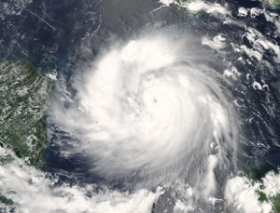
PUERTO CABEZAS, Nicaragua (Reuters) - Bodies of Miskito Indians killed by Hurricane Felix floated in the Caribbean off Central America and washed up on beaches on Thursday as the death toll from the storm rose to over 60.

Many of the dead were traveling by boat when they were hit by huge waves as Felix struck near the border between Honduras and Nicaragua on Tuesday as a giant Category 5 storm.

Other victims appeared to have been sucked away from their flimsy shacks on the shore. Nicaraguan fishermen told reporters they saw bodies of people still tied to trees in a vain bid to stay safe from winds of 160 mph (256 kph) and roaring seas.

"We have at 42 people dead," local Gov. Reynaldo Francis told reporters, adding that he expected that figure to rise. "In Honduras and in our territory on the coast ... more are appearing," he said.

Relatives sheltering in the port of Puerto Cabezas wept as soldiers in small boats carrying emergency food returned from tiny coastal villages and reported inhabitants missing. Others rejoiced as boats brought bedraggled survivors to the port.

The fierce storm struck fear into the local people.

"They told us a hurricane was coming and all the men and women were in their houses crying," said Ana Isolina Alvarado, an indigenous woman arriving from one of the tiny Cayos Miskitos islets in a fishing boat. She took refuge from the storm in the boat after it got trapped in nearby mangroves.

She told a local television channel that four of her family were missing and dozens more from her village.

Up to 25 bodies floated in the sea near the Nicaraguan border on Thursday, the Honduran civil protection agency said.

Reviving memories of Hurricane Mitch, which killed 10,000 people in Central America in 1998, Felix smashed up thousands of flimsy wooden homes in Nicaragua, flattened trees and made barely developed jungle areas even less passable than normal.

It mainly hit the turtle-fishing Miskitos, who formed a British protectorate until the 19th century and still live in wooden shacks in isolated and sparsely populated marshlands dotted with lagoons and crocodile-infested rivers. Some 35,000 of them live in Honduras and more than 100,000 in Nicaragua.


BODIES FLOATING

Aerial images showed the area strewn with debris.

Felix came on the heels of another deadly Category 5 storm, Hurricane Dean -- the first time on record that two Atlantic storms made landfall as Category 5 hurricanes in one season.

An exact number of dead and missing was hard to come by. Nicaraguan President Daniel Ortega said on Wednesday that more than 200 people were missing, but 52 Miskito Indian survivors were later fished out of the sea off Honduras.

"They were holding onto planks and buoys for hours," said local Honduran deputy Carolina Echeverria. The Navy was amazed when it found the Miskito Indians near Raya, close to the Nicaraguan border.

Half the group were in good enough shape to be sent home on a Nicaraguan Navy boat, while the rest were taken to hospitals in Honduras.

Teams of Nicaraguan soldiers distributed food to cut-off villagers surviving on nothing but coconuts.

"We are still waiting for help," a Miskito woman called Lilian told reporters in her coastal hamlet where 2,000 people stood helplessly in the debris of their wrecked homes.

(Additional reporting by Gustavo Palencia in Tegucigalpa and Ivan Castro in Managua)

APEC officials agree on global warming statement

From: Associated Press
Published September 7, 2007

SYDNEY (AP): Pacific Rim nations on Friday reached agreement on a joint statement on global warming, overcoming bickering between rich and poor nations about whether to include targets on emissions, two Asian officials said.

Experts from the 21-member Asia Pacific Economic Cooperation forum approved the wording of a final draft statement on climate change that would be handed to leaders at their summit starting Saturday, the officials said.

If the leaders agree to the statement in it's current form, it would be a big victory for the goal of Australia and the United States to have China - one of the world's biggest polluters ”“ and other developing nations commit to quantifiable goals to tackle climate change.

One official involved in the talks, Indonesia's Salman Al-Farisi, said the draft statement included agreement on setting an "energy intensity" reducing target - a major concession by poorer nations that had earlier refused to consider including any quantifiable goals.

The target was for all 21 APEC members to work toward a 25 percent reduction of energy intensity by 2030, said a Southeast Asian officials involved in the talks, speaking on condition of anonymity because he was not authorized to release the information.

In return for the reduction target, developed countries have accepted the inclusion of recognition of the U.N. principle that poorer nations had fewer responsibilities to cut carbon emissions that developed ones, officials said.

The sides also agreed that the U.N. was the chief place for global negotiations on the problem.

"Everybody cannot get everything, but everybody did not lose too much," Al-Farisi said of the compromise. He stressed that, in line with APEC's consensus-based, non-binding approach, nothing in the agreement was cast in stone.

"It is (up to members') discretion to follow, in accordance to their national programs," he said.

Another Southeast Asian official, speaking on condition of anonymity because he was not authorized to speak to the media, confirmed that agreement had been reached among officials, and the final draft was ready to be handed to the leaders

NOAA study backs up predictions of sea ice loss

From: Associated Press

Sea ice loss in regions of the Arctic is likely to exceed 40 percent by 2050 compared with the 1980s, according to an analysis of ice computer models by researchers at the National Oceanic and Atmospheric Administration.


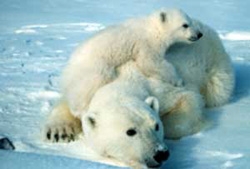
A 40 percent loss of sea ice off Alaska in the Beaufort Sea could have profound effects on marine mammals dependent on the sea ice such as polar bears, now under consideration by the U.S. Fish and Wildlife Service for "threatened" status under the Endangered Species Act because of changes in the animals' habitat from global warming.

Researchers James Overland, an oceanographer at NOAA's Pacific Marine Environmental Laboratory in Seattle, and Muyin Wang, a meteorologist at NOAA's Joint Institute for the Study of the Atmosphere and Ocean at the University of Washington in Seattle, reviewed 20 computer models provided through the International Panel on Climate Change in its fourth assessment report released this year.

The researchers compared those models' projections from 1979 through 1999 with actual sea ice observations and eliminated models deemed to be less reliable.


"About half the models were off, or outliers, in that they had too much ice or too little ice or not enough difference between the ice in the summer or winter compared to the observations of ice we already have," Overland said at a news conference Thursday.

The analysis increases the confidence in projections that greenhouse gas emissions will eliminate 40 percent of Arctic sea ice in summer and winter by the middle of the century, Overland said, based on emissions already in the atmosphere and those pumped out in the next two decades. In the 1980s, sea ice receded 30 to 50 miles each summer off the north coast of Alaska, Overland said.

"Now we're talking about 300 to 500 miles north of Alaska," he said of the projections for 2050.

That's far past the edge of the highly productive waters over the relatively shallow continental shelf off Alaska's north coast, considered important habitat for polar bears and their main prey, ringed seals, plus other ice-dependent mammals such as walrus.

It also will mean a changing ecosystem for commercial fishermen and marine mammals in the Bering Sea, Overland said.

With sea ice present, much of the nutrients produced in the ocean feed simple plankton that bloom and sink to the ocean floor, providing rich habitat for crabs, clams and the mammals that feed off them, including gray whales and walrus.

"If you don't have the ice around, the productivity stays up closer to the surface of the ocean," Overland said. "You actually have a change in the whole ecosystem from one that depends on the animals that live on the bottom to one that depends on the animals that live in the water column. So you have winners and losers."

That could mean short-term gains for salmon and pollock, he said. But it also could mean that fishermen will have to travel farther north to fish in Alaska's productive waters, and warm-water predators might also begin showing up.

Thursday, September 6, 2007

Giant Solar Plant Planned In California Desert

SAN FRANCISCO (Reuters) - BrightSource Energy Inc, a private solar energy company, said on Thursday it filed for a construction permit from the California Energy Commission to build a 400-megawatt solar power plant in the Mojave Desert.

The project would cover between 3,000 and 3,500 acres near the Nevada border about 40 miles southeast of Las Vegas and use solar thermal technology to generate electricity at two 100 MW plants and one 200 MW plant.

The planned technology will use thousands of small mirrors to reflect sunlight on boilers atop 300-foot-tall towers, said Charles Ricker, a senior vice president at BrightSource. The sunlight would heat water to produce steam to run turbines.

The technology was developed by BrightSource subsidiary Luz II, which built power plants in the Mojave in the 1980s.

The site is on land managed by the U.S. Bureau of Land Management and the company has applied to the agency for a right-of-way grant.

BLM already has received right-of-way requests on more than 300,000 acres of California desert for development of about 34 large solar plants totaling 24,000 MW.

That would be about half of the electricity consumed in California on a hot summer day.

BrightSource has responded to power purchase solicitations by three California utilities -- PG&E Corp's Pacific Gas & Electric unit, Edison International's EIX.N Southern California Edison, and San Diego Gas & Electric, a unit of Sempra Energy SRE.N.

Ricker said the project would be built in three stages, with 2010 the target for the first plant. Development costs were not disclosed.

The Oakland-based company said it was working with the California Independent System Operator, which manages 80 percent of the state power grid, to determine availability of transmission lines.

© Reuters 2007. All rights reserved.

Congressional Report: Climate Change Hitting Federal Lands And Waters Hard

From: Deborah Zabarenko, Environment Correspondent, Reuters

WASHINGTON (Reuters) - More beetles and fewer spruce trees in Alaska, whiter coral and fewer scuba-divers in Florida and more wildfires in Arizona already show the impact of climate change on U.S. lands and waters, a congressional watchdog agency reported on Thursday.


But the federal agencies that manage over 600 million acres of federal land -- nearly 30 percent of the land area of the United States -- and more than 150,000 square miles of protected waters have little guidance on how to deal with the effects of global warming, the Government Accountability Office said.

"Undertaking activities that address the effects of climate change is currently not a priority" for the five U.S. agencies that manage this territory, the report by the nonpartisan investigative arm of Congress said.

These agencies are the Bureau of Land Management, Forest Service, Fish and Wildlife Service, National Park Service and the National Oceanic and Atmospheric Administration.

The Interior Department, which includes three of the five agencies, ordered them in 2001 to analyze potential climate change effects on U.S.-managed lands, but has not yet provided direction to managers on how to plan for climate change, the report said.

Resource managers at the other two agencies echoed that sentiment, according to the report.

"Resource managers are uncertain about what actions, if any, they should take to address the current effects of climate change and to plan for future effects on their resources," the report's authors wrote.

DWINDLING GLACIERS, INVADING GRASSES

The authors based their conclusions on discussions with scientists, economists and federal resource managers, and field studies of four federal areas that represent distinct ecosystems.

These are: the Florida Keys National Marine Sanctuary, representing coasts and oceans; the Chugach National Forest in Alaska, representing forests; Glacier National Park in Montana, representing fresh waters; and the Bureau of Land Management's Arizona field office, representing grasslands and shrublands.

In the Florida Keys, they found rising sea levels that can be attributed to climate change have already affected low-lying areas, and saltwater intrusion on land has cut the fresh water and habitat that support native plants and animals.

In the future, the report said global warming may hamper fishing and tourism in this ecosystem, notably by causing coral to bleach, cutting down on fish habitats and lessening the coral's draw for snorkelers and scuba-divers.

Warmer temperatures and reduced precipitation associated with climate change in Alaska's Chugach National Forest have contributed to outbreaks of insects, such as the spruce bark beetles which have killed some kinds of spruce trees over the forest's 400,000 acres, the report said.

In Montana, the glaciers that give Glacier National Park its name are dwindling, down from 150 in 1950 to 26 now, according to the report.

Arizona's Mojave Desert is suffering more virulent wildfires due at least in part to climate change, the report said, because drought has damaged native plants and allowed invasive grasses to take over, making it easier for fires to start and harder to extinguish them.

The Agriculture, Commerce and Interior departments all generally agreed with the report's recommendation to develop clear plans for resource managers at the five agencies, the report said.

Virus called chief suspect in bee death

Carolyn Cole / LAT
Beekeeper Dave Hackenberg of West Milton, Pa., moves hives into an apple orchard for the night. Hackenberg, who sounded one of the earliest alarms, figures he lost more than $460,000 this winter in bees, honey and missed pollination opportunities. “If that happens again, we’re out of business,” he says.
But researchers say they can't yet prove it's the cause of a disease that's killing American bee colonies in record numbers.
By Thomas H. Maugh II, Los Angeles Times Staff Writer

Scientists have found a virus that is associated with the destruction of a large fraction of American commercial bee colonies, but they have not been able to prove that it is the cause of the mysterious disease that has wreaked havoc on the bee industry.

The virus, called Israeli acute paralysis, may have been brought into the United States in bees imported from Australia. That importation was first permitted in 2004, about the same time that the new disease -- called Colony Collapse Disorder, or CCD -- began appearing in this country.

Bee Mystery
Australian bees do not suffer from CCD, leading researchers to speculate that the virus acts synergistically with chemicals in the environment or with another infectious agent, such as the varroa mite, which is not common in Australia.

Experiments are underway to determine which combination of virus and chemical or infectious agent, if any, causes the disease, and researchers hope to have an answer this year. Researchers are also examining archived bee specimens to determine whether the virus was present before 2004.

"Our results indicate that [the virus] is a significant marker for CCD," said Dr. W. Ian Lipkin of Columbia University's Mailman School of Public Health, a coauthor of the report published online today by the journal Science. "The next step is to ascertain whether [the virus], alone or in concert with other factors, can induce CCD in healthy bees."

Entomologist May Berenbaum of the University of Illinois said the new find was "compelling."

But researchers from the U.S. Army's Edgewood Chemical Biological Center in Maryland cautioned that they had unpublished results in which they found the Israeli virus in non-CCD colonies.

Although America has had many bee die-offs in the past, the latest episode has been one of the worst, affecting an estimated 23% of beekeepers. Typically, from 50% to 90% of a keeper's colonies are affected, with the worker bees simply failing to return to their hives, leaving behind the queen and a handful of newborn bees.

Agricultural experts have viewed the deaths with alarm because bees are required to pollinate about a third of the nation's food crops, including almonds, cherries, blueberries, pears, strawberries and pumpkins.

The number of bee colonies in the country is about 2.5 million, down from 5 million in the 1940s and 1950s. "We don't have a great deal of buffer" for dealing with bee losses, said entomologist Diana Cox-Foster of Pennsylvania State University.

In May, scientists from around the country formed a working group led by Cox-Foster and entomologist Jeffery S. Pettis of the U.S. Department of Agriculture to track down the cause of the deaths.

They enlisted virologist Lipkin to look for pathogens infecting the sick bees, using samples from four sick colonies around the United States and healthy colonies from Hawaii and Pennsylvania. Lipkin and his colleagues ground up the bees, extracted RNA, sequenced it and matched the non-honeybee sequences to known databases. The results surprised everybody.

All of the bees, both healthy and sick, had a set of eight distinctive bacteria "that have not been found in any other environment or host," said coauthor Nancy A. Moran of the University of Arizona. "They are all unnamed species about which we know very little. They probably perform essential functions in bees, providing essential nutrients or contributing defenses against pathogens."

Similarly, there was "a remarkably high viral burden in bee populations, both those with CCD and those without it," said coauthor Edward C. Holmes of Penn State University. "There were seven different viruses, but only one was consistently found with CCD."

Israeli acute paralysis virus was found in all the CCD specimens, but in neither of the healthy specimens. It was also present in some bees imported from Australia and in two of four samples of royal jelly imported from China. The imported jelly is normally used as a cosmetic, but some beekeepers feed it to larvae to produce queens.All of the infected colonies, moreover, had bees from Australia or were housed close to bees from that country. U.S. officials are considering reinstating the ban on bees from Australia, Pettis said, but it may be too late to limit the damage already done.

Israeli acute paralysis virus was discovered in 2002 in dead bees from Israeli colonies by virologist Ilan Sela of the University of Jerusalem. In experiments reported this summer, Sela found that injecting the virus into bees killed 98% of recipients within days.

The symptoms in the Israeli bees -- shivering wings, paralysis and death -- are different from those exhibited by American bees. But Holmes speculated that the virus might have undergone slight genetic changes that had altered its pathogenicity.

"We know from other viruses that very small genetic changes can turn a benign virus into a very virulent one," he said.

Or it may be that the symptoms are different in bees whose immune systems are stressed by the varroa mite or by being trucked from farm to farm during the growing season.

The finding does offer one ray of hope. Sela has reported that about 30% of bees he studied in Israel had incorporated the viral genome into their genetic blueprint and had become resistant to the virus. If the virus is shown to be the cause of CCD, it may be possible to replace current bee colonies with hives of resistant specimens.

thomas.maugh@latimes.com

Global warming: Too hot to handle for the BBC

The Independent, UK

Green groups protest after corporation calls off day of programming dedicated to climate change

By Michael McCarthy, Environment Editor

The transformation of climate change from a scientific to a political issue became clear last night when the BBC dropped plans for a day-long TV special on global warming.

The scrapping of Planet Relief, an awareness-raising broadcast similar in concept to programmes such as the poverty-focused Comic Relief and Live8, and planned for early next year, marked a watershed moment: it showed that opining about climate change is now as significant in Britain as scientific fact.

Environmentalists and politicians fiercely criticised the BBC for abandoning the programme, for which Ricky Gervais and Jonathan Ross had been provisionally lined up as presenters. The corporation said that it had decided it was not the BBC's job to lead opinion on the global warming issue. However, critics complained that the effect of the decision was to imply that there was no scientific consensus on the reality of climate change and its human causes, and accused the corporation of being swayed by increasingly vocal climate-change sceptics.

Chris Huhne, Liberal Democrat spokesman on the environment, said: "The consensus about global warming in the science community is now overwhelming, so accusing the BBC of campaigning on such an undisputed threat is like suggesting it should be even-handed between criminals and their victims."

The green activist and author Mark Lynas said that the decision showed "a real poverty of understanding among senior BBC executives about the gravity of the situation we now face.

"The only reason why this became an issue is that there is a small but vociferous group of extreme right-wing climate 'sceptics' lobbying against taking action, so the BBC is behaving like a coward and refusing to take a more consistent stance," he said.

Planet Relief was a working title for the TV special, which was being developed by Jon Plowman, head of BBC Comedy. While the event might have been similar in scale to Comic Relief or Children in Need, it would not have involved fundraising.

It was intended to raise awareness of the issue of climate change. The BBC had been in discussions with the National Grid about the possibility of calling on viewers to participate in a mass electricity "switch-off" or if that had not proved feasible, to turn off the electricity at selected iconic landmarks.

The abandonment of the programme came about after an intense in-house debate about exactly how the corporation should treat the global warming issue, now becoming increasingly politicised in Britain. It could be broadly said that action on climate change, while favoured by many across the political spectrum, has a particular appeal for radical groups, not least because industrial capitalism is seen as being the principal cause of the problem.

By extension, some voices on the right regard it as just another radical cause, oppose it instinctively and seek to cast doubt on its scientific basis. The BBC has been under fire, especially from right-wing commentators, for proselytising in its presentation of some concerns, and some senior executives had doubts about the Planet Relief proposal in particular, suggesting it would leave the corporation open to the charge of bias.

Speaking at the Edinburgh International Television Festival this month, Newsnight's editor, Peter Barron said: "It's abso- lutely not the BBC's job to save the planet." The head of television news, Peter Horrocks, wrote in the BBC News website editor's blog: "It is not the BBC's job to lead opinion or proselytise on this or any other subject."

However, a spokeswoman for BBC1, the channel on which Planet Relief would have been shown, insisted that last night's decision was not made "in light of the recent debate around impartiality." She added: "BBC1 aims to bring a mass audience to contemporary and relevant issues and this includes the topic of climate change.

"Our audiences tell us they are most receptive to documentary or factual-style programming as a means of learning about the issues surrounding this subject, and as part of this learning we have made the decision not to go proceed with the Planet Relief event. Instead we will focus our energies on a range of factual programmes on the important and complex subject of climate change."

Mark Lynas dismissed the argument that Planet Relief was dropped for purely editorial reasons as "PR guff". "This is all to do with the fact that climate change is such a political issue and it's too hot for the BBC to handle," he said. "It's intellectual bankruptcy. The entire scientific community is telling the world that it's the biggest threat to human civilisation. What more evidence do you need?" Tony Juniper, executive director of Friends of the Earth, said the decision was very disappointing "considering the huge potential for the BBC in helping us more quickly make the shift toward a low-carbon society."

Andrew Neil, who presents the Daily Politics and This Week on the BBC, said: "I'm delighted the BBC has cancelled it. Our job is to cover these things, not to comment on them. There's a great danger that on some issues we're becoming a one-party state in which we're meant to have only one kind of view. You don't have to be a climate-change denier to recognise that there's a great range of opinion on the subject."

Fires cast haze over region

sfgate.com

Thursday, September 6, 2007

A flock of pigeons sits under an unusually red sunrise in... Smoke from a forest fire in southern Santa Clara County i... Brush Fire Burns Thousands of Acres. Chronicle Graphic A firefighter from the St. Helena Fire Dept. looks at a s...

(09-06) 09:07 PDT Greenville -- A fire burning more than 200 miles from San Francisco has cast an eerie pall over the Bay Area this morning, making the sun appear red.

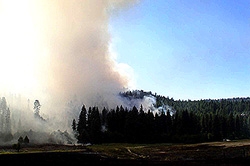
Offshore winds are pushing smoke and haze southwest from a 24,300-acre blaze in Plumas County, near Greenville, said National Weather Service forecaster Brian Tentinger. Much of the smoke from the Moonlight Fire had settled in the Sacramento Valley on Wednesday, but now appears to have spread south away from the capital and into the Bay Area, said Daniel Berlant, a spokesman for the California Department of Forestry and Fire Protection.

"The Plumas (County) fire is burning pretty good and ... blowing all the smoke down to the Bay Area ... the sunlight passing through the smoke and haze makes it do different things," said Tentinger. "(It) should switch back to onshore winds by tomorrow and (the smoke) will start to disperse a little bit this afternoon and evening."

Dennis Perfetto, who lives in San Francisco's Panhandle area, said he was stunned by the red and orange sky this morning.

"It was absolutely beautiful, spectacular," he said. "I looked east about 8 a.m. and I just thought, that's spectacular, then I thought, 'What's causing this?' I figured it was smoke ... It looked like in Hawaii, on the Big Island, when the volcano kicks up."

The rural blaze, which is only eight percent contained, is being fed by windy, dry conditions and low humidity, Berlant said. It has forced the evacuation of 500 homes in Greenville, said Berlant, though the majority of the blaze is in rugged, steep and rural terrain.

"It fanned out to a huge number of acres in a short amount of time," he said.

Firefighters' efforts are also being hampered in Santa Clara County, where about 1,750 people are battling an 18,900-acre fire east of Morgan Hill in Henry W. Coe State Park. Officials said Wednesday that the blaze was caused by an illegal debris burn. Both fires began on Monday.

Henry DeKruyff, a forestry spokesman, said the Santa Clara County blaze, dubbed the Lick Fire, is still only 25 percent contained. Officials are bracing for a rough day, he said, with low humidity also expected to help fan the flames in the South Bay.

"The low humidity is affecting burnout operations and will continue to affect our efforts intensely," he said. "We're expecting significant resistance (today) - the fire is going into a lot of heavy timber and brush."

The large amount of smoke from that fire has also grounded air support this morning, said DeKruyff. Officials hope to get planes and helicopters back up later this morning, he said.

Fire crews are attempting to build 19 miles of fire lines around the blaze, which is still moving east. Twenty-five residences and 10 outbuildings remain in danger, as well as the park's visitor center and several campgrounds. State park officials and archeologists are also working to protect archeological sites in the area, said DeKruyff.

The good news, according to the National Weather Service, is that temperatures are expected to peak today in the low 90s and then drop off a bit tomorrow into the mid-80s.

Felix kills 38 in Nicaragua; survivors wash ashore

From: Oswaldo Rivas -Reuters

PUERTO CABEZAS, Nicaragua (Reuters) - Soldiers searched for more bodies on Thursday after Hurricane Felix killed 38 people in Nicaragua, while 52 members of a group of Miskito Indians washed ashore alive in neighboring Honduras.


Dozens were still missing after Felix tore into Nicaragua's swampy Caribbean coast late on Tuesday, destroying thousands of flimsy homes and making tracks through barely developed jungle areas even less passable than normal.

But local government officials said 52 bedraggled Miskitos, mainly fishermen, washed up in the Honduran port of Raya near the Nicaraguan border after being swept off a tiny island and surviving the storm clinging to boards and lifebuoys.

"Fifty-two Nicaraguan Miskitos, part of the 150 or so that had disappeared, were found in Honduran waters," Carolina Echeverria, a deputy from Cabo Gracias a Dios on the border with Nicaragua, told Reuters by telephone.

"They were holding onto planks and buoys for hours," she said, after speaking to officials in Raya by radio.

She said around half of the survivors were in good enough health to be sent home on Thursday on a Nicaraguan Navy boat, while the other half were being taken to hospital in Honduras for treatment for exposure.

The turtle-fishing Miskito Indians, who live mainly in wooden shacks in isolated marshlands dotted with lagoons and crocodile-infested rivers, were hard hit by Felix. Some 35,000 Miskitos live in Honduras and more than 100,000 in Nicaragua.

Echeverria said the survivors had been on a small key fishing for lobster when the storm approached, and many more may still be unaccounted for.

RIVERS NEAR BURSTING

In Nicaragua, soldiers combed the area around Puerto Cabezas for more casualties while the Navy tried to reach settlements on marshy spits of land or on keys.

Felix crashed into the coast on Tuesday as an extremely powerful Category 5 hurricane but was downgraded to a tropical depression by Wednesday evening as it moved westward and drenched already waterlogged southeastern Mexico with rain.

Nicaraguan disaster prevention chief Col. Ramon Arnesto put the death toll there at 38, with dozens believed missing.

"There are a lot of missing people," he told reporters on Wednesday, as people wept at the harbor in Puerto Cabezas for a dozen fishermen they said had not returned.

Visiting the area on Wednesday, President Daniel Ortega said about 9,000 homes had been destroyed. Residents and soldiers battled to clear the streets of uprooted trees.

"We are talking about really serious damage," Ortega said.

Felix revived memories throughout Central America of Hurricane Mitch, which killed 10,000 people in 1998.

In the early hours of Thursday Felix's eye was grinding through western Honduras, dropping sheets of rain. It left the capital Tegucigalpa relatively unscathed but flooded villages in the north and left rivers close to bursting their banks.

There were no reports of deaths in Honduras but local media said some 25,000 people were evacuated from their homes.

Felix came on the heels of another deadly Category 5 storm, Hurricane Dean, marking the first time on record that two Atlantic storms made landfall as Category 5 hurricanes in one season. Dean killed 27 people in the Caribbean and Mexico.

In Mexico, Hurricane Henriette lost strength as it drenched northern states on Thursday after lashing Los Cabos and killing seven people as it tore through the Gulf of California this week. Two more people were reported dead late on Wednesday in northern Sonora state.

(Additional reporting by Gustavo Palencia and Noel Randewich in Tegucigalpa and Ivan Castro in Managua)

Nuclear industry hails climate-driven "renaissance"

From: Jeremy Lovell -Reuters

wikipedia.org

LONDON (Reuters) - The nuclear power industry said on Thursday it provided a clean alternative to fossil fuels and a global warming crisis, shrugging off environmentalist concerns about nuclear waste and atomic security.


The term "renaissance" was the buzz word as nuclear industry players emerged from the 21-year-long shadow of the Chernobyl nuclear disaster and gathered in London for two days of talks at the 32nd annual symposium of the World Nuclear Association.

"Nuclear power is now a fully competitive electricity source," said WNA chairman Ralf Gueldner. "Today we see the nuclear renaissance begin to reach full bloom."

Nuclear power now provides 16 percent of a world electricity demand predicted to at least keep pace with the 50 percent growth in population expected by 2075 -- and nuclear optimists see that share rising.

Gueldner said he even expected his own country Germany to reverse its current policy of phasing out nuclear power plants.

Scientists predict that global average temperatures will rise by between 1.8 and 4.0 degrees Celsius this century due to carbon gases from burning fossil fuels for power and transport, bring climatic and humanitarian disasters.

As the world wakes up to the threat governments are seeking to curb carbon emissions through clean sources of power that do not harm economic growth.

The nuclear power industry, despite environmentalists' worries about security, nuclear weapons proliferation and the fact that nuclear waste remains deadly for thousands of years, sees itself as an obvious choice.

"The prospects for nuclear energy are more promising today than at any time since its development," said Dennis Spurgeon, U.S. Assistant Secretary for Nuclear Energy, who also termed it a "global renaissance."

"There is now a worldwide momentum for the expansion of nuclear power."

At present there are some 429 reactors operating globally, with 25 more under construction, 76 planned and 162 proposed.

Coal-rich China, which is building a coal-fired power station a week to fuel its booming economy, has also embarked on a major nuclear power program.

International Atomic Energy Agency head Mohamed ElBaradei said nuclear power had a role with 1.6 billion people without any access to electricity and the developed world using 170 times more electric power than the developing nations.

But he said the world had to guard "relentlessly" against the dangers of weapons proliferation.

"Nuclear power can't be an exclusive solution for wealthy nations," he said. "But the challenges of introducing nuclear power in developing countries are formidable."

Environmentalist James Lovelock, who outraged the green movement several years ago by saying nuclear power had a role to play, introduced a more somber note to the gathering.

"World systems are already in failure mode," he said. "The world itself is in no danger and we as a species will probably survive. What is at risk is our civilization."

Cutting carbon emissions would, like a kidney failure patient on dialysis, buy time. But temperatures would inevitable rise bringing floods and famines and forcing the surviving humans into isolated areas until the planet recovered.

Norway says cars neither "green" nor "clean"

From: Alister Doyle -Reuters

OSLO (Reuters) - No car can be "green," "clean" or "environmentally friendly," according to some of the world's strictest advertising guidelines set to enter into force in Norway next month.

"Cars cannot do anything good for the environment except less damage than others," Bente Oeverli, a senior official at the office of the state-run Consumer Ombudsman, told Reuters on Thursday.

Carmakers such as Toyota, General Motor's Opel, Mitsubishi, Peugeot Citroen, Saab and Suzuki had all used phrases this year in advertisements that the watchdog judged misleading, she said.

One Toyota advertisement for a Prius, for instance, described the gasoline-electric hybrid as "the world's most environmentally friendly car."

"If someone says their car is more 'green' or 'environmentally friendly' than others then they would have to be able to document it in every aspect from production, to emissions, to energy use, to recycling," she said.

"In practice that can't be done," she said of tougher guidelines entering into force in Norway from October 15.

The guidelines distributed to carmakers said: "We ask that ... phrases such as 'environmentally friendly', 'green', 'clean', 'environmental car', 'natural' or similar descriptions not be used in marketing cars."

Carmakers would risk fines if they failed to drop the words. Oeverli said she did not know of other countries going so far in cracking down on cars and the environment.

UTMOST RESPECT?

In one ruling abroad, for instance, Britain's advertising watchdog said that Volvo advertisements should not repeat a claim that its C30 car was "designed with the utmost respect for the environment in mind."

Oeverli said carmakers, who are making huge investments in cleaning up emissions, seemed happy to get clearer rules about advertising. In future in Norway, they could only give information that could be firmly documented.

That meant that even phrases such as "Car X has low emissions of carbon dioxide," the main greenhouse gas released by burning oil, should be avoided.

The watchdog argued that mentioning carbon dioxide alone could mislead buyers into believing that the car also had low emissions of toxic nitrous oxide or other polluting particles.

Transport, mainly trucks and cars, accounts for about a fifth of all greenhouse gas emissions from human sources, widely blamed for stoking a warming that could bring more floods, desertification, heatwaves and rising seas.

APEC rift opens over climate change deba

From: Bill Tarrant -Reuters

SYDNEY (Reuters) - Leaders at an Asia-Pacific summit appeared deadlocked on Thursday over what their "Sydney declaration" on climate change and cutting greenhouse gas emissions should say.

China's President Hu Jintao gave only qualified support to Australia's initiative on climate change, while some developing nations criticized Australian and U.S. moves to put climate change at the top of the agenda of the APEC gathering in Sydney.

Hu told a rare news conference after meeting Australian Prime Minister John Howard that he preferred the U.N. framework for handling climate change proposals.

"We very much hope that this Sydney Declaration will give full expression to the position that the U.N. Framework Convention on Climate Change would remain the main channel for international efforts to tackle climate change," Hu said.

The declaration should also reflect U.N. principles of "common but differentiated responsibilities" towards lowering harmful greenhouse gas emissions, he added.

Malaysia Trade Minister Rafidah Aziz said APEC should not be dealing with emission targets at all.

"I'm saying it is not the place to discuss the whys and the wherefores of climate change and what kind of agreement and so on. It should be the U.N. and the appropriate forums," she told Malaysian journalists.

"We don't want people to use climate change as an issue to target certain countries or penalize certain countries."

Ministers from the Philippines and Indonesia have also questioned the approach.

A major meeting of top officials from around the world under the U.N. framework is set for Indonesia's Bali in December. Governments hope environment ministers will launch a two-year series of talks to find a replacement for the Kyoto agreement.

ASPIRATIONAL TARGETS

Australia, as host of the Asia Pacific Economic Cooperation forum, has put climate change at the top of the agenda.

Its draft declaration calls for a new global framework that would include "aspirational" targets for all APEC members on lowering greenhouse gas emissions, which scientists say is causing the climate to change.

Australia, backed by the United States, says the Kyoto protocol, the world's main climate change treaty, is flawed because it does not commit big polluters in the developing world, such as India and China, to the same kind of targets as industrialized nations.

That approach is getting a decidedly lukewarm response at the APEC meeting from China and developing countries, which prefer to see the whole issue handled under the U.N. framework.

Kyoto's first phase runs out in 2012 and the APEC summit is one of a growing number of efforts to find a formula that brings rich and developing countries together on climate change.

FORTRESS SYDNEY

Hu met U.S. President George W. Bush later in the day and talked about China's currency, whose weakness has been an irritant in Sino-U.S. relations.

After an hour-and-a-half meeting with Hu, Bush said: "We talked about Iran and North Korea and Sudan. We talked about climate change and our desire to work together on climate change."

Hu has had a warm reception since his arrival in Australia on Monday, when he visited the mining-rich state of Western Australia before heading to Canberra and a tour of a sheep farm.

But in Sydney, religious group Falun Gong staged a protest against China's human rights record that attracted more than a thousand people in Sydney's Hyde Park.

Australia has launched its biggest ever security operation in Sydney to welcome the 21 leaders attending this week's APEC meetings. Newspapers have dubbed the city of more than 4 million people "Fortress Sydney".

At his news conference, Hu said China was ready to boost international cooperation to ensure its export products met appropriate safety standards.

Food safety was also highlighted at the APEC ministerial meeting, which established an APEC Food Safety Cooperation forum, co-chaired by Australia and China.

The initiative aims to harmonize APEC members' food safety regulations with international standards, among other things, and to explore ways to expand this work to include other products.

(Additional reporting by John Ruwitch, Jalil Hamid, Matt Spetalnick and Richard Pullin)

Video

"Manufactured Landscapes" SEE THIS BRILLIANT MOVIE! You'll never have the same shopping experience again.