Wednesday, September 5, 2007

Delta Ecosystem Collapse: California Must Find an Alternative Water Source Say Fishermen

From: Pacific Coast Federation of Fishermen’s Associations

San Francisco, CA ”“ The most important estuary on the west coast of North and South America is in immediate danger of ecological collapse if water diversions are not sharply cut, a commercial fishing organization warned today.


On the heels of a Federal Court decision last Friday in Fresno ”“ ordering a reduction in diversions from the Sacramento-San Joaquin Delta - the Pacific Coast Federation of Fishermen’s Associations (PCFFA) today called on the Governor and Legislature to begin developing alternatives to Delta water in order to save the fish of the estuary and finally provide the state with a reliable water supply.

“Judge Oliver Wanger’s ruling should have come as no surprise to anyone who’s been paying attention to water and the environment in California,”said Pietro Parravano, a Half Moon Bay fisherman who served on the State’s Bay-Delta Advisory Committee and was a member of the Pew Oceans Commission. “We were warned twenty years ago - following hearings by the State Water Board - the Delta was being over drafted by an average 1.6 million acre-feet a year.

In recent years that overdraft was probably much higher. Is it any surprise fish populations are collapsing?”asked Parravano.

The fishing group accused California administrations over the past two decades, as well as the Legislature and water leaders, of being in a state of denial, thinking they could continue, or even increase the levels of diversions from the Delta and its tributaries without anyone noticing the destruction to the environment.

“They just kept denying the problem and finding ploys to study away the clear science that estuaries ”“ our most biologically productive water bodies ”“ require freshwater inflow,” continued Parravano. “They were no different than the tobacco industry that denied the relationship between smoking and lung cancer, or the oil and coal industries that denied the link between greenhouse gasses and global warming. It’s seemed like denial was the biggest river in California.”

“It’s not just the Delta and longfin smelt that are in trouble here,” said Larry Collins, president of San Francisco’s Crab Boat Owners Association. “The lower than predicted salmon returns to the Sacramento River last year, when there was almost no fishing, and the poor catches so far this year may mean that the west coast’s second largest salmon run - that migrates from the Pacific through the Bay and Delta to the Sierra streams - is also feeling the impact of a collapsing Delta.”

In addition to the Central Valley’s Chinook salmon, that supplies 90 percent of California’s catch and provide the majority of salmon taken offshore Oregon and Washington as well, the Bay and Delta provide one of the largest nursery areas for Dungeness crab, and is home to the largest herring fishery south of British Columbia. The Bay and Delta, too, have historically supported large recreational fisheries for sturgeon, striped bass and shad. PCFFA warns all this could be lost if steps are not taken to save the Delta.

Collins said he welcomed the leadership of the Governor on the water issue, but warned that a peripheral canal and reservoirs are not the answer.

“We need 21st century solutions, not the failed ideas of the 1950’s like reservoirs that lose much of their water to evaporation or an isolated canal stealing high quality Sacramento River water from the Delta.” Collins had harsh words for the Peripheral Canal, which was first proposed to help save fish nearly 50 years ago when the State was considering barriers in the Delta blocking fish passage. “What we’ve learned over the years is that the water agencies ”“ and I don’t care if they’re state or federal - can’t be trusted,”Collins emphasized. “In 1992 we were promised 800,000 acre-feet of water each year under the Central Valley Project Improvement Act for fish and wildlife. Well we’ve had to fight each year to get it and often don’t and then they [Bureau of Reclamation] steal it in the Delta before it ever gets to the Bay.”

Collins continued, “as for the state, it’s hasn’t even offered to make up its half of the 1.6 million acre deficit. And, you want us to trust them to make releases from a canal for the Delta? Forget it! Once it’s in that canal, its headed straight south to the big water contractors on the Westside of the San Joaquin and Southern California.”

More than half of all Californians currently depend on the Delta or its tributaries for their drinking water. The Delta’s watershed provides the flows to irrigate Central Valley agriculture.

Even without the fishery and environmental concerns, the fishing group warns the Delta is an increasing unreliable water source. Predictions are, with global warming, the Sierra snow pack whose melt provides flow to the Delta will be substantially less. Sea level rise will exacerbate saltwater intrusion into the Delta. Moreover, the fishing group says, the area is vulnerable to a major Earthquake affecting its levies and water delivery infrastructure. Developing alternative sources to the Delta, they say, is the only way to ensure a dependable water supply for the state.

PCFFA’s Executive Director, Zeke Grader, who serves on the State’s “Delta Vision” Blue Ribbon Stakeholder Committee said the State should look first to the California Water Plan Update

“Providing assistance to communities and agriculture to save water is one of the most effective and least expensive things we can do right now,” said Grader. “We don’t need expensive reservoirs that will be useless in any kind of prolonged drought, or a $26 billion dollar Peripheral Canal, euphemistically called an ”˜isolated facility.’”

Grader said water recycling and reuse is also more cost effective than new reservoirs and a canal and could help to curb sources of polluted runoff. He said reestablishing flood plains, to allow rivers places to go during winter high flows, coupled with incentives for groundwater recharge would be the best way of using nature’s “natural storage - instead of environmentally damaging surface reservoirs that lose supply to evaporation. Groundwater recharge will also help to maintain stream flows.


“Finally,”Grader said, “it’s time to stop wasting money studying again and again ill-advised reservoirs and canals and invest in research for the development of environmentally friendly desalination systems.” The fishermen recommend the state provide seed money to some of its best universities for research to make California the world leader in desalination technology, much as it is doing with stem cell research. Desalination, Grader said, is California’s hedge against multi-year droughts - a way to keep water in stream for fish and to maintain flows to farms for prudent irrigation practices.

“We have a huge water resource in our front yard, called the Pacific Ocean,” said Grader. “Investing in research we should be able to take water safely from the ocean, utilize solar energy - which is in ample supply in much of the state - to remove the salts from the water, and then develop a use for that salt or safely store it.”

The fishing group mentioned beach wells as an example of a safe intake system for desalination plants. They suggested piping seawater inland where there is ample sunlight for solar powered desalination could do the desalination process itself. The waste brines they say could then be dried and safely stored, in lieu of potentially toxic discharges back into the ocean. Dual use facilities such as combination wave energy and desalination processes they say should be considered, too, in the mix of alternative water sources.

Parravano concluded for the group, saying, “It’s not enough for California to reduce its carbon footprint, leadership also means preparing for impacts from global warming that we can’t avoid. Part of that is preparedness is water planning. We’re not going to solve California’s water crisis, or save its fish by trying to repackage bad old ideas calling it ”˜thinking outside the box.’ A true solution requires bold vision and leadership. It also requires the ability to understand the basic principle that water is necessary to sustain California’s fisheries and coastal communities.”

Search for Water Gets Harder in U.S. Southwest

From: Nick Carey, Reuters
Originally Published June 20, 2007

FLAGSTAFF, Arizona -- Like many towns in this part of the arid U.S. Southwest, Flagstaff faces a never-ending challenge in its search for water, and it is getting harder.

"Eight years of drought conditions and a growing population haven't helped," said Randy Pellatz, the assistant director of utilities for the city of Flagstaff.

The heavily forested, mountain town of Flagstaff has grown to 62,000 people from 45,000 in 1990, straining its water resources. Upper Lake Mary, a man-made reservoir that provides up to 40 percent of the town's water needs of 11 million gallons a day, is down to 18 percent of normal levels.

Mark Shiery of Flagstaff's fire department said the area is up to three years behind normal precipitation levels, heightening the risk of forest fire in this high desert town.

"Wild fire is the single biggest threat we face," he said.

It is a stark puzzle: how to provide water for a growing population in desert or near-desert conditions. Then add in the long drought.

"As the population rises in the Southwest, the water system is on a slippery slope toward breaking point," said Mark Svoboda, a climatologist at the U.S. National Drought Mitigation Center at the University of Nebraska-Lincoln.

THIRSTY NOW, BUT BOOM ONLY BEGUN?

The U.S. Census Bureau projects California's population will rise to more than 46 million by 2030 from 36.5 million now, while Arizona and Nevada will nearly double to 10.7 million and 4.3 million people, respectively.

Arizona already is the fastest-growing U.S. state, up nearly 70 percent from 1990 to about 6.2 million in 2006.

The projected growth will put further pressure -- from cities and agriculture -- on the Colorado River, the region's lifeline. The river is reduced to a trickle when it reaches the Gulf of California in Mexico.

"Right now, no one's getting any surplus water. But there are no shortages yet," said Bob Walsh, Lower Colorado Region spokesman of the U.S. Bureau of Reclamation, the government agency overseeing water rights in the 17 western U.S. states.

"That should continue for a few years before we begin to stretch the existing supply," Walsh said.

Some scientists warn global warming will worsen the situation. A study published in the journal Science in April projected that the Southwest, with its fast-growing cities, could by 2030 face baking Dust Bowl conditions like those that blew away topsoils in the Great Plains a hundred years before.

"BLUE GOLD" FOR DESERT BOOM TOWNS

Even without the specter of global warming, desert towns already focus on conservation, water recycling, drilling new wells and buying fresh water from anyone who has a surplus.

Towns like Bullhead City, Arizona, have seen a boom in recent decades as retirees and second-home owners have sought to escape harsh northern winters.

Just across the Colorado River from the casino town of Laughlin, Nevada, Bullhead City has grown to 40,000 people from just 10,000 in the mid-1980s -- and planners say it may hit 100,000 in another 30 years.

"Right now, we have a cushion with our water allocation from the river," said Janice Paul, Bullhead City's development services director. "But we will not have anywhere near enough water to support that kind of population without significant changes to water use."

She said within a few years water rationing would likely be enforced with fines.

During the current long drought, the Colorado River has seen below-normal snow runoff for five consecutive years. It's snow in the mountains more than rain that matters here.

The seven states along the river -- Colorado, New Mexico, Utah, Wyoming, Arizona, California and Nevada -- reached a new deal in April on sharing water during the drought. The deal is awaiting approval from the U.S. Department of the Interior.

NO WASTING WASTE WATER

Flagstaff, further from the Colorado River than Bullhead City, already enforces water restrictions and fines. The town's two 18-hole golf courses use recycled waste water.

Flagstaff also recently bought water rights at a site called Red Gap Ranch, 35 miles away.

But the site "unfortunately is downhill from us, so we'll be pumping it uphill all the way," said Flagstaff city council member Joe Haughey. "That won't come cheap."

Flagstaff may also buy Colorado River water rights and try to obtain water from the nearby Hopi and Navajo reservations.

Navajo President Joe Shirley said water could be sold from the vast reservation, part of the Colorado and Little Colorado River water systems. But the tribe lacks funds to drill for what he called "blue gold."

Any deal with towns like Flagstaff should involve paying to have water pipes built to serve Navajos who "live in Third World conditions without running water," he said.

"We're open to discussion," Shirley said. "We're not going anywhere, and right now neither is our water."

(additional reporting by Tim Gaynor in Phoenix)


Source: Reuters

Calif. Heat Wave Blamed for 14 Deaths

Scorching heat that has gripped Southern California for more than a week is responsible for at least 14 deaths, authorities said Tuesday.

Temperatures were down slightly Tuesday as the heat wave entered its eighth day, with a high of 101 degrees reported in Los Angeles.

Authorities reported finding bodies in vehicles and apartments. Twelve of the deaths occurred in Los Angeles County and two in San Bernardino County, authorities said. With the death toll climbing, officials urged caution.

"If you have elderly relatives or neighbors, do everything you can to check in on them as often as possible, make sure that they're OK during this heat wave," Mayor Antonio Villaraigosa said.

In Los Angeles, an elderly couple were found dead in their San Fernando Valley apartment Monday, authorities said. Temperatures of 106 degrees were reported in the area in recent days.

Apartment manager Sheila Friedman said that paramedics told her it was 110 degrees inside the third-floor unit, and that she believed the couple kept their air conditioner off to cut costs.

Meanwhile, San Bernardino County sheriff's deputies found a man's body on the Marine Corps base in Twentynine Palms on Sunday. His dehydrated and sunburned friend reported the man, identified as of Michael Cuhna of Hesperia, as missing a day earlier, the Sheriff's Department said.

The friend told police the two were separated while illegally gathering scrap metal from the base. A preliminary coroner's report found Cuhna died of exposure and dehydration.

Elsewhere in San Bernardino County, a 47-year-old woman whose vehicle got stuck in the sand in a desert area was found dead Saturday, according to county deputy coroner Chalone Rhea.

Throughout Southern California, utility crews struggled to restore electricity as increased air conditioner use strained power grids.

About 29,000 homes were without power in 15 counties, including Los Angeles, Orange, Ventura, Riverside and San Bernardino counties, said Paul Klein, spokesman for Southern California Edison.

The outages were caused by equipment failures rather than power shortages, Klein added, meaning rolling blackouts were not expected.

Another 18,000 homes in the Los Angeles area were dark Tuesday night, said MaryAnne Pierson, a spokeswoman for the city's Department of Water and Power.

Near-record demand was causing transformers to pop and other electrical equipment to fail. People returning from vacations and businesses starting up after Labor Day put additional pressure on the grid, officials said.

Scientists Say Global Warming To Hit Africa Hardest

From: Paul Simao, Reuters

PRETORIA (Reuters) - Africa will suffer the most if the world fails to reduce global warming, with parts of the impoverished continent becoming uncultivable or uninhabitable, top British government scientists said on Wednesday.


In a presentation in Pretoria, David King, the British government's chief scientific adviser, warned climate change, if unchecked, would lead to worsening drought in Africa as well as flooding along much of its coastline.


He said an additional 70 million Africans could be at risk of hunger by the 2080s as a result of continued global warming -- temperatures in Africa have risen by about 0.7 degrees Celsius during the last century.


"This is the continent that will come under the most severe pressure from climate change," King told academics and media.


Gordon Conway, the chief scientific adviser for Britain's department for international development, said the current trend in Africa's climate was characterized by polarized change. "It's going to get wetter and drier," Conway told the group.

They urged Africa to make climate change a top priority and the international community to do a better job of sharing technology and skills with what they described as a key battleground in the global warming debate.


Britain has taken a leading role in pushing for a global agreement by 2009 to cut carbon dioxide emissions, the so-called greenhouse gases that are the biggest contributor to the warming of the planet.


Although consensus is building on the need for action, the United States and China, the top two emitters, are among those that have expressed reservations about how a global agreement would be implemented.


President George W. Bush agreed at the Group of Eight summit in June that substantial cuts in greenhouse gas emissions were warranted but stopped short of defining what the United States considered an appropriate reduction.


The European Union, Japan and Canada have all talked about a need to halve world emissions by 2050 to slow warming.


"We have managed to push the point along, but without American leadership it is going to be a struggle," King said.


There is growing support for the "Bali road map," a two-year plan agreed in Indonesia that aims to follow up on the United Nations' Kyoto Protocol, which obliges 35 industrial nations to cut emissions by 5 percent below 1990 levels by 2008-2012.


Among the proposals likely to spark intense debate is one by developing nations with large areas of forest to have wealthy nations that have contributed the most to climate change compensate them for keeping their forests intact.


© Reuters 2007. All rights reserved.

Tuesday, September 4, 2007

Loss of Arctic ice leaves experts stunned

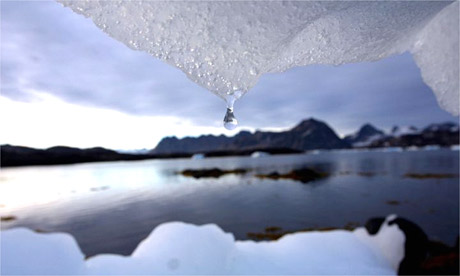
A melting iceberg

An iceberg melts in Kulusuk, Greenland near the Arctic circle. Photo: John McConnico/AP

The Arctic ice cap has collapsed at an unprecedented rate this summer and levels of sea ice in the region now stand at record lows, scientists have announced.

Experts say they are "stunned" by the loss of ice, with an area almost twice as big as the UK disappearing in the last week alone.

So much ice has melted this summer that the Northwest passage across the top of Canada is fully navigable, and observers say the Northeast passage along Russia's Arctic coast could open later this month.

If the increased rate of melting continues, the summertime Arctic could be totally free of ice by 2030.

Mark Serreze, an Arctic specialist at the US National Snow and Ice Data Centre at Colorado University in Denver, said: "It's amazing. It's simply fallen off a cliff and we're still losing ice."

The Arctic has now lost about a third of its ice since satellite measurements began thirty years ago, and the rate of loss has accelerated sharply since 2002.

Dr Serreze said: "If you asked me a couple of years ago when the Arctic could lose all of its ice then I would have said 2100, or 2070 maybe. But now I think that 2030 is a reasonable estimate. It seems that the Arctic is going to be a very different place within our lifetimes, and certainly within our childrens' lifetimes."

The new figures show that sea ice extent is currently down to 4.4m square kilometres (1.7m square miles) and still falling.

The previous record low was 5.3m square kilometres in September 2005. From 1979 to 2000 the average sea ice extent was 7.7m square kilometres.

The sea ice usually melts in the Arctic summer and freezes again in the winter. But Dr Serreze said that would be difficult this year.

"This summer we've got all this open water and added heat going into the ocean. That is going to make it much harder for the ice to grow back."

Changes in wind and ocean circulation patterns can help reduce sea ice extent, but Dr Serreze said the main culprit was man-made global warming.

"The rules are starting to change and what's changing the rules is the input of greenhouse gases."

Southern California heat wave expected to break after today


Staying cool
Wally Skalij / LAT
Narda Esperanza, 11, along with her brothers Paul, 6, and Jose, 2, pour water on each other to cool off in downtown Los Angeles.
By Jesus Sanchez, Los Angeles Times Staff Writer
9:16 AM PDT, September 4, 2007
Southern California is expected to wither under more baking temperatures today before a weeklong heat wave finally gives way to cooler weather by midweek.

Temperatures will generally be lower today than they were over the holiday weekend, but conditions will remain hot, with highs expected from the mid-70s to the low 80s at the beaches to the low 90s in downtown Los Angeles and up to 106 in the Santa Clarita Valley, according to the National Weather Service.

SoCal presses to stay cool
It will be significantly cooler beginning Wednesday, according to forecasters, who predict high temperatures will drop by 10 degrees or more across much of the region.

The cool-down will bring a sigh of relief to firefighters battling several brush fires across the region and utility crews trying to restore power to thousands of residents.

East of Santa Clarita, firefighters endured 107-degree heat as they struggled to contain a blaze that had scorched 700 acres of steep, densely vegetated terrain in Angeles National Forest The fire flared Monday afternoon, doubling in size and prompting voluntary evacuations of 25 homes, said Bruce Quintelier, a spokesman for the U.S. Forest Service.

Using water-dropping aircraft, firefighters had the blaze 20% contained by Monday evening, Quintelier said. But given the continuing heat and dry conditions, the fire was a long way from containment, he said.

The fire's cause was under investigation.

About 275 firefighters had more cooperative conditions as they battled an 85-acre blaze at the east end of Big Bear Lake in San Bernardino National Forest. Crews had the fire 95% contained, but they evacuated two campgrounds and closed a five-mile stretch of California 18.

The heat wave knocked out power to more than 24,000 customers Monday.

Southwest Forecast: Expect 90 Years of Drought


Andrea Thompson, LiveScience Staff Writer

originally posted: 05 April 2007 02:00 pm ET

Human-induced change in Earth's atmosphere will leave the American Southwest in perpetual drought for the next 90 years, a new study finds.

Conditions in the southwestern states and portions of northern Mexico will be similar to those seen during a severe multiyear drought in the southwest during the 1950s and the drought that turned the Great Plains into the Dust Bowl in the 1930s.

The southern United States lies in a climatic region called the subtropics, which is dry because “the atmosphere moves water out of those regions,” explained study team leader Richard Seager of Columbia University's Lamont Doherty Earth Observatory.

The moist air is transported to temperate regions at higher latitudes. The study, published in the April 5 issue of the journal Science, found that as greenhouse gases warm the air, it can hold more moisture, so the atmospheric flow moves more water vapor out of subtropical zones and into higher latitudes. The dry areas then become drier, and the wet become wetter.

This flow, known as the Hadley cell, features rising air over the equator and descending air over the subtropics, which suppresses precipitation.

“And that Hadley cell, in a warming world, expands poleward,” Seager said, bringing the U.S. Southwest more under the influence of the descending air.

Similar changes in the atmosphere produced past droughts and conditions such as the Dust Bowl, but the study found that the ultimate cause of historic droughts was natural, unlike this projected drought. During those droughts, La Niña, El Niño’s cool-water counterpart, brought cooler ocean temperatures to the equatorial Pacific, which resulted in drier conditions over North America.

The researchers used climate models to determine the level of drought based on the amount of evaporation at the ground subtracted from the amount of precipitation that falls at the surface.

The balance between these two processes is what maintains rivers and groundwater flow. As less water is available, water resources become jeopardized.

“The lifeline there is the Colorado River,” Seager said, and it and other rivers are already stressed by the 10th year of drought in the Southwest.

As populations in the Southwest increase, governments will have to make adjustments to reduce water usage, but Seager and others unsure just what those changes should be.

Vatican agrees to a carbon offset scheme

International Herald Tribune, France
By Elisabeth Rosenthal

TISZAKESZI, Hungary: This summer the cardinals at the Vatican accepted an unusual donation from a Hungarian start-up called Klimafa: The company said it would plant trees to restore an ancient forest on a denuded island by the Tizsa River to offset the Vatican's carbon emissions.

The young trees, on a 15-hectare, or 37-acre, tract of land that will be renamed the "Vatican Climate Forest" will in theory absorb as much carbon dioxide as the Vatican makes through its various activities in 2007: driving cars, heating offices, lighting St. Peters Basilica at night.

In so doing, the Vatican announced, it would become the world's first carbon-neutral state.

"As the Holy Father, Pope Benedict XVI, recently stated, the international community needs to respect and encourage a 'green culture,' " said Cardinal Paul Poupard, head of the Pontifical Council for Culture, who took part in a ceremony marking the event at the Vatican. "The Book of Genesis tell us of a beginning in which God placed man as guardian over the earth to make it fruitful."

The Vatican, which has recently made an effort to go green on its own by installing solar panels, sought to set an example by offsetting its carbon emissions.

Hungary, whose government scientists are consulting on the project, will take over large swaths of environmentally degraded, abandoned land restored as a native forest. That will have a beneficial effect on the climate there, and provide jobs in a economically depressed area, as well.

Klimafa, an 18-month-old company, gets the Vatican's seal of approval and a lot of free publicity for its first project. In addition to the Vatican's 15 hectares, several European governments as well as Dell, the computer maker, have purchased carbon offsets, which will be backed by tree planting on the 225-hectare island.

"It seems so obvious, but no one was doing it," said David Gazdag, a former medical doctor who brokered the project, with backing from his San Francisco parent company, Planktos International.

But creating and selling carbon "offsets" or "credits" is still a novel concept for both business and science, and many controversies remain. The calculation for tree planting in particular is complicated.

Planting forests is only "a partial solution, and a temporary one," said Laszlo Galhidy, forestry officer for the environmental group WWF Hungary, although he praised the project as a useful step.

Young forests - dominated by growing trees - soak up lots of carbon dioxide, but once the forests mature, they absorb far less, he said.

Also, "carbon credits" are not a hard currency like a euro or a Hungarian forint, but something far more nebulous, like a stock market future. There is no scientific system for predicting the exact carbon absorbing capacity of a project like the Vatican Forest, whose trajectory depends on rainfall, temperature and how fast trees grow.

Finally, man increases his polluting activities faster than he can offset them.

"Planting forests will only compensate for a small fraction of emissions, even if you cover all of Hungary in young trees," Galhidy said.

Gazdag acknowledges that carbon offsetting is not an exact science. "People have only been thinking about offsetting for about 10 years," he said.

But he and others say that market mechanisms created by the Kyoto Protocol and the European Union at least force polluters to pay in some form for the emissions they create.

Kyoto and the European Union's Cap and Trade scheme set emissions targets for countries or large companies. Those that exceed their allowances - emitting too much carbon - need to purchase "carbon credits" from countries or companies that do not need their allotment or from companies like Klimafa that create credits through green projects like planting trees.

On the EU market, carbon credits are trading at about €21, or $28; one credit counters one ton of emitted carbon dioxide. Klimafa says its donation to the Vatican is worth about €100,000.

Some U.S. companies, like Dell, voluntarily purchase credits as a sign of their environmental commitment even though there is currently no U.S. law that requires them to do so.

Within Europe, the EU scheme allows for a much needed transfer of money from the more developed countries of Western Europe to the new economies of the East. Countries and companies in the West tend to exceed their allowance, whereas Eastern countries tend to have excess credits to sell since so many polluting Communist-era factories have been shut.

Also, many of the former Eastern Bloc countries had to decommission farmland to join the European Union in accordance with EU agricultural policy. In Hungary, as in other new member states, huge tracts of marginal fields have been repurchased by the government from farmers and are readily available for reforesting.

The island that will host Klimafa's first eco-restoration project, originally called "Forest Island," was cleared in the Middle Ages, though it is on a flood plain and has always been risky to farm.

Klimafa is also negotiating for nine more projects in Hungary as well as others in Bulgaria and Romania.

The island is now a mix of tangled weeds, wetlands, a lake and a few fields of corn that farmers are planting illegally even though they no longer own the land. Much of the island is a jumble of goldenrod and amorpha fruticosa - a tree-like weed that grows like wildfire.

The plant "doesn't sequester much, and it is not stable since it has little biodiversity since it is mostly two or three species," said Gergely Torda, a plant biologist from the Hungarian Academy of Sciences, who is consulting on the project. "It is deforested enough that you pretty much have to start from scratch to restore the native forest."

He scans the land as a blank canvas, describing plans for what will be planted where.

Later this year, Klimafa will begin clearing the weeds, using local labor, and then start environmentally sensitive planting of saplings that are native and will thrive in the local environment. These include willows, beeches, ash, certain poplars and oaks. The growing forest will absorb 10 times the carbon that the land currently absorbs, and will be self-sustaining, Torda said.

Klimafa has been given the right to restore the land by the Bukk National Park, which owns it; costs will be covered by carbon credit purchases.

Torda notes that it will take 50 to 150 years to produce a mature forest. Once that happens it will be less effective, since mature forests contain decaying trees that release CO2, as well as growing trees that absorb it. Also, there are pitfalls that will need to be avoided. Too much plowing, for example, releases carbon from the soil, which reduces the beneficial effect.

In some carbon credit projects, for example in Indonesia, the draining and plowing of peatland to make way for tree planting released so much carbon (peat is rich in the element) that it canceled the effect of the later planting of palm trees, according to Wetlands International. But the soil on the Hungarian island now is dry and low in carbon.

The world of carbon credits is filled with untested projects. For example, Planktos, Klimafa's San Francisco-based parent company, plans to seed an area in the Pacific with iron to stimulate the growth of carbon-eating algae.

After the Vatican agreement was announced, Monsignor Melchor Sánchez de Toca Alameda, an official at the Vatican's Council for Culture, told the Catholic News Service that buying credits was like doing penance: "One can emit less CO2 by not using heating and not driving a car or one can do penance by intervening to offset emissions, in this case by planting trees," he said.

But some critics derided the Vatican for planting trees rather than trying to rein in energy use in Rome. The Vatican did not have to pay anything for the Klimafa program, although the donation is only for 2007, and does not cover air travel.

Just last week, the Vatican began sponsoring low-cost flights for pilgrims from Rome to holy sites like Lourdes ("More convenient than a 22-hour train ride!" one priest said on Italian television.) Plane travel is hugely polluting.

Sydney protest peaceful ahead of Bush's APEC visit

From: Michael Perry -Reuters

SYDNEY (Reuters) - The first APEC protest was staged in Sydney on Tuesday, hours before U.S. President George W. Bush was due to arrive for a summit of 21 Asia-Pacific leaders, but police and media far outnumbered activists.

Chanting "Bush go home", "Out of Iraq" and "Go Back to Texas now", about 100 protesters staged a peaceful but noisy demonstration outside Sydney's main railway station.

Ringed and photographed by police, protesters waved anti-Iraq war and anti-Bush posters, while a tall black and white skeleton puppet danced as rush-hour commuters headed home.

"We cannot sit on the sidelines while a warmonger like George Bush comes to our country," protest organizer Alex Bainbridge told the "Stop Bush 2007" rally.

But within an hour most protesters had dispersed.

Australian police said they expect violent protests during the Asia Pacific Economic Co-operation (APEC) summit week and have launched the nation's biggest ever security operation.

Authorities have erected a 5-km (3-mile) security fence across the central business district to isolate the leaders in the Sydney Opera House and nearby hotels. A total of 5,000 police and troops are patrolling the city centre.

Protesters plan a major rally on Saturday, the first day the leaders meet, but police have refused to issue a march permit.

"Our intelligence tells us there is an intent to act violently," New South Wales (NSW) state Police Commissioner Andrew Scipione said.

COURT ACTION

Police took court action on Tuesday to stop the march. The court adjourned the case until Wednesday, saying protesters had insufficient time to prepare for the case.

Police said they are not opposed to a march but reject the protesters' planned route, which passes the U.S. Consulate in Sydney, but is several city blocks from the summit venue.

"We are not going to be intimidated," said Bainbridge who is organizing the "Stop Bush Coalition" march on Saturday, promising 20,000 protesters will take to the streets.

"We cannot stop defending our democratic rights, defending our civil liberties," Bainbridge said.

With Chinese President Hu Jintao and Russian President Vladimir Putin attending the APEC summit, protesters also plan to demonstrate against human rights abuses in China, nuclear proliferation and global warming.

Police warned Sydney residents to avoid protests.

"Be aware of the mob rule mentality. Don't be enticed by those that would seek to have you get involved in an unlawful act," Scipione told a news conference.

Members of the Falun Gong spiritual movement, which is outlawed in China, staged a candle-lit protest when Hu arrived in the outback mining state of Western Australia on Monday and plan similar protests in Canberra and Sydney, following Hu throughout his Australian trip.

Sydney school students plan to walk out of classrooms on Wednesday to protest against Bush and the Iraq war, but authorities have warned children not to join in any protests.

"Our very strong message to school kids and to their parents is that tomorrow is a school day -- you're expected to be at school," said NSW deputy premier John Watkins.

Bluefin tuna sanctuary needed to save fish species in western Mediterranean

From: WWF

WWF is advocating the immediate establishment of a sanctuary for the imperilled bluefin tuna around the Balearic islands in the western Mediterranean.

Along with other international and Spanish conservation organizations working to save the marine environment — Ecologistas en Acción, GEN-GOB and Greenpeace — WWF is calling on the fisheries administrations of the European Union, the Balearic islands and Spain to set up a protected area in the archipelago to protect the species from severe overfishing.

The proposal for this sanctuary is based on scientific research by Spanish marine biologists, whose findings show the outstanding importance of the area for the breeding of the species.

The Balearic islands were traditionally the most important breeding ground for bluefin tuna in the world, but massive overfishing in the last ten years, especially by French and Spanish fleets, has seen stock levels plummet to a dangerous all-time low.

In only five years, the industrial catch of bluefin tuna in the Balearics has dropped by 85%, from 14,000 tonnes in 2001 to just 2,000 tonnes in 2006.


“Industrial tuna fleets may have exploited Mediterranean bluefin to the point of no return in Balearic waters, and the breeding tuna have nowhere left to hide,” said Dr Sergi Tudela, Head of Fisheries at WWF's Mediterranean office based in Rome.

“We urgently need this sanctuary to give a fighting chance to the breeding bluefin that still remain. Where else can the tuna go?”

WWF is calling for legal measures to support the establishment of this bluefin sanctuary, as well as much stricter control of tuna fishing activities across the Mediterranean.

“Massive illegal fishing is allowed to continue season after season, estimated at almost 50% of all activity in the Mediterranean bluefin fishery,” added Tudela.

“Strict monitoring and observation are crucial to protect vulnerable stocks and avoid collapse.”

WWF is also calling on those involved in the fishery to get bluefin tuna on the agenda of the next meeting of ICCAT in Turkey this November, to establish an appropriate scientifically based recovery plan.

Bank-Led Satellite Imagery Sheds More Light on Gas Flaring Pollution


From: Worldbank

www.noaa.org

From more than 400 miles in space, the World Bank is pinpointing the true extent of one of the planet’s major environmental problems ”“ gas flaring.

The problem isn’t new. Gas flaring ”“ a byproduct of petroleum production that spews about 400 millions of tons of greenhouse gases in the atmosphere ”“ has been going on for decades. But new satellite imagery, commissioned by the Bank’s Global Gas Flaring Reduction public-private partnership, is showing that some countries are burning off more gas than what was initially reported.

The imagery has reshuffled who are the top 20 gas-flaring nations, compared to previous official figures from 2004. Russia has moved to No. 1, replacing Nigeria, and new on the list, based on what satellite sensors see on their 14 daily globe-girdling journeys, are China, Oman, Uzbekistan, Malaysia, Egypt, and Saudi Arabia.

The World Bank collaborated with the U.S. National Oceanic and Atmospheric Administration to produce the eagle-eyed imagery.

“Gas flaring reduction is a concrete and relevant contribution to climate change mitigation and the transition to a low-carbon economy,” says Somit Varma, Director of the World Bank-IFC’s Oil, Gas, Mining, and Chemicals Department. “Oil-producing countries and companies should step up efforts in reducing flaring.”

To better comprehend which countries were reducing their flaring, and where flaring was increasing, NOAA scientists looked at satellite imagery extending from 1995 to 2006, and created color-coded, time-phased composite images that produced a new list of the top 20 flarers.

Gas flaring estimates, which were produced for 60 countries or areas around the world, show that global gas flaring has remained largely stable over the past twelve years, in the range of 150 to 170 billion cubic meters (bcm)..

Because most gas flaring occurs outside urban areas, NOAA scientists were able to pinpoint burn-offs and convert their light intensity to measurable quantities of pollution, primarily from carbon dioxide. To ensure precise correlations, only nighttime photos under cloud-free conditions were analyzed.

“Gas flaring harms the environment and wastes a cleaner source of energy that could generate much needed electricity in poor countries,” said Bent Svensson, Manager of the Bank’s GGFR partnership. “The study’s estimates are a good additional source of information but satellite imagery has its limitations and uncertainties that we are working with the scientists to reduce.”

These sources of error and uncertainty include variations in flare efficiency, mis-identification of flares, non-continuous sampling, and environmental effects like snow reflection.

Nigeria is gradually reducing its flaring output

Nigeria, which for years was the No. 1 flarer, has been gradually reducing its output with the help of the GGFR. The partnership helped put together that West African country’s Kwale flaring reduction project ”“ the first and biggest from Africa to be registered under the Kyoto Protocol’s Clean Development Mechanism. That means the project can earn carbon-reduction credits that lower the cost of flare reduction, and thus encourage petroleum-producing countries and their energy-company partners to invest in the infrastructure needed to stop flaring.

Reducing flaring can be costly. In recent years, however, renewed efforts have been made to eliminate flaring, such as re-injecting natural gas into the ground to boost oil production, liquefying it for shipment to international markets, transporting it to markets via pipelines, or using it on site for generation of electricity or for distribution to nearby communities..

But in a high oil price environment, oil development projects are highest on the list of the producing countries’ capital investment projects. Carbon credits encourage those countries to undertake gas flaring reduction projects. “If they’re getting a 30 percent return on petroleum production and only 10 percent on natural gas after infrastructure costs, you know what they’re going to do,” Svensson said. “You have to balance them out.” Carbon credits help even out the returns.

”˜We bring the countries and the companies together around the table’

The GGFR partnership has grown to 14 oil-producing nations ”“ including Nigeria but not Russia ”“ that are responsible for about 70 percent of flaring worldwide. Gabon, Nigeria’s West African neighbor in the petroleum-rich Gulf of Guinea, will officially become the newest GGFR partner in the coming weeks. The partnership also includes 10 major oil companies.

“We don’t have the funds to invest in projects, but we catalyze investments,” Svensson said. “We bring the countries and the companies around the table so that they can work together to reduce the barriers to gas flaring reduction.”

These barriers, particularly in developing countries, include: lack of effective regulatory frameworks and access to financing, insufficient infrastructure and poor access to local and international energy markets.

GGFR has undertaken gas-flaring reduction projects in eight countries, and a majority of GGFR partners have endorsed a global standard for flaring reduction. The partnership is assisting Algeria, Cameroon, Equatorial Guinea, Kazakhstan, Nigeria, and Qatar to meet target dates for zero or minimum flaring.

Collectively, GGFR projects underway will potentially eliminate some 32 million tons of greenhouse gases by 2012.

Catastrophic Hurricane Felix hits Nicaragua

Haroon Siddique and agencies
Guardian Unlimited


Hurricane Felix today made landfall in north-eastern Nicaragua as a category 5 storm with the potential to cause catastrophic damage.

Felix, which had previously been downgraded to category 4, had peak winds of 155mph as it hit land. It marked the first time in recorded history that two maximum-rated storms had come ashore in the same season.

Ahead of the hurricane's arrival, ten of thousands of people on the Miskito coast, which straddles the Honduras-Nicaragua border, took refuge in shelters. Felix was expected to rake northern Honduras before slamming into southern Belize tomorrow and cutting across northern Guatemala and southern Mexico.

Up to 40,000 Hondurans were evacuated to shelters but some 15,000 people were unable to find transportation and were forced to ride out the storm in their homes.

"They couldn't be evacuated because there is no fuel to take them to safe areas," said Carolina Echeverria, an official in the Honduran town of Cabo Gracias a Dios.

Hundreds of tourists were flown to the Honduran mainland from beach and diving resorts on the Bay Islands, and police reported long lines at supermarkets and gas stations in coastal cities as residents stocked up on food, water and fuel.

A Chinook helicopter yesterday evacuated 19 US citizens from Roatan, including tourists and members of a US taskforce visiting the island.

Emergency workers sailed thousands of Miskito Indians out of sparsely populated coastal areas near the border amid fears that their community could be devastated by Hurricane Felix.

The Miskitos formed a British protectorate until the 19th century. Some 35,000 live in Honduras, and more than 100,000 in Nicaragua.

The US national hurricane centre in Miami said Felix could dump up to 30cm of rain in isolated parts of northern Honduras and north-eastern Nicaragua, possibly bringing flash floods and mudslides.

The hurricane, the second of the Atlantic season after Hurricane Dean, prompted fears of a repeat of 1998, when Hurricane Mitch killed some 10,000 people in Central America.

The Honduras civil protection head, Marco Burgos, said: "We are faced with a very serious threat to lives and property. The most important thing is that people pay heed to the call for evacuation so that we don't have to count bodies later."

The World Food Program said its food stocks in the region could feed 600,000 people for a month.

Meanwhile, off Mexico's Pacific coast, tropical storm Henriette reached hurricane strength on a path to hit the resort-studded tip of the Baja California peninsula today.

Dean, the first storm of the Atlantic season, killed 27 people in the Caribbean and Mexico last month.

Video

"Manufactured Landscapes" SEE THIS BRILLIANT MOVIE! You'll never have the same shopping experience again.